February 19, 2026


Google Gemini has become a central force in AI-powered search, powering AI Overviews in Google Search, integrated throughout Google Workspace, and embedded across Android devices. With Gemini 3's enhanced multimodal capabilities and deeper ecosystem integration, understanding how to optimize for this AI system is essential for maintaining search visibility.
Here's how to position your content for Gemini citations in 2026.
Gemini is Google's family of multimodal AI models designed to understand text, code, images, audio, and video. Unlike single-mode AI systems, Gemini processes multiple content types simultaneously, making it uniquely capable of understanding rich web content.
Capability | What It Means for Content |
Multimodal understanding | Processes text, images, video together |
Long context windows | Can analyze up to 1 million tokens |
Real-time web access | Retrieves current information |
Reasoning capabilities | Performs step-by-step analysis |
Ecosystem integration | Surfaces across Google products |
These capabilities shape how Gemini selects and cites content in AI-generated responses.
Unlike standalone AI assistants, Gemini is embedded throughout Google's ecosystem:
When users search on Google, Gemini powers the AI Overview boxes that appear above traditional results. These summaries synthesize information from multiple sources and cite them directly. Understanding Google AI Overview SEO strategy helps maximize your visibility in these prominent placements.
Gemini assists users in Gmail, Docs, Sheets, and Slides—summarizing emails, drafting content, and analyzing data. Content you create may be referenced when Gemini helps users with related tasks.
Gemini integration in Chrome enables tab summarization, video analysis, and contextual assistance. Users interact with Gemini without explicitly choosing it.
System-level AI experiences on Android mean Gemini handles voice queries, app interactions, and contextual assistance across mobile devices.
This distribution advantage means optimizing for Gemini impacts visibility across multiple touchpoints, not just search.
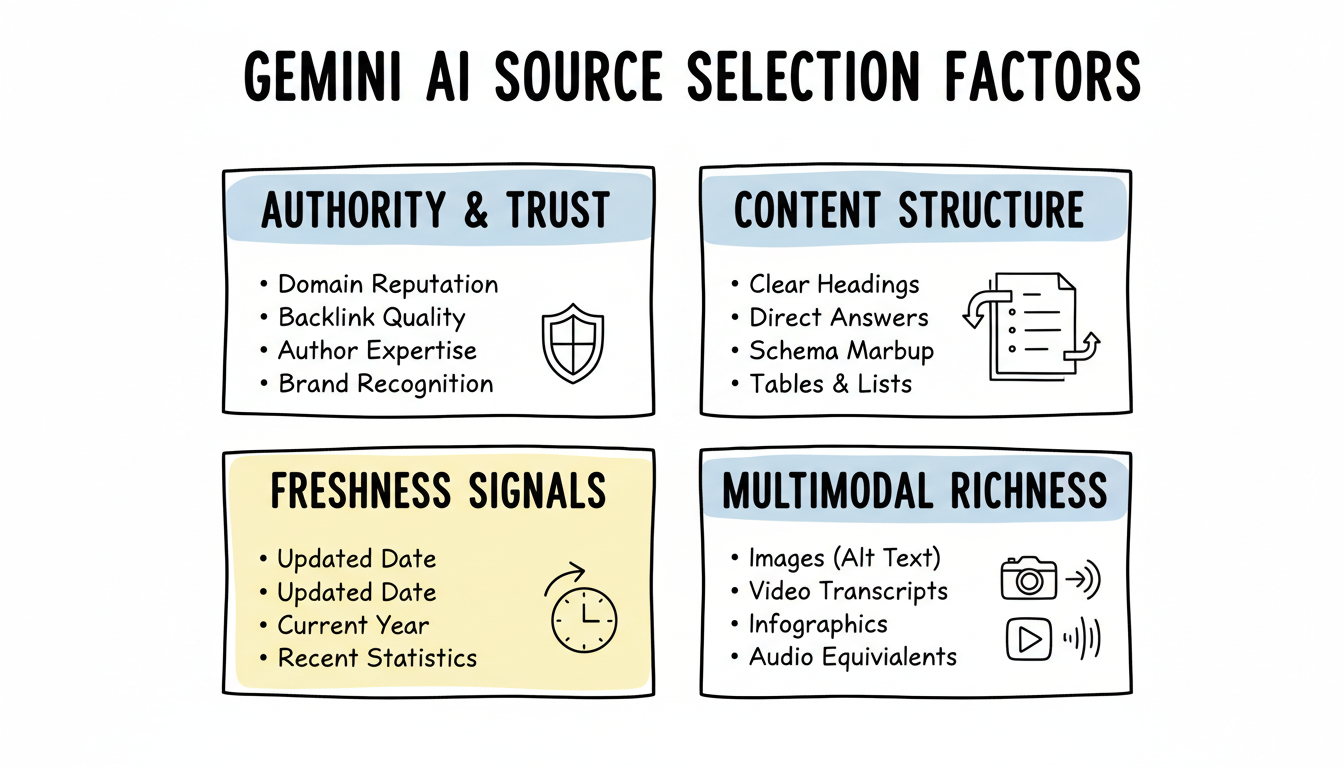
Gemini's source selection combines traditional ranking signals with AI-specific factors.
Gemini heavily weights established authority signals:
Content from recognized authorities earns more citations than equivalent content from unknown sources. Building EEAT for answer engine optimization strengthens your authority across AI platforms including Gemini.
Gemini prefers content that's easy to parse and extract:
Well-structured content reduces interpretation errors and increases citation confidence.
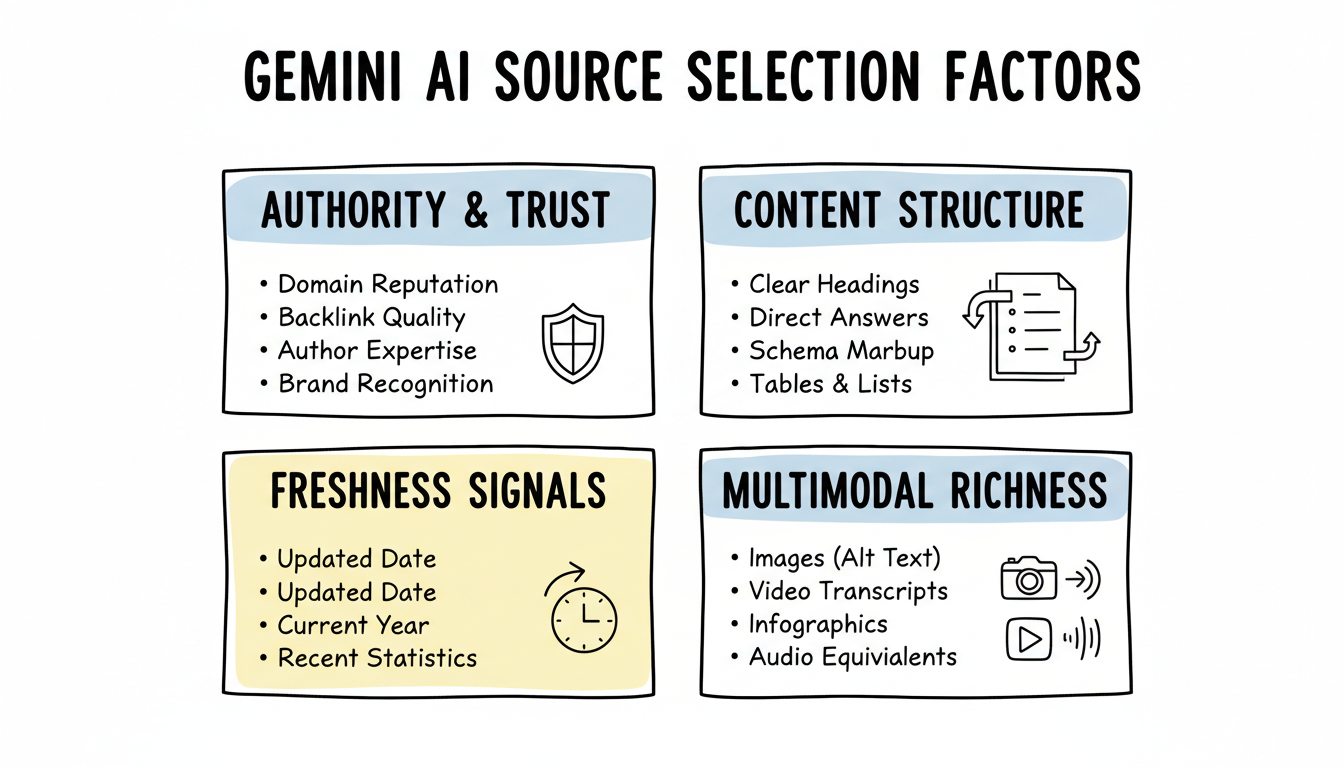
Real-time web access means Gemini can prioritize recent content:
For evolving topics, freshness can outweigh older but more comprehensive content.
Gemini's multimodal capabilities mean it evaluates more than text:
Rich media content may earn citations for queries where visual or audio elements add value.
Google's AI Overviews are Gemini's most visible output. Optimize specifically:
Answer-first formatting: Place direct answers in opening paragraphs. AI Overviews extract early content more reliably than buried conclusions.
Question-based headings: Use H2 and H3 tags formatted as questions users actually ask. This creates direct alignment with query intent.
Concise sections: Keep sections to 150-300 words. Overly long sections may be truncated or skipped entirely.
Gemini uses structured data to understand content meaning:
Schema Type | Gemini Application |
FAQPage | Q&A extraction for direct answers |
HowTo | Step-by-step instruction parsing |
Article | Content type and author identification |
Organization | Brand and entity recognition |
Proper schema implementation increases citation probability by 40-60% according to industry studies.
Leverage Gemini's multimodal capabilities:
Gemini connects content to knowledge graph entities:
Strong entity recognition means Gemini understands who you are, not just what you publish.
Tracking Gemini citations requires specialized approaches:
Regularly search queries in your topic areas and note:
Platforms like SE Visible, Otterly.AI, and Semrush AI Toolkit track Gemini visibility alongside other AI platforms. For comprehensive tracking, consider specialized AI SEO software that monitors citations across multiple AI search engines.
Tool | Gemini Tracking |
SE Visible | AI Overview monitoring |
Otterly.AI | Cross-platform visibility |
Semrush AI Toolkit | Integrated SEO + AI tracking |
While Search Console doesn't explicitly track AI Overview impressions, monitor:
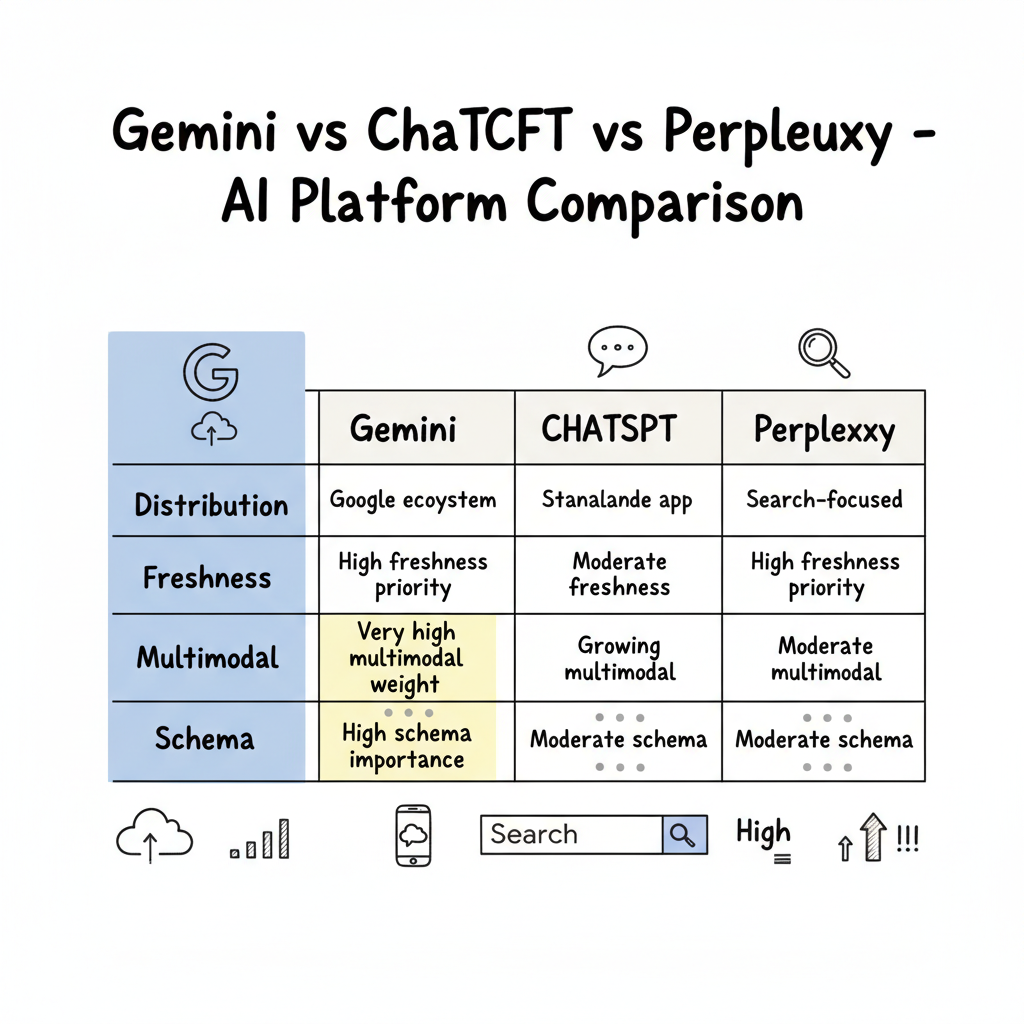
Gemini optimization overlaps with but differs from other AI platforms. To understand how different AI-powered search engines compare, consider their unique ranking factors and content preferences.
Factor | Gemini | ChatGPT | Perplexity |
Primary distribution | Google ecosystem | Standalone app | Search-focused |
Content freshness | High priority | Moderate | High priority |
Multimodal weight | Very high | Growing | Moderate |
Schema importance | High | Moderate | High |
Optimize for Gemini specifically by emphasizing multimodal content and Google ecosystem presence.
Yes, significantly. Gemini draws heavily from Google's search index and ranking signals. Content ranking well in traditional Google search has much higher probability of earning Gemini citations. Strong SEO creates the foundation for Gemini visibility.
Gemini synthesizes multiple sources and may present varying perspectives for complex queries. Building authority and trust increases the likelihood your perspective is featured prominently rather than mentioned as one of several views.
They're closely related since Gemini powers AI Overviews. However, Gemini also appears in Gmail, Docs, Chrome, and Android contexts. Comprehensive Gemini optimization considers all these touchpoints, not just search.
By submitting this form, you agree to our Privacy Policy and Terms & Conditions.