E-E-A-T for Answer Engine Optimization: Building AI Trust (2026)

If AI can't verify your expertise, you won't get surfaced—no matter how good your content is. AI doesn't just crawl your website; it cross-references your identity across the web. The brands AI platforms learn to trust today will compound authority advantages for years.

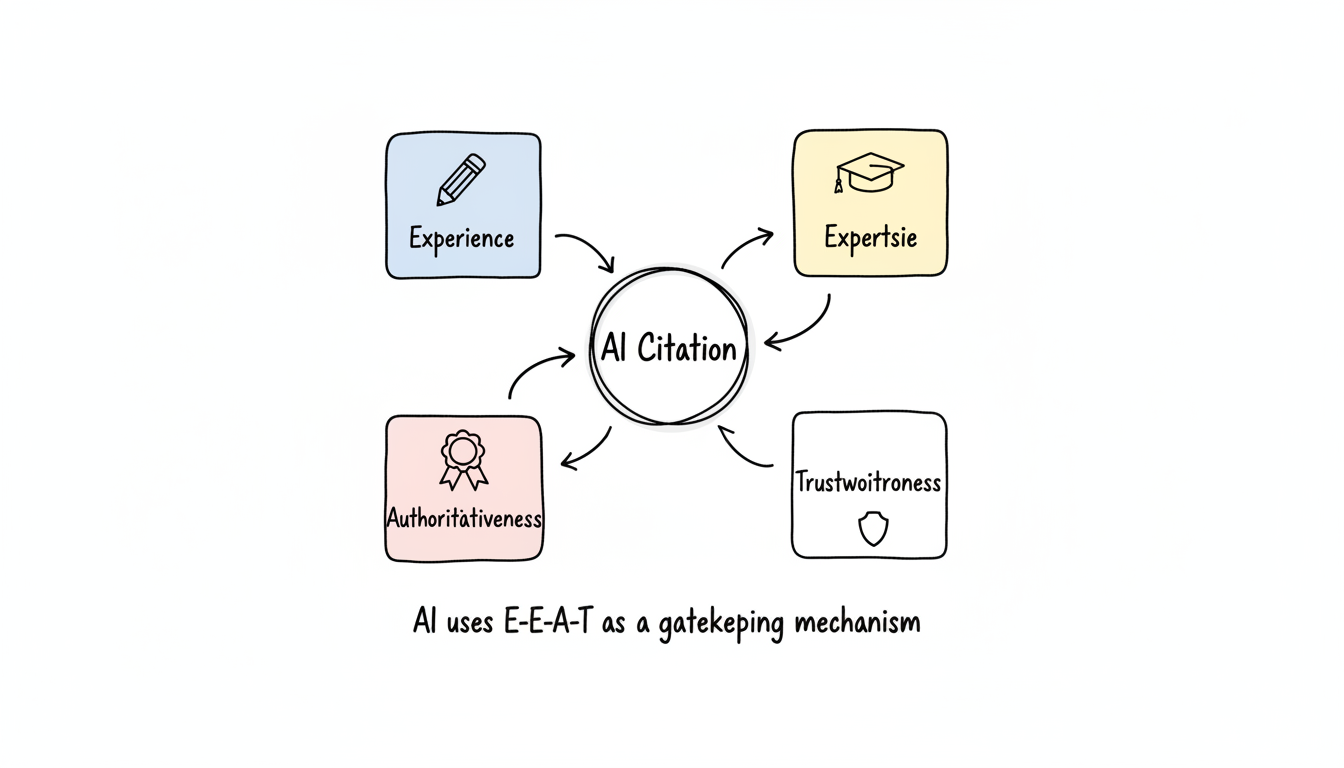
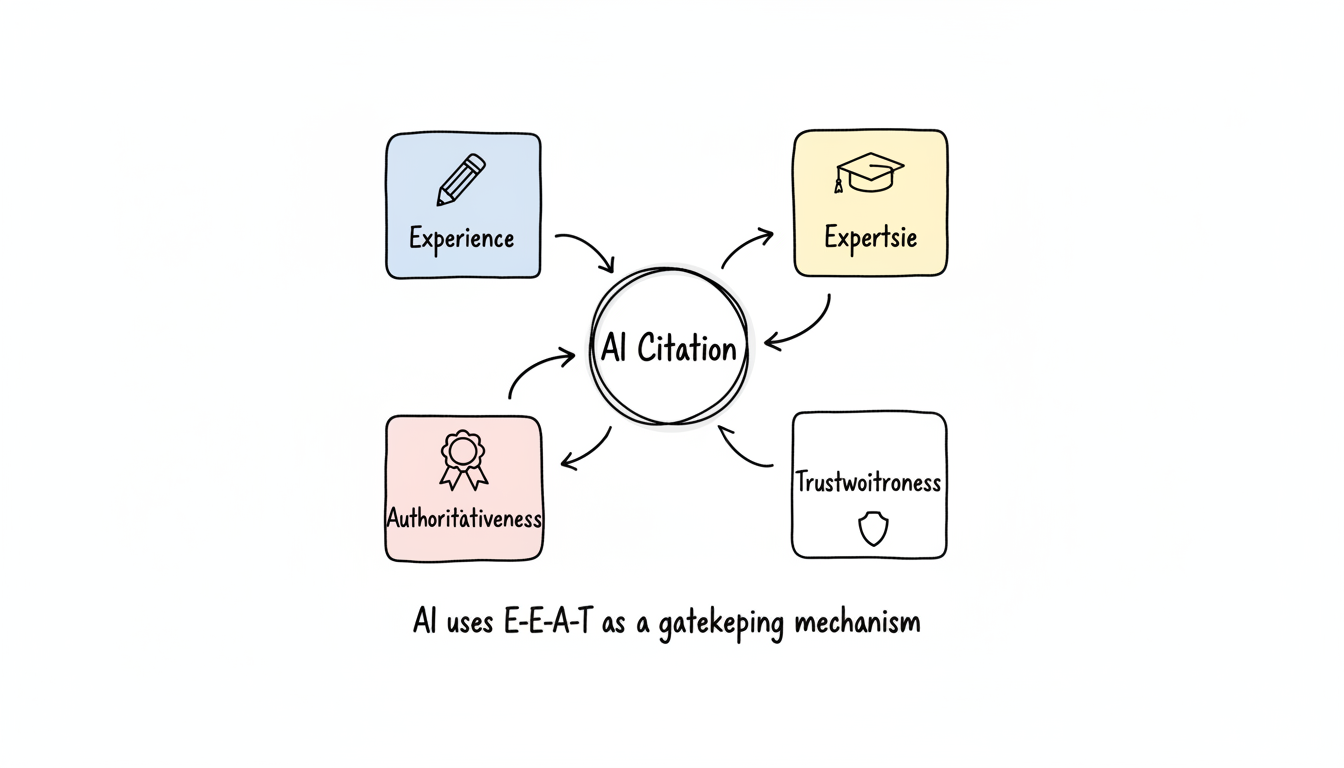
E-E-A-T—Experience, Expertise, Authoritativeness, and Trustworthiness—has become even more critical for AI search visibility. Here's how to demonstrate each component so AI systems choose to cite you.

Why E-E-A-T Matters More in AI Search

Traditional SEO used E-E-A-T as a quality signal. AI search uses it as a gatekeeping mechanism.

Generative engines rely heavily on source credibility when deciding which content to cite and how prominently to feature it. When ChatGPT, Perplexity, or Google AI Overviews generate answers, they're not just finding information—they're verifying whether sources deserve to be trusted.

The AI trust hierarchy:
  • AI engines form their own trust hierarchies that don't mirror Google's top 10
  • They reflect what models consider authoritative, learnable, and consistently reliable
  • A Semrush study of 230,000+ prompts found Reddit, LinkedIn, and Wikipedia lead AI citations
  • These platforms dominate because they demonstrate verifiable trust signals at scale

Search volume for "EEAT" has increased by 344% over the past five years. As AI search expands, E-E-A-T signals become the primary filter determining citation eligibility.

Experience: Demonstrate First-Hand Knowledge

Experience shows you've actually done what you're writing about. AI models recognize experiential content through specific linguistic markers.

Experience signals AI systems detect:

  • "In my experience" / "We tested" / "Our results showed"
  • Case studies with specific outcomes and timelines
  • Personal insights from direct involvement
  • Practical examples others couldn't synthesize from research alone
  • Original screenshots, data, and documentation

How to demonstrate experience:

  • Share real-world usage tips, not just specifications
  • Include pros and cons from actual implementation
  • Document who solutions work best for—and who they don't
  • Show your process, including failures and iterations
  • Use specific numbers: "Conversion rates increased 23% in our client tests"

AI models can distinguish between content summarized from other sources and content created from genuine experience. The linguistic patterns differ, and AI systems increasingly reward the authentic version.

Expertise: Establish Verifiable Credentials

Expertise proves you have the knowledge to speak authoritatively on your topic. For YMYL (Your Money or Your Life) topics especially, AI systems verify expertise signals.

Building expertise signals:

Author Credentials

Every piece of content should connect to a verifiable expert:

  • Clear author bios establishing credentials, role, and subject-matter relevance
  • Links to author profiles on LinkedIn, professional associations
  • Publication history demonstrating consistent expertise
  • Credentials that AI can verify across multiple sources

Entity Consistency

AI systems cross-reference your brand identity across the web:

  • Consistent information in Google Knowledge Panel
  • Accurate Wikipedia or Wikidata entries (if applicable)
  • Aligned business directory listings
  • Matching information across social profiles

When entity information conflicts across sources, AI systems trust you less—even if individual pages are accurate.

Topical Authority Clusters

One blog post doesn't establish expertise. AI systems look for comprehensive coverage:

  • 15-20+ interconnected pieces around core topics
  • Clear site architecture demonstrating depth
  • Internal linking that shows topical relationships
  • Progressive depth from introductory to advanced content

Authoritativeness: Earn External Validation

Authoritativeness comes from others recognizing your expertise. AI systems evaluate who links to you, who mentions you, and who corroborates your claims.

Authority signals for AI:

Link Diversity

Research shows link diversity correlates most clearly with ChatGPT citations:

  • Links from varied domains, industries, and content types
  • News sites, industry blogs, educational institutions (.edu)
  • Government sources (.gov) and complementary businesses
  • Natural link profiles AI systems trust

Third-Party Mentions

AI platforms frequently cite community discussions:

  • Reddit mentions in relevant subreddits
  • Quora answers referencing your brand or content
  • Industry forum discussions
  • User-generated content on review platforms

Participate genuinely in these communities—share insights from real experience without overtly promoting products.

Media Coverage and Co-Citations

Traditional PR benefits AI visibility:

  • Expert commentary on industry platforms
  • Journalist quotes through HARO and similar platforms
  • Co-citations with other authoritative sources
  • Consistent coverage over time building recognition

Trustworthiness: Remove Doubt

Trustworthiness removes barriers to AI citation. It's about transparency, accuracy, and reliability.

Trust signals for AI systems:

Factual Verification

AI systems increasingly evaluate content accuracy:

  • Claims supported by verifiable sources
  • Statistics with proper attribution
  • Updated information reflecting current reality
  • Corrections or updates when information changes

Transparency Signals

Show you have nothing to hide:

  • Clear About Us, Contact, Privacy Policy pages
  • Visible business identity and location
  • Author information accessible from content
  • Disclosure of affiliations and potential conflicts

Schema Implementation

Structured data helps AI verify your claims:

  • Organization schema with verified details
  • Author schema linking to credentials
  • FAQ schema for question-answer pairs
  • Review schema for product or service content

Platform-Specific E-E-A-T Application

Different AI platforms weight E-E-A-T signals differently:

ChatGPT

Relies heavily on training data authority and browsing verification:

  • Consistent entity recognition across the web
  • High-authority backlink profiles
  • Content that influenced training data

Perplexity

Real-time retrieval emphasizes current authority:

  • Recent expert commentary and mentions
  • Fresh content with clear credentials
  • Citation diversity from multiple authoritative sources

Google AI Overviews

Leverages existing search infrastructure:
  • Traditional E-E-A-T signals from Search Quality Guidelines
  • Knowledge Graph integration
  • Page experience and technical quality signals

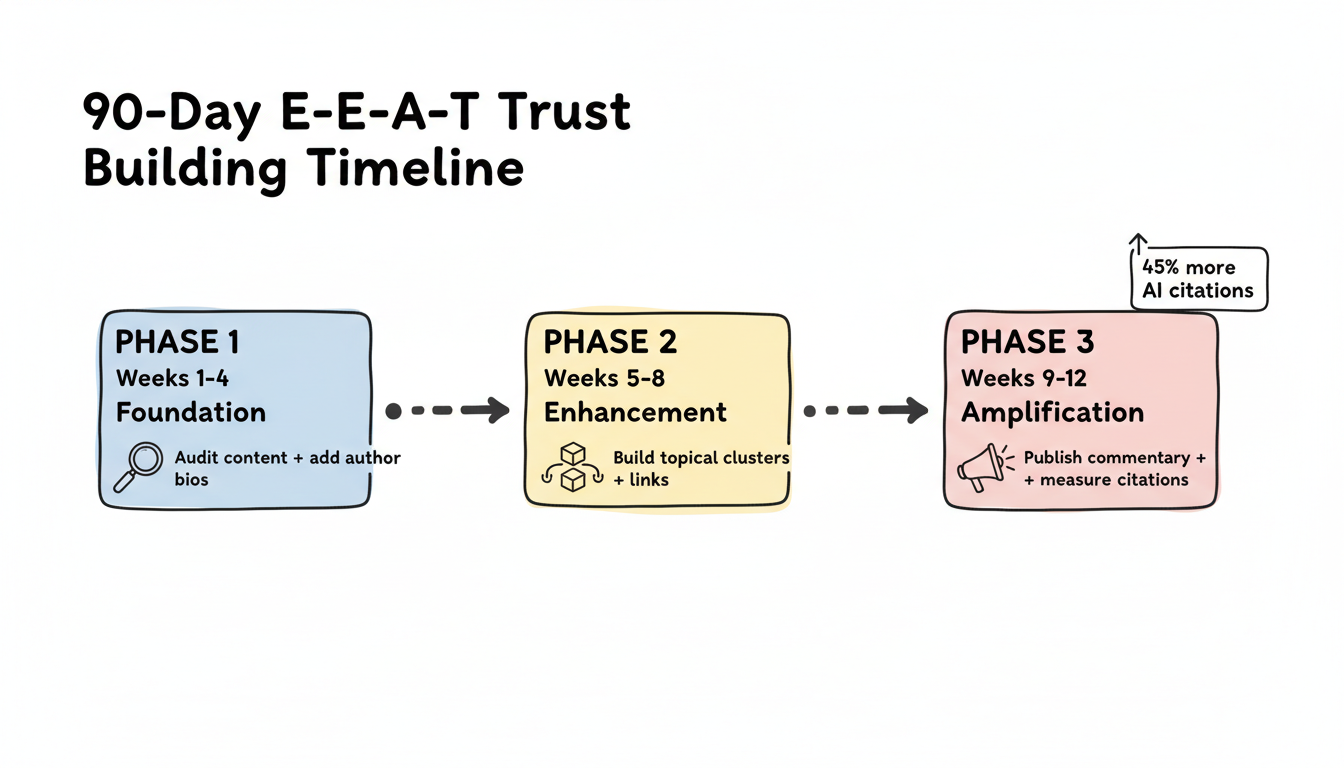
Implementation: The 90-Day Trust Building Framework

Weeks 1-4: Foundation

  • Audit top 20 content assets for E-E-A-T gaps
  • Add clear author bios with verifiable credentials
  • Implement Person and Organization schema
  • Test 15 priority queries in ChatGPT and Perplexity for baseline

Weeks 5-8: Enhancement

  • Build topical authority clusters around priority topics
  • Develop experience-based content with first-hand insights
  • Pursue high-trust link opportunities from relevant sources
  • Optimize existing content for clarity and factual support

Weeks 9-12: Amplification

  • Publish expert commentary on industry platforms
  • Configure AI visibility monitoring across platforms
  • Establish fact-checking protocols for ongoing content
  • Measure citation share of voice improvements

One Fortune 500 company implementing this framework documented a 45% increase in AI platform citations and 32% growth in sales-qualified leads within six months.

FAQs

Do AI platforms use the same E-E-A-T criteria as Google Search?

Similar but not identical. AI platforms evaluate E-E-A-T through different mechanisms—they can verify information across multiple sources simultaneously and detect linguistic patterns indicating authentic experience. The core principles align, but implementation details differ by platform.

Can small businesses compete on E-E-A-T against large brands?

Yes. E-E-A-T rewards genuine expertise, not just size. Small businesses with deep niche knowledge, authentic experience, and consistent entity information can outperform larger competitors with broader, shallower content. Focus on demonstrating real expertise in specific areas.

How long does it take to build E-E-A-T for AI citations?

Initial improvements can appear within 90 days with systematic implementation. However, authority compounds over time—the brands that establish E-E-A-T signals today will hold compounding advantages as AI systems develop stronger source preferences.


Need help building E-E-A-T signals for AI visibility? Our team conducts comprehensive trust audits and develops strategies that establish your authority across AI platforms. Schedule a consultation to discuss your E-E-A-T optimization needs.


Related Articles:

Get started with Stackmatix!

Get Started

Share On:

blog-facebookblog-linkedinblog-twitterblog-instagram

Join thousands of venture-backed founders and marketers getting actionable growth insights from Stackmatix.

Thank you! Your submission has been received!
Oops! Something went wrong while submitting the form.

By submitting this form, you agree to our Privacy Policy and Terms & Conditions.

Related Blogs