
February 19, 2026


Last Updated: January 2026
ChatGPT now has over 800 million weekly active users and processes 5.72 billion monthly visits. When users ask questions, ChatGPT pulls information from across the web—and either cites your content or ignores it entirely.
This guide explains exactly how ChatGPT selects and cites sources, what Microsoft officially recommends for optimization, and the specific tactics that get your content mentioned in AI-generated responses.
ChatGPT doesn't crawl the web like Google. When users enable web browsing or use ChatGPT Search, the system retrieves real-time information through Microsoft Bing's index. This partnership between OpenAI and Microsoft fundamentally shapes how content gets discovered and cited.
Here's what happens when a user asks ChatGPT a question requiring current information:
This Bing dependency has major implications. If Bing doesn't know your site exists—or hasn't recently crawled your pages—ChatGPT cannot cite your content in real-time search results. Traditional Google-focused SEO helps, but Bing-specific optimization directly impacts ChatGPT visibility.
ChatGPT draws from two distinct sources:
Training Data: Information from its pre-training corpus (cutoff varies by model). ChatGPT can discuss concepts, facts, and topics learned during training without any web search.
Real-Time Search: Current information retrieved through Bing when:
For ChatGPT SEO, optimizing for real-time search matters most. Your content needs to rank well in Bing and be structured for AI extraction.
Research reveals specific patterns in how ChatGPT chooses which sources to cite.
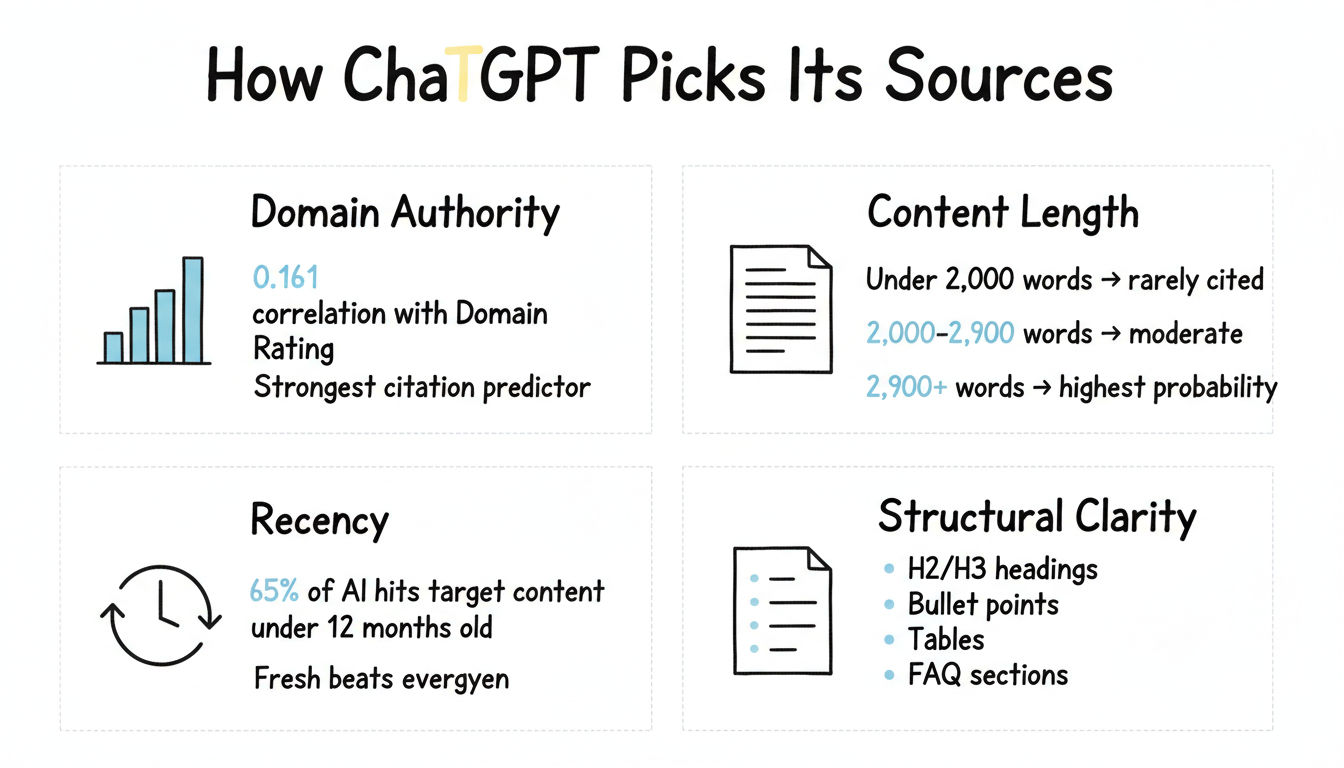
ChatGPT heavily weights domain authority when selecting sources. High-traffic sites with strong backlink profiles receive disproportionate citation share. Analysis shows ChatGPT citations correlate 0.161 with Domain Rating—the strongest correlation factor among those measured.
This creates both challenge and opportunity. Competing against Forbes or Wikipedia for general topics is difficult. But building authoritative content in specific niches—where major publications have thin coverage—creates citation opportunities.
Research indicates content length correlates with citation likelihood:
Content Length | Citation Pattern |
Under 2,000 words | Rarely cited |
2,000-2,900 words | Moderate citation rate |
2,900+ words | Highest citation probability |
ChatGPT prefers comprehensive resources that fully answer questions without requiring additional sources. Thin content that touches topics superficially gets skipped for sources that cover subjects thoroughly.
ChatGPT prioritizes recent content. Data suggests 65% of AI bot hits target content published within the past 12 months. Older content—even if authoritative—loses visibility as fresher sources emerge.
Publication dates matter. ChatGPT's real-time search can see when content was published and updated. Regular content updates with visible modification dates signal relevance, which is why understanding AI search analytics tracking becomes crucial for monitoring your citation performance.
ChatGPT extracts information from clearly structured content more easily. Pages with:
...receive more citations than walls of text covering the same information. Structure isn't just about human readability—it directly impacts AI extraction efficiency.
Since Microsoft powers ChatGPT's web search, their official guidance carries significant weight. While Microsoft hasn't published a dedicated "ChatGPT SEO guide," Bing optimization guidelines apply directly.
Microsoft emphasizes semantic clarity—content that clearly communicates meaning without ambiguity. Write content that answers questions directly. Avoid jargon that obscures meaning. Use natural language patterns that match how users actually phrase queries.
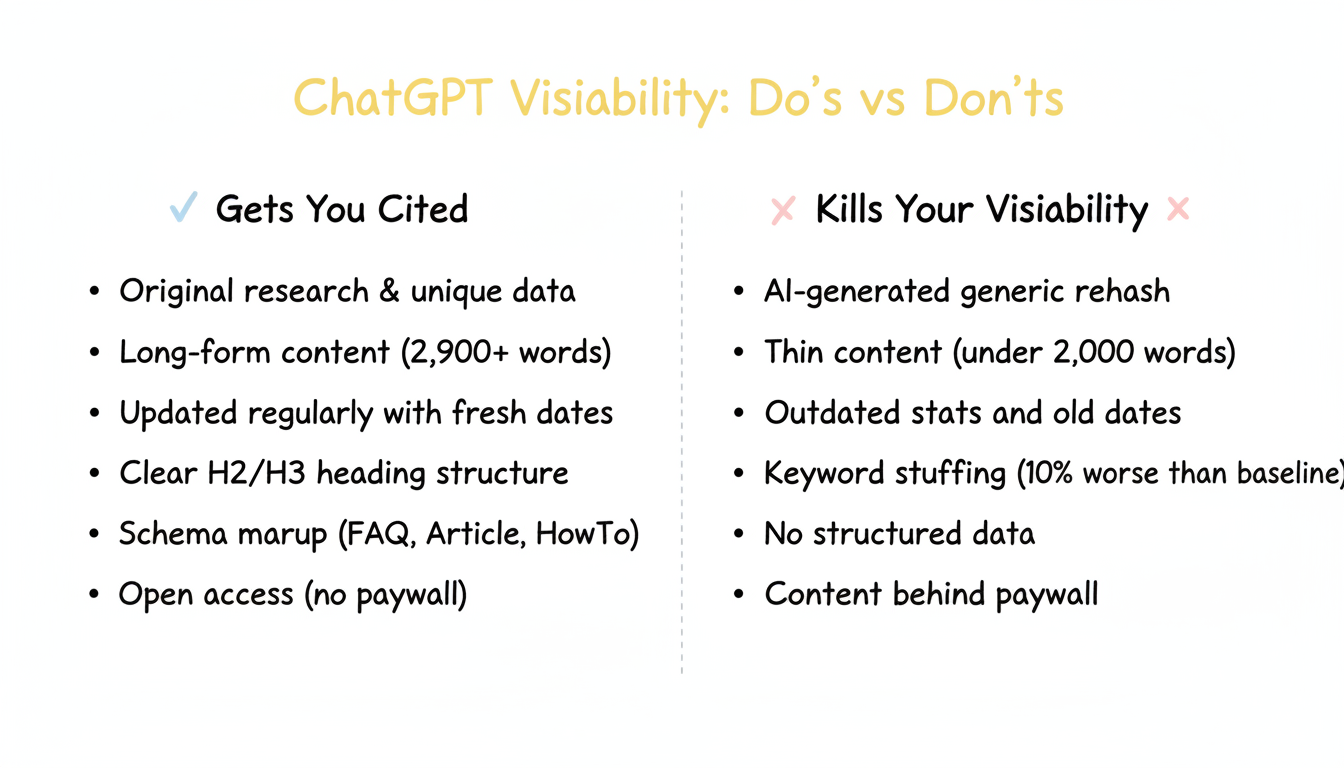
Keyword stuffing actively harms visibility. Bing is stricter about unnatural language than Google. Content that reads awkwardly to achieve keyword density performs worse than naturally written alternatives.
Structured data helps Bing (and therefore ChatGPT) understand your content's meaning. Priority schema types:
Schema doesn't guarantee citations, but missing schema means Bing must infer content meaning—adding friction to the citation process. Implementing schema markup alignment for AEO ensures your content is structured optimally for AI extraction.
Microsoft's guidance emphasizes Q&A formatting. Content structured as questions and answers maps directly to how users interact with ChatGPT. When a user asks "How do I [task]?" and your content has a heading "How to [task]" with a direct answer beneath, extraction becomes straightforward.
The pattern:
This mirrors how ChatGPT synthesizes responses—pulling concise answers and optionally including supporting detail.
Microsoft explicitly warns against:
These anti-patterns hurt Bing rankings, which cascades to reduced ChatGPT visibility.
Beyond general best practices, specific structural choices optimize for ChatGPT citation.
Place brief, complete answers immediately after headings:
Instead of:
"When considering how to optimize for ChatGPT, many factors come into play. First, you should understand that..."
Write:
"Optimize for ChatGPT by ensuring your site is indexed in Bing, using clear heading structure, and including citable facts with specific data. Here's the detailed breakdown..."
The direct answer gives ChatGPT something to quote. The expansion provides depth for comprehensive responses.
ChatGPT actively seeks specific, verifiable information. Research shows:
Replace "significantly improved results" with "improved results by 34% over six months." ChatGPT can cite the specific figure; it cannot cite vague assertions.
Create content in discrete, self-contained sections. Each section should:
ChatGPT may pull only one section from your page. If that section depends on context from other sections, the citation becomes useless. Self-contained blocks maximize citation utility, similar to how platform-specific content strategies adapt information for different AI platforms.
Tables perform exceptionally well for ChatGPT citations. When users ask comparison questions ("What's the difference between X and Y?"), ChatGPT looks for structured comparisons.
Format tables with:
Since ChatGPT relies on Bing's index, Bing-specific optimization directly impacts ChatGPT visibility.
Many sites focus exclusively on Google Search Console and neglect Bing Webmaster Tools. For ChatGPT visibility, this oversight costs citations.
Setup checklist:
If Bing hasn't indexed your key pages, ChatGPT cannot cite them—regardless of Google rankings.
IndexNow is Microsoft's protocol for instant indexing notification. When you publish or update content, IndexNow alerts Bing immediately rather than waiting for regular crawls.
Implementation options:
Faster Bing indexing means faster ChatGPT visibility for new content.
Bing weights factors differently than Google:
Higher Bing Weight:
Lower Bing Weight:
Sites that rank well on Google but poorly on Bing may have ChatGPT visibility gaps despite strong traditional SEO. Understanding search engine optimization with AI helps bridge these platform differences.
Your robots.txt may inadvertently block AI crawlers. Review your file for rules affecting:
Blocking these crawlers prevents citation entirely. Unless you have specific IP concerns, allow AI crawlers access.
ChatGPT processes language differently than traditional search algorithms. Optimization requires understanding these differences.
ChatGPT understands entities—people, places, organizations, concepts—and relationships between them. Content that clearly defines entities and their relationships performs better than keyword-focused content.
Example:
The entity approach provides clear information ChatGPT can process and cite accurately.
Users ask ChatGPT conversational questions: "How do I get my website to show up in ChatGPT?" not "ChatGPT SEO website visibility." Structure content around how people naturally ask questions.
Include long-tail conversational phrases as headings. Answer in natural language. This alignment between user queries and content structure increases citation likelihood.
ChatGPT favors sources demonstrating comprehensive topic coverage. A site with one article about ChatGPT SEO gets cited less than a site with 20+ related articles building topical authority.
Build content clusters around core topics. Internal link between related pieces. Create pillar pages that connect cluster content. This structure signals topical expertise that improves citation probability across your content.
Certain practices actively harm ChatGPT citation potential.
ChatGPT already knows generic information from its training. Publishing AI-generated content that rehashes existing knowledge provides nothing worth citing. ChatGPT won't cite content that contains information it could generate itself.
Winning content requires:
Research shows keyword stuffing performs 10% worse than baseline in AI search. Unlike traditional SEO where keyword density sometimes helped, ChatGPT actively penalizes unnatural language patterns.
Write naturally. Cover topics comprehensively. Trust that semantic understanding will connect your content to relevant queries without forced keyword repetition.
Content with old dates, outdated statistics, or superseded information gets skipped for fresher alternatives. ChatGPT's real-time search specifically seeks current information.
Maintain regular update schedules. Add modification dates. Refresh statistics annually. Remove or update content that's no longer accurate.
Content behind paywalls cannot be cited by ChatGPT. The system cannot log in, pay for access, or bypass authentication. If your best content requires subscription access, ChatGPT will cite freely available alternatives instead.
Consider strategic free content that can earn citations while maintaining premium offerings for direct monetization.
Bing considers mobile experience in rankings. Sites that perform poorly on mobile rank lower in Bing, reducing ChatGPT citation opportunity. Ensure responsive design, readable text without zooming, and accessible interactive elements.
Measuring ChatGPT SEO success requires specific tracking approaches.
Configure Google Analytics 4 to track ChatGPT referrals:
Traffic from these sources indicates users clicked through from ChatGPT citations to your site.
Dedicated tools track ChatGPT mentions across queries. Leveraging answer engine optimization tools provides comprehensive visibility:
These tools run regular queries and report when your brand or content gets cited.
Regularly test target queries in ChatGPT directly:
Manual testing reveals citation performance for your specific target queries.
Current benchmarks show AI referral traffic at approximately 1% of total web traffic, growing roughly 1% per month. ChatGPT accounts for 87% of all AI referrals, though Gemini grew 388% year-over-year.
Set realistic expectations. ChatGPT traffic won't replace Google traffic. But ChatGPT citations signal brand credibility and often convert at higher rates due to user intent.
Real examples illustrate effective ChatGPT optimization.
A B2B software company discovered ChatGPT recommended competitors but not their brand. Their optimization approach:
Results after 90 days: 12 of 50 target queries returned brand citations.
An e-commerce brand wanted product recommendations in ChatGPT Shopping results:
Results: Products began appearing in ChatGPT Shopping recommendations within 60 days.
A consulting firm optimized thought leadership content for ChatGPT citation:
Results: Firm became default citation for industry-specific queries, demonstrating the AEO benefits that matter for professional services.
Several tools specifically support ChatGPT SEO workflows.
Price: Free Purpose: Essential for Bing indexing status, crawl verification, and search performance data that directly impacts ChatGPT visibility.
Price: Free (various plugins) Purpose: Instant indexing notification to Bing when content publishes or updates.
Price: Enterprise pricing Purpose: End-to-end AEO platform with ChatGPT citation tracking across queries.
Price: Enterprise pricing Purpose: 10+ AI engine coverage including detailed ChatGPT Shopping insights.
Price: From $29/month Purpose: Budget-friendly ChatGPT citation monitoring for smaller teams.
Price: Free Purpose: Google's Rich Results Test and Schema.org validator ensure structured data works correctly.
How long does ChatGPT SEO take to show results? Technical optimizations (Bing indexing, schema) can impact visibility within 2-4 weeks. Authority building and content depth improvements typically require 2-3 months to affect citation patterns measurably.
Does Google ranking help ChatGPT visibility? Indirectly. Sites that rank well on Google often rank well on Bing, which powers ChatGPT search. But Google rankings alone don't guarantee ChatGPT citations—Bing-specific optimization matters.
Can I optimize for ChatGPT without Bing optimization? For real-time search, no. ChatGPT's web browsing uses Bing exclusively. However, ChatGPT's training data includes content regardless of Bing indexing—but you can't control training data inclusion.
Should I block ChatGPT crawlers? Generally no. Blocking GPTBot or ChatGPT-User prevents citation opportunities. Only block if you have specific concerns about AI training on your content—and understand this prevents real-time citations too.
How does ChatGPT SEO differ from Google AI Overviews optimization? Understanding the nuances between Google AI Overview SEO strategy and ChatGPT optimization is crucial. Google AI Overviews draw from Google's index and favor content already ranking well traditionally. ChatGPT search uses Bing's index. Optimization overlaps significantly, but Bing-specific tactics help ChatGPT more than Google.
What content types perform best for ChatGPT citations? Comprehensive guides, data-driven research, product comparisons, and FAQ content earn the most citations. How-to content with clear step-by-step instructions also performs well.
Does social media presence affect ChatGPT visibility? Bing weights social signals more heavily than Google. Strong social engagement can indirectly improve Bing rankings, which impacts ChatGPT citation potential.
How do I know if ChatGPT is citing my competitors? Test competitor brand names and product categories in ChatGPT with web search enabled. Note which sources ChatGPT cites. Use citation monitoring tools to track competitor mentions systematically.
By submitting this form, you agree to our Privacy Policy and Terms & Conditions.



