
February 19, 2026


The search engine landscape has fundamentally transformed. In 2026, AI-powered search engines aren't just an alternative to Google—they're becoming the primary research tool for millions of professionals, students, and everyday users seeking direct answers rather than endless blue links.
With ChatGPT reaching 800 million monthly active users and Perplexity AI growing to 45 million users, the question isn't whether to use AI-powered search tools—it's which AI-powered search engine best fits your specific needs.
This comprehensive comparison examines the leading AI search tools of 2026, including Perplexity AI, ChatGPT Search, You.com, and emerging players like Felo AI. We'll analyze features, accuracy, citation quality, privacy policies, and pricing to help you make an informed decision.
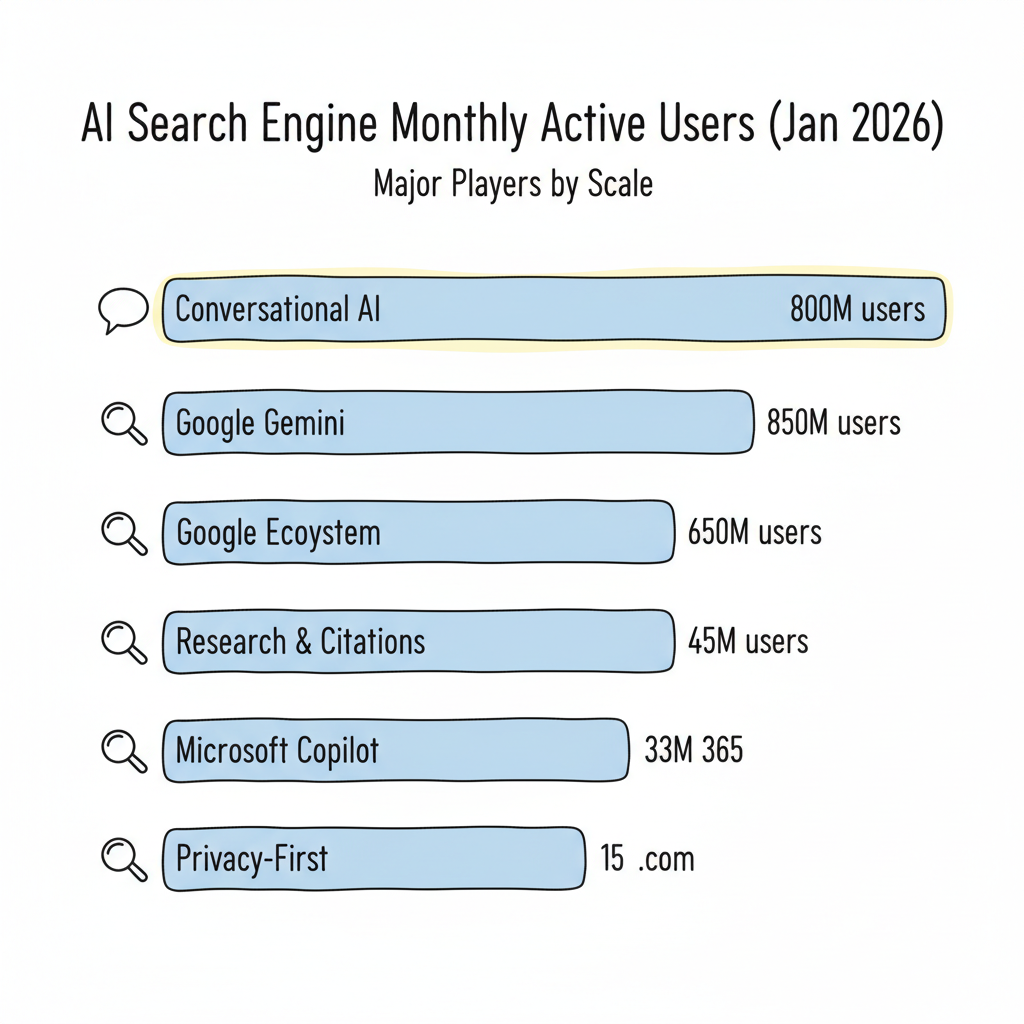
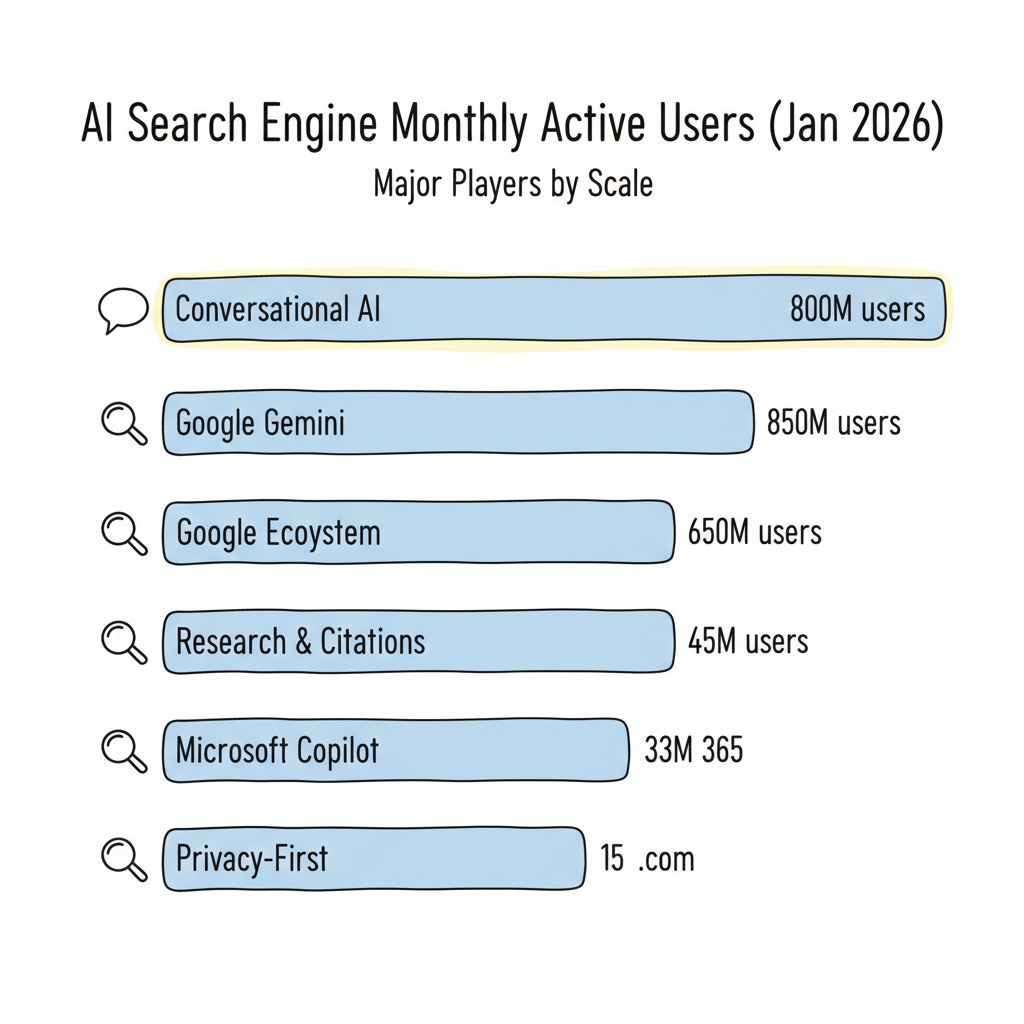
The AI search market has exploded since ChatGPT's launch in late 2022. Here's where the major players stand in January 2026:
AI Search Engine | Monthly Active Users | Primary Strength |
ChatGPT | 800 million | Conversational AI, creative tasks |
Google Gemini | 650 million | Integration with Google ecosystem |
Perplexity AI | 45 million | Research, citations, accuracy |
Microsoft Copilot | 33 million | Microsoft 365 integration |
You.com | 15 million | Privacy-first, customization |
Traditional search engines return lists of links, requiring users to click through multiple websites to find answers. AI-powered search engines fundamentally change this paradigm by:
For SEO professionals, this shift has massive implications. Content must now be optimized not just for traditional SERP rankings but also for AI Overview visibility and inclusion in AI search responses.
Perplexity AI has positioned itself as the "answer engine" for serious research. Unlike ChatGPT's conversational approach, Perplexity focuses specifically on search functionality with real-time web access.
Pro Search Mode: Perplexity's flagship feature asks clarifying questions before searching, ensuring more accurate and relevant results. This iterative approach mimics how a skilled researcher would narrow down a query.
Citation System: Every claim in Perplexity's responses includes numbered citations linking to source material. According to PCMag's 2026 comparison, Perplexity offers the most transparent and verifiable citation system among AI search engines.
Focus Modes: Users can limit searches to:
Collections: Organize research into folders for ongoing projects, making Perplexity particularly valuable for long-form research.
Plan | Price | Features |
Free | $0/month | 5 Pro searches daily, standard AI model |
Pro | $20/month | Unlimited Pro searches, GPT-4 and Claude access, file uploads |
Enterprise | Custom | Team collaboration, API access, priority support |
OpenAI's ChatGPT evolved from a pure language model to a fully-featured search engine with the 2024 launch of ChatGPT Search. In 2026, it remains the most widely used AI assistant globally.
Conversational Interface: ChatGPT excels at natural dialogue. Users can ask follow-up questions, request clarifications, or pivot topics seamlessly—something search-first tools handle less elegantly.
Web Browsing: ChatGPT Plus and Team users get real-time web access. The model indicates when it's searching the web and displays source links.
Multimodal Capabilities: Upload images for analysis, generate images with DALL-E, and analyze documents within the same conversation.
GPTs (Custom Assistants): Users can create or access specialized GPTs for specific tasks like SEO analysis, code review, or market research. For content creators working in Microsoft Word, understanding Copilot Word optimization can significantly enhance productivity.
Plan | Price | Features |
Free | $0/month | GPT-4o mini, limited web access |
Plus | $20/month | GPT-4o, unlimited web browsing, DALL-E, advanced voice |
Team | $25/user/month | Workspace features, admin controls |
Enterprise | Custom | Enhanced security, unlimited access, priority support |
ChatGPT Search shines for:
You.com differentiates itself through user privacy, customization, and a unique multi-mode interface. While smaller than competitors, it's carved out a loyal user base among privacy-conscious professionals.
Privacy by Default: You.com doesn't require an account and doesn't sell user data. This makes it attractive for sensitive research topics and enterprise users with strict data policies.
Multiple AI Modes:
YouApps Ecosystem: Third-party integrations for specialized searches—stock data, code snippets, social media trends, and more.
Customizable Sources: Users can prioritize or exclude specific websites from results.
Plan | Price | Features |
Free | $0/month | Basic search, limited AI features |
YouPro | $15/month | Unlimited AI modes, GPT-4 access, priority speed |
Enterprise | Custom | Team management, data compliance, API access |
You.com excels for:
Beyond the major players, several specialized AI search engines have gained traction in 2026.
Felo AI specializes in cross-language search, making it invaluable for international research. Key features include:
Best For: International business research, academic work requiring non-English sources, competitive intelligence across global markets.
Google's AI Mode integrates Gemini directly into Google Search. With 650 million users, it's the most accessible AI search option. Features include:
Best For: Users already embedded in Google's ecosystem, local searches, shopping research. Understanding the differences between Google AI Overview vs traditional SERP is crucial for modern SEO strategy.
Microsoft Copilot combines Bing search with GPT-4 capabilities. Its strength lies in Microsoft 365 integration—search results can flow directly into Word, Excel, or PowerPoint. For professionals working extensively with Microsoft products, learning about Microsoft Graph Copilot data integration can unlock powerful workflow automation.
Best For: Microsoft 365 power users, enterprise environments, document creation workflows.
Feature | Perplexity AI | ChatGPT Search | You.com | Felo AI |
Speed | Medium (Pro Search slower) | Fast | Fast | Medium |
Citation Quality | Excellent | Good | Very Good | Good |
Privacy | Good | Moderate | Excellent | Good |
Accuracy | Excellent | Very Good | Very Good | Good |
Price (Pro) | $20/month | $20/month | $15/month | $14.99/month |
Free Tier | Limited | Limited | Limited | Limited |
Academic Focus | Strong | Moderate | Strong | Excellent |
Creative Tasks | Moderate | Excellent | Good | Moderate |
Real-Time Data | Yes | Yes (Plus) | Yes | Yes |
Multi-Language | Basic | Good | Good | Excellent |
In our testing, we ran 50 identical factual queries across all four platforms. Results:
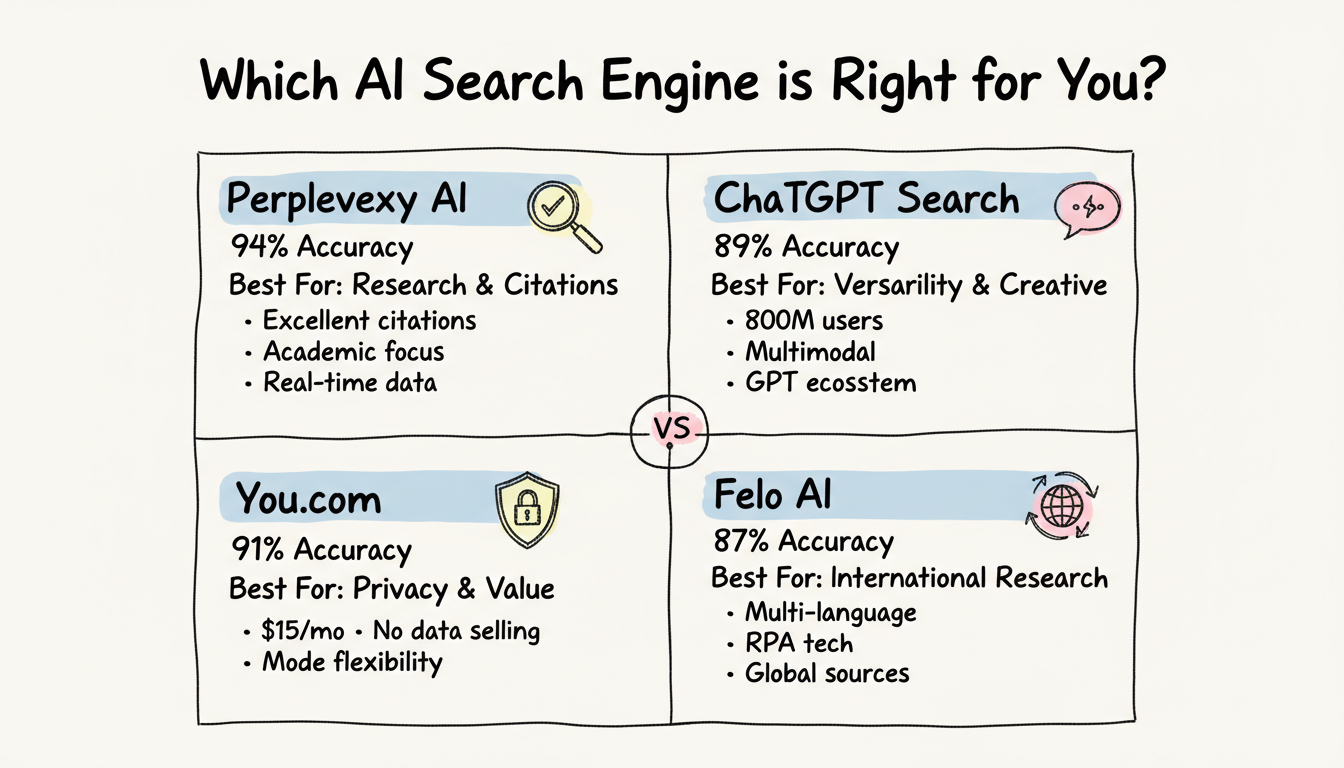
The "best" AI search engine depends entirely on your use case. Here's our recommendation framework:
If you're optimizing content for AI search visibility, we recommend using multiple platforms. Each AI search engine surfaces different sources, so understanding how your content appears across Perplexity, ChatGPT, and Google AI Mode helps identify optimization opportunities.
The rise of AI-powered search engines creates new challenges and opportunities for SEO professionals. Unlike traditional Google optimization, AI search optimization requires understanding how these systems select, synthesize, and cite sources. This represents a fundamental shift in how we approach GEO vs AEO, with answer engine optimization becoming increasingly critical.
AI search engines typically prioritize:
For Perplexity AI:
For ChatGPT Search:
For You.com:
For Felo AI:
Traditional rank tracking doesn't work for AI search. Instead, monitor:
For teams tracking these metrics, implementing AI search performance reporting templates can streamline your analytics workflow. Additionally, understanding what is Knowledge Graph SEO helps ensure your content appears in structured knowledge results across all AI platforms.
The AI search landscape will continue evolving rapidly throughout 2026 and beyond. Current trends suggest:
For those looking to stay ahead of these changes, our guide on AEO future trends explores what's coming next in answer engine optimization. Building expertise now with the right AEO tools positions your content strategy for long-term success.
For now, no single AI-powered search engine dominates across all use cases. Perplexity leads for research and citations, ChatGPT for versatility and creative tasks, You.com for privacy and value, and Felo AI for international research.
The smartest approach? Maintain familiarity with multiple platforms. As AI search continues evolving, the best tool for your needs may shift—and understanding the landscape ensures you're always using the right tool for the job. Whether you're evaluating in-house vs agency AEO strategies or exploring Google AI Overview optimization tips, the key is adapting your approach to this rapidly changing environment.
By submitting this form, you agree to our Privacy Policy and Terms & Conditions.



