February 19, 2026


AI-powered search tools have transformed how people find information. Traditional search engines that return link lists are giving way to AI systems that synthesize answers, cite sources, and engage in conversational research. For marketers, understanding these tools reveals where your audience searches and which platforms to optimize for.
This directory covers the major AI search tools of 2026, comparing features, use cases, and implications for visibility strategy.
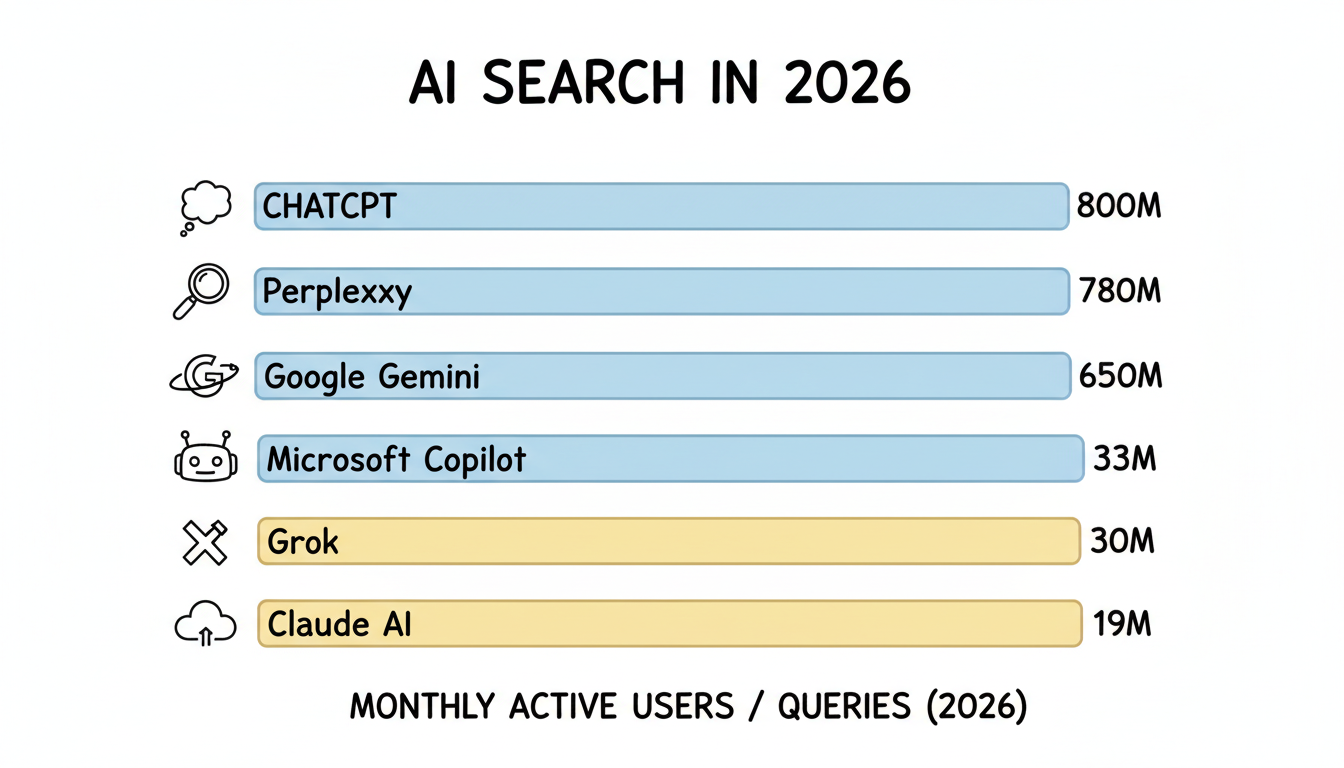
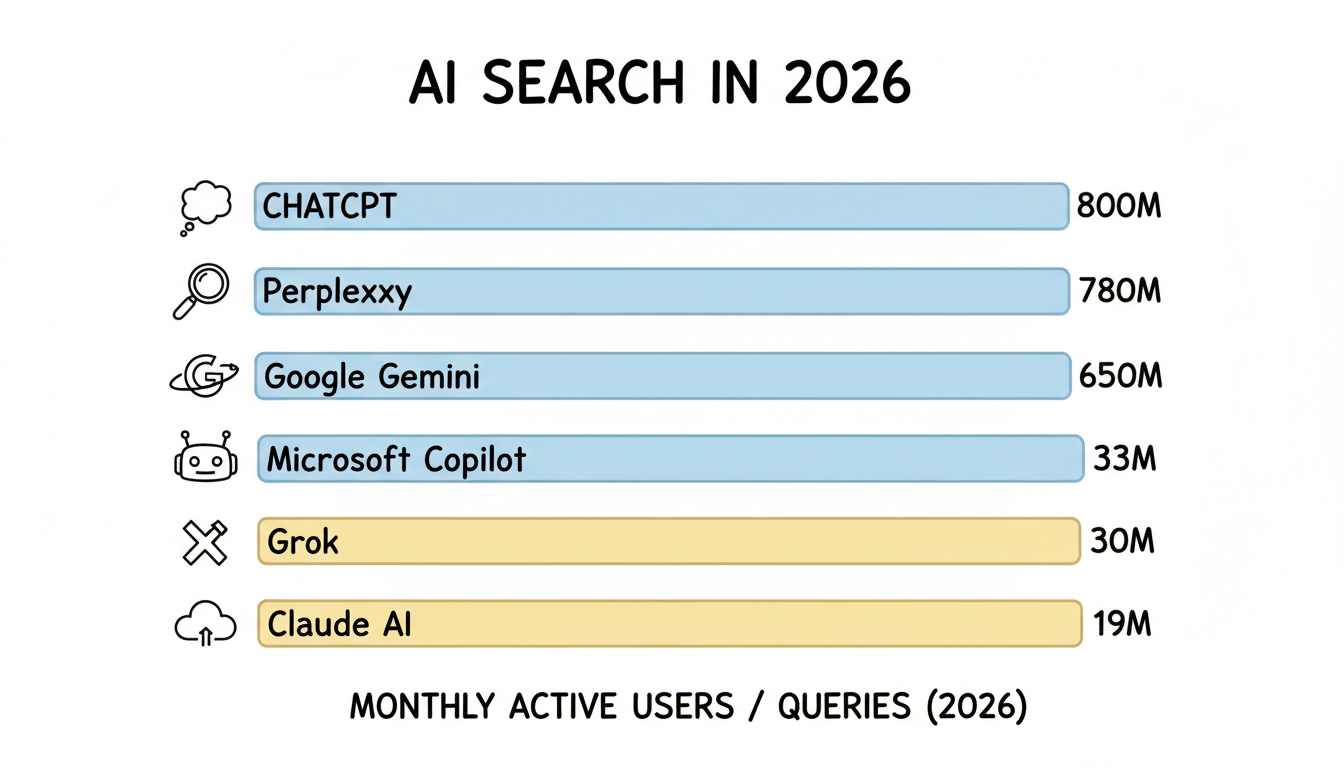
The market has expanded dramatically from early experiments to mainstream adoption. ChatGPT leads with approximately 800 million monthly active users, followed by Google Gemini at 650 million. Perplexity processes over 780 million monthly queries and has become a go-to alternative to traditional search for researchers.
These aren't just chatbots—they're becoming primary information interfaces that compete directly with Google for research, comparison, and discovery queries. Organizations building a comprehensive AI SEO strategy must now account for visibility across multiple platforms beyond traditional search engines.
Developer: OpenAI
Pricing: Free tier available; Plus at $20/month
Monthly Users: ~800 million
ChatGPT has evolved from conversational AI to full search engine with ChatGPT Search integration. The GPT-4o model powers natural language understanding, while web search capabilities pull real-time information.
Key Strengths:
Best For: General research, complex multi-step queries, creative exploration, users wanting conversational depth.
Optimization Note: ChatGPT citations match Bing's top 10 results 87% of the time. Strong Bing visibility correlates with ChatGPT mentions.
Developer: Google
Pricing: Free; Advanced at $20/month
Monthly Users: ~650 million
Gemini integrates Google's AI capabilities with its massive search index. AI Overviews now appear in approximately 15% of Google searches, making Gemini the most direct path from traditional SEO to AI visibility.
Key Strengths:
Best For: Google ecosystem users, teams needing workspace integration, queries requiring fresh information.
Optimization Note: Google AI Overviews maintain the strongest correlation with traditional search rankings among AI platforms. Implementing Google Analytics 4 for AI search tracking helps measure performance across both traditional and AI-powered results.
Developer: Perplexity
Pricing: Free; Pro at $20/month
Monthly Queries: ~780 million
Perplexity has carved out a niche as the citation-first AI search engine. Every answer includes source links, making it particularly valuable for research requiring verification.
Key Strengths:
Best For: Researchers needing verifiable sources, journalists, analysts, anyone prioritizing citation transparency. Our detailed Perplexity SEO guide covers specific optimization strategies for this platform.
Optimization Note: Reddit accounts for 46.5% of Perplexity citations. Active Reddit presence significantly impacts Perplexity visibility.
Developer: Microsoft
Pricing: Free; Pro at $20/month; Enterprise pricing varies
Monthly Users: ~33 million
Built on GPT-4, Copilot integrates deeply with Windows and Microsoft 365. It's the most embedded AI assistant within an operating system and productivity suite.
Key Strengths:
Best For: Microsoft 365 users, enterprise teams, Windows power users needing system-level AI assistance.
Optimization Note: Copilot pulls from Bing's index, so Bing SEO directly impacts visibility.
Developer: Anthropic
Pricing: Free; Pro at $20/month
Monthly Users: ~19 million
Claude has become the industry standard for technical work, coding, and document analysis. Its 200,000+ token context window can process entire codebases or lengthy legal documents.
Key Strengths:
Best For: Developers, legal professionals, anyone working with lengthy technical documents.
Optimization Note: Claude emphasizes accuracy through Constitutional AI principles. Authoritative, well-cited content performs well.
Developer: xAI
Pricing: Included with X Premium
Monthly Users: ~30 million
Grok operates within the X (Twitter) ecosystem, offering real-time access to social conversations and news.
Key Strengths:
Best For: Social media managers, journalists following breaking news, users wanting real-time social context.
Focus: Developer-centric search
Pricing: Free tier; Pro options available
Phind functions as an AI answer engine specifically designed for developers. Technical documentation, code examples, and programming solutions receive priority.
Best For: Software developers seeking coding solutions, technical documentation search.
Focus: Privacy-first AI search
Pricing: Free; Premium available
Brave integrates AI capabilities into its privacy-focused browser, offering AI summaries without the tracking common to other platforms.
Best For: Privacy-conscious users, those avoiding ad-tech ecosystem.
Focus: Academic and research search
Pricing: Free; Premium for institutions
Consensus searches scientific literature specifically, providing AI-synthesized summaries of research findings with proper academic citations.
Best For: Researchers, academics, anyone needing peer-reviewed sources.
Enterprise organizations need different capabilities than consumer users—security, governance, integration with internal systems.
Key Features: Unifies 55+ content sources, personalized results, permission-aware search
Best For: Large organizations with scattered knowledge bases
Coveo provides AI-powered enterprise search across customer-facing and internal content, respecting existing permission models.
Key Features: Fast search infrastructure, AI recommendations, analytics
Best For: E-commerce, content platforms requiring sub-second search
Key Features: Integrates with Slack, connects ChatGPT to verified company knowledge
Best For: Teams needing AI search within internal knowledge management
Understanding how your brand appears across AI search requires specialized monitoring. Traditional rank tracking doesn't capture AI citations. Using dedicated AEO checker tools helps measure performance across multiple AI platforms simultaneously.
Tool | Platforms Tracked | Starting Price |
SE Visible | ChatGPT, Gemini, Perplexity, Google AIO | $189/month |
Ahrefs Brand Radar | ChatGPT, Claude, Gemini, Google AIO | $129/month |
Semrush AI Toolkit | ChatGPT, Perplexity, Gemini, Google AI Mode | $99/month |
Scrunch AI | ChatGPT, Claude, Perplexity, Gemini, Meta AI | $300/month |
Otterly AI | ChatGPT, Perplexity, Google AIO, Copilot | $29/month |
Key Evaluation Criteria:
Not every business needs visibility across all AI search platforms. Consider:
For B2B/Enterprise: Prioritize ChatGPT, Perplexity, and Google AI Overviews. Business research often starts in these platforms.
For Consumer Products: Google Gemini and ChatGPT Search capture the largest audiences. Monitor these first.
For Technical Audiences: Claude and Phind matter more for developer-focused products.
For Local Services: Google AI Overviews maintain the strongest local search integration.
Research reveals only 11% of domains are cited by both ChatGPT and Perplexity. Success on one platform doesn't guarantee visibility on others. Each AI search system has distinct citation patterns:
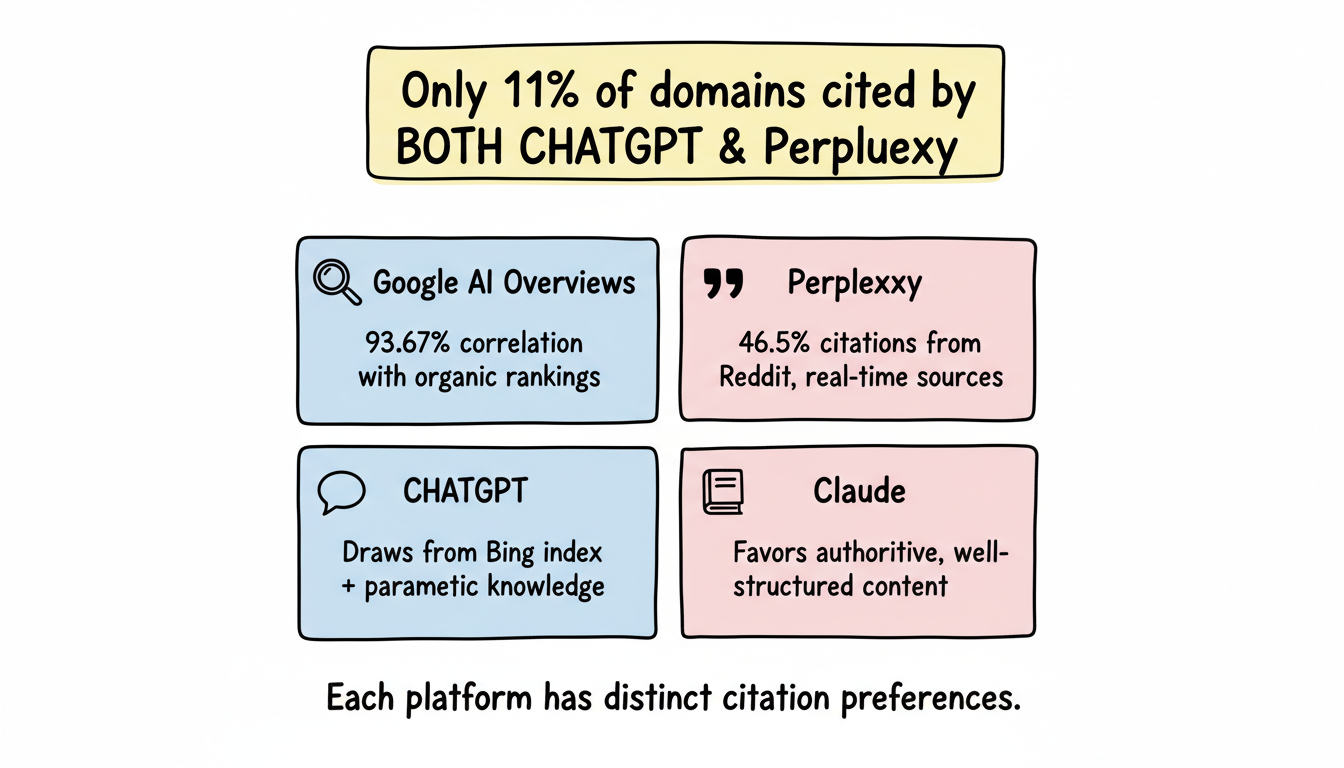
Building visibility across AI search requires understanding each platform's preferences rather than assuming universal optimization works. A multi-platform AI search optimization strategy addresses these distinct citation patterns with platform-specific tactics.
The AI search market—valued at $43.6 billion in 2025—is projected to reach $108.88 billion by 2032. Analysts predict AI search could capture 30-50% of the search market by 2030.
This represents a fundamental shift in how people discover information. The transition from "search and click" to "ask and receive" changes what content succeeds and which brands gain visibility.
For marketers, the proliferation of AI search tools means expanding optimization beyond Google. The businesses that build visibility across multiple AI platforms now will maintain advantages as these systems mature and capture increasing market share.
By submitting this form, you agree to our Privacy Policy and Terms & Conditions.