February 19, 2026


Google AI Overviews now appear for approximately 39% of informational queries—and that percentage climbs to 67% for queries with eight or more words. Getting cited in these AI-generated summaries has become a meaningful traffic and visibility opportunity.
The good news: you don't need a complete content overhaul to improve AI Overview performance. These 10 quick wins deliver results with focused, tactical changes.
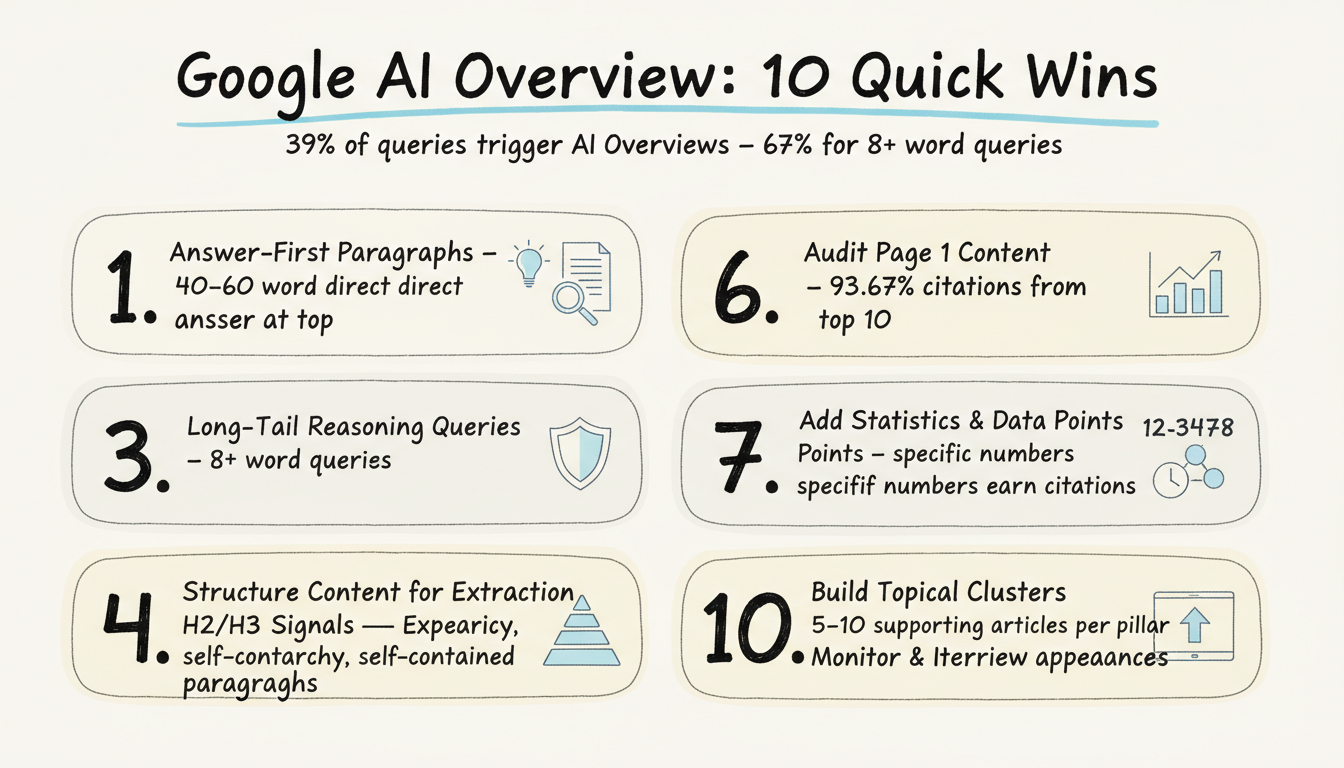
AI Overviews pull content that directly answers the query. Move your clearest, most definitive answer to the top of each page.
Quick implementation:
Pages with answer-first structure get cited more frequently because AI systems can easily extract the response without parsing through introductory content.
FAQ schema signals question-answer content to Google's systems. Pages with FAQ markup show 43% higher citation rates in AI Overviews compared to unstructured equivalents.
Quick implementation:
Schema markup takes 15 minutes to implement but provides ongoing AI visibility benefits.
Short queries rarely trigger AI Overviews. Implementing long-tail keywords for featured snippet success is a proven strategy—especially for queries requiring explanation or comparison that trigger AI responses far more frequently.
Quick implementation:
Focus content efforts on queries where AI Overviews actually appear rather than high-volume head terms.
Google's AI systems weight Experience, Expertise, Authoritativeness, and Trustworthiness heavily when selecting citation sources. Strengthen these signals for higher citation rates.
Quick implementation:
Content demonstrating genuine expertise gets cited over generic informational pages. Many organizations working with an ai-seo-agency-guide-2026 prioritize E-E-A-T improvements as their first optimization step.
AI systems extract content in predictable patterns. Structure pages to make extraction easy.
Quick implementation:
Well-structured content gets cited more accurately because AI systems can extract clean, coherent snippets.
Research shows 93.67% of AI Overview citations come from pages already ranking in the top 10. Your best AI Overview opportunities are pages that rank well but aren't yet being cited.
Quick implementation:
Prioritize pages with existing ranking strength—they're closest to AI citation.
AI Overviews frequently cite pages containing specific statistics, research findings, and quantifiable data. Content with concrete numbers earns more citations than general discussion.
Quick implementation:
A page with "conversion rates improved 34%" gets cited over one saying "conversion rates improved significantly."
AI systems prefer recent information. Outdated content gets passed over for fresher alternatives—even when the underlying information remains accurate.
Quick implementation:
Quarterly content refreshes maintain citation eligibility for high-priority pages.
Isolated pages struggle to earn AI citations. AI systems favor sources demonstrating comprehensive topic coverage through interconnected content.
Quick implementation:
Topical clusters signal expertise that single pages cannot demonstrate alone. Organizations measuring aeo-optimization-metrics often find topical authority correlates strongly with citation rates.
AI Overview citations fluctuate more than traditional rankings. What gets cited this week may not appear next week. Active monitoring enables rapid response.
Quick implementation:
Tools like Semrush AI Toolkit, Otterly AI, and manual query testing provide visibility into citation patterns. Companies evaluating cross-platform-ai-search-roi-analysis use these monitoring tools to track performance across multiple AI platforms.
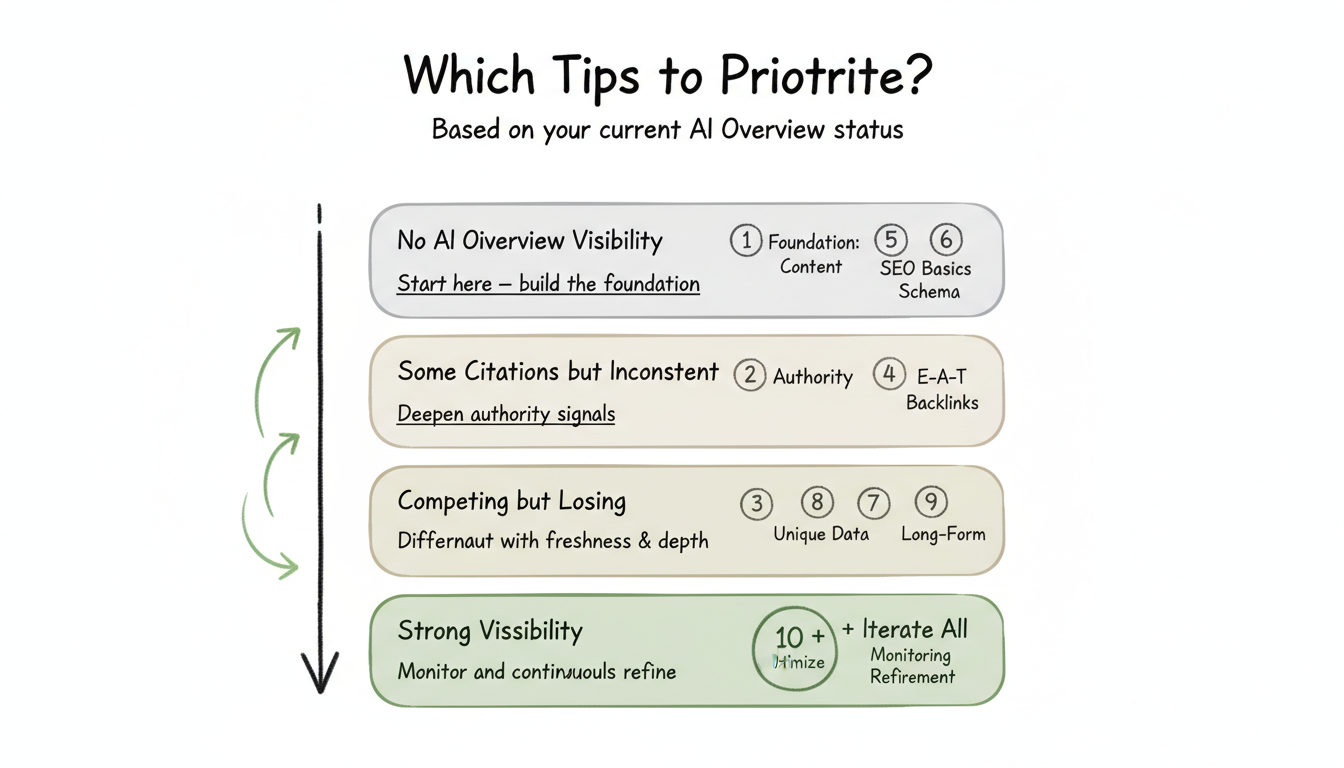
Not all tips deliver equal impact. Prioritize based on your current state:
Current State | Priority Actions |
No AI Overview visibility | Tips 1, 5, 6 (foundation) |
Some citations but inconsistent | Tips 2, 4, 7 (strengthen) |
Competing but losing to competitors | Tips 3, 8, 9 (differentiate) |
Strong visibility, seeking gains | Tips 10, iterate on all (optimize) |
These quick wins can be implemented progressively:
Week 1: Audit existing Page 1 content (Tip 6), add answer-first paragraphs to top 5 pages (Tip 1)
Week 2: Implement FAQ schema on pages with Q&A sections (Tip 2), strengthen E-E-A-T signals (Tip 4)
Week 3: Add statistics and data points (Tip 7), structure content for extraction (Tip 5)
Week 4: Target long-tail queries (Tip 3), update freshness signals (Tip 8)
Ongoing: Build topical clusters (Tip 9), monitor and iterate (Tip 10)
Changes typically appear in AI Overview citations within 2-4 weeks after Google recrawls and reprocesses your content. Schema markup changes may show impact faster. Monitor weekly to track progress.
Yes, these optimization principles apply across industries. However, AI Overview trigger rates vary by query type—informational and educational content sees higher AI Overview frequency than transactional or navigational queries.
By submitting this form, you agree to our Privacy Policy and Terms & Conditions.