February 19, 2026


Google search results look fundamentally different than they did just two years ago. AI Overviews—AI-generated summaries that appear at the top of search results—have transformed how users interact with search and how websites receive traffic. Understanding the differences between AI Overviews and traditional blue link results determines whether your SEO strategy succeeds in 2026's search landscape.
According to ALM Corp's Semrush study analysis, AI Overviews now appear for 15.69% of keywords as of November 2025, with 794 of the top 1,000 "What is" queries triggering AI-generated responses by December 2025. This expansion beyond purely informational queries means AI Overviews increasingly impact commercial and transactional searches.
AI Overviews represent Google's integration of generative AI directly into search results.
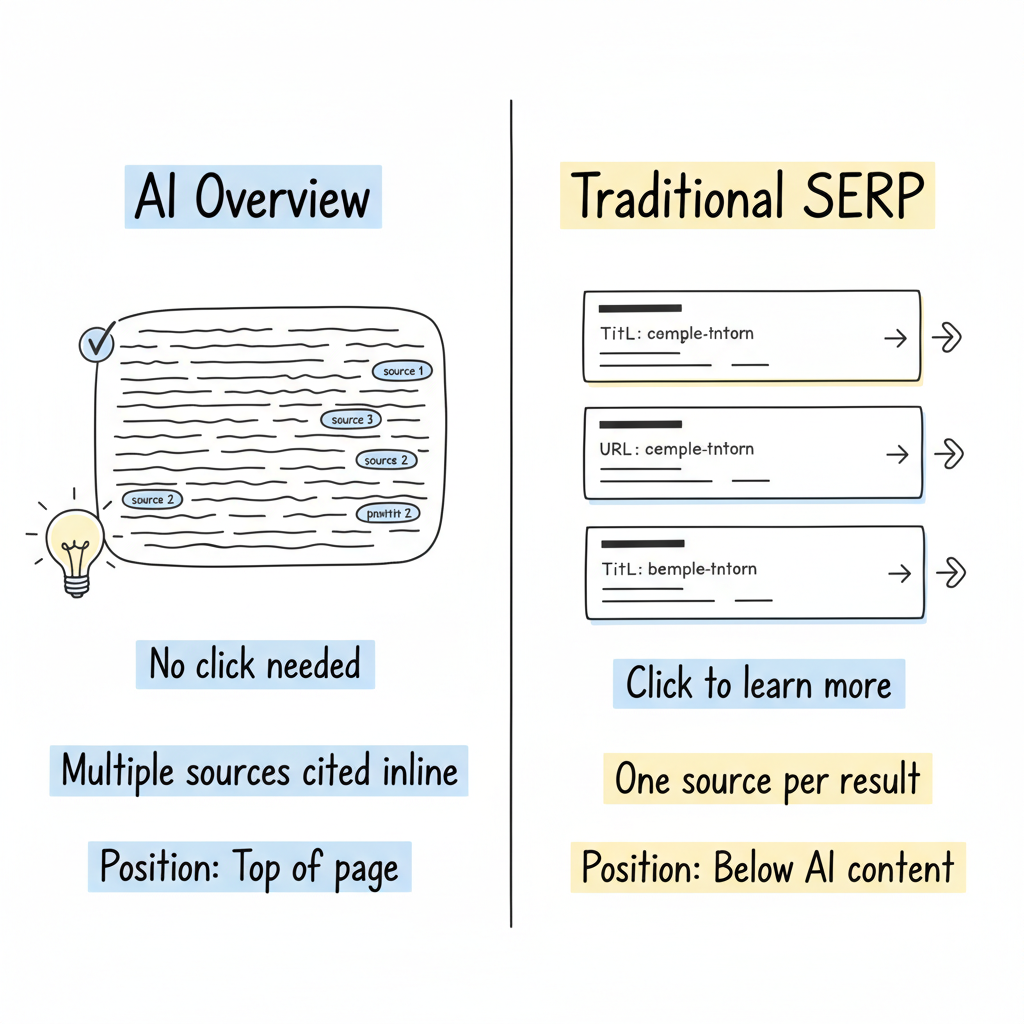
According to Yoast's AI Overviews guide, AI Overviews are AI-generated summaries that appear at the top of Google search results. They synthesize information from multiple sources to provide direct answers, reducing the need for users to click through to individual websites.
AI Overviews vs Traditional Results:
Feature | AI Overviews | Traditional SERP |
Position | Top of page | Below any AI content |
Format | Synthesized summary | Title, URL, description |
Sources | Multiple, cited inline | One source per result |
User action | Often answers directly | Requires click to learn |
Attribution | Expandable citations | Clear link ownership |
The most significant difference lies in how users interact with each result type.
According to NoGood's future of search analysis, organic click-through rates drop from 1.76% to 0.61% when AI Overviews appear—a 65% decline. The position 1 organic result sees CTR drop 34.5% when competing with an AI Overview above it.
CTR comparison by position:
Click-Through Rate Changes with AI Overviews
├── Position 1 Organic
│   ├── Without AI Overview: ~27.6% CTR
│   ├── With AI Overview: ~18.0% CTR
│   └── Impact: -34.5% decline
│
├── Position 2-5 Organic
│   ├── Without AI Overview: Varies 5-15%
│   ├── With AI Overview: Significantly reduced
│   └── Impact: -40-60% decline
│
├── AI Overview Citations
│   ├── Pages cited in overview: +35% more clicks
│   ├── Visibility without click: High
│   └── Brand exposure: Significant
│
└── Overall Search Behavior
    ├── Zero-click searches: 60% of all queries
    ├── Click reduction with AI: ~50%
    └── Conversion quality: Higher for remaining clicks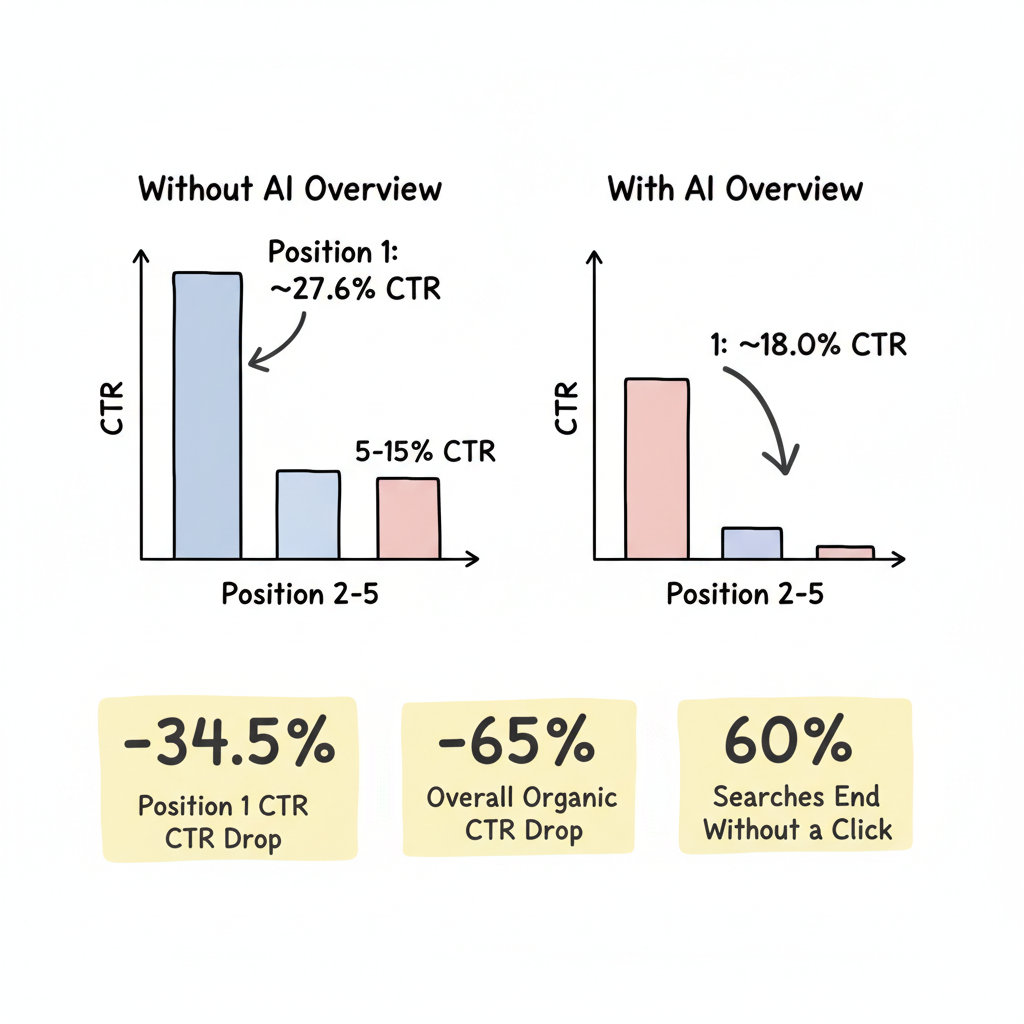
Understanding traffic changes helps recalibrate expectations and strategy.
According to Stryde's AI Overviews analysis, Pew Research found a 50% drop in overall click-through when AI Overviews appear. However, pages that get cited within AI Overviews can see up to 35% more clicks than they would receive from traditional organic positions alone.
Traffic impact scenarios:
Scenario | Traffic Impact | Strategic Response |
Not cited, AI Overview present | -50-65% traffic | Optimize for citation |
Cited in AI Overview | +35% potential increase | Maintain citation status |
No AI Overview triggered | Normal organic traffic | Traditional SEO works |
AI Overview for your brand terms | Mixed impact | Monitor and adapt |
Different query types trigger AI Overviews at different rates.
According to WordStream's 2026 AI trends analysis, AI Overviews initially dominated informational queries but have expanded into commercial and transactional categories. Understanding which queries trigger AI Overviews helps prioritize optimization efforts, similar to how AEO vs SEO vs GEO strategies must account for different search engines and their AI implementations.
AI Overview trigger patterns:
Query Type | AI Overview Frequency | Example Queries |
"What is" definitions | Very High (79%+) | "What is SEO" |
"How to" tutorials | High | "How to optimize for AI search" |
Comparison queries | Growing | "HubSpot vs Salesforce" |
Product research | Moderate | "Best CRM software" |
Transactional | Low but growing | "Buy running shoes" |
Brand searches | Low | "Nike official website" |
Users interact with AI Overviews fundamentally differently than traditional results.
According to OptinMonster's zero-click search analysis, 60% of searches now end without a click to any website. Users get their answers directly from AI Overviews, changing the relationship between search visibility and website traffic. This trend extends beyond Google, with Perplexity AI search engine offering similar direct-answer experiences that bypass traditional website visits.
Behavioral differences:
User Interaction Patterns
├── Traditional SERP Behavior
│   ├── Scan titles and descriptions
│   ├── Click to read full content
│   ├── Visit multiple results
│   └── Clear traffic attribution
│
└── AI Overview Behavior
    ├── Read summary first
    ├── Click only for more depth
    ├── Fewer total clicks
    ├── Higher intent when clicking
    └── Brand exposure without clicks
The strategic response differs significantly between traditional and AI-era SEO.
According to SE Roundtable's search analysis, traditional SEO focused primarily on ranking in positions 1-10. AI Overview optimization adds a new layer: getting cited within the AI-generated summary itself, which requires different content characteristics than traditional ranking factors. Many businesses are turning to specialized AI SEO agencies to navigate this complex transition.
Strategy comparison:
Focus Area | Traditional SEO | AI Overview Optimization |
Primary goal | Rank position 1-10 | Get cited in AI summary |
Content format | Keyword-optimized pages | Answer-first structure |
Success metric | Rankings, CTR | Citations, brand mentions |
Competitive analysis | SERP competitors | Cited sources analysis |
Link building | Domain authority | Entity authority |
Metrics must evolve to capture AI Overview performance.
According to Semrush's AI visibility research, users discovering brands through AI search are 4.4x more valuable when they convert, despite lower overall click volumes. This shifts success measurement from traffic quantity to traffic quality.
New metrics framework:
Old Metric | New/Additional Metric | Why It Matters |
Organic rankings | AI citation frequency | Visibility in AI results |
Click-through rate | Engagement rate | Quality over quantity |
Traffic volume | Conversion value | Higher-intent visitors |
Keyword positions | Share of AI voice | Competitive visibility |
Practical steps to succeed in both traditional and AI-influenced search.
Dual optimization approach:
Understanding the AI Overview vs traditional SERP distinction shapes effective 2026 SEO:
According to ALM Corp, the expansion of AI Overviews beyond informational queries means every SEO strategy must now account for AI-generated results. The websites that thrive will optimize for both traditional blue links and AI Overview citations simultaneously.
By submitting this form, you agree to our Privacy Policy and Terms & Conditions.