
February 19, 2026


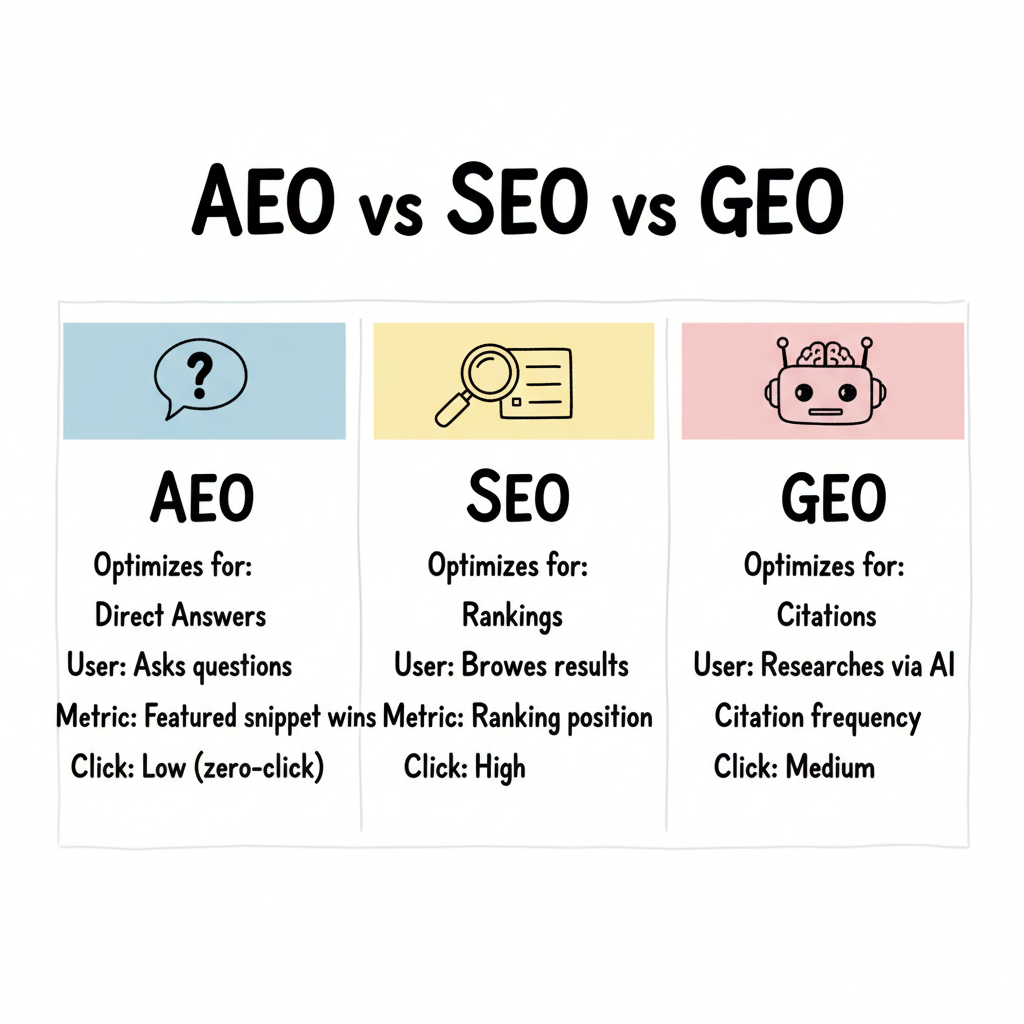
Search behavior has fragmented. Users no longer just "search"—they ask questions, conduct research, and expect immediate answers. Three distinct optimization strategies have emerged to match these behaviors: AEO focuses on being the direct answer, SEO focuses on ranking in results, and GEO focuses on getting cited by AI.
The core question isn't which one matters most. It's which one matters most for how your specific audience discovers information.
Each strategy optimizes for a different user behavior:
AEO (Answer Engine Optimization): Optimizes for users who ask specific questions and want immediate, direct answers. Success means being selected as THE answer—in featured snippets, voice responses, or AI-generated summaries.
SEO (Search Engine Optimization): Optimizes for users browsing search results to find relevant resources. Success means ranking high enough to earn clicks from users scanning result pages.
GEO (Generative Engine Optimization): Optimizes for users who ask AI systems to research and synthesize information. Success means being cited when ChatGPT, Perplexity, or AI Overviews construct comprehensive responses.
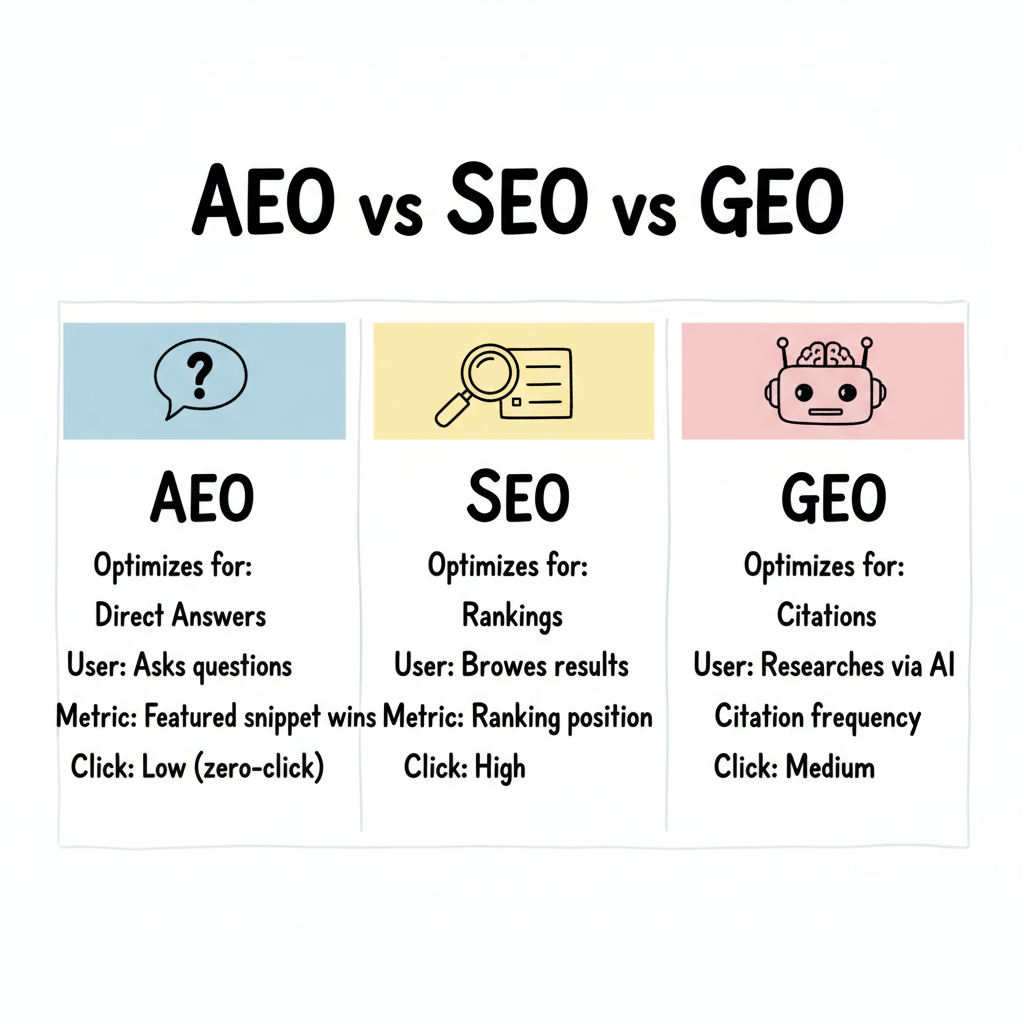
Answer Engine Optimization positions your content to be selected as the definitive response to user questions. When someone asks "What is the best time to post on Instagram?" AEO determines whether your answer gets quoted.
Where AEO matters:
AEO success requires:
The AEO mindset: "Can an AI quote me accurately?"
Research shows AEO depends on clicks less than traditional SEO. Instead, AEO wins without clicks by appearing directly in the answer. Visibility comes from being selected, not from being listed.
Search Engine Optimization focuses on appearing prominently in traditional search results. When users browse Google results for "marketing automation platforms," SEO determines whether your page appears on page one.
Where SEO matters:
SEO success requires:
The SEO mindset: "Can I rank for this term?"
SEO still fuels discovery. Most web traffic flows through traditional search results. Abandoning SEO eliminates the largest source of organic visibility.
Generative Engine Optimization focuses on earning citations when AI systems synthesize answers from multiple sources. When ChatGPT explains "how to choose a CRM," GEO determines whether your brand gets mentioned.
Where GEO matters:
GEO success requires:
The GEO mindset: "Will AI trust me enough to cite me?"
GEO fuels long-term relevance. As AI search grows, brands invisible to generative engines lose influence during the research phase of buyer journeys.
Factor | AEO | SEO | GEO |
Optimizes for | Direct answers | Rankings | Citations |
User behavior | Asking questions | Browsing results | Researching via AI |
Success metric | Featured snippet wins | Ranking position | Citation frequency |
Content focus | Concise Q&A pairs | Comprehensive pages | Authoritative depth |
Key technical element | FAQ schema | Backlinks | Entity signals |
Click dependency | Low (zero-click) | High | Medium |
Speed to results | Weeks | Months | Days to months |
The answer depends entirely on how your audience finds information.
AEO matters most for informational queries where being the answer builds trust. Professional services, SaaS support content, and educational resources benefit most. Understanding what is AEO vs SEO helps determine when to emphasize direct answers over rankings.
SEO remains essential for most businesses. Despite changes in search, traditional rankings still drive the majority of website traffic.
GEO grows increasingly important as AI adoption accelerates. Companies targeting early adopters, researchers, and sophisticated buyers should invest early. Examining GEO SEO examples reveals how top brands balance citation optimization with traditional search visibility.
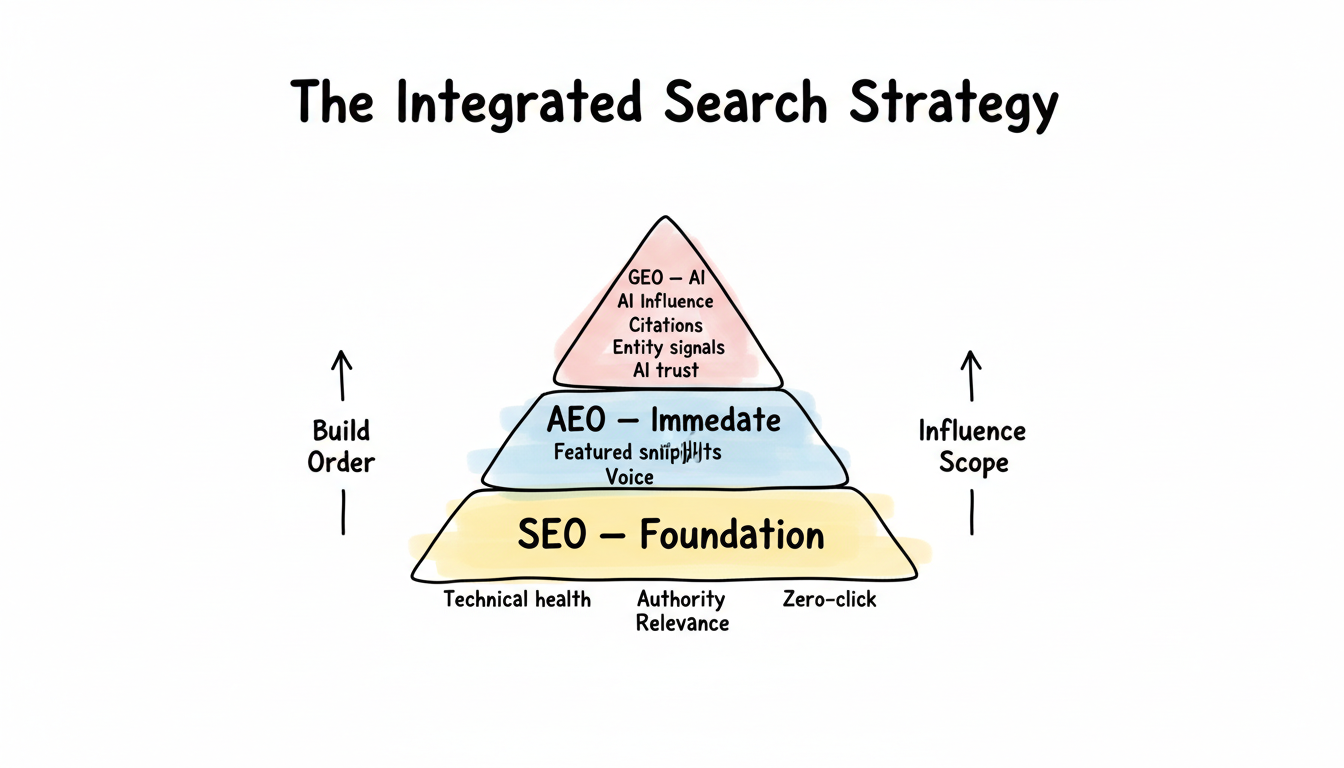
Most businesses need all three strategies working together:
SEO provides the foundation. Technical excellence, content authority, and backlink profiles support both AEO and GEO success. Without strong SEO fundamentals, the other strategies struggle.
AEO captures immediate opportunities. For queries with clear answers, AEO-optimized content earns featured snippets and voice results. This visibility builds brand awareness even without clicks.
GEO extends influence into AI. For research queries where AI synthesizes multiple sources, GEO ensures your brand appears in the narrative. This influences buyers before they reach traditional search.
Practical integration:
Content created with all three approaches captures visibility across the full spectrum of modern search behavior. Effective AI content optimization combines principles from all three strategies to maximize discoverability across traditional and AI-powered search platforms.
AI search is growing, but traditional search isn't disappearing. Companies that abandon SEO for AEO or GEO exclusively lose access to billions of queries.
Each approach requires different tactics. Long-form SEO content isn't automatically AEO-ready. Concise answers aren't automatically GEO-optimized. Match your approach to your goals.
Different strategies require different metrics. Track featured snippet appearances for AEO, rankings for SEO, and citation frequency for GEO. Combined dashboards show complete visibility. Organizations investing in AEO metrics KPIs gain clarity on which strategy delivers the highest return for their specific audience.
If you're building a search strategy from scratch:
Start with SEO. Technical foundation, content quality, and authority building support everything else. Most immediate opportunities exist in traditional search.
Add AEO for question content. Restructure pages that answer specific questions. Add FAQ schema. Create direct, quotable answers.
Build GEO for competitive differentiation. Monitor AI platforms for your brand. Optimize content for citation. Develop entity authority.
The goal isn't choosing one approach—it's building integrated visibility that captures your audience wherever they search.
By submitting this form, you agree to our Privacy Policy and Terms & Conditions.



