February 19, 2026


AI search traffic has grown 527% year-over-year according to recent industry data, but raw traffic numbers tell an incomplete story. Organizations optimizing for AI visibility must focus not just on citation frequency but on conversion quality—turning AI-referred visitors into customers, subscribers, or leads. This guide explores strategies for maximizing the business value of AI search traffic rather than simply chasing visibility metrics.
AI search fundamentally changes the traffic quality equation.
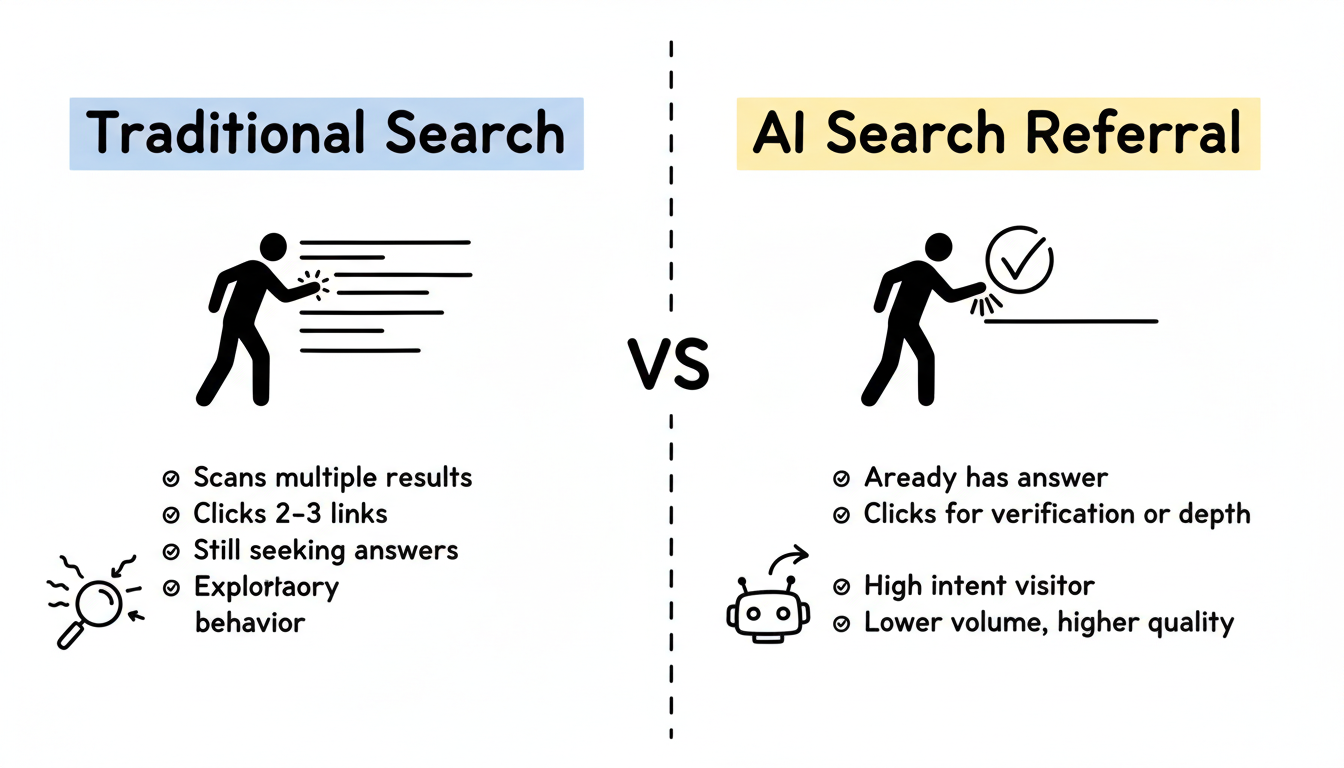
AI-referred visitors arrive with different context than traditional search users.
Traditional search behavior:
AI search referral behavior:
Research indicates ChatGPT drives 89% of measured AI referrals when users do click through, but the click-through rate itself is lower than traditional search. The visitors who do click represent a more intentional audience, which is why understanding AI search platform strengths and weaknesses becomes crucial for optimization.
AI search creates more zero-click experiences where users get answers without visiting source websites.
Implications for conversion strategy:
Organizations measuring only direct referral traffic miss significant AI-driven business impact that flows through branded search and direct navigation. When developing your AEO strategy framework, it's essential to account for these indirect conversion pathways.
Effective optimization requires appropriate measurement frameworks.
Attributing AI search traffic accurately presents technical challenges.
Attribution difficulties:
Measurement approaches:
Imperfect attribution is acceptable—directional insights enable optimization even without perfect measurement. For comprehensive tracking methodologies, explore how cross-platform AI search ROI measurement can provide a more complete picture.
Focus on metrics revealing AI traffic quality.
Primary conversion metrics:
Quality indicators:
AI traffic that engages deeply and converts suggests effective alignment between your content and AI user intent.
Before optimization, establish current performance baselines.
Baseline data points:
Baseline documentation best practices:
Document baselines before implementing optimization changes to measure impact accurately. Organizations without clear baselines cannot distinguish optimization wins from normal variation.
Apply specific strategies to improve AI traffic conversion.
AI-referred visitors have unique needs requiring tailored landing experiences.
Optimization approaches:
Validate and expand on AI answers: Visitors clicking from AI often want verification or deeper detail. Confirm the information they received while providing additional value.
Clear value beyond the AI answer: Demonstrate why visiting your site provides value the AI answer didn't. This might include interactive tools, downloadable resources, expert consultation, or product purchase options.
Reduce friction for high-intent visitors: AI-referred visitors have already researched. Minimize steps between arrival and conversion with prominent CTAs and streamlined forms.
Match content to citation context: Understand what queries drive AI citations to your content and ensure landing pages align with that user intent. Implementing conversational content writing for AEO can help match the natural language patterns AI platforms expect.
AI traffic arrives after receiving summary answers. Content must provide complementary depth.
Depth approaches:
Comprehensive detail sections: Include sections offering depth AI summaries can't provide—case studies, implementation guides, detailed comparisons, and nuanced analysis. Using descriptive subheadings for AEO helps both AI platforms and human visitors navigate your content effectively.
Interactive elements: Calculators, configurators, quizzes, and assessment tools provide value AI systems can't replicate in text responses.
Expert consultation offers: For complex topics, human expertise remains valuable. Prominent offers for consultation convert AI-referred visitors seeking personalized guidance.
Downloadable resources: Checklists, templates, and guides offer tangible takeaways encouraging email capture and further engagement.
Design conversion paths appropriate for AI-referred visitor psychology.
Effective path elements:
Multiple conversion levels: Not all visitors are ready for high-commitment actions. Offer low-friction options (newsletter signup, content download) alongside primary conversions (demo request, purchase).
Trust reinforcement: AI-referred visitors may be verifying AI information. Display credibility signals prominently—testimonials, credentials, certifications, and third-party validation.
Clear next steps: AI users are accustomed to direct answers. Provide clear, specific next actions rather than generic "contact us" CTAs.
Mobile optimization: Significant AI usage occurs on mobile devices. Ensure conversion paths function seamlessly across devices.
Different AI platforms send traffic with different characteristics.
ChatGPT drives the largest volume of AI referrals with 89% of measured AI traffic.
ChatGPT traffic characteristics:
Optimization priorities:
Perplexity demonstrates a 6.2x Referral Efficiency Index—users are far more likely to click citations. For detailed tactics, see our Perplexity optimization guide.
Perplexity traffic characteristics:
Optimization priorities:
Google AI Overviews reach 2 billion users monthly with different referral patterns. Understanding the AI Overview impact helps inform your optimization priorities.
AI Overviews traffic characteristics:
Optimization priorities:
Different business models require different AI conversion strategies.
For product sales, AI traffic optimization focuses on purchase conversion.
E-commerce strategies:
For B2B and service businesses, lead capture is the primary goal. Organizations can leverage affordable AEO services to enhance their lead generation without excessive investment.
Lead generation strategies:
For publishers and content businesses, engagement and subscription matter.
Content strategies:
Avoid these errors undermining AI traffic conversion.
AI-referred visitors have already received answers. Treating them as uninformed browsers misses their actual intent and needs. Understanding the fundamental AEO vs SEO comparison helps avoid this mistake.
Better approach: Acknowledge their research and offer next-level value they haven't yet received.
Users seeing your brand cited in AI responses receive impression value even without clicking. This exposure influences later conversion through brand search or direct navigation.
Better approach: Track branded search volume and direct traffic alongside AI referrals to capture full impact.
Chasing maximum AI citations without considering traffic quality leads to visitors who don't convert. A smaller volume of highly-converting traffic outperforms large volumes of low-intent visitors. Consider using free AEO tools to identify high-value optimization opportunities.
Better approach: Prioritize optimization for topics and queries aligned with conversion intent, not just volume.
AI-referred customers who have positive post-conversion experiences generate reviews, testimonials, and word-of-mouth that strengthen future AI citations.
Better approach: Invest in customer success and encourage reviews to create virtuous cycles.
Integrate conversion optimization into overall AI search strategy.
Align visibility and conversion goals:
Create feedback loops:
Resource allocation:
Organizations can accelerate results by partnering with specialized generative engine optimization companies that have proven conversion optimization frameworks.
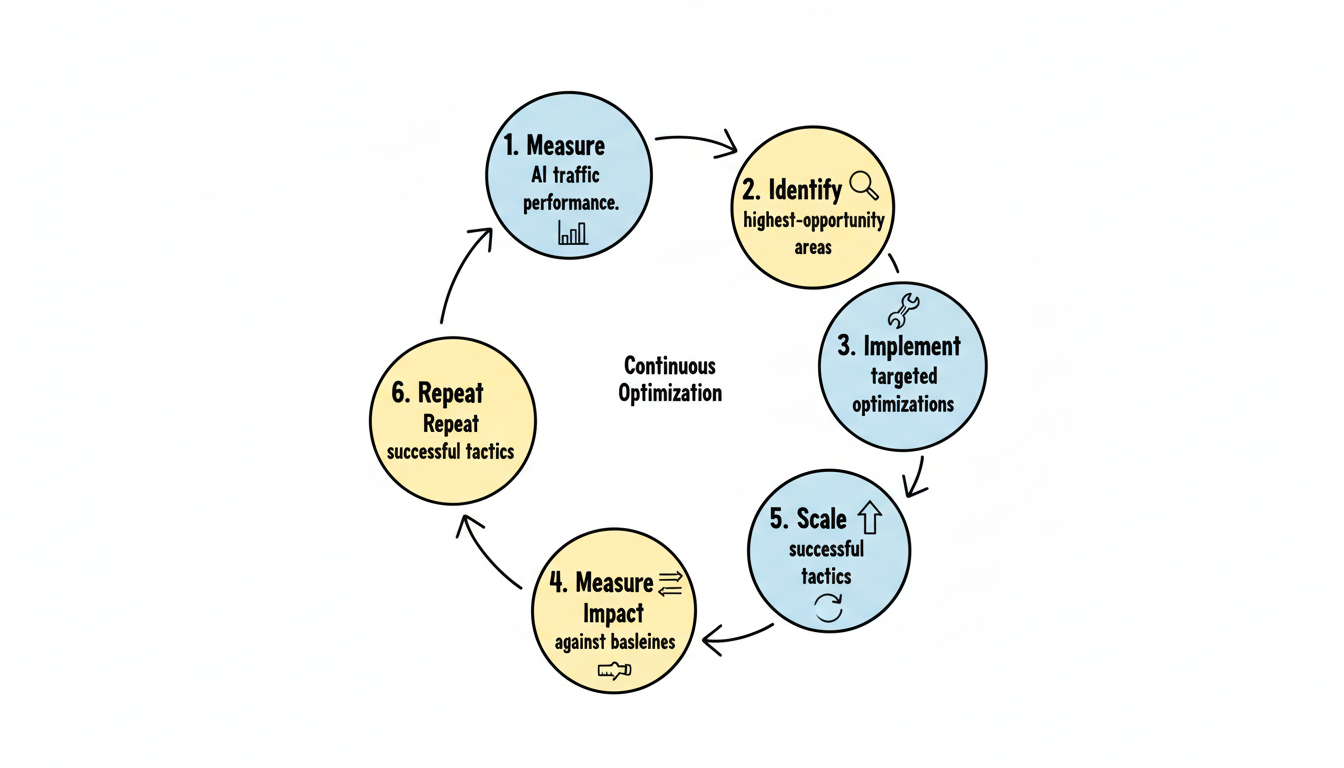
AI search optimization is ongoing, not one-time.
Optimization cycle:
Organizations treating conversion optimization as continuous improve results over time rather than achieving one-time gains. Leveraging specialized AEO tools and software can streamline this iterative process.
Conversion optimization requires systematic testing.
Test variations to identify what converts AI visitors best.
Testing priorities:
Ensure sufficient traffic volume before drawing conclusions—AI referral traffic may require longer testing periods than traditional traffic.
Quantitative data alone doesn't explain visitor behavior.
Qualitative approaches:
Qualitative insights complement quantitative data for comprehensive optimization understanding.
It depends on alignment. AI-referred visitors who click have high intent—they chose to visit despite receiving an AI answer. However, total volume is lower. When properly optimized, AI traffic often converts at higher rates than traditional search traffic. The key is ensuring your content and conversion paths align with AI-referred visitor needs.
Compare conversion rates between AI referral traffic and other sources. Segment by AI platform if volume allows. Also track branded search volume increases that may indicate AI-influenced conversions not captured in direct referral data. Industry benchmarks are still emerging, so focus on improving your own baselines over time.
Visibility must precede conversion—you can't convert traffic you don't have. However, don't ignore conversion while building visibility. Optimize content for both citation potential and conversion simultaneously. The best approach integrates visibility and conversion optimization from the start rather than treating them as sequential phases.
Conversion rates vary significantly by industry, offer type, and optimization level. Early data suggests well-optimized AI traffic can convert at 1.5-2x traditional organic rates due to higher visitor intent. However, focus on improving your specific baselines rather than chasing industry averages.
By submitting this form, you agree to our Privacy Policy and Terms & Conditions.