February 19, 2026


Content structure directly impacts whether AI systems cite your content. Research from Princeton University and Georgia Tech found that specific content optimizations—including clear, descriptive headings—can boost AI visibility by up to 40%. While traditional SEO treated headers as keyword placement opportunities, AEO treats them as extraction signals that help AI systems understand and cite your content.
This guide explains why descriptive subheadings matter for AI visibility and how to optimize them for maximum citation potential.
AI systems process content differently than humans. They chunk content into segments, embed those segments for retrieval, and match them against user queries. Descriptive subheadings create clear extraction boundaries that improve this entire process.
When AI systems encounter content, they break it into chunks for processing. Vague headers like "Overview" or "More Information" provide no context about what follows. Descriptive headers like "How Schema Markup Improves AI Citations" tell the AI exactly what content to expect.
This clarity matters because AI systems use headers to:
Understanding real-time vs static data optimization helps you structure content that AI systems can process efficiently and update as needed.
Users ask specific questions. AI systems match those questions to content segments. Descriptive headers that reflect common queries create direct matching opportunities.
When a user asks "What tools track AI visibility?" and your H2 reads "AI Visibility Tracking Tools for 2026," the match is direct. Generic headers force AI systems to analyze full paragraphs to determine relevance—a process that reduces citation likelihood.
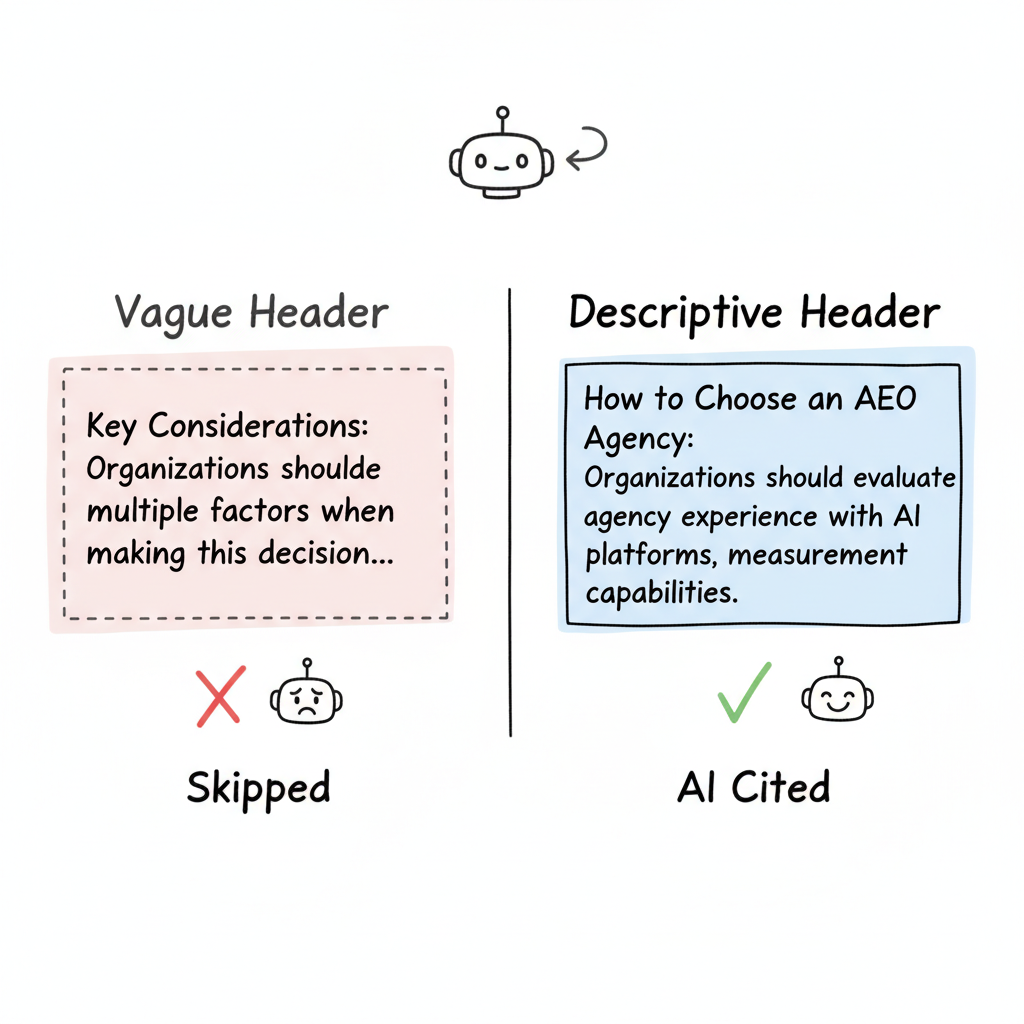
AI systems often pull the header and first 1-2 sentences when generating citations. Descriptive headers ensure the extracted snippet makes sense in isolation.
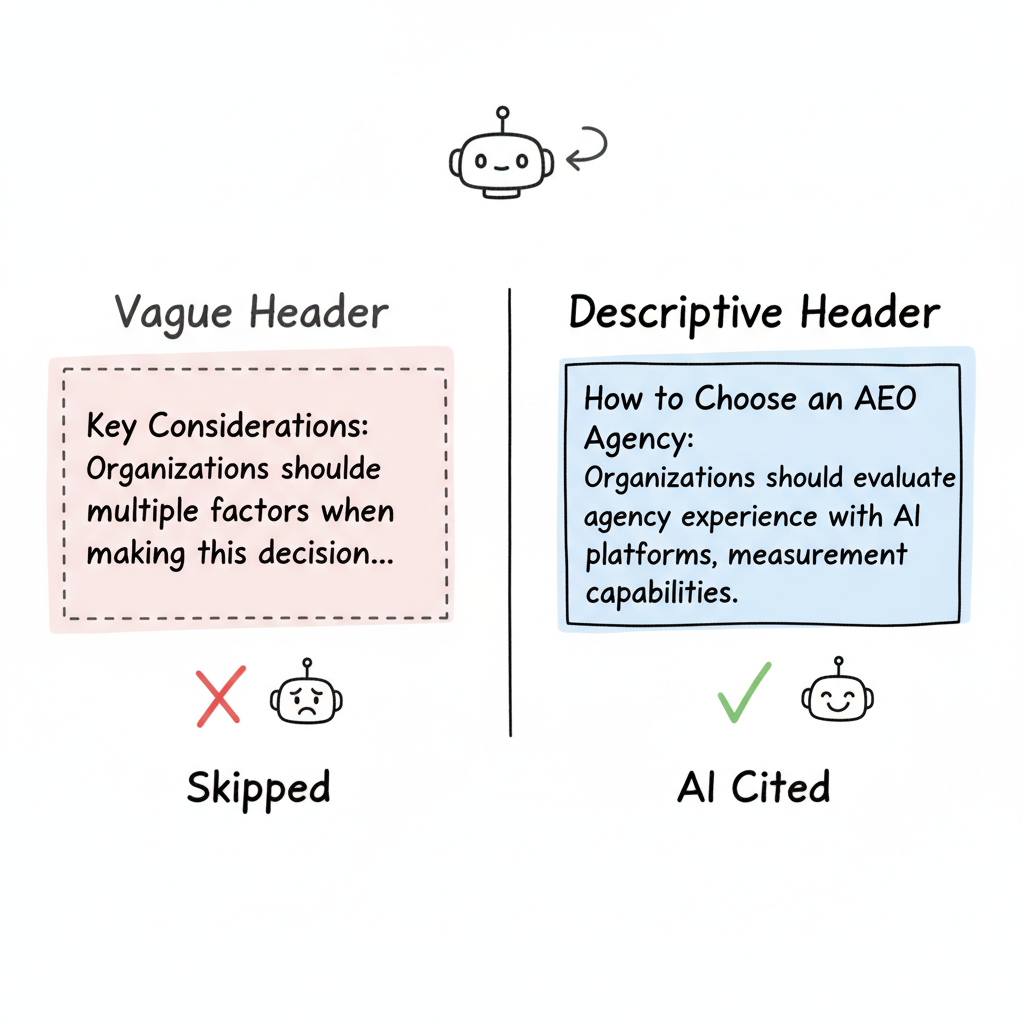
Compare these extraction results:
Vague header extraction:
"Key Considerations: Organizations should evaluate multiple factors when making this decision..."
Descriptive header extraction:
"How to Choose an AEO Agency: Organizations should evaluate agency experience with AI platforms, measurement capabilities, and industry expertise..."
The descriptive version communicates value immediately. The vague version requires additional context to be meaningful.
Descriptive subheadings share specific characteristics that distinguish them from generic alternatives.
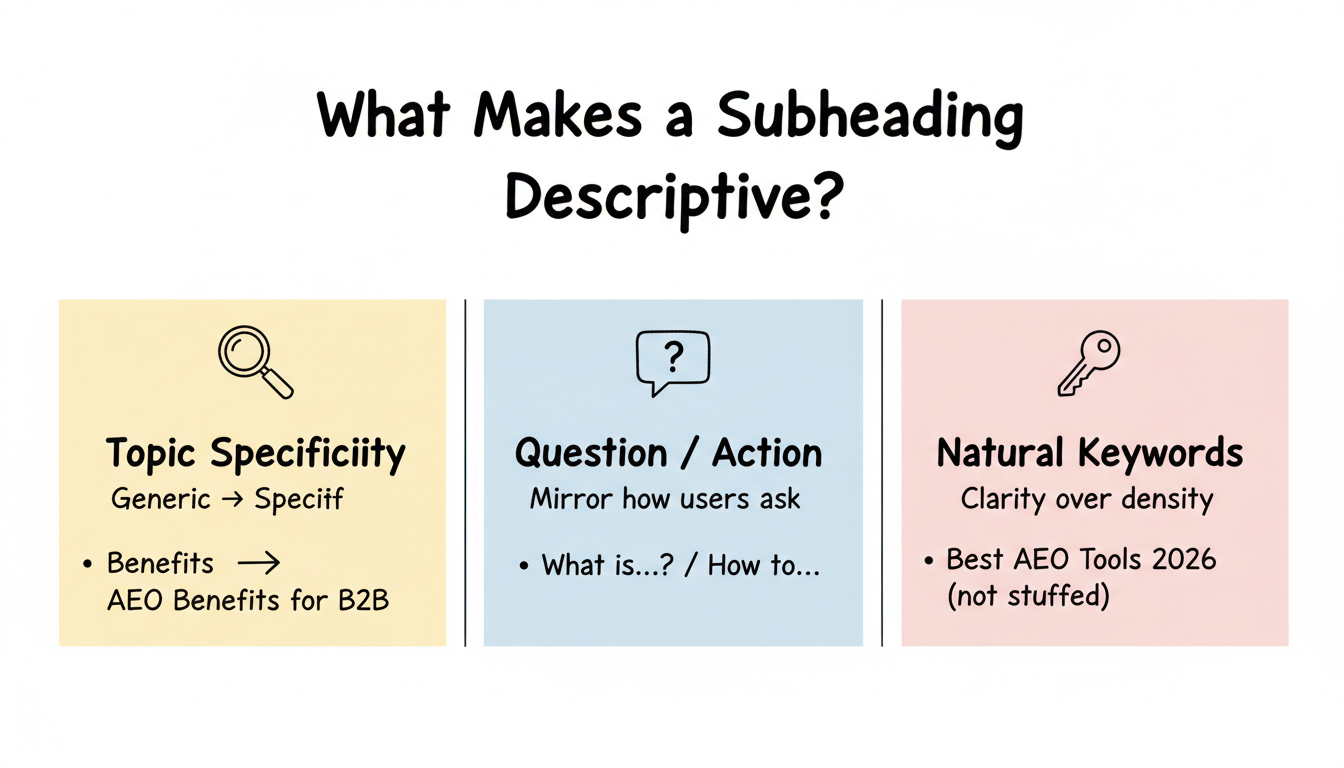
Effective descriptive headers name the specific topic they address:
Generic | Descriptive |
Benefits | AEO Benefits for B2B Companies |
Implementation | Implementing Schema Markup for AI Visibility |
Tools | AI Content Analysis Tools for 2026 |
Tips | Content Formatting Tips for Answer Extraction |
Specificity helps both AI systems and human readers understand content at a glance. When researching best AEO tools reviews, you'll notice that top-performing platforms consistently use specific, descriptive headers throughout their content.
The most effective AEO headers either pose questions users ask or describe actions users want to take:
Question-oriented:
Action-oriented:
Both patterns align with how users phrase queries to AI systems. Implementing question-based headers for AEO creates natural matching opportunities between user queries and your content structure.
Descriptive headers include relevant keywords naturally—not stuffed artificially. The goal is clarity, not keyword density.
Overstuffed: "Best AEO AI SEO Answer Engine Optimization Tools Guide"
Natural: "Best Answer Engine Optimization Tools for 2026"
AI systems trained on natural language recognize and prefer natural phrasing.
Effective header structure follows patterns that maximize AI comprehension and citation potential.
Use H2s for main topics and H3s for subtopics within those sections. This hierarchy helps AI systems understand relationships between concepts.
H2: AEO Implementation for Enterprise Organizations
  H3: Building Cross-Team Alignment
  H3: Selecting Enterprise AEO Tools
  H3: Measuring Enterprise AI Visibility

H2: AEO Implementation for Small Businesses
  H3: Prioritizing High-Impact Pages
  H3: Using Free and Low-Cost Tools
  H3: Tracking Results Without Enterprise Budgets
Each section stands alone while contributing to a coherent whole.
Place the most important words at the beginning of headers:
Less effective: "A Guide to Understanding How Schema Markup Works"
More effective: "Schema Markup: How It Improves AI Citations"
AI systems sometimes truncate headers. Front-loading ensures key information survives truncation.
Use consistent header patterns throughout content. If you use question headers for one section, consider using them for parallel sections. Consistency helps AI systems recognize patterns and structure.
Several header patterns reduce AI visibility despite seeming reasonable for traditional content.
Creative headers that rely on wordplay or references often fail AI extraction:
Problematic: "The Yellow Brick Road to AI Success"
Better: "Step-by-Step Path to AI Search Visibility"
AI systems interpret literally. Metaphors and cultural references create confusion rather than engagement.
Headers that could apply to any content provide no value:
Replace these with descriptive alternatives:
Long content blocks without subheadings force AI systems to process undifferentiated text. Break content into logical sections—ideally every 150-300 words—with descriptive headers marking each segment.
Start improving header structure with these steps:
Review your highest-traffic pages. Identify headers that are:
Transform generic headers into descriptive alternatives. Ask: "Would someone scanning headers understand what this section covers?"
Insert new headers where content changes topic without signaling the shift. Each distinct concept deserves its own clearly labeled section.
Read each header followed by its first sentence. Does this combination make sense in isolation? Would it be useful as a cited snippet? If not, revise. Following the AI SEO implementation checklist can help you systematically test and improve header extraction across your entire site.
Include a subheading every 150-300 words, roughly. The right frequency depends on content complexity—more complex topics benefit from more frequent headers that break information into digestible segments.
Yes. Clear headers improve user experience, reduce bounce rates, and help search engines understand content structure. Descriptive header optimization benefits both traditional rankings and AI citation rates.
By submitting this form, you agree to our Privacy Policy and Terms & Conditions.