
February 19, 2026


SearchGPT—OpenAI's search-enabled ChatGPT—doesn't provide analytics dashboards like Google Search Console. When SearchGPT cites your content in responses, you won't receive a notification or see it in standard analytics. Tracking your SearchGPT visibility requires deliberate monitoring approaches designed for this specific platform's behavior.
This guide focuses specifically on SearchGPT citation tracking, not general AI visibility monitoring.
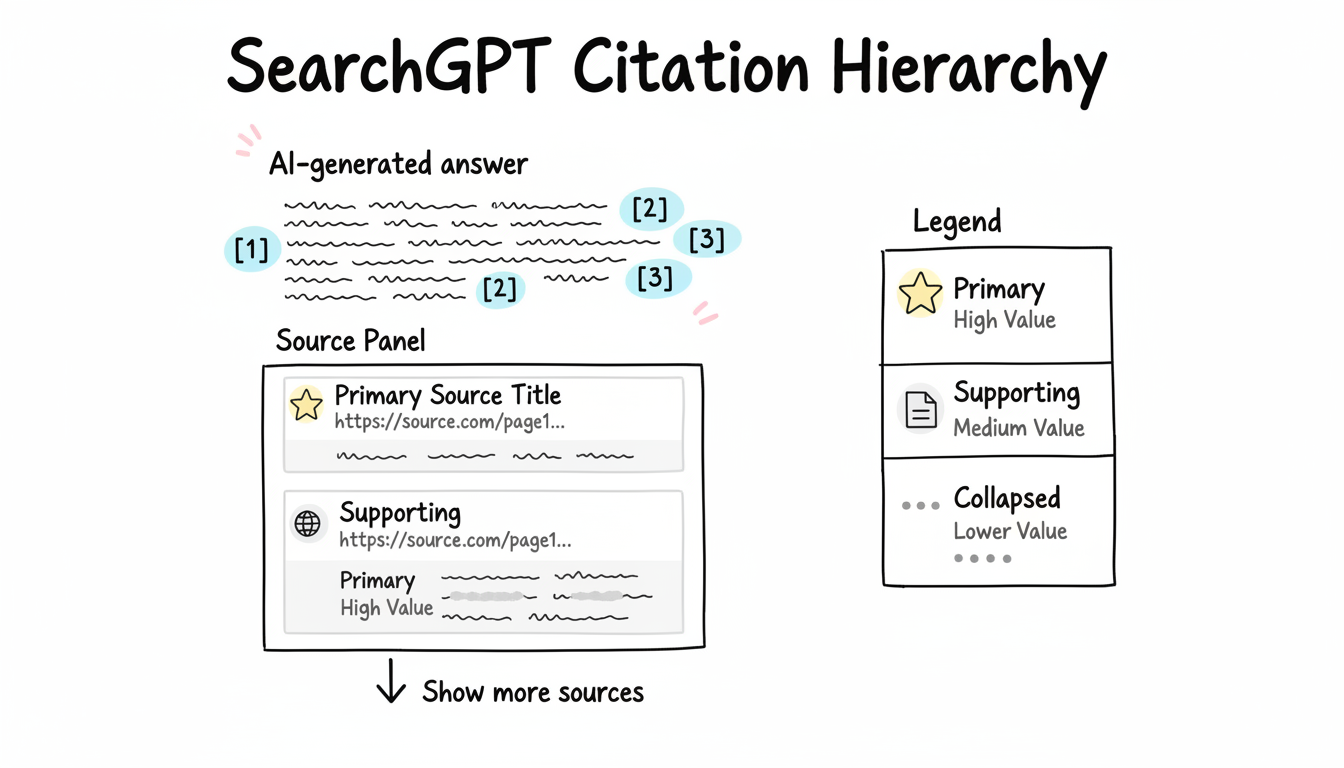
SearchGPT displays citations differently than traditional search results.
How SearchGPT presents sources:
SearchGPT Response Structure:
├── AI-generated answer (synthesized text)
├── Inline citation markers [1] [2] [3]
├── Source panel (expandable)
│   ├── Website favicon
│   ├── Page title
│   ├── URL
│   └── Brief excerpt
└── "Show more sources" expansion
Citation types in SearchGPT:
Type | Appearance | Value |
Primary citation | Numbered in main answer | High |
Supporting source | Listed in source panel | Medium |
Collapsed source | Behind "show more" | Lower |
Your tracking should distinguish between these citation levels.
Without automated tools, manual testing remains the foundation of SearchGPT tracking. Understanding how to optimize website ai-powered search engines provides essential context for interpreting your citation data.
Focus on queries relevant to your business that SearchGPT handles with citations.
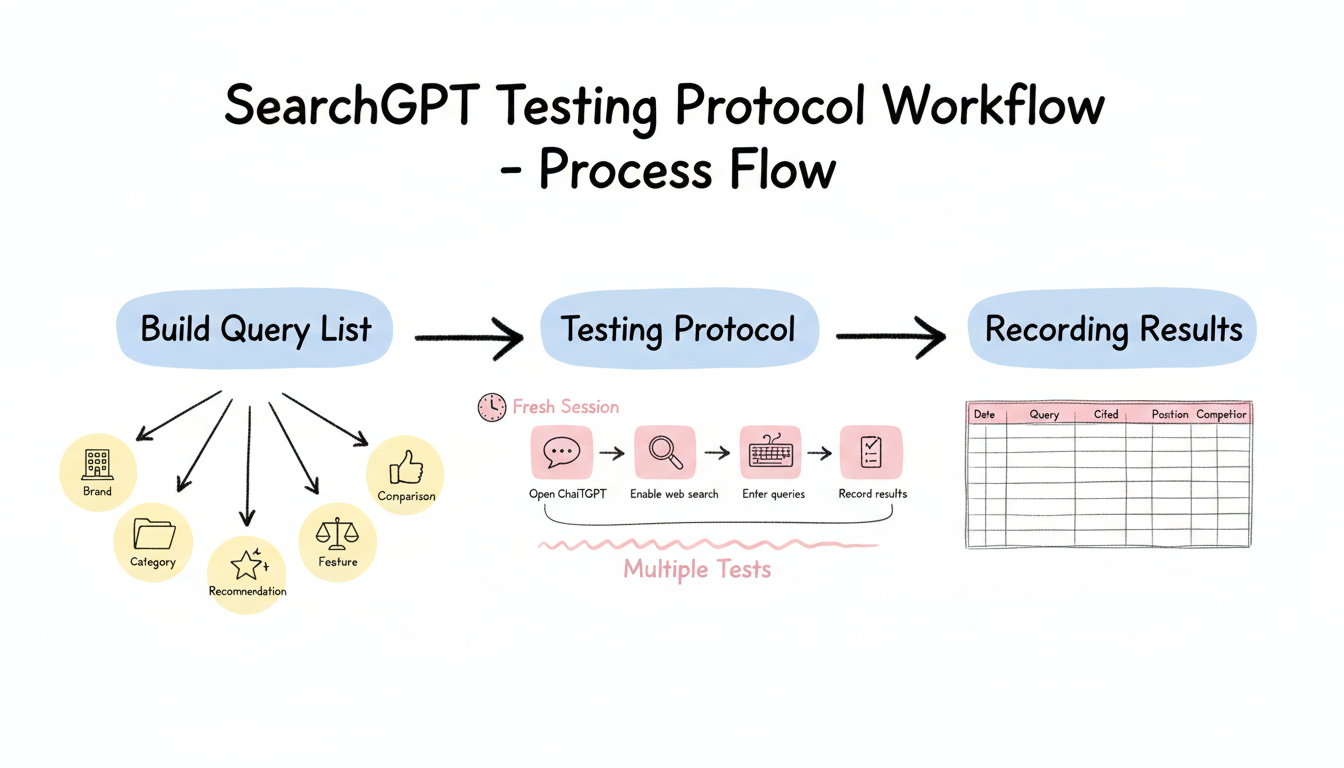
Query types to test:
Query Category | Example | Why Test |
Brand queries | "[Your company name]" | Direct recognition |
Category queries | "Best [your category]" | Competitive positioning |
Comparison queries | "[Your brand] vs [competitor]" | Head-to-head visibility |
Feature queries | "How to [solve problem you address]" | Use case alignment |
Recommendation queries | "What's the best way to [outcome]" | Citation likelihood |
Sample test query list:
Brand/Direct:
1. "[Company name]"
2. "[Company name] review"
3. "Is [company name] good?"

Category/Competitive:
4. "Best [your category] 2026"
5. "[Category] comparison"
6. "Top [category] tools"

Problem/Solution:
7. "How to [solve problem]"
8. "What's the best way to [achieve outcome]"
9. "[Problem] solutions"

Comparison:
10. "[Your brand] vs [competitor 1]"
11. "[Your brand] vs [competitor 2]"
Consistent testing produces meaningful data.
Daily/weekly testing process:
Recording template:
Date | Query | Your Site Cited | Position | Top Competitor |
[date] | [query] | Yes/No | 1/2/3/N/A | [domain] |
SearchGPT behaves differently from other AI search platforms. The searchgpt vs chatgpt search technical differences reveal important distinctions that affect citation tracking strategies.
SearchGPT doesn't give identical answers to the same query.
Variability factors:
Factor | Impact on Citations |
Session context | Previous questions influence responses |
Time of query | Source selection changes over time |
Response regeneration | Same query may yield different sources |
Account history | Personalization may affect results |
Accounting for variability:
Certain query structures more reliably trigger SearchGPT citations.
High-citation queries:
Patterns that generate citations:
├── "What is [topic]" - definitional, cites educational content
├── "Best [category] for [use case]" - recommendation, cites reviews
├── "How to [task]" - instructional, cites tutorials
├── "[Thing A] vs [Thing B]" - comparison, cites comparison content
└── "[Topic] in 2026" - recency-dependent, cites recent content
Low-citation queries:
Some platforms offer SearchGPT-specific monitoring.
Tools with SearchGPT coverage:
Tool | SearchGPT Feature | Limitations |
Otterly AI | ChatGPT tracking | Subscription required |
Semrush AI Toolkit | Multi-platform including ChatGPT | Part of broader suite |
Surfer SEO AI Tracker | SearchGPT monitoring | Limited query volume |
Manual testing | Full control | Time-intensive |
What tools actually track:
What tools can't track:
Meaningful SearchGPT visibility measurement requires longitudinal tracking. Similar to tracking ai overview performance, establishing consistent metrics helps identify optimization opportunities.
Before optimization, establish your current state.
Baseline metrics to capture:
Track changes monthly to detect improvement or decline.
Monthly tracking spreadsheet:
Month | Total Queries Tested | Your Citations | Citation Rate | Avg Position |
[month] | 20 | 8 | 40% | 2.3 |
Connect optimization activities to visibility changes. Applying broader search engine optimization ai principles helps correlate content improvements with citation rate changes.
What to correlate:
Activity | Expected Impact Timeline |
New content published | 2-4 weeks |
Review volume increase | 4-6 weeks |
Backlink acquisition | 4-8 weeks |
Schema implementation | 2-4 weeks |
Raw citation counts need context to be actionable.
Signal | What It Suggests |
Consistent citation presence | Stable authority recognition |
Improving citation position | Growing relevance |
Citations across query types | Broad topic authority |
Citation after content update | Content being re-indexed |
Signal | Potential Issue |
Declining citation rate | Competitor improvement or your decline |
Position drops | Relative authority decrease |
Disappearing from query types | Topical relevance loss |
Competitor citations increasing | Market share shift |
Tracking your SearchGPT visibility:
SearchGPT doesn't provide native analytics. Your visibility tracking depends on deliberate, systematic testing. Businesses that monitor their SearchGPT presence can identify what's working and adjust strategies based on actual citation patterns.
By submitting this form, you agree to our Privacy Policy and Terms & Conditions.



