
February 19, 2026


Mid-market SEO tools serve most organizations well—until they don't. Enterprise AI SEO platforms exist for a reason: scale, security, integration complexity, and AI capabilities that smaller tools can't deliver. The question isn't whether enterprise platforms are better, but whether your organization actually needs what they offer.
This guide helps you recognize when upgrade signals appear, understand what enterprise platforms actually provide, and evaluate the leading options in 2026.
The jump from $99-249/month tools to enterprise platforms costing $500-2000+/month requires clear justification. Watch for these indicators.
Scale Limitations Hit Hard
You're managing hundreds or thousands of keywords across multiple sites. Daily API limits throttle your workflows. Crawl allowances restrict audit frequency. Mid-market tools weren't designed for this volume—they throttle usage to maintain price points.
Security Requirements Tighten
Your IT security team requires SOC 2 Type II compliance, SSO integration, role-based access controls, and audit logging. Mid-market tools often lack these capabilities, or charge enterprise pricing to access them anyway.
Integration Complexity Grows
You need API access beyond basic exports. Custom integrations with internal systems require enterprise-grade documentation and support. Your tech stack demands tools that play well with existing infrastructure.
AI Visibility Becomes Critical
Tracking brand presence across ChatGPT, Perplexity, Google AI Overviews, and emerging AI platforms moves from nice-to-have to business necessity. Enterprise platforms lead in AI search monitoring capabilities, and understanding how to turn Google AI Overviews on or off becomes essential for controlling your brand's AI visibility.
Team Size Demands Governance
Dozens of users need differentiated access levels. Workflow approvals, content governance, and cross-team coordination require platform support. Mid-market "unlimited users" plans lack the governance features large teams need.
Stakeholder Reporting Expands
C-suite executives, board members, and cross-functional teams require sophisticated reporting. Custom dashboards, white-label exports, and executive summaries exceed mid-market capabilities.
Enterprise pricing buys specific capabilities. Understand what you're paying for.
Comprehensive AI Visibility Tracking
Leading enterprise platforms monitor brand presence across multiple AI systems simultaneously. This includes ChatGPT, Google AI Overviews, Perplexity, Claude, Gemini, and Copilot. Beyond simple mention tracking, enterprise tools analyze sentiment, citation accuracy, source influence, and competitive positioning in AI-generated answers. Organizations implementing ChatGPT SEO optimization strategies need these visibility insights to measure effectiveness.
Advanced Analytics and Forecasting
Predictive models estimate traffic impact from ranking changes. Anomaly detection flags unusual patterns before they become problems. Custom attribution modeling connects SEO performance to revenue outcomes. These capabilities require data volume and processing power that smaller platforms can't economically provide.
Enterprise Security and Compliance
SOC 2 Type II certification validates security practices. SSO integration with existing identity providers (Azure AD, Okta) simplifies user management. Role-based access controls ensure users see only what they should. Comprehensive audit logging satisfies compliance requirements across regulated industries.
Dedicated Support and Strategy
Enterprise contracts include dedicated account managers, not just priority ticket queues. Many platforms provide AI Search Strategists who consult weekly on optimization approaches. This human support layer accelerates value realization and helps navigate platform complexity.
Custom Integration Capabilities
Full API access enables integration with internal systems, custom reporting platforms, and proprietary workflows. Enterprise documentation and support make complex integrations feasible. Data residency options address geographic compliance requirements.
Scale Without Throttling
Unlimited or dramatically expanded limits on keywords, crawl pages, API calls, and tracked domains. Enterprise pricing removes the artificial constraints that make mid-market tools economical at their price points.
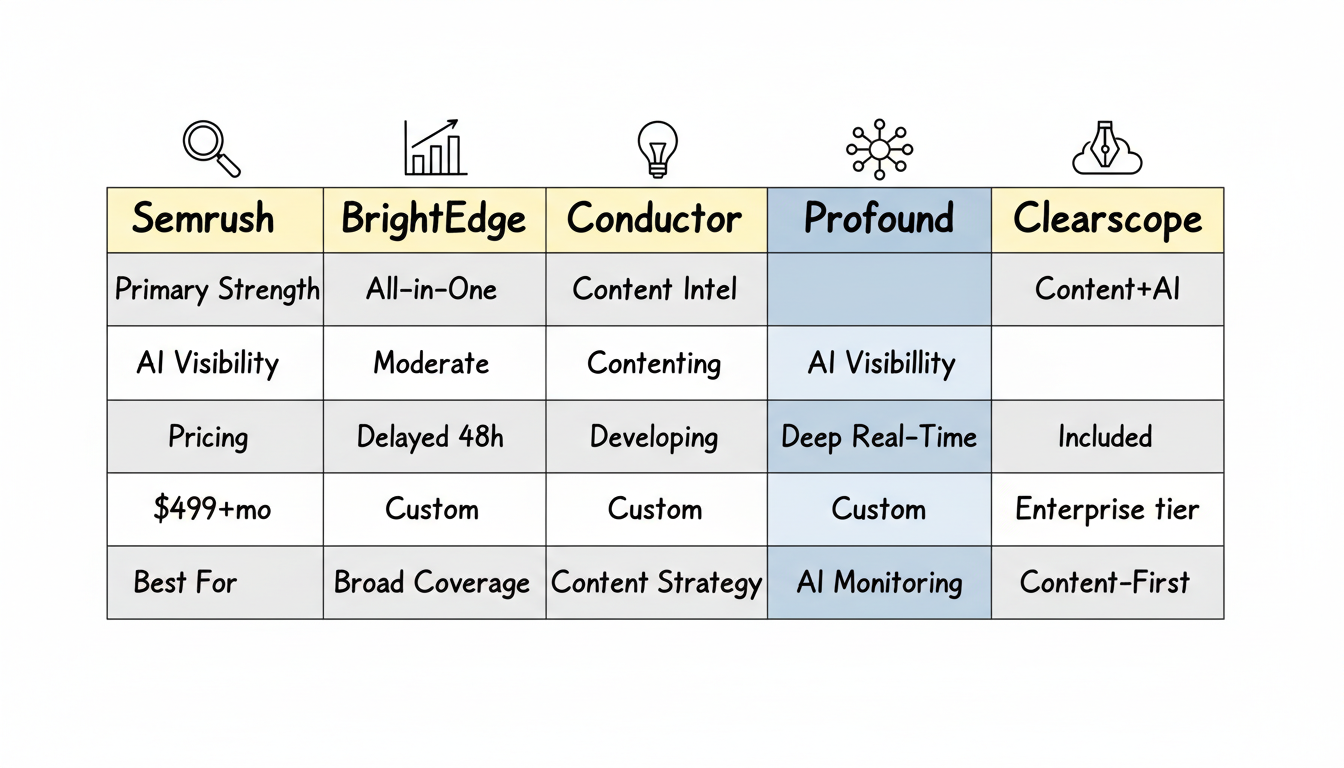
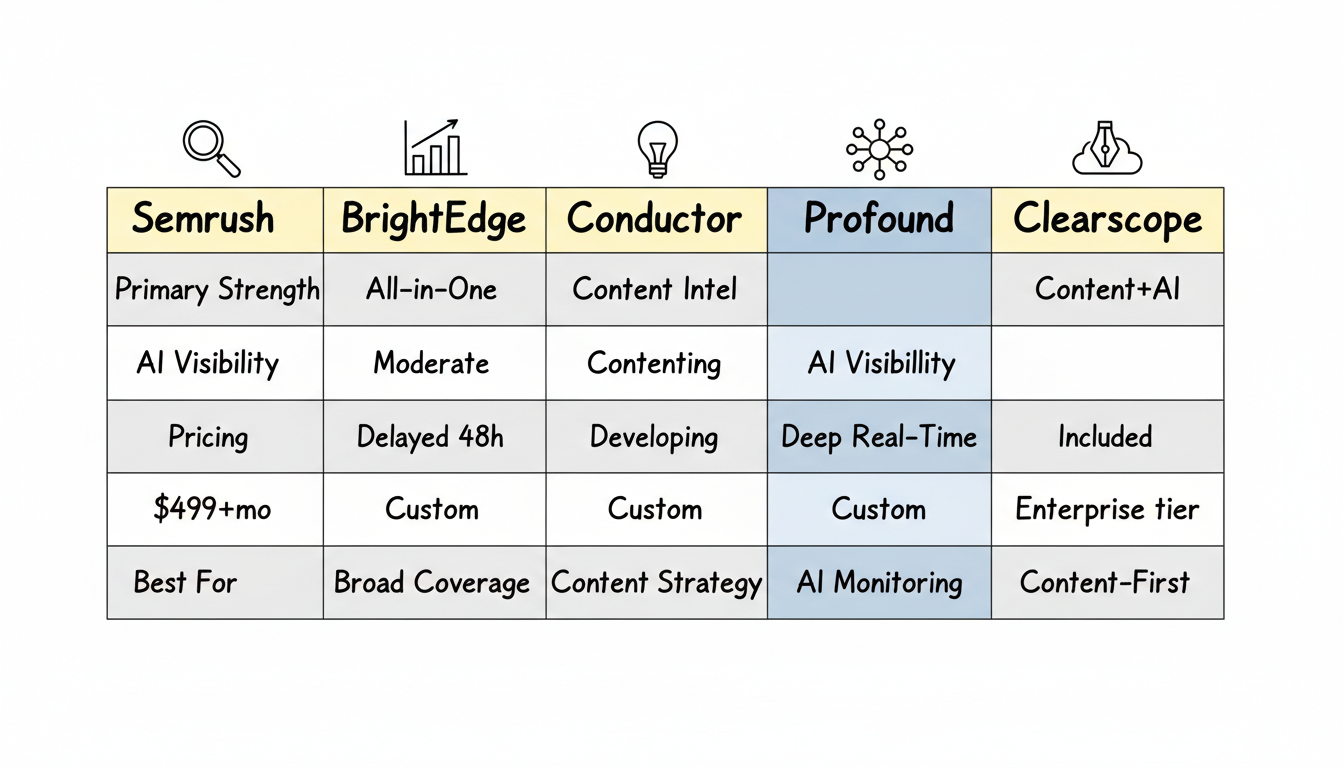
The enterprise AI SEO market has matured around several distinct positioning strategies.
Semrush Enterprise
Semrush has evolved from mid-market leader to credible enterprise option. The Enterprise tier ($499+/month) includes AI Copilot for automated insights, AI visibility tracking for Google AI Overviews, and expanded limits across all platform features.
Strengths: Comprehensive all-in-one coverage, strong content tools, established reputation.
Considerations: AI monitoring features are newer—purpose-built AI platforms go deeper. Add-ons increase total cost significantly.
BrightEdge
BrightEdge has long served enterprise SEO teams with data-driven recommendations and executive reporting. Recent updates include AI visibility tracking through BrightEdge Prism.
Strengths: Mature enterprise features, strong stakeholder reporting, established customer success programs.
Considerations: AI visibility data reportedly has 48-hour delays. Pricing requires custom quotes.
Conductor
Conductor positions itself as the enterprise organic marketing platform, emphasizing content intelligence alongside technical SEO capabilities.
Strengths: Strong content strategy features, established enterprise customer base, good stakeholder alignment tools.
Considerations: AI visibility features developing. Some users report interface complexity.
Profound
Profound emerged as a purpose-built AI SEO monitoring platform, now positioned as the enterprise leader for AI visibility. The platform tracks ChatGPT, Google AI Overviews, Perplexity, Copilot, and Gemini with real-time monitoring.
Strengths: Deepest AI visibility analytics, SOC 2 Type II compliance, dedicated AI Search Strategist support. Named G2 Winter 2026 AEO Leader.
Considerations: Focused on AI visibility—needs complementary tools for traditional SEO. Custom enterprise pricing.
Clearscope Enterprise
Clearscope upgraded from content optimization tool to discoverability platform, now tracking AI chatbot visibility alongside traditional search.
Strengths: Strong content intelligence, AI visibility tracking included in subscription, unlimited users.
Considerations: Less comprehensive than all-in-one platforms. Enterprise tier pricing.
Use this framework for vendor evaluation.
Map Current Pain Points
Document specific limitations you're experiencing with current tools. Quantify impact where possible—hours lost to workarounds, security gaps requiring manual compensating controls, missed opportunities from insufficient data.
Define AI Visibility Requirements
How important is tracking brand presence in AI-generated answers? If critical, evaluate purpose-built AI platforms like Profound alongside traditional enterprise SEO tools. If secondary, broader platforms with AI features may suffice. Comparing approaches like Perplexity vs ChatGPT for SEO helps clarify which AI platforms matter most to your audience.
Assess Integration Requirements
Document existing tools that require integration—CRM, business intelligence, content management, project management. Verify API capabilities and integration support before committing.
Validate Security Claims
Request SOC 2 reports. Verify SSO compatibility with your identity provider. Confirm data residency options if geographically constrained. Security gaps discovered post-purchase create painful remediation cycles.
Negotiate Thoughtfully
Enterprise pricing is negotiable. Annual commitments reduce monthly rates. Multi-year deals provide leverage. Pilot periods with success criteria protect both parties. Don't accept list pricing as final.
Many enterprise organizations combine platforms rather than seeking single-vendor coverage.
Traditional SEO + AI Visibility
Pair Semrush Enterprise or BrightEdge for comprehensive SEO capabilities with Profound for deep AI visibility tracking. This combination covers both traditional search optimization and emerging AI answer engine presence.
Content Intelligence + Technical SEO
Combine Clearscope or MarketMuse for content strategy with technical SEO platforms like Botify or Lumar for site health. Specialized tools often outperform all-in-one alternatives in their focus areas. When evaluating content tools, a Surfer SEO vs Clearscope comparison reveals key differentiators.
Platform Selection Matrix
Match platform strengths to your priorities:
Priority | Platform Type | Examples |
All-in-one coverage | Enterprise SEO suite | Semrush, BrightEdge |
AI visibility focus | Purpose-built AI SEO | Profound, Scrunch AI |
Content intelligence | Content optimization | Clearscope, MarketMuse |
Technical depth | Enterprise crawlers | Botify, Lumar |
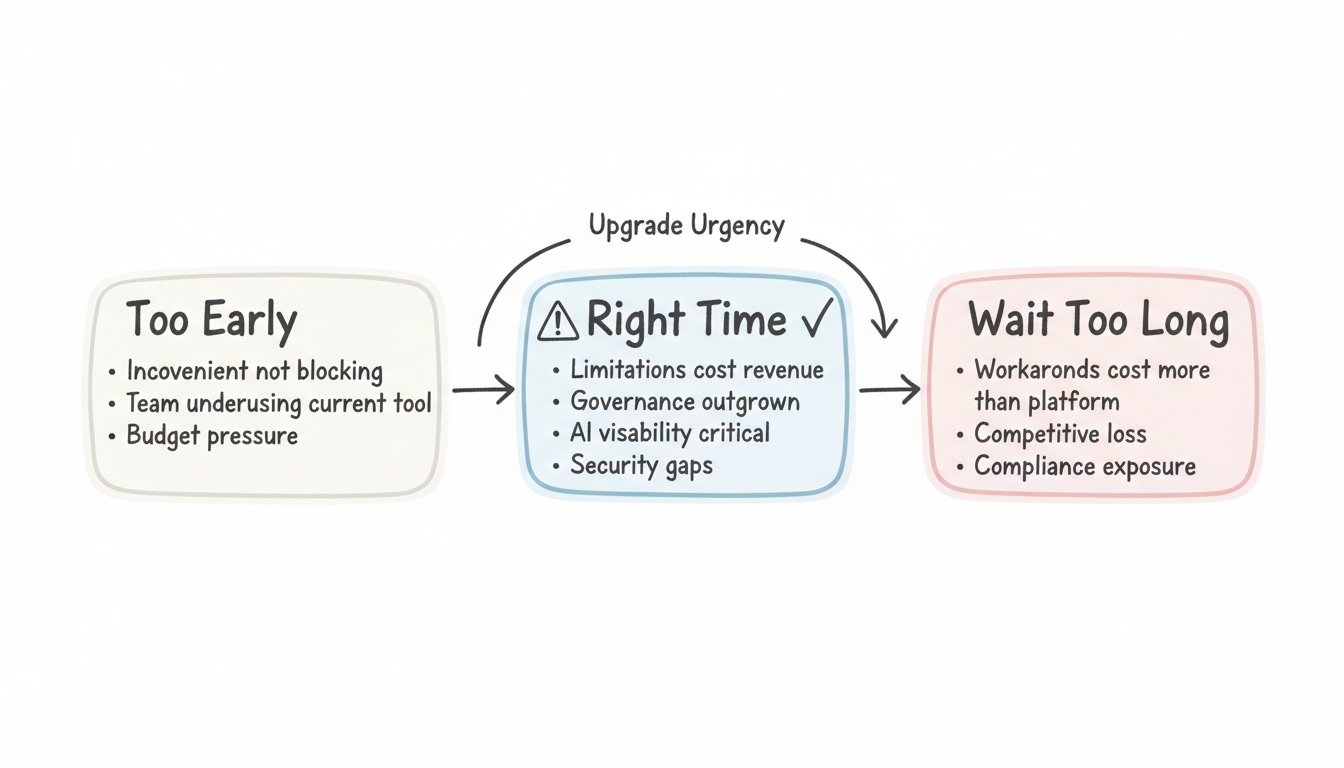
Rushing to enterprise platforms wastes budget. Waiting too long costs opportunity.
Upgrade Too Early When
Current tool limitations are inconvenient but not blocking. Team hasn't maximized existing platform capabilities. Budget constraints force trade-offs against other investments.
Upgrade At Right Time When
Specific limitations directly cost revenue or create unacceptable risk. Team has outgrown current platform's governance capabilities. AI visibility has become competitively critical. Security requirements mandate enterprise features.
Wait Too Long When
Workarounds consume more staff time than enterprise subscription would cost. Competitive positioning suffers from insufficient AI visibility. Security gaps create compliance exposure.
Enterprise upgrades require stakeholder buy-in. Build your case around:
Quantified Current Limitations
Calculate time spent on workarounds. Document security gaps and compliance risks. Show competitive visibility deficits.
Expected Capability Gains
Detail specific features addressing documented limitations. Project efficiency improvements. Outline competitive advantages from enhanced AI visibility.
Total Cost Analysis
Include full costs—base subscription, add-ons, implementation, training. Compare against current tool costs plus workaround expenses. Enterprise platforms often cost less than multiple mid-market subscriptions combined.
The enterprise AI SEO platform decision shapes how your organization competes for visibility across traditional and AI search. Choose based on actual needs, not aspirational capabilities you might someday use.
By submitting this form, you agree to our Privacy Policy and Terms & Conditions.



