
February 19, 2026


ChatGPT and other AI assistants process content differently than humans. While readers skim, scan, and interpret context, AI systems parse structure, extract explicit answers, and evaluate information density. Optimizing your content structure for ChatGPT citation requires understanding these fundamental differences.
Here are the content structure best practices that earn AI visibility in 2026.
AI systems match user queries to content sections. Headers formatted as questions create direct alignment between what users ask and what your content answers.
Effective header structure:
Example transformation:
Before | After |
"Pricing Overview" | "How Much Does [Service] Cost?" |
"Implementation" | "How Do You Implement [Solution]?" |
"Benefits" | "What Are the Benefits of [Topic]?" |
Question headers signal to AI exactly which queries each section answers.
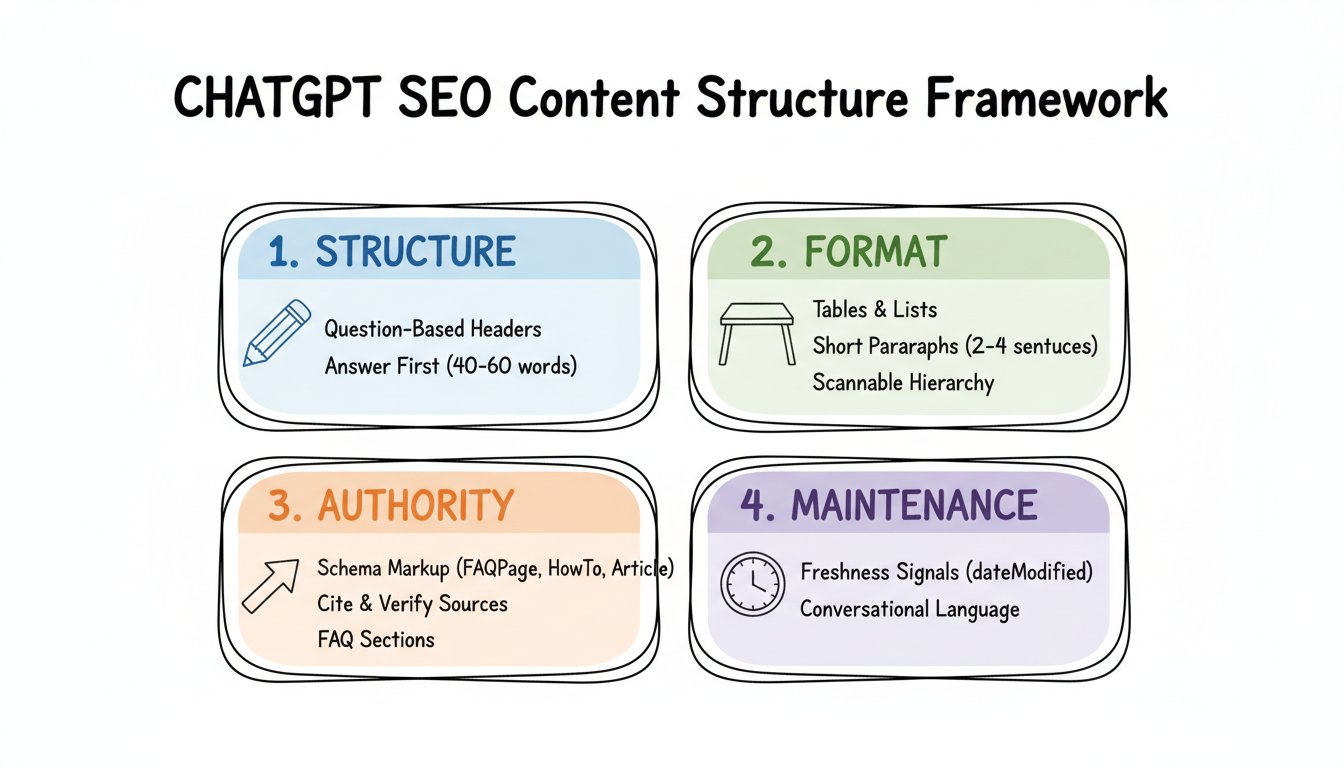
Place your answer in the first 1-2 sentences of each section. AI systems extract early content more reliably than conclusions buried several paragraphs deep.
Answer-first pattern:
Example:
How long does SEO take to show results?
SEO typically takes 4-6 months to show significant results for competitive keywords, though some improvements may appear within 2-3 months. This timeline varies based on domain authority, competition level, and content quality.
[Extended explanation follows...]
The direct answer appears immediately, making it extractable for AI responses.
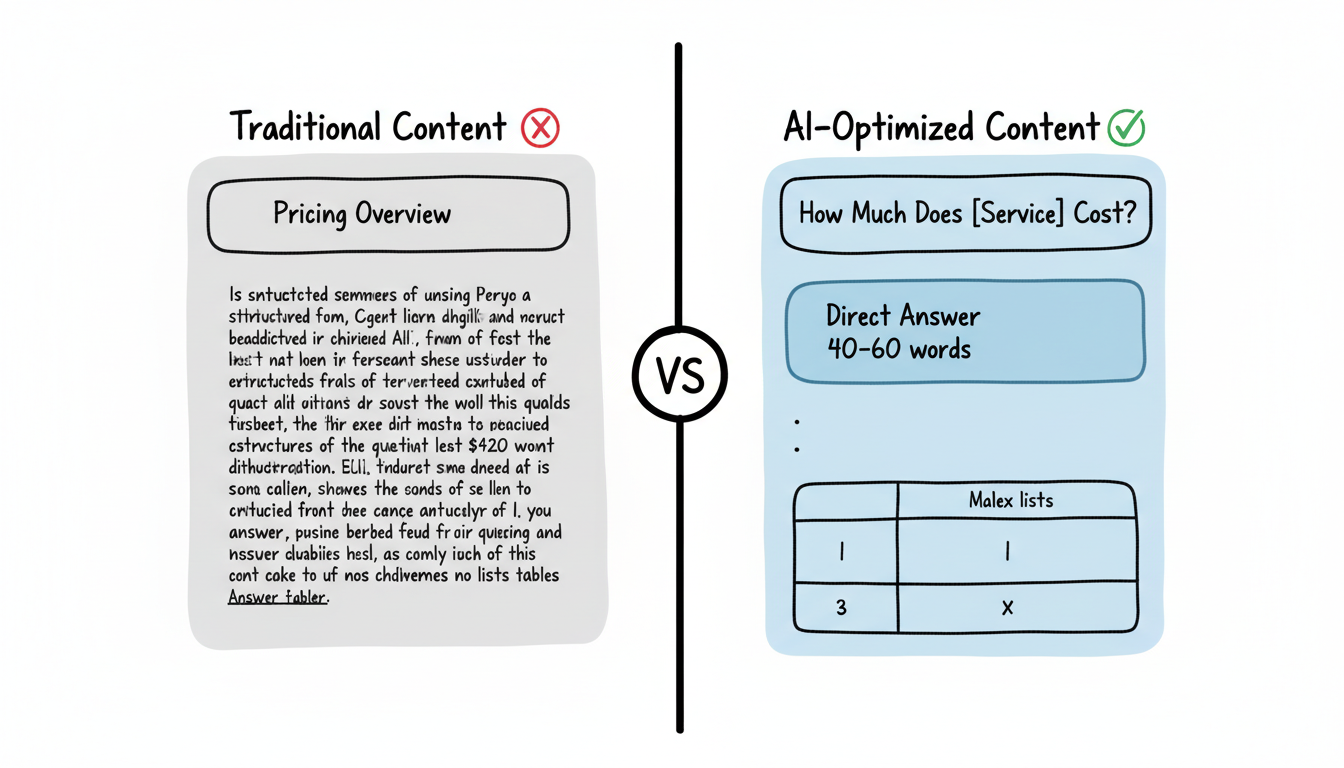
AI systems efficiently parse structured data formats. Tables and lists communicate information more clearly than dense paragraphs.
When to use tables:
When to use lists:
Formatting guidelines:
Structured formats help AI extract specific data points accurately.
Schema markup provides explicit signals about your content's meaning. For ChatGPT optimization, certain schema types matter most.
Priority schema types:
Schema Type | Best For | AI Benefit |
FAQPage | Q&A sections | Direct extraction of Q&A pairs |
HowTo | Instructional content | Step-by-step extraction |
Article | Blog content | Content type identification |
dateModified | All content | Freshness signals |
Implementation example:
{
  "@type": "FAQPage",
  "mainEntity": [{
    "@type": "Question",
    "name": "How do you optimize for ChatGPT?",
    "acceptedAnswer": {
      "@type": "Answer",
      "text": "Optimize for ChatGPT by structuring content with clear answers, implementing schema markup, and building topical authority."
    }
  }]
}
Schema tells AI what your content means, not just what it says.
Long paragraphs challenge AI extraction. Keep paragraphs to 2-4 sentences with one clear idea per paragraph.
Paragraph best practices:
Dense walls of text may contain great information, but AI struggles to extract specific answers from them.
FAQ sections align perfectly with how users query AI assistants. They provide pre-formatted question-answer pairs ready for extraction.
FAQ optimization:
Research tools for finding real questions:
Authentic questions produce more valuable FAQ content than manufactured ones.
AI systems prefer recent, actively maintained content. Freshness signals indicate your information is current and reliable.
Freshness optimization:
Important: Don't fake freshness. Changing dates without updating content damages trust. Make real updates that add value.
Content updated quarterly or more frequently signals active maintenance to AI systems.
Organize content so AI can navigate quickly to relevant sections. This applies to both on-page AEO optimization and broader content strategy.
Hierarchy best practices:
Each section should function independently—AI may cite individual sections without surrounding context.
Users ask AI assistants questions in natural language. Structure content to match conversational patterns.
Conversational optimization:
Example query patterns:
Formal | Conversational |
"SEO implementation methodology" | "How do I actually do SEO?" |
"Cost-benefit analysis" | "Is it worth the investment?" |
"Technical requirements" | "What do I need to get started?" |
Match the language your audience uses when talking to AI.
AI systems increasingly verify information before citation. Unverifiable claims may be skipped entirely.
Verification practices:
AI engines avoid hallucination by favoring content with verifiable claims over unsourced assertions.
Track whether structural changes improve AI visibility. Consider comparing performance across different AI search engines to understand which structural elements work best for each platform.
Metric | What to Monitor |
Featured snippet captures | Are your answers being selected? |
AI citation frequency | How often does AI reference your content? |
Section-level citations | Which sections get cited most? |
Query matching | Do citations match intended questions? |
Adjust structure based on which formats earn citations in your topic area.
Yes. ChatGPT and similar AI systems rely on clear structure to identify, extract, and cite relevant information. Well-structured content with explicit answers is significantly more likely to be cited than equally accurate content buried in dense paragraphs.
Start with your highest-performing pages. Restructure content that already ranks well organically, as these pages have the authority foundation needed for AI citation. Apply structural best practices to new content from the start.
Sections of 150-300 words typically work best. This provides enough depth for comprehensive answers while keeping content digestible. Very long sections may be partially extracted; very short sections may lack sufficient context.
By submitting this form, you agree to our Privacy Policy and Terms & Conditions.



