February 19, 2026


Answer Engine Optimization didn't emerge overnight. It evolved from decades of search engine optimization as AI platforms fundamentally changed how users discover information. Understanding this history reveals why traditional SEO alone no longer captures the full visibility picture—and why AEO has become essential for modern digital marketing.
For nearly three decades, search optimization meant one thing: ranking higher in Google results.
The original model:
This model remained largely unchanged from Google's 1998 launch through 2020. Tactics evolved—keyword stuffing gave way to content quality, link farms to authoritative backlinks, desktop to mobile-first—but the fundamental goal stayed constant: rank higher, get more clicks.
The closest predecessor to AEO was featured snippet optimization, which emerged around 2014. Marketers learned that formatting content as direct answers could win the "position zero" box above organic results. This was the first hint that search was shifting from discovery to delivery.
Everything changed in November 2022 when OpenAI launched ChatGPT. Within two months, it reached 100 million users—the fastest-growing consumer application in history. By late 2025, ChatGPT processed over 200 million queries daily with roughly 800 million monthly active users.
Key AI search platform launches:
Platform | Launch Date | Significance |
ChatGPT | November 2022 | Introduced conversational AI to mainstream |
Perplexity AI | 2022 (founded), mainstream 2023 | Citation-focused answer engine |
Google Bard (later Gemini) | March 2023 | Google's conversational AI response |
Google AI Overviews | May 2024 (public) | AI summaries in Google search results |
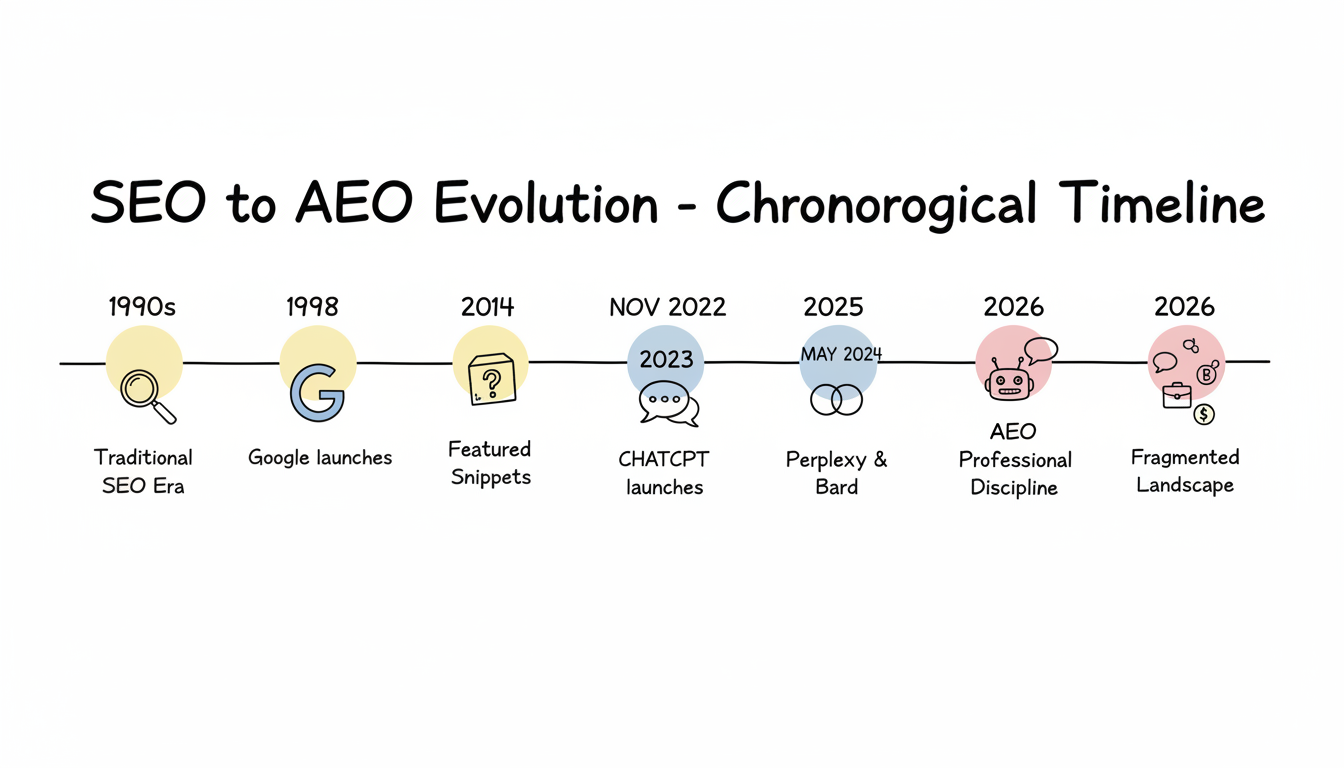
Google's AI Overviews represented a watershed moment. When Google—the dominant search engine—started displaying AI-generated summaries directly in search results, the implications for traditional SEO became impossible to ignore.
By May 2025, the percentage of news searches ending without any website clicks increased from 56% to nearly 69% since AI Overviews launched. Users got answers without visiting sites.
The term "Answer Engine Optimization" gained traction as marketers recognized that traditional SEO metrics missed critical visibility.
Princeton University and Georgia Tech researchers formalized the concept of Generative Engine Optimization (GEO) in academic research, finding that GEO methods can boost visibility in AI responses by up to 40%. The terms GEO vs SEO vs AEO began appearing in industry discourse, often used interchangeably.
The distinction from traditional SEO became clear:

By 2025, over 45% of searches ended in "zero-click" results where users received answers directly in AI summaries without visiting any website. Ranking on page one was no longer enough—you had to be chosen by AI.
As AI search matured, AEO evolved from experimental tactic to professional discipline.
Industry developments in 2025-2026:
Research showed that enterprises dedicated approximately 12% of digital marketing budgets to GEO/AEO in 2025, with 94% planning to increase spending in 2026.
The shift wasn't just tactical—it was conceptual. Marketers moved from asking "How do we rank higher?" to "How do we become the answer?"
Today, AEO operates alongside traditional SEO as a complementary discipline. Neither has replaced the other; they serve different functions in a fragmented search landscape.
Search behavior in 2026:
The fragmentation creates both challenge and opportunity. Single-platform strategies no longer work, but competitors who haven't adapted leave market share available.
Despite the AI revolution, core principles remain constant:
Authority still matters: AI systems evaluate the same trust signals—domain reputation, expert credentials, consistent information across sources. Building authority benefits both SEO and AEO.
Quality content wins: Whether for rankings or citations, substantive, accurate, well-structured content outperforms thin alternatives. The specifics differ (answer-first formatting for AEO), but quality remains foundational.
User intent drives strategy: Understanding what users want—and how they phrase questions—guides both SEO keyword research and AEO prompt optimization. For instance, understanding what is an answer engine helps inform content strategy for both traditional search and AI platforms.
The fundamentals of "mature SEO"—semantic relevance, contextual depth, structured content, helpfulness—didn't arrive with AI. They've been core principles since search moved beyond exact-match keywords.
AEO continues evolving rapidly. Key developments shaping the near future:
AI agent integration: As AI systems move from answering questions to taking actions (shopping, booking, researching), visibility within agent workflows becomes critical.
Advertising within AI: ChatGPT advertising launches in Q1 2026, and Google has expanded AI Overview ads globally. Commercial dimensions of AI search are just beginning, creating new opportunities for B2B AEO marketing strategies.
Platform-specific optimization: As ChatGPT, Perplexity, Gemini, and others differentiate, platform-specific AEO tactics will become more important. Learning how to rank on ChatGPT requires different approaches than optimizing for Google AI Overviews.
The trajectory is clear: AI search isn't replacing traditional search, but it's capturing an expanding share of how users discover information. Brands that optimize for both SEO and AEO will dominate visibility in this fragmented landscape.
AEO emerged as a distinct discipline in 2024-2025, driven by ChatGPT's mainstream adoption (2022-2023), Perplexity's growth, and Google AI Overviews launching in May 2024. By 2025, over 45% of searches ended in zero-click results, making AEO essential for comprehensive visibility.
No. AEO extends SEO rather than replacing it. Traditional search still drives the majority of web traffic, and strong SEO foundations support AEO success. The most effective 2026 strategy integrates both disciplines, as outlined in our guide on SEO vs AEO key differences.
The terms are often used interchangeably. AEO (Answer Engine Optimization) emphasizes getting cited as answers. GEO (Generative Engine Optimization) emphasizes visibility within AI-generated content. Both describe optimizing for AI search platforms.
By submitting this form, you agree to our Privacy Policy and Terms & Conditions.