
February 19, 2026


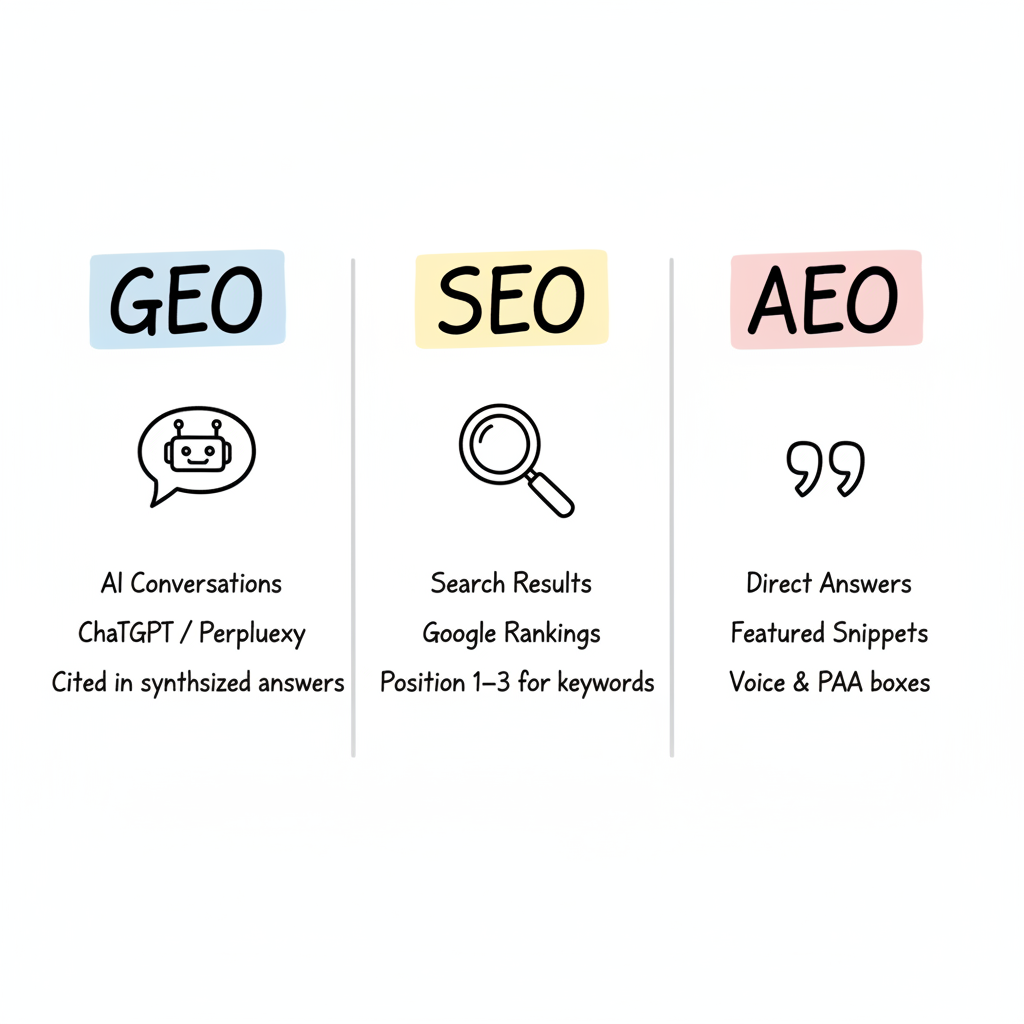
GEO positions your business inside AI answers. SEO ranks your pages in search results. AEO makes you the quoted source. Each optimization strategy serves a different discovery mechanism—and choosing between them misses the point entirely.
The real question isn't which matters most. It's how to sequence and integrate all three so your brand captures visibility wherever your audience searches.
Each strategy targets a fundamentally different way people find information.
Generative Engine Optimization focuses on getting your brand cited when AI systems construct responses. When someone asks ChatGPT for recommendations or Perplexity synthesizes research, GEO determines whether your content gets included.
How GEO works:
AI platforms don't return lists of links. They generate answers by evaluating multiple sources and deciding which to cite. Your content either appears in that synthesized response or doesn't exist in the user's awareness.
GEO success looks like:
"According to [Your Brand], the best approach is..." appearing in ChatGPT responses. Your statistics quoted in Perplexity answers. Your brand mentioned in Google AI Overviews as an authoritative source.
Search Engine Optimization focuses on appearing prominently when users browse traditional search results. When someone scans Google's page one, SEO determines whether they see your listing.
How SEO works:
Search engines evaluate content relevance, authority signals, and technical factors to rank pages. Higher positions capture more clicks from users actively browsing results.
SEO success looks like:
Position one to three for target keywords. Growing organic traffic from search engines. Domain authority that compounds over time.
Answer Engine Optimization focuses on being selected as THE answer when users ask specific questions. When Google shows a featured snippet or a voice assistant responds, AEO determines whether that answer comes from you.
How AEO works:
AI systems identify the most quotable, authoritative response to specific questions. They extract that answer and display it directly—often without requiring users to visit the source.
AEO success looks like:
Your content appearing in position zero featured snippets. Voice assistants quoting your answers. Your explanation displayed directly in People Also Ask boxes.
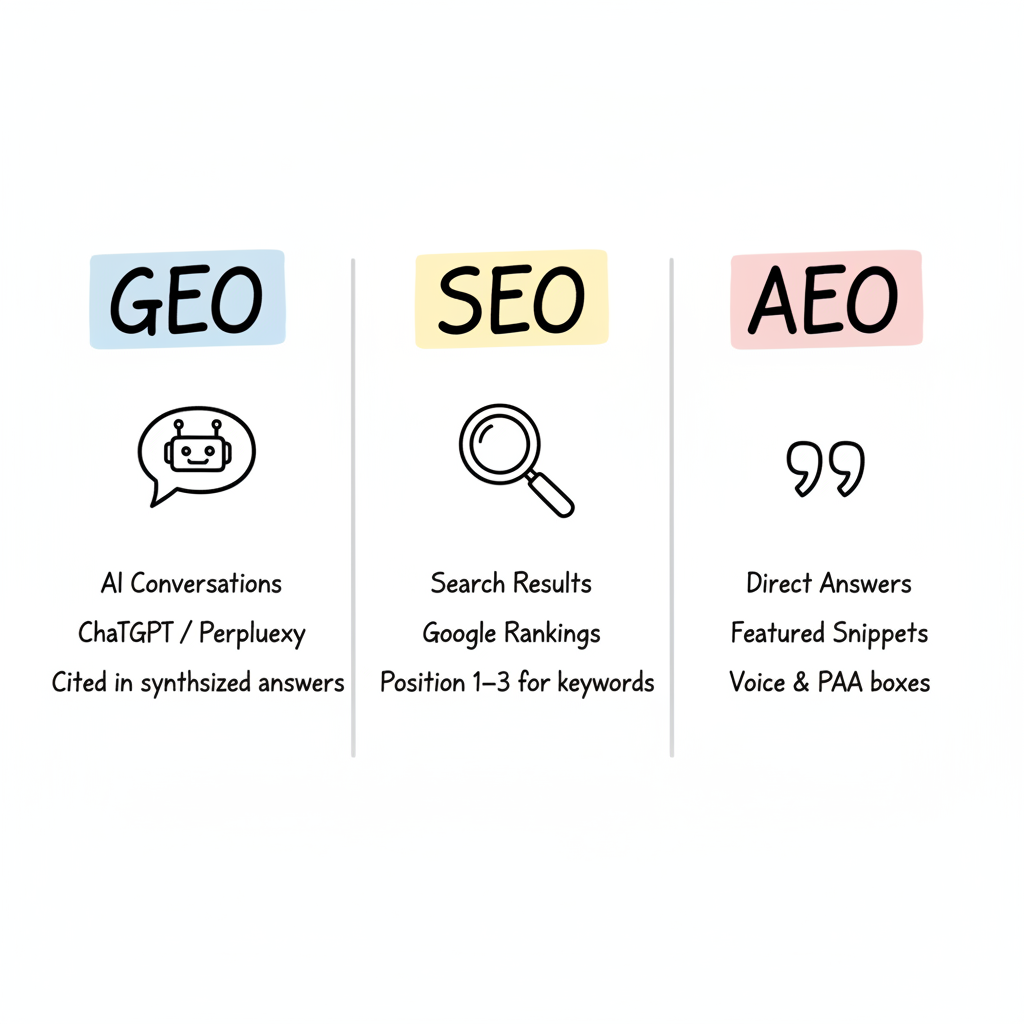
Treating GEO, SEO, and AEO as competing alternatives creates strategic gaps.
When SEO, AEO, and GEO align:
Your brand stays visible across search engines, answer engines, and AI systems shaping how decisions get made. Users encounter your content regardless of which discovery mechanism they use.
When strategies operate in isolation:
Without AEO and GEO layered on top, SEO limits you to rankings and clicks while missing visibility inside AI summaries and direct-answer experiences. Strong SEO without GEO means users researching in ChatGPT never see your brand.
The foundation relationship:
Strong SEO creates the foundation for effective GEO and AEO. Content that ranks well in traditional search has higher probability of AI citation. Technical excellence and authority signals support all three approaches.
Use this framework to allocate resources across GEO, SEO, and AEO.
Before strategizing, understand your starting position across all three channels.
SEO audit:
Track keyword rankings for priority terms. Measure organic traffic trends. Assess domain authority relative to competitors.
AEO audit:
Identify featured snippets you own or could capture. Check People Also Ask visibility. Test voice search results for relevant queries. Consider using an AEO checker to systematically evaluate your answer optimization performance.
GEO audit:
Query ChatGPT, Perplexity, and Google AI Overviews with questions your buyers ask. Document who gets cited. Note whether competitors appear where you don't.
Different audiences use different discovery mechanisms. Your strategy should match where your specific buyers search.
Traditional search dominant:
If your audience primarily uses Google's organic results, prioritize SEO with AEO enhancements for question-based queries. Add GEO for future-proofing.
AI research dominant:
If your audience researches through ChatGPT or Perplexity before traditional search, prioritize GEO alongside SEO fundamentals. These users form opinions in AI before seeing search results.
Answer-seeking behavior:
If your audience asks specific questions expecting direct answers, prioritize AEO. Featured snippets and voice results capture users who want immediate responses without browsing.
Understand where competitors have advantages and where gaps exist.
SEO competitive analysis:
Who ranks for your target keywords? What would it take to outrank them? Are there underserved keywords with opportunity?
GEO competitive analysis:
Who gets cited when AI answers questions in your space? What makes their content citation-worthy? Where is AI visibility unconsolidated?
AEO competitive analysis:
Who owns featured snippets for your target queries? How strong is their answer-first formatting? Can you provide better responses?
With limited resources, sequence investments based on current position and opportunity.
Scenario A: Strong SEO foundation, weak AI visibility
You rank well traditionally but don't appear in AI responses. Priority: Add GEO optimization to existing content. Restructure for answer-first formatting. Build entity consistency for AI recognition.
Scenario B: Weak SEO foundation, growing market
You're building from scratch in a market where AI adoption is accelerating. Priority: Build SEO fundamentals while incorporating GEO principles from the start. Content structured for both channels.
Scenario C: Competitive SEO, question-heavy queries
You compete in a space where users ask specific questions with definitive answers. Priority: AEO captures immediate wins through featured snippets while building longer-term SEO and GEO authority.
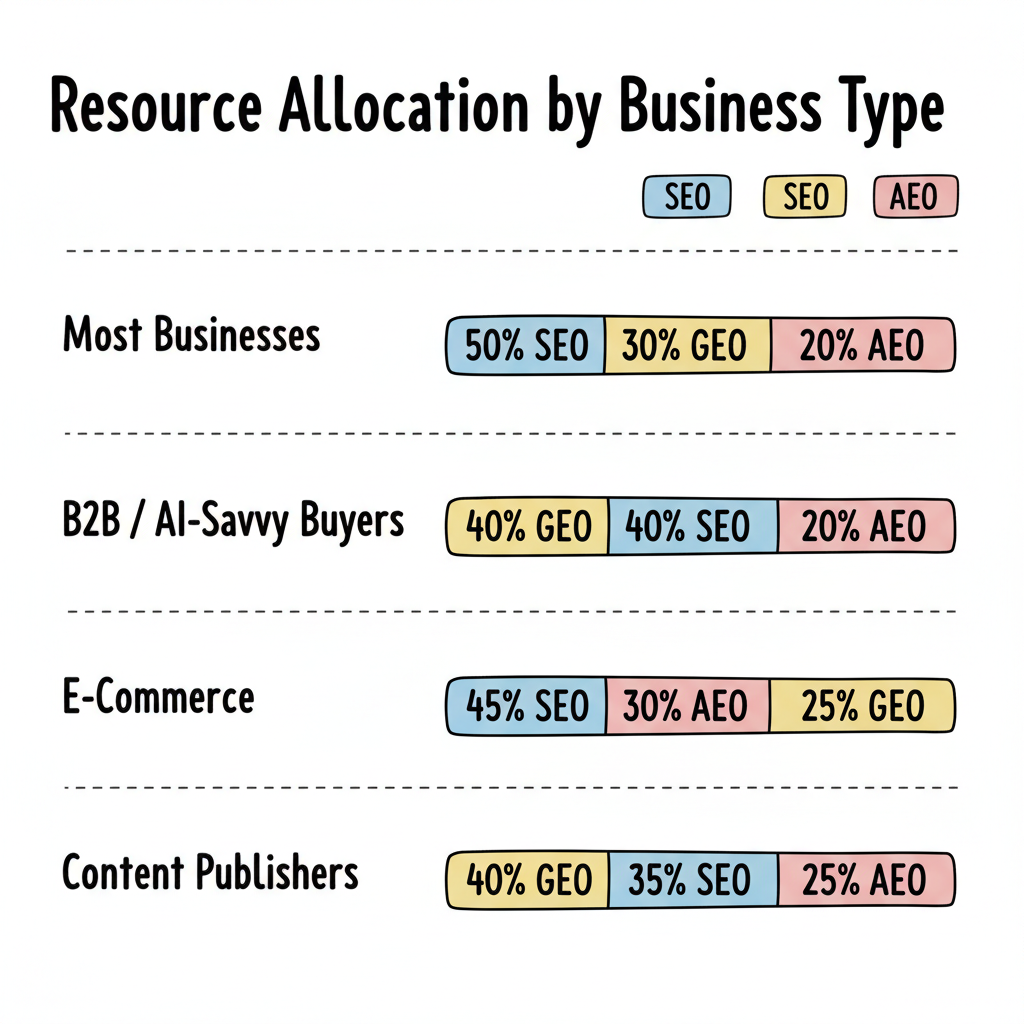
AI visibility and traditional rankings correlate. Pages ranking well organically have higher citation probability. Abandoning SEO weakens your GEO foundation.
Some queries favor SEO (browsing behavior), others favor AEO (specific questions), others favor GEO (research synthesis). Match your optimization to query type.
Search behavior continues shifting. Static strategies decay. Build measurement systems that track all three channels and adapt allocation as the landscape evolves.
Track metrics across all three strategies:
SEO metrics: Keyword rankings, organic traffic, domain authority AEO metrics: Featured snippet ownership, PAA visibility, voice search appearance GEO metrics: Citation frequency in AI responses, brand mention accuracy, AI platform referral traffic
Combined dashboards show complete visibility. Optimize based on where you're gaining or losing relative to competitors across the full discovery landscape.
By submitting this form, you agree to our Privacy Policy and Terms & Conditions.



