
February 19, 2026



Last Updated: January 2026
Checking your AEO performance is essential for understanding how well your content appears in AI-generated answers. Unlike traditional SEO where ranking positions are clearly visible, AEO success requires systematic checking across multiple AI platforms. This guide explains how to audit your answer engine optimization effectively.
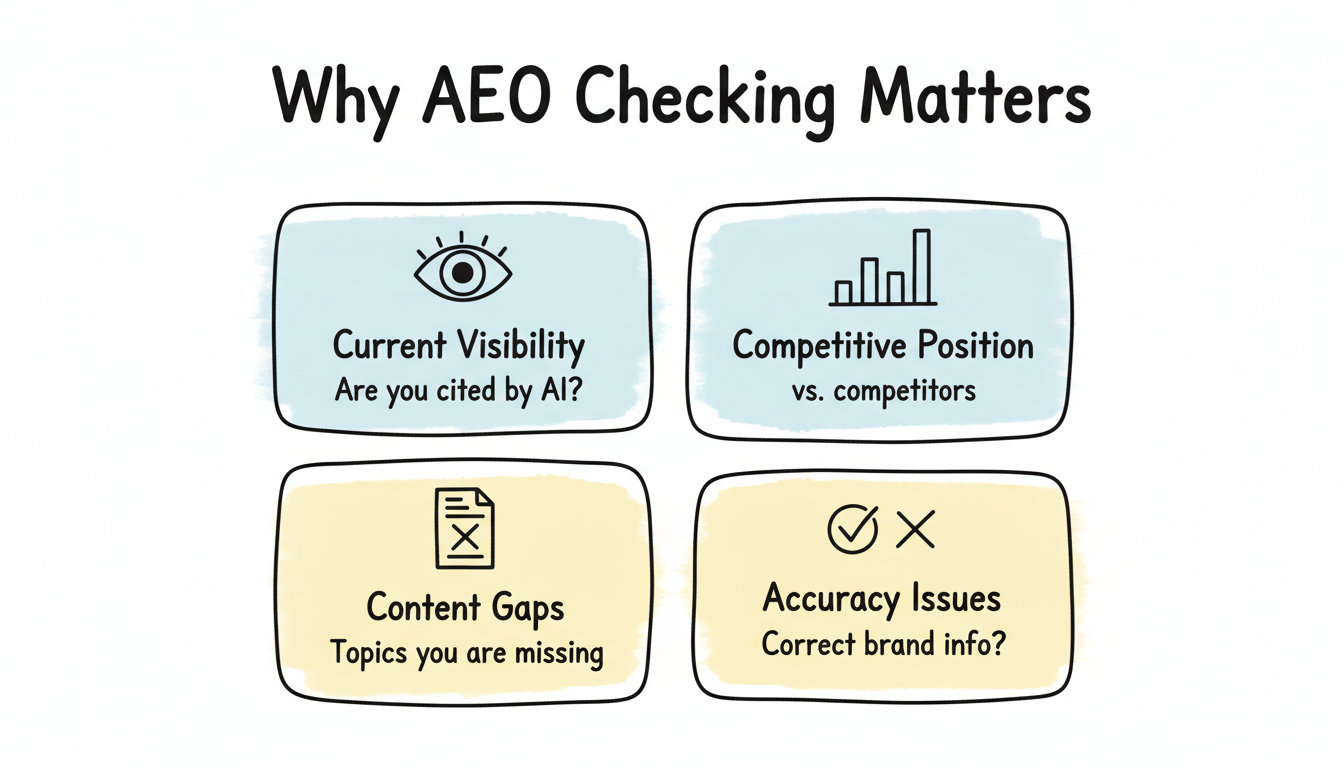
You cannot improve what you don't measure. AEO checking reveals:
Without systematic checking, AEO efforts proceed blindly.
Manual checks provide direct insight into how AI platforms treat your content.
Test your visibility in ChatGPT:
Systematic manual testing across 20-50 queries provides baseline visibility understanding. This foundational work complements broader ChatGPT optimization strategies.
Perplexity shows sources explicitly, making checking straightforward:
Perplexity's transparent citation system makes manual checking efficient.
Check visibility in Google's AI-generated summaries:
AI Overviews appear selectively, so not all queries trigger them.
Featured snippets often feed voice assistants and influence AI citations:
Featured snippet visibility often correlates with broader AEO success.
Manual checking doesn't scale. Automated tools monitor visibility continuously.
Several platforms specialize in AEO checking:
SE Visible provides straightforward LLM visibility tracking. The platform monitors your presence across major AI chatbots, tracking citation frequency over time. Historical trending helps identify whether optimization efforts improve visibility.
Otterly.AI focuses on practical citation monitoring with alert systems. Get notified when visibility changes significantly—either improvements from optimization or declines requiring attention.
Scrunch AI offers prompt-level monitoring showing exactly which queries cite your content. Topic clustering reveals patterns in how AI systems engage with different content areas. Organizations working with a generative engine optimization agency often integrate these monitoring capabilities into broader programs.
Larger organizations benefit from comprehensive solutions:
Ahrefs Brand Radar combines AI visibility monitoring with traditional SEO data. For teams already using Ahrefs, integrated reporting simplifies unified measurement.
Conductor provides enterprise-grade AEO monitoring connected to content workflows. Citation data informs content prioritization and optimization decisions.
Profound specializes in detailed citation analysis including sentiment—understanding not just whether AI cites you, but how it portrays your brand.
Choose AEO checker tools based on:
Comprehensive AEO audits examine multiple dimensions.
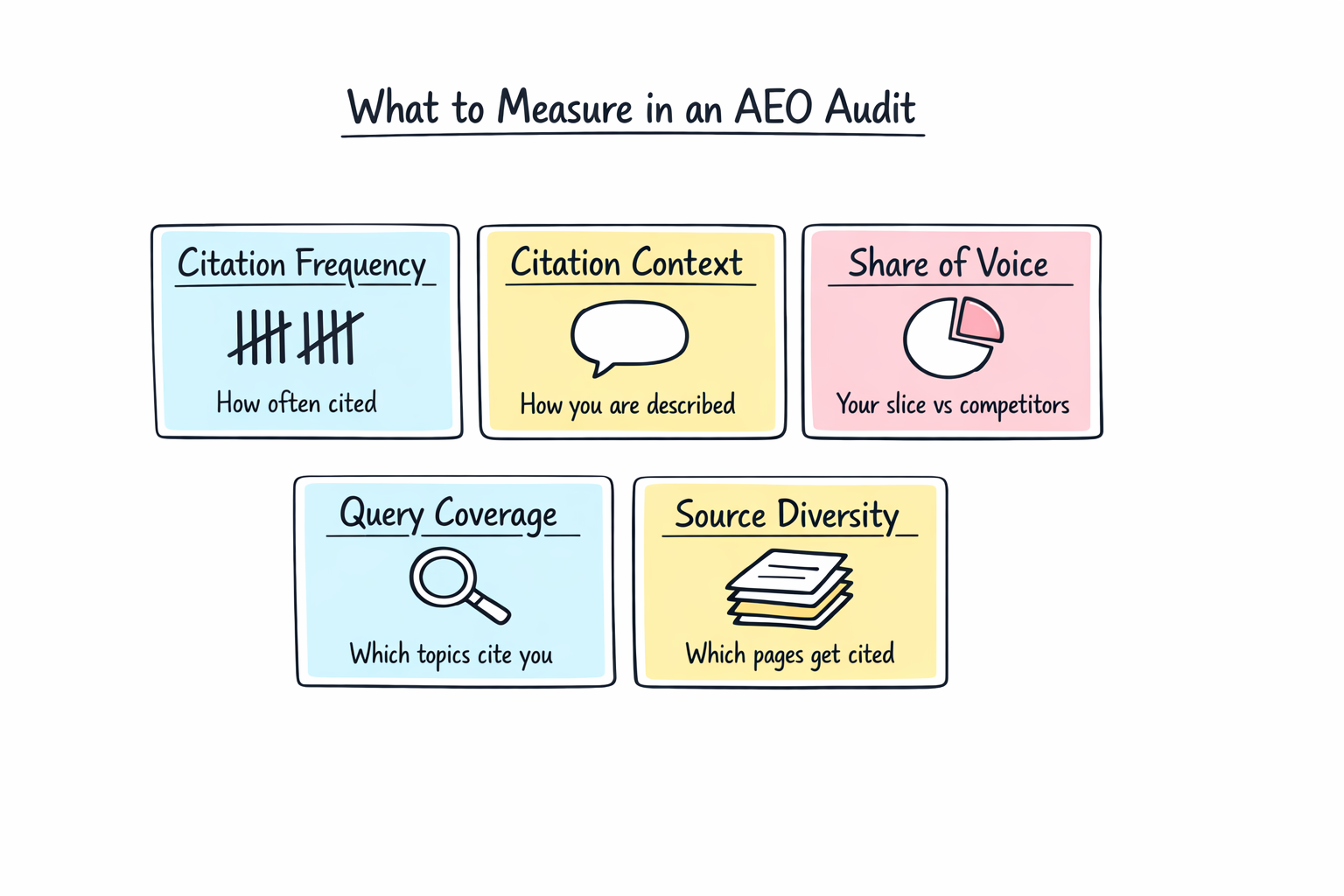
What to measure: How often AI platforms cite your content for target queries
What it indicates: Overall visibility and authority recognition
Benchmark: Track changes over time rather than absolute numbers
What to measure: How AI platforms describe you when citing
What it indicates: Brand accuracy and positioning
Red flags: Incorrect information, outdated details, competitor confusion
What to measure: Your citation frequency relative to competitors
What it indicates: Competitive positioning in AI answers
Goal: Increase share for high-priority topics
What to measure: Which target queries cite you versus which don't
What it indicates: Content and authority gaps
Action: Create or optimize content for uncovered queries
What to measure: Which specific pages get cited most frequently
What it indicates: Content concentration and opportunity
Insight: Diversify citations beyond a few dominant pages
Systematic audits follow consistent processes, much like the structured approach in an AEO marketing strategy framework.
Understanding what results mean guides action.
If citation frequency is low:
If AI misrepresents your brand:
If competitors get cited for queries you should own:
Regular checking is essential. AEO visibility isn't visible without active monitoring. Build systematic checking into your optimization workflow.
Combine manual and automated methods. Manual checks provide detailed insight; automated tools enable scale and trending.
Check multiple dimensions. Citation frequency matters, but so do context, accuracy, and competitive position.
Act on findings. Checking without response wastes effort. Build action plans from audit insights.
Run comprehensive audits quarterly. Monitor key metrics through automated tools continuously. Manual spot-checks of priority queries should happen monthly. Adjust frequency based on how actively you're optimizing—more active programs warrant more frequent checking.
The best tool depends on your needs. For basic monitoring, SE Visible or Otterly.AI provide accessible starting points. For enterprise needs with existing Ahrefs investment, Brand Radar integrates well. Most teams benefit from starting simple and adding capabilities as programs mature.
Yes. Manual checking across ChatGPT, Perplexity, and Google AI Overviews provides meaningful insight without tool investment. This approach doesn't scale but works for initial assessment and small-scale programs. Add automated tools when you need historical trending or competitive comparison.
By submitting this form, you agree to our Privacy Policy and Terms & Conditions.



