February 19, 2026


Featured snippets haven't disappeared in the AI search era—they've evolved. While AI Overviews now handle many informational queries, list-based featured snippets remain valuable for factual, high-intent queries where structured answers serve users best. In 2026, winning the answer box requires understanding how list formats interact with both traditional snippets and AI-generated results.
This guide covers how to optimize list-based content for featured snippets and AI Overviews, including format selection, structure best practices, and measurement strategies.
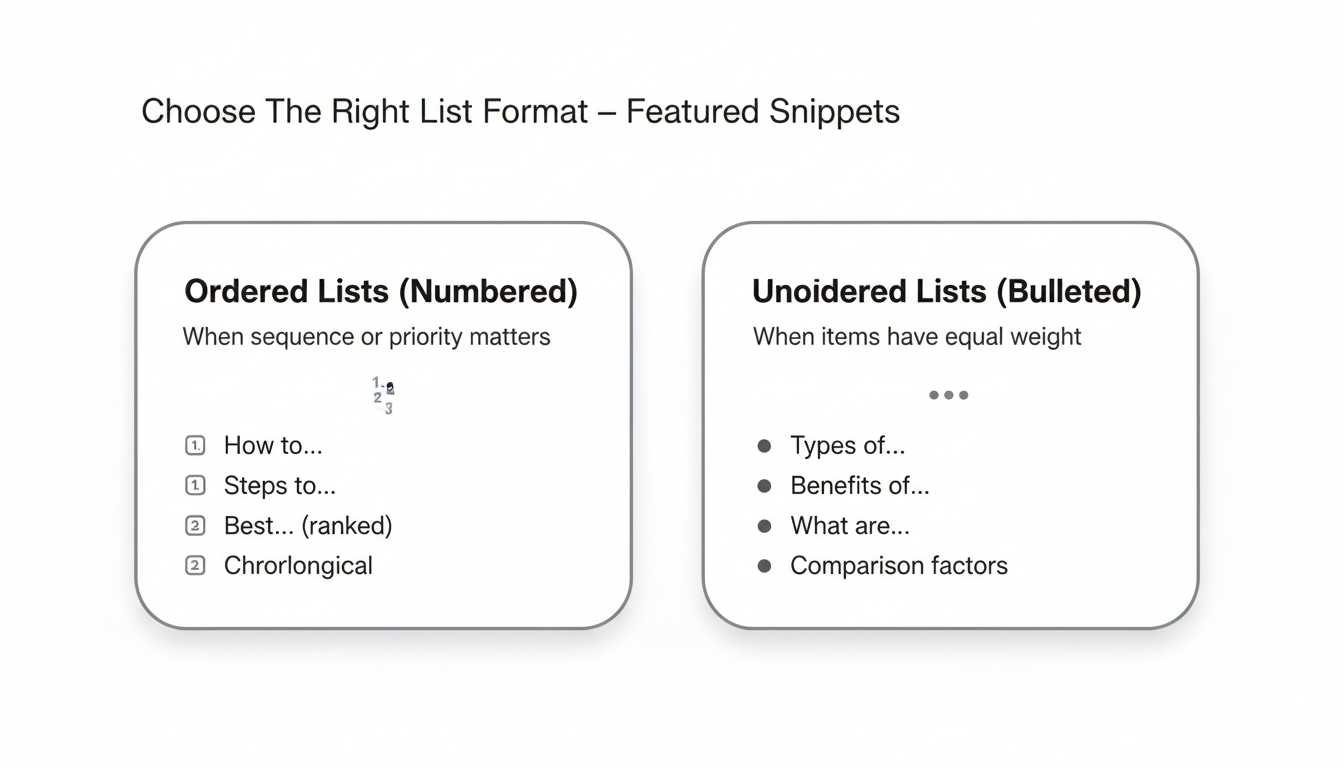
Google displays two primary list formats in featured snippets, each suited for different content types.
Ordered list snippets appear when the sequence matters:
Google extracts numbered lists from content when it detects sequential importance. The format signals that order carries meaning—step 1 must come before step 2.
Unordered list snippets work when items have equal weight:
Bulleted lists communicate that all items matter equally. Users can process them in any order without losing context.
Query Type | Best Format | Example |
"How to..." | Ordered list | How to optimize for featured snippets |
"Steps to..." | Ordered list | Steps to implement schema markup |
"Best..." (ranked) | Ordered list | Best AI SEO tools 2026 |
"Types of..." | Unordered list | Types of AI search engines |
"Benefits of..." | Unordered list | Benefits of structured data |
"What are..." | Unordered list | What are E-E-A-T signals |
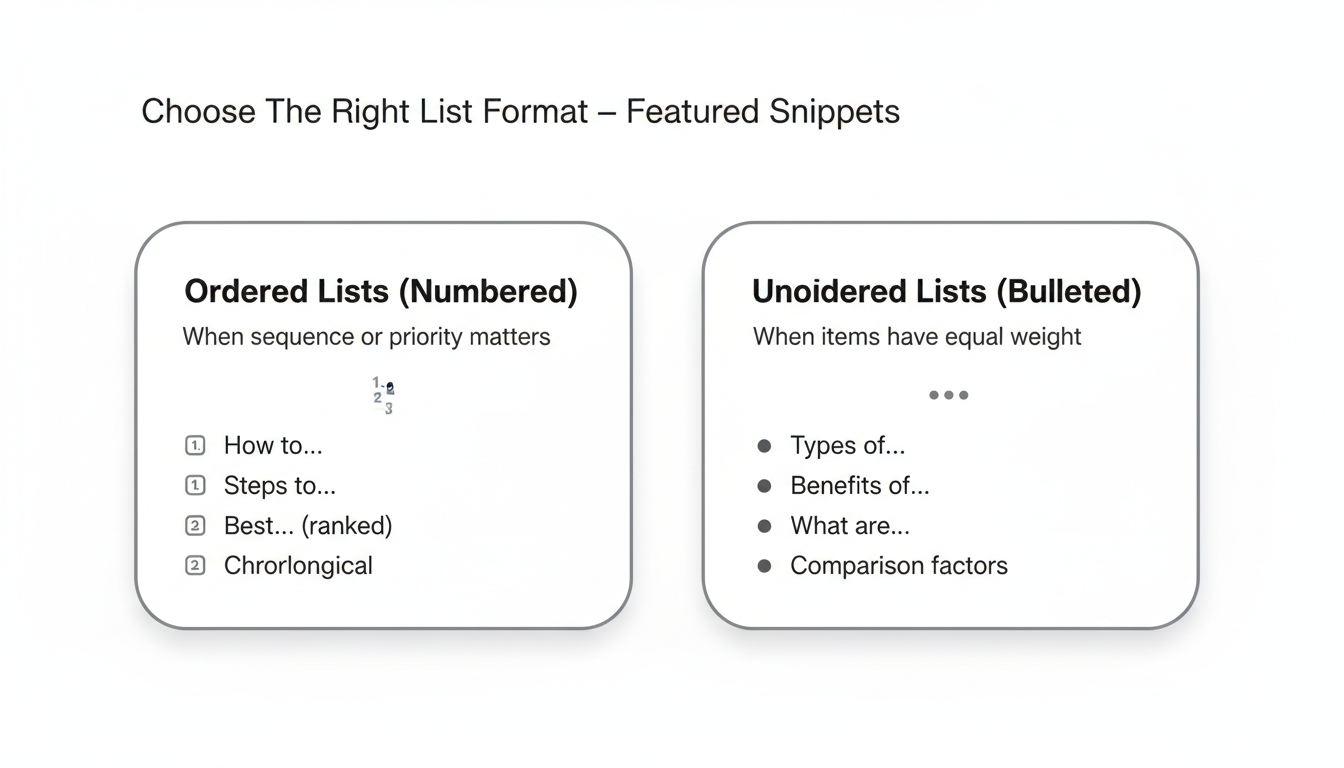
Match your format to query intent. Mismatched formats reduce extraction likelihood.
Specific tactics increase your chances of winning list-based featured snippets.
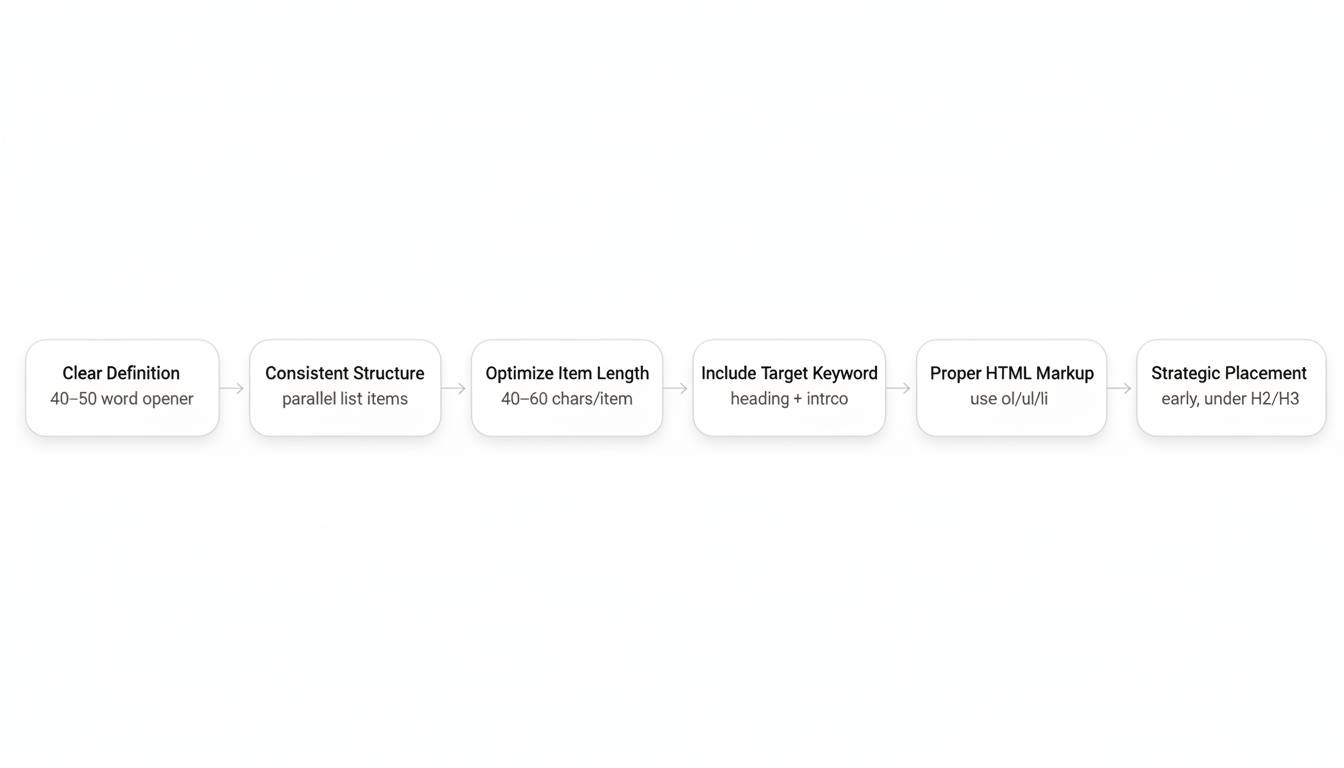
Google assigns an internal "answerability score" to your page. Open with a direct definition that can stand alone:
Good example: "Featured snippets are brief excerpts of content that appear at the top of Google search results, designed to quickly answer user queries."
Poor example: "In this article, we'll explore everything you need to know about featured snippets and why they matter for your SEO strategy."
The first sentence should define the topic without filler. Aim for 40-50 words that work if extracted independently.
Each list item should follow the same grammatical pattern:
Consistent (good):
Inconsistent (poor):
Parallel structure helps Google understand list relationships and improves extraction accuracy. Understanding Google AI overview ranking factors can further improve your content's chances of appearing in both traditional snippets and AI-generated results.
Keep individual list items between 40-60 characters when possible. Google typically displays 4-8 list items in snippets—longer items get truncated.
For complex topics, use the list as a summary with detailed explanations below each item. Google extracts the list; users click through for depth.
Place your target keyword in:
This signals relevance for the specific query you're targeting.
How you structure list content affects both extraction likelihood and AI Overview inclusion.
Use semantic HTML for lists:
<ol> for ordered lists
<ul> for unordered lists
<li> for individual items
Avoid fake lists created with manual numbers or bullet characters. Proper markup helps search engines understand content structure.
Place your target list:
Lists buried deep in long-form content rarely win snippets. Implementing geo content optimization strategies can help structure your lists more effectively for AI search engines.
Optimal list length for snippet extraction:
Longer lists still work but may be truncated. If your complete list exceeds 8 items, Google might select only the most relevant portion.
Nest related content under clear subheadings:
## How to Optimize for List Snippets

### Step 1: Research Current Snippet Holders
[Content about research]

### Step 2: Analyze Format Requirements
[Content about format analysis]
This structure provides both a scannable list (from headings) and detailed supporting content.
The relationship between featured snippets and AI Overviews has shifted. Understanding this dynamic helps prioritize optimization efforts.
Research shows featured snippets and AI Overviews rarely appear together—co-occurrence dropped from 34% in early 2025 to approximately 18% by late 2025. Google increasingly treats AI Overviews as a replacement for featured snippets on informational queries.
However, featured snippets still dominate certain query types:
List-based featured snippets remain competitive for:
If you're seeing AI Overviews for your target queries, optimize for AI Overview inclusion. If featured snippets still appear, traditional snippet optimization applies. Working with generative engine optimization services can help you develop content strategies that perform well in both traditional and AI-powered search results.
Track list snippet performance through multiple channels.
Monitor in Search Console:
Regularly search your target queries and document:
Learning how to check site appears google ai overviews helps you track your visibility across multiple search formats simultaneously.
Google continuously tests snippet holders. If you win a position:
Snippets are not permanent—ongoing monitoring is essential.
Target query: "How to optimize for AI search"
## How to Optimize for AI Search

Optimizing for AI search requires structured content and authoritative signals.

1. Audit your current AI search visibility across platforms
2. Implement comprehensive schema markup for key pages
3. Structure content with clear, extractable answers
4. Build topical authority through content clusters
5. Monitor citations and mentions in AI responses
Target query: "Benefits of schema markup"
## Benefits of Schema Markup

Schema markup provides several advantages for search visibility:

- Improves rich result eligibility in Google search
- Helps AI systems understand content context
- Increases click-through rates with enhanced listings
- Supports voice search answer extraction
- Builds entity recognition in knowledge graphsYes, but their role has narrowed. List snippets remain valuable for procedural, comparison, and high-intent queries where AI Overviews don't appear. Co-occurrence between snippets and AI Overviews has dropped to approximately 18%.
5-8 items for ordered lists, 4-6 items for unordered lists. Google typically displays this range and truncates longer lists.
Use ordered lists when sequence matters (steps, rankings). Use unordered lists when items have equal weight (features, types, benefits).
Check Google Search Console for "Featured snippet" search appearance. Also manually search your target queries to verify snippet ownership.
By submitting this form, you agree to our Privacy Policy and Terms & Conditions.