February 19, 2026


ChatGPT now serves nearly 800 million weekly active users and has become one of the fastest-growing search alternatives in existence. For businesses and content creators, being cited in ChatGPT responses represents a massive opportunity—and a significant strategic shift from traditional SEO.
But here's what many marketers don't realize: ChatGPT optimization is fundamentally different from Google SEO. Understanding the mechanics behind ChatGPT's citation process—particularly its relationship with Bing—is the key to unlocking visibility in AI-generated answers.
This comprehensive guide breaks down exactly how to rank in ChatGPT, from technical foundations to content optimization to authority building strategies that actually work in 2026.
Traditional SEO focuses on ranking in Google's blue links. ChatGPT optimization focuses on something entirely different: becoming a cited source in AI-generated answers.
When a user asks ChatGPT a question, they're not browsing a list of results—they're receiving a synthesized answer that may (or may not) include citations to supporting sources. Your goal isn't to appear in position #1; it's to be the source ChatGPT trusts enough to cite.
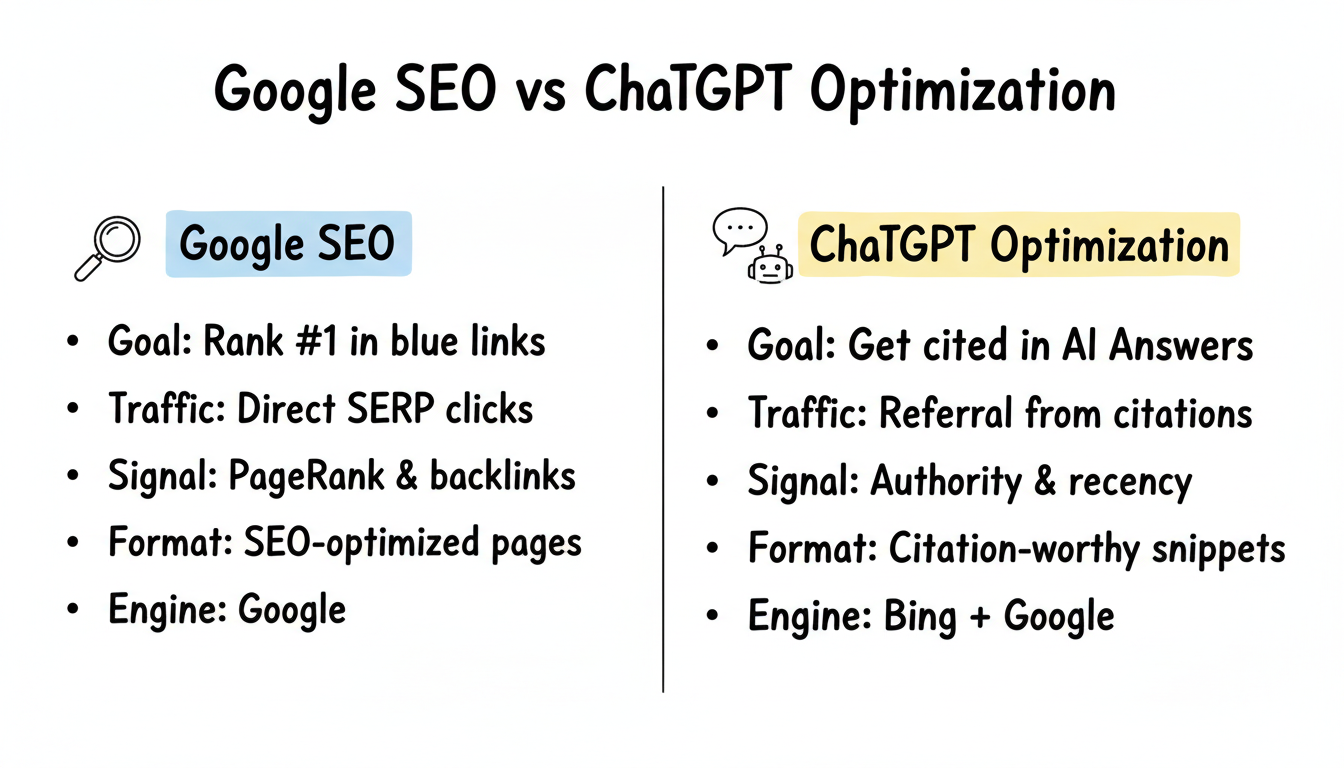
Key differences from traditional SEO:
Factor | Google SEO | ChatGPT Optimization |
Goal | Rank #1 in blue links | Get cited in AI answers |
Traffic source | Direct clicks from SERPs | Referral clicks from citations |
Ranking signal | PageRank, backlinks, keywords | Authority, structure, recency |
Content format | SEO-optimized pages | Citation-worthy snippets |
Primary search engine | Bing (historically), Google (2025+) |
According to WSI World's 2026 marketing predictions, brand mentions now matter more than traditional backlinks for AI visibility. The systems surface brands referenced across trusted sources—reviews, forums, podcasts, and social channels—creating what experts call "AI authority."
Understanding how ChatGPT actually selects citations is critical for optimization. The mechanics have evolved significantly since ChatGPT first introduced web browsing.
When ChatGPT initially launched citation features, it operated through a partnership with Microsoft's Bing. The process worked like this:
This is why 87% of ChatGPT's citations historically matched Bing's top results. If your content ranked well on Bing, you had a dramatically higher chance of being cited by ChatGPT.
In July 2025, French SEO consultant Alexis Rylko discovered that ChatGPT had quietly shifted from Bing to Google search results for its citations—and the citations often appeared in the same order as Google's SERP.
What this means for optimization:
According to comprehensive AI search engine research, when a user asks ChatGPT a question, the following process occurs:
Content that performs best in this process shares common characteristics: authoritative domains, content depth (2,900+ words), recency (within 12 months), clear structure, and factual accuracy verified across multiple sources.
Even with ChatGPT's partial shift to Google, Bing optimization remains foundational for AI visibility. ChatGPT still uses Bing's index for many queries, and Microsoft Copilot—which also uses Bing—continues to grow.
Bing's ranking algorithm differs from Google's in several important ways:
1. Social Signals Unlike Google, Bing explicitly considers social engagement. Pages with higher social sharing and engagement tend to rank better on Bing. This has indirect benefits for ChatGPT visibility.
2. Exact-Match Keywords Bing places more weight on exact-match keywords in titles, headers, and content. While Google has evolved toward semantic understanding, Bing still rewards precise keyword targeting.
3. Backlink Quality Over Quantity Bing prioritizes backlink quality more heavily than quantity. A few links from highly authoritative domains outweigh many links from lesser sources.
4. Page Age and Domain History Established domains with consistent publishing history rank better on Bing. This "trustworthiness" signal directly influences ChatGPT citation probability.
5. Multimedia Content Bing indexes and values multimedia content (images, videos) more prominently. Including high-quality visual elements can boost Bing rankings.
Before any content optimization, ensure ChatGPT can actually find your content. According to ChatGPT optimization experts, ranking is impossible if the AI doesn't know your site exists.
Submitting your sitemap ensures Bing can discover all your pages:
Review the Site Explorer for crawl errors that prevent indexing:
Critical step: Ensure your robots.txt allows the OpenAI crawler:
User-agent: GPTBot
Allow: /

User-agent: ChatGPT-User
Allow: /
If you've blocked these crawlers (intentionally or not), your content won't appear in ChatGPT responses regardless of how well it ranks.
Set up regular monitoring:
Being indexed is just the foundation. Getting cited requires content that ChatGPT deems citation-worthy.
Based on extensive citation analysis, ChatGPT favors:
According to Fortis Media's 2026 optimization guide, entity-first content structuring dramatically improves ChatGPT visibility:
Start with definitions: Begin pages with "What is [topic]" sections. If writing about CRM software, start with "What is CRM software?" as an H2. This approach mirrors clear definitions aeo advantage strategies that work across multiple AI platforms.
Maintain consistent naming: Use the same terms for products, concepts, and entities across all pages. Consistency helps AI understand your content.
Include related concepts: Mention essential related topics. An article about "electric cars" should include "batteries," "charging stations," and "range."
ChatGPT favors content with easily-extractable answer sections:
Example format for citation-optimized content:
## What Is [Topic]?

[Topic] is [clear 1-2 sentence definition]. [Additional context sentence].

### Key Points:
- Point 1
- Point 2
- Point 3
ChatGPT prefers content with high factual density:
Content that states "many businesses report increased revenue" is less citation-worthy than "73% of B2B companies reported 15-25% revenue increases according to [Study Name]."
ChatGPT is fundamentally a conversational AI. Content structured for conversation performs better.
Structure content around the questions users actually ask:
Traditional header: "Benefits of Email Marketing"
Conversational header: "What Are the Benefits of Email Marketing?" or "Why Should Businesses Use Email Marketing?"
Question-based headers match how users query ChatGPT, increasing the chance your content addresses their exact question. Understanding aeo vs seo vs geo distinctions helps refine this question-focused approach.
Don't bury the answer. Provide direct responses immediately:
Poor format:
"There are many factors to consider when thinking about email marketing ROI. Studies have shown various results depending on industry, audience, and implementation. Generally speaking, most businesses find..."
Better format:
"Email marketing delivers an average ROI of $42 for every $1 spent according to DMA research. This 4,200% return makes it one of the highest-performing digital marketing channels."
According to Shopify's AEO research, ChatGPT citations connect to snippable, machine-digestible portions of text relevant to headings:
ChatGPT consistently favors recent content, particularly for time-sensitive queries.
AI systems recognize that information has shelf life. A 2022 article about "best project management tools" is less reliable than a 2026 article—the landscape has changed.
Fortis Media research confirms ChatGPT tends to ignore outdated content, making freshness optimization essential.
Publication dates: Display clear, recent dates on content pages
Last modified dates: Show when content was last updated
Annual updates: Refresh cornerstone content annually with:
Date in titles: For time-sensitive content, include the year: "Best CRM Software for Small Business (2026)"
For existing content competing for ChatGPT citations:
AI systems don't just evaluate individual pages—they assess the overall authority and trustworthiness of sources.
According to ALM Corp's comprehensive guide, ChatGPT pulls from 36+ different sources when answering queries, including Reddit discussions, comparison sites, review platforms, and industry publications.
Third-party authority signals that matter:
When implementing searchgpt review management strategies, these same authority signals apply across multiple AI platforms.
Citation analysis research shows link diversity correlates most strongly with ChatGPT citations. AI systems trust sources with links from:
A natural link profile signals broad recognition and authority that AI systems trust.
Google's E-E-A-T framework (Experience, Expertise, Authoritativeness, Trustworthiness) applies equally to AI citation:
Structured data helps AI systems understand and cite your content, much like structured data ai search implementations benefit broader AI visibility.
FAQPage Schema: For pages with question-and-answer content
{
  "@context": "https://schema.org",
  "@type": "FAQPage",
  "mainEntity": [{
    "@type": "Question",
    "name": "How to rank on ChatGPT?",
    "acceptedAnswer": {
      "@type": "Answer",
      "text": "To rank on ChatGPT, optimize for Bing indexing, structure content for AI extraction, and build authority across trusted sources."
    }
  }]
}
HowTo Schema: For instructional content, particularly when creating howto schema ai search optimization strategies.
{
  "@context": "https://schema.org",
  "@type": "HowTo",
  "name": "How to Optimize Content for ChatGPT",
  "step": [{
    "@type": "HowToStep",
    "text": "Set up Bing Webmaster Tools and submit your sitemap"
  }]
}
Article Schema: For blog posts and articles
Include author information, publication date, and publisher details to enhance credibility signals.
You can't improve what you don't measure. Tracking ChatGPT visibility requires specialized tools, similar to those used for ai search conversion optimization.
Profound: Tracks how often you appear across multiple AI channels
PromptRush: Simulates thousands of prompts to measure brand appearance in ChatGPT answers
Keyword.com AI Visibility Tracker: Provides real-time inclusion rates, sentiment scoring, and prompt-level insights
AI Product Rankings: Free tool showing how your website appears in AI search engines
For those seeking comprehensive solutions, explore options among generative engine optimization tool providers.
Regularly test key queries in ChatGPT:
Here's a real-world example of systematic ChatGPT optimization success:
A B2B SaaS company in the project management space had:
Week 1-2: Technical Foundation
Week 3-4: Content Restructuring
Week 5-6: Schema Implementation
Week 7-8: Authority Building
Week 9-12: Content Freshness
After 90 days:
Even with strong fundamentals, several common mistakes can undermine ChatGPT visibility:
The problem: Many SEOs focus exclusively on Google, neglecting Bing optimization entirely.
The fix: Set up Bing Webmaster Tools, submit sitemaps, and monitor Bing-specific ranking factors alongside Google. Understand what is aeo vs seo to optimize for both traditional and AI search.
The problem: Some sites inadvertently block GPTBot or ChatGPT-User in robots.txt.
The fix: Audit robots.txt and ensure AI crawlers have access to important content.
The problem: Content that simply aggregates publicly available information won't earn citations.
The fix: Create content with unique data, expert insights, original research, or proprietary perspectives that AI can't find elsewhere.
The problem: Content without clear publication or update dates signals potential staleness.
The fix: Display dates prominently, update content regularly, and include year references in titles for time-sensitive topics.
The problem: Without schema markup, AI systems must work harder to understand content structure.
The fix: Implement FAQ, HowTo, and Article schema on relevant pages.
The problem: Focusing only on owned properties while ignoring presence across the web.
The fix: Build mentions on review platforms, industry forums, Wikipedia (if notable enough), and social channels.
The problem: ChatGPT optimization takes time. Training data updates and authority building don't happen instantly.
The fix: Commit to a 90-day minimum timeline, track progress weekly, and iterate based on data. Consider consulting top generative engine optimization companies for expert guidance.
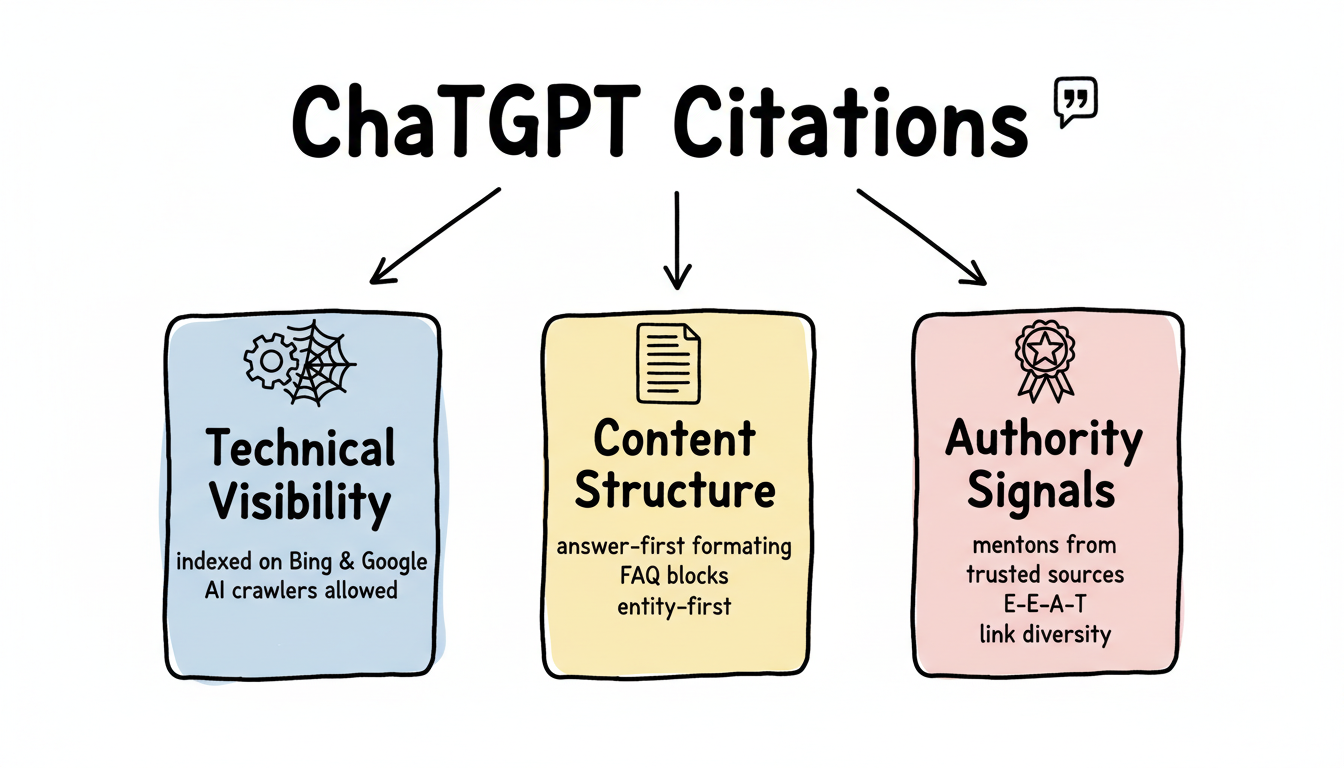
Ranking on ChatGPT isn't about gaming an algorithm—it's about becoming genuinely citation-worthy. The sites that earn consistent ChatGPT visibility share common traits: technical accessibility, structured content, demonstrable authority, and ongoing freshness.
The three pillars of ChatGPT optimization are clear:
As NoGood's future of search analysis notes, traditional SEO remains foundational—you can't skip the fundamentals. But layering AI optimization on top creates compounding visibility across both traditional search and AI-generated answers. Organizations developing multi-platform ai search optimization strategy approaches find the greatest success.
The hard truth: If AI doesn't quote you, you increasingly don't exist. With 800 million weekly ChatGPT users and growing adoption reflected in searchgpt market share adoption trends, the question isn't whether to optimize for AI search—it's how quickly you can establish the presence that earns citations.
By submitting this form, you agree to our Privacy Policy and Terms & Conditions.