
February 19, 2026


The AI search landscape has transformed dramatically. ChatGPT Search—the integrated web search feature that replaced the standalone SearchGPT prototype—now serves 900 million weekly active users. Understanding these adoption patterns helps businesses prioritize which AI platforms deserve optimization resources. Here's what the data reveals about AI chatbot market dynamics in 2026.
According to Backlinko's ChatGPT statistics, ChatGPT now has an estimated 900 million weekly active users as of December 2025, up from 300 million in December 2024—representing a 3x increase in just twelve months.
ChatGPT's growth from launch to dominance happened remarkably fast.
According to FirstPageSage's market analysis, ChatGPT grew from 100 million weekly active users in November 2023 to 200 million by August 2024, then accelerated to 300 million by December 2024. The explosive growth continued through 2025, reaching 700 million by August and 900 million by December.
ChatGPT growth milestones:
Date | Weekly Active Users | Growth Note |
November 2023 | 100M | One year after launch |
August 2024 | 200M | 2x in 9 months |
December 2024 | 300M | 3x YoY |
August 2025 | 700M | 7x in 21 months |
December 2025 | 900M | 9x total growth |
ChatGPT leads but faces growing competition.
According to FirstPageSage's January 2026 data, ChatGPT holds 64.5% market share, down significantly from 86.7% just twelve months prior. Google Gemini captured 21.5% share with 650 million monthly users. The remaining market splits among DeepSeek (3.7%), Grok (3.4%), Perplexity (2%), and Claude (2%).
AI chatbot market share (January 2026):
Market Share Distribution
├── ChatGPT: 64.5%
│   └── 900M weekly / 5.8B monthly visits
│
├── Google Gemini: 21.5%
│   └── 650M monthly users, +237% YoY
│
├── DeepSeek: 3.7%
│   └── Emerged rapidly in late 2025
│
├── Grok: 3.4%
│   └── X platform integration
│
├── Perplexity: 2%
│   └── Citation-first positioning
│
└── Claude: 2%
    └── Enterprise/developer focus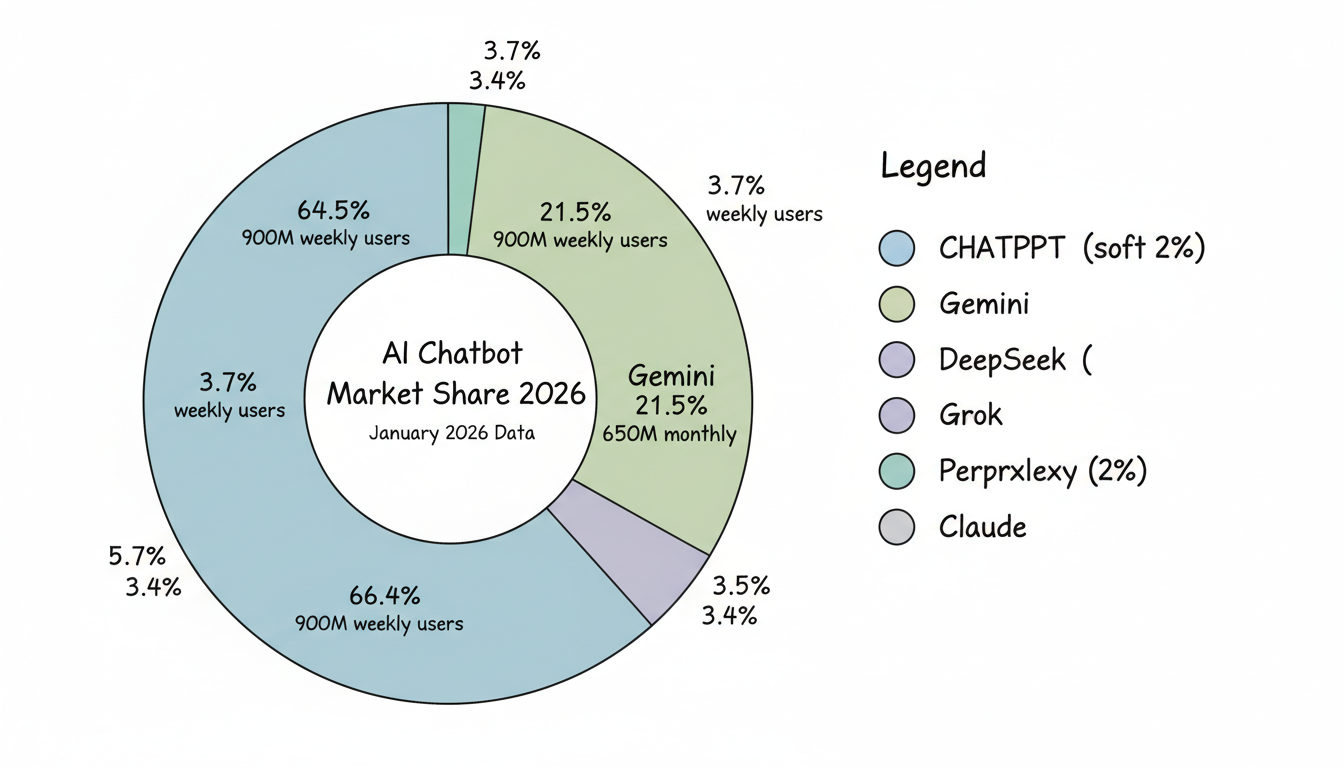
Raw user counts only tell part of the story.
According to Vertu's AI visibility guide, ChatGPT maintains 5.72 billion monthly visits and an 81% market share in what's termed the "Agentic Internet." These metrics make AI Search Brand Visibility and Citation Rate critical KPIs for brands in 2026. Understanding generative AI search optimization strategies helps businesses maximize visibility across these platforms.
Platform traffic comparison:
Platform | Monthly Visits | Market Position |
ChatGPT | 5.72B-5.8B | Dominant leader |
Google Gemini | ~2B+ | Fastest growing |
Perplexity | ~500M | Citation-focused |
Claude | ~200M | Enterprise segment |
The market isn't static—significant shifts are occurring.
According to ALM Corp's comprehensive analysis, Google Gemini referral traffic grew 388% year-over-year, dramatically outpacing other platforms. While ChatGPT maintains the largest user base, Google's integration of AI into search creates different competitive dynamics than standalone AI chatbots. The distinction between AEO vs GEO becomes increasingly important as these platforms diverge in functionality.
Year-over-year growth rates:
Platform | YoY Growth | Notes |
Google Gemini | +388% referral traffic | Search integration advantage |
Perplexity | +370% | Citation-first differentiation |
Claude | +190% | Enterprise/API focus |
ChatGPT | ~200% users | Base effect (already large) |
Users approach different platforms for different purposes.
According to Xenoss research on AI disruption, Google still dominates transactional queries with 90% share, while ChatGPT leads generative and creative queries at 64%. ChatGPT handles 23% of informational queries compared to Google's declining share in that category.
Query type distribution:
Query Intent by Platform
├── Transactional Queries
│   ├── Google: 90%
│   ├── ChatGPT: Limited
│   └── Implication: E-commerce still Google-centric
│
├── Informational Queries
│   ├── ChatGPT: 23%
│   ├── Google: Declining
│   └── Implication: Growing AI search shift
│
├── Generative/Creative Queries
│   ├── ChatGPT: 64%
│   ├── Others: Distributed
│   └── Implication: ChatGPT dominates creation
│
    └── Navigational Queries
    ├── Google: Still dominant
    └── Implication: Brand search remains Google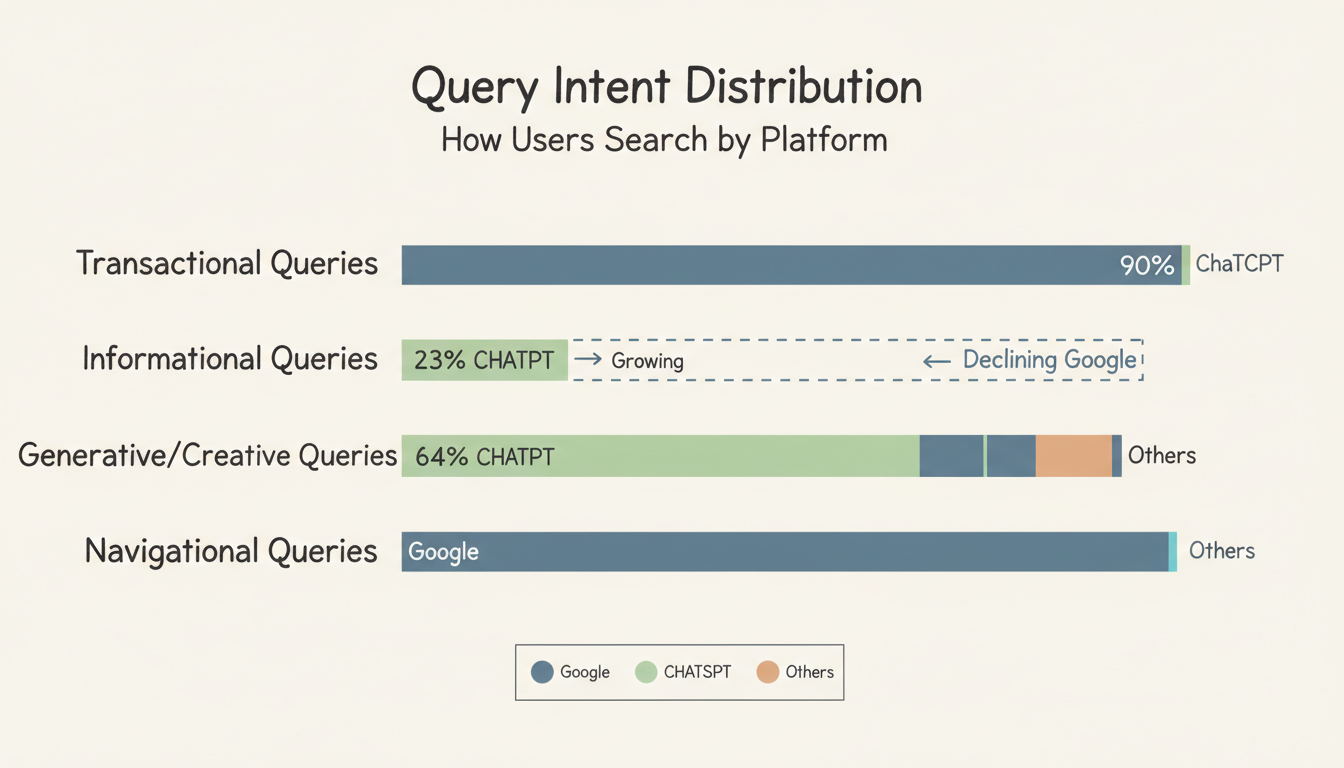
Age significantly influences platform preference.
According to Digiday's search behavior analysis, younger users show stronger AI chatbot adoption. Among 13-24 year olds, 74% use Google and 17% use ChatGPT for search. For users 65+, Google captures 89% while ChatGPT reaches only 5%. These demographic patterns reflect broader trends in ChatGPT SEO adoption across different user segments.
Age-based platform preferences:
Age Group | ChatGPT | Implication | |
13-24 | 74% | 17% | Youth AI adoption |
25-44 | ~80% | ~12% | Working professionals |
45-64 | ~85% | ~8% | Traditional search habits |
65+ | 89% | 5% | Strongest Google loyalty |
Commercial metrics validate market significance.
According to Microsoft's AI Economy Institute research, organizations that have adopted AI in their operations now have an economic impact worth $4.8 trillion. This validates continued investment in AI search optimization as the economic footprint expands.
Revenue indicators:
Market share data informs optimization priorities. Organizations comparing Perplexity vs ChatGPT SEO strategies should consider both market share and query intent patterns when allocating resources.
Strategic implications:
Insight | Optimization Response |
ChatGPT dominates at 64.5% | Primary AI search focus |
Gemini growing fastest (+388%) | Monitor Google AI Mode/Overviews |
Perplexity high citation rates | Include in tracking strategy |
Youth skews ChatGPT | B2C youth brands prioritize ChatGPT |
Transactional stays Google | E-commerce maintains Google SEO |
AI search market share data reveals clear patterns for optimization strategy:
According to FirstPageSage, the AI chatbot market continues evolving rapidly. Brands optimizing for AI search visibility should track these adoption trends quarterly—market share shifts can change optimization priorities within months, not years.
By submitting this form, you agree to our Privacy Policy and Terms & Conditions.



