
February 19, 2026


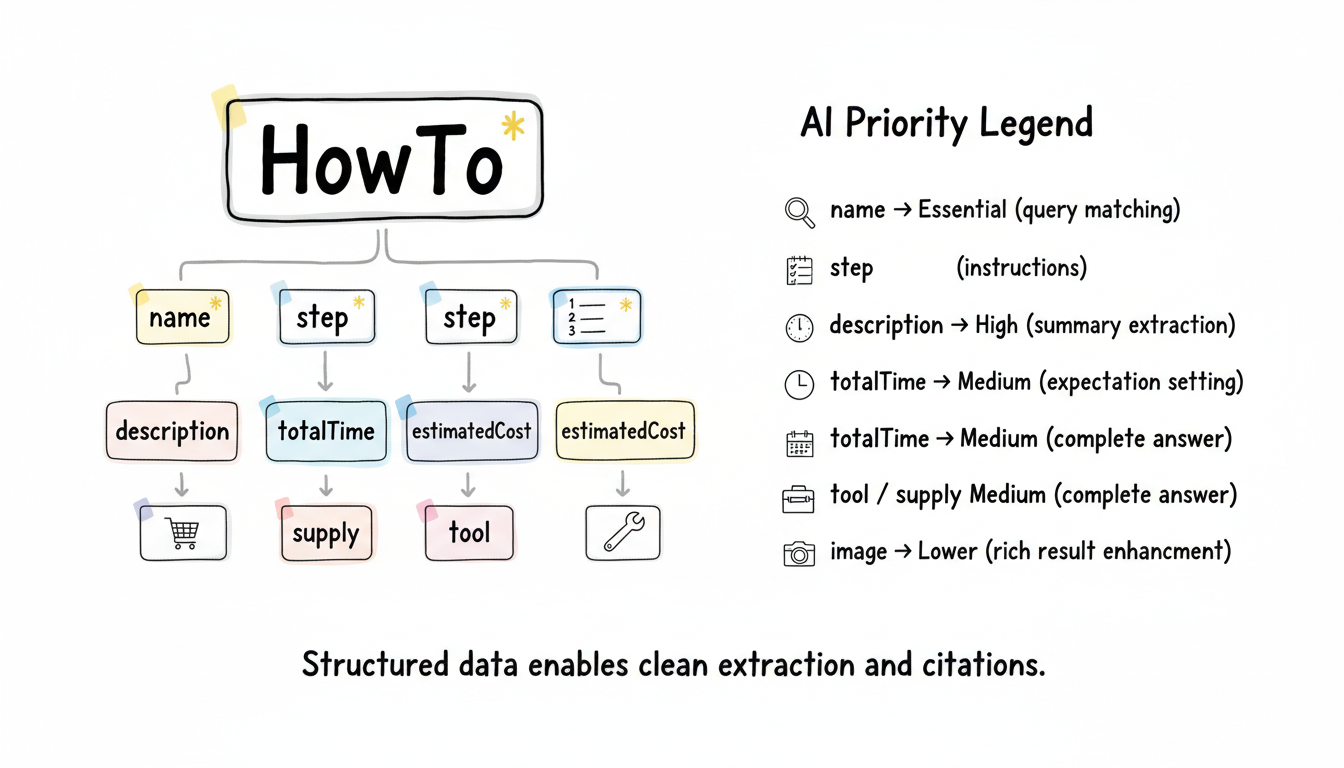
HowTo schema tells AI systems exactly how your tutorial content is structured—step by step. When users ask ChatGPT, Perplexity, or Google AI how to accomplish something, these platforms preferentially cite content with properly implemented HowTo markup. The schema transforms prose into machine-readable instructions AI can extract, summarize, and cite with confidence.
This guide covers the specific implementation requirements and optimization tactics for HowTo schema in AI search.
"How to" queries represent a massive share of AI search volume. AI systems need to deliver accurate, sequential instructions.
HowTo schema advantages:
Without HowTo Schema | With HowTo Schema |
AI parses text for implicit steps | AI reads explicit step definitions |
Step order may be misinterpreted | Step sequence is guaranteed |
Extraction errors more common | Clean, structured extraction |
Partial instructions possible | Complete process capture |
HowTo schema eliminates guesswork. AI systems know exactly where each step begins and ends, what supplies are needed, and how long the process takes.
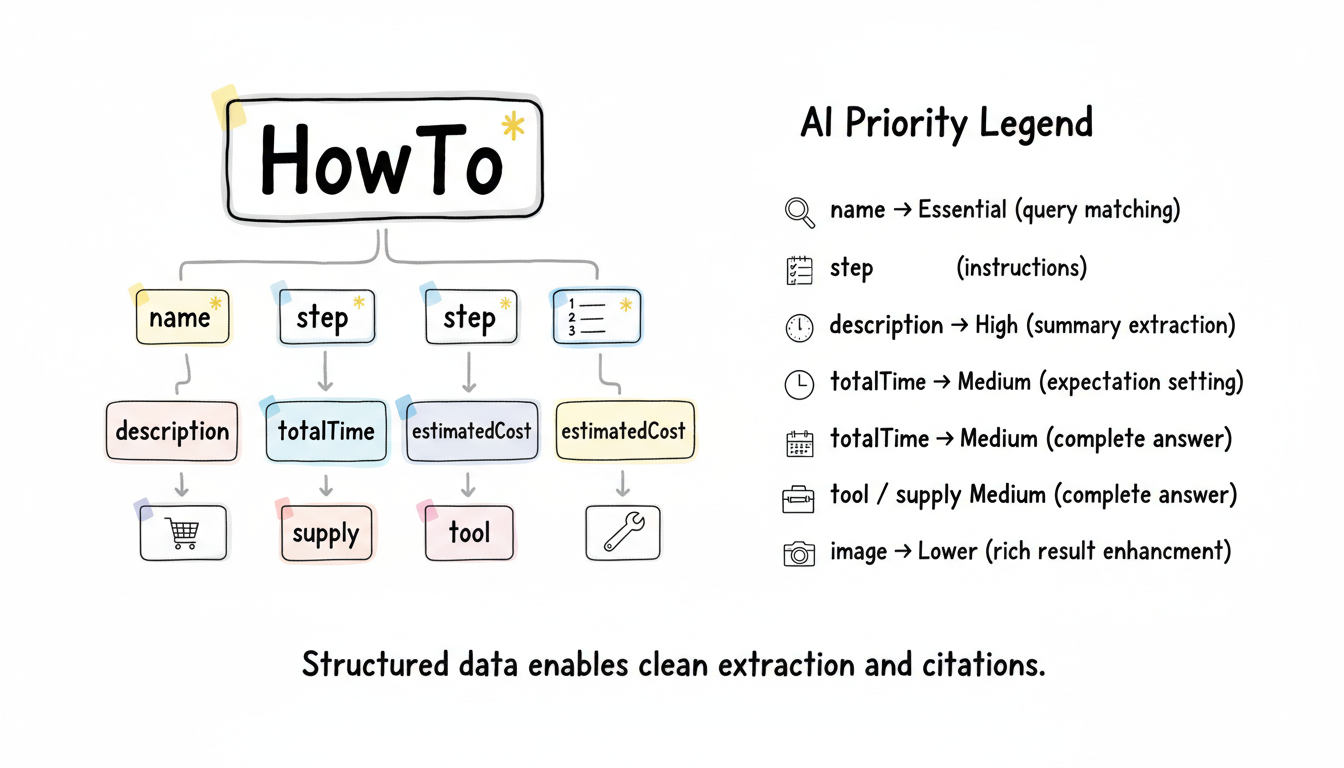
The HowTo schema type includes several properties that AI systems evaluate.
Core HowTo properties:
HowTo Schema Structure:
├── name (required)
│   └── Title of the process/tutorial
│
├── description (recommended)
│   └── Brief overview of what user will accomplish
│
├── step (required)
│   └── Array of HowToStep objects
│
├── totalTime (recommended)
│   └── ISO 8601 duration format
│
├── estimatedCost (optional)
│   └── Cost to complete the process
│
├── supply (optional)
│   └── Materials needed
│
└── tool (optional)
    └── Tools/equipment required
Property priorities for AI:
Property | AI Priority | Why It Matters |
name | Essential | Query matching |
step | Essential | The actual instructions |
description | High | Summary extraction |
totalTime | Medium | User expectation setting |
tool/supply | Medium | Complete answer provision |
image | Lower | Rich result enhancement |
Implementing proper structured data is fundamental to article schema AI platforms visibility, and HowTo markup follows the same principles of machine-readable content signals.
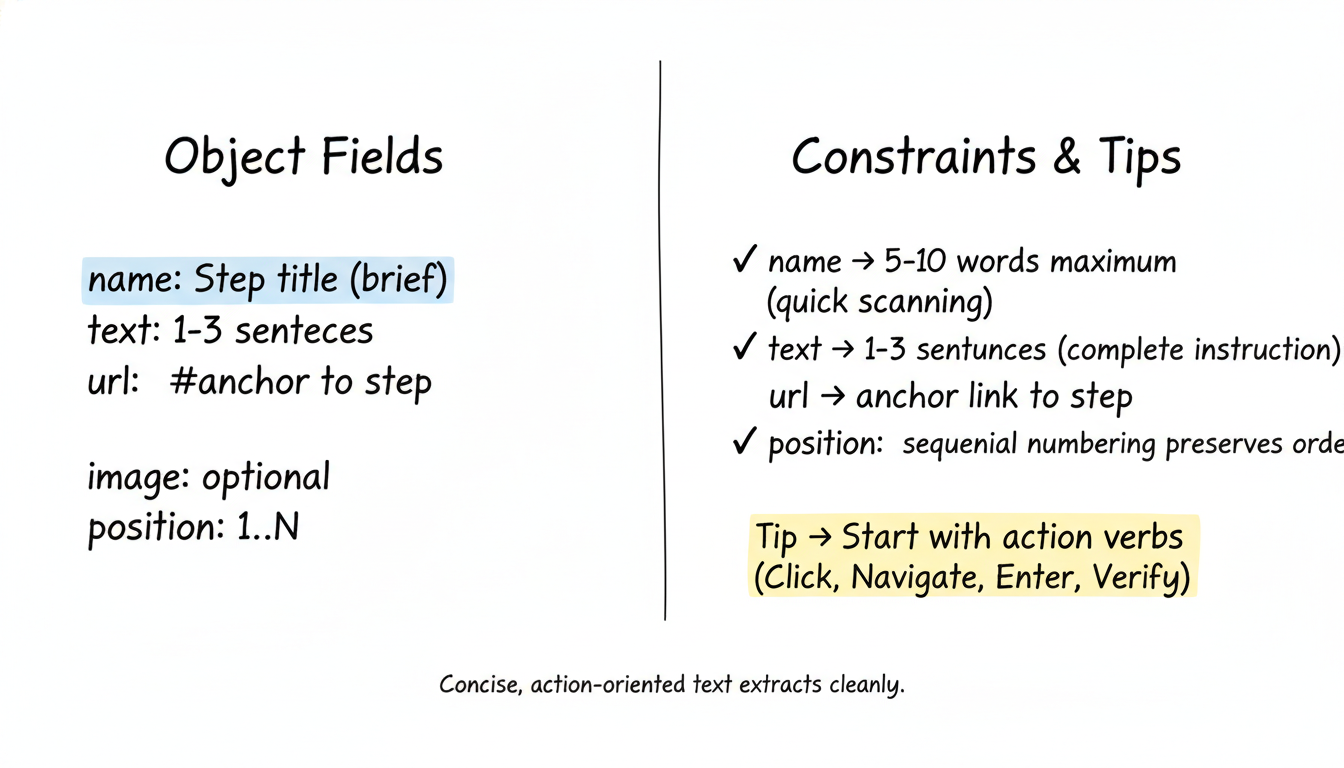
Steps are the core of HowTo schema. Proper implementation determines extraction success.
HowToStep structure:
{
  "@type": "HowToStep",
  "name": "Step title (brief)",
  "text": "Detailed step instructions",
  "url": "https://example.com/guide#step1",
  "image": "https://example.com/step1-image.jpg"
}
Step formatting requirements:
Element | Requirement | AI Benefit |
name | 5-10 words maximum | Quick scanning and extraction |
text | 1-3 sentences | Complete instruction delivery |
url | Anchor link to step | Direct navigation |
position | Sequential numbering | Order preservation |
Step text best practices:
Good step text:
"Open your WordPress dashboard and navigate to Settings > Permalinks."

Poor step text:
"You'll want to go ahead and find your dashboard, which should be
accessible at yourdomain.com/wp-admin, and then when you're there
look for the Settings menu on the left side..."
Concise, action-oriented text extracts cleanly. Verbose instructions get truncated.
Full HowTo schema implementation for AI optimization:
{
  "@context": "https://schema.org",
  "@type": "HowTo",
  "name": "How to Set Up Google Search Console",
  "description": "A step-by-step guide to adding and verifying your website in Google Search Console.",
  "totalTime": "PT15M",
  "estimatedCost": {
    "@type": "MonetaryAmount",
    "currency": "USD",
    "value": "0"
  },
  "tool": [
    {
      "@type": "HowToTool",
      "name": "Google account"
    },
    {
      "@type": "HowToTool",
      "name": "Website admin access"
    }
  ],
  "step": [
    {
      "@type": "HowToStep",
      "position": 1,
      "name": "Access Search Console",
      "text": "Go to search.google.com/search-console and sign in with your Google account.",
      "url": "https://example.com/guide#step1"
    },
    {
      "@type": "HowToStep",
      "position": 2,
      "name": "Add your property",
      "text": "Click 'Add property' and enter your website URL. Choose either Domain or URL prefix verification.",
      "url": "https://example.com/guide#step2"
    },
    {
      "@type": "HowToStep",
      "position": 3,
      "name": "Verify ownership",
      "text": "Select a verification method. DNS verification or HTML file upload are most reliable.",
      "url": "https://example.com/guide#step3"
    },
    {
      "@type": "HowToStep",
      "position": 4,
      "name": "Submit your sitemap",
      "text": "Navigate to Sitemaps and submit your XML sitemap URL to help Google discover your pages.",
      "url": "https://example.com/guide#step4"
    }
  ]
}
AI systems extract and summarize HowTo content. Optimize for clean extraction.
Step optimization tactics:
Tactic | Implementation |
Start with action verbs | "Click," "Navigate," "Enter," "Select" |
One action per step | Don't combine multiple tasks |
Include specifics | Menu names, button labels, exact values |
Number consistently | Maintain sequential position values |
Keep text brief | 50-100 characters per step optimal |
Action verb effectiveness:
High extraction clarity:
├── Click, Tap, Select
├── Navigate, Go to, Open
├── Enter, Type, Input
├── Copy, Paste, Save
└── Verify, Confirm, Check

Lower extraction clarity:
├── Consider, Think about
├── You might want to
├── It's recommended that
└── Generally speaking
Direct instructions extract reliably. Hedging language creates ambiguity. For comprehensive technical configuration beyond HowTo markup, AI overview Google SEO technical requirements ensure maximum platform compatibility.
Adapt HowTo implementation to content category.
Content type variations:
Content Type | HowTo Focus | Additional Properties |
Software tutorials | UI navigation | tool (software names) |
DIY projects | Physical steps | supply, tool, image per step |
Recipes | Cooking process | Use Recipe schema instead |
Business processes | Workflow steps | estimatedCost, totalTime |
Technical procedures | Implementation | tool (technologies used) |
Avoid errors that reduce AI visibility benefits.
Mistakes and solutions:
Mistake | Problem | Solution |
Missing position values | Step order ambiguous | Add explicit position numbers |
Steps too long | Truncation, extraction errors | One action per step |
Vague step names | Poor query matching | Specific, descriptive names |
Schema doesn't match content | Trust penalty | Exact alignment required |
Missing required properties | Invalid markup | Include name and step minimum |
Verify HowTo schema before publishing.
Validation checklist:
Time format reference:
Duration | ISO 8601 Format |
15 minutes | PT15M |
1 hour | PT1H |
1 hour 30 minutes | PT1H30M |
2 hours | PT2H |
Different AI platforms use HowTo schema differently.
Platform behavior:
Platform | HowTo Usage |
Google AI Overviews | Direct step extraction for featured snippets |
ChatGPT | Step sequences cited in how-to responses |
Perplexity | Steps quoted with source attribution |
Microsoft Copilot | Bing-indexed HowTo content prioritized |
All major AI platforms recognize HowTo schema. Implementation benefits visibility across the AI search ecosystem. Understanding platform-specific behavior parallels the strategic considerations in AEO vs GEO optimization approaches.
HowTo schema optimization for AI search:
Tutorial content with proper HowTo schema has significantly higher AI citation potential than unstructured how-to articles. The investment in proper implementation pays compound returns across all AI search platforms.
By submitting this form, you agree to our Privacy Policy and Terms & Conditions.



