February 19, 2026


The marketing industry loves new acronyms. When AI search exploded in 2024-2025, "Answer Engine Optimization" (AEO) emerged as the supposed successor to traditional SEO. Agencies launched AEO services. Consultants rebranded as "AEO specialists." Industry publications declared SEO dead—again.
Then Google spoke up.
In December 2025, Google's Danny Sullivan and John Mueller addressed the AEO vs SEO debate directly on their Search Off the Record podcast. Their message was unambiguous: optimizing for AI search is the same as optimizing for traditional search.
This guide examines Google's official position on AEO, what it means for marketers, and why good SEO has always been—and remains—the foundation for visibility in any search format.
On December 18, 2025, Search Engine Roundtable reported on the Search Off the Record podcast episode where Danny Sullivan and John Mueller directly addressed the AEO terminology and whether businesses need to optimize differently for AI search features.
Their conclusion? There's no meaningful distinction between AEO and SEO.
Danny Sullivan, Google's Search Liaison, explained that the fundamentals haven't changed:
"The same things that help you with traditional search—quality content, expertise, good user experience—those are exactly what help you appear in AI Overviews and AI Mode."
John Mueller echoed this sentiment, questioning the need for new terminology:
"If you're doing SEO well, you're already doing what you need to do for AI search. Adding new acronyms doesn't change the underlying principles."
The podcast specifically cautioned against treating AI search optimization as a separate discipline requiring different strategies, different teams, or different approaches.
Just weeks later, on January 8, 2026, Sullivan went further in a follow-up podcast appearance. He explicitly warned against fragmenting content into "bite-sized chunks for LLMs"—a common recommendation from the AEO consulting industry.
According to industry reporting on the January podcast, Sullivan stated clearly: "We don't want you to do that."
Sullivan explained that Google's engineers had confirmed this guidance. Creating artificial content structures specifically designed for AI extraction doesn't improve your chances of appearing in AI responses—and may actually harm overall content quality.
Answer Engine Optimization emerged as a concept to describe optimization for AI-powered search systems that generate direct answers rather than links. The term gained traction as tools like ChatGPT, Perplexity, and Google's own AI Overviews began reshaping search behavior.
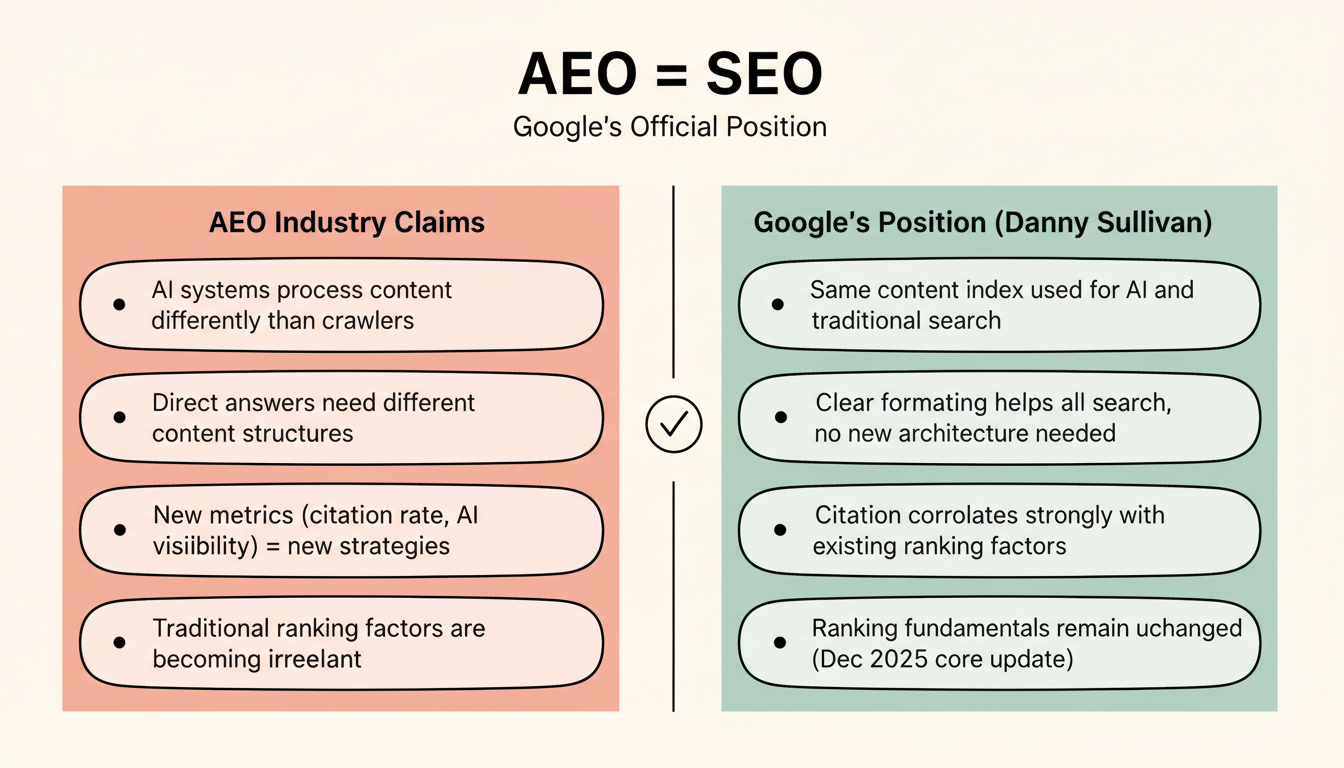
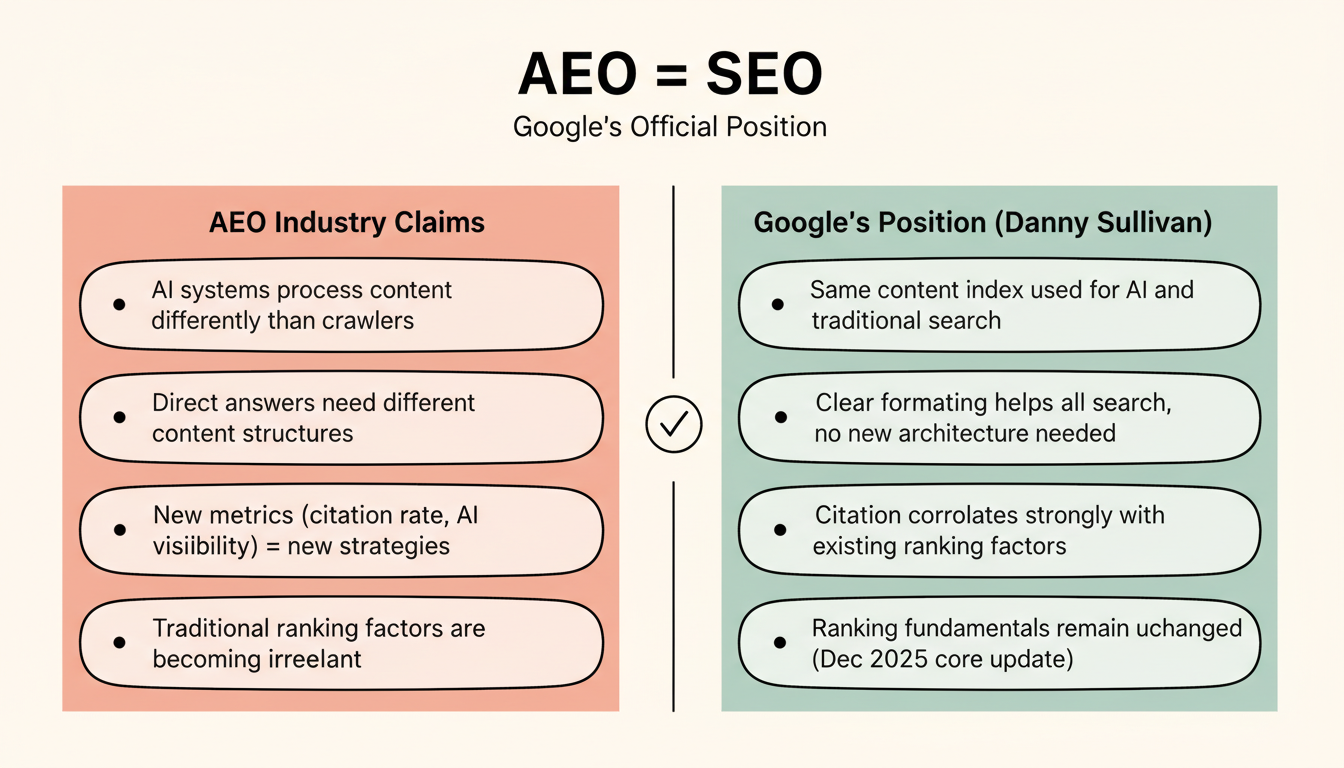
AEO proponents typically argue that:
Google's position undermines each of these claims:
On content processing: Google's AI systems use the same underlying content index as traditional search. Content that ranks well organically is the same content that gets cited in AI Overviews.
On content structure: While structured data and clear formatting help all search systems, Google isn't asking for fundamentally different content architecture for AI features.
On metrics: Citation in AI Overviews correlates strongly with traditional ranking factors—authority, relevance, E-E-A-T signals. New metrics are interesting but not indicative of new optimization requirements.
On ranking factors: The December 2025 core update analysis showed that sites ranking well in traditional search also performed well in AI Overviews. The ranking fundamentals remain unchanged.
If Google says AEO equals SEO, what should marketers actually do? The answer is both simple and challenging: execute traditional SEO better.
Content Quality: Create genuinely useful content that answers user questions comprehensively. Understanding how to optimize content for AI Overview starts with the same quality principles that have always mattered.
E-E-A-T Signals: Expertise, Experience, Authoritativeness, and Trustworthiness matter for AI citations just as they matter for traditional rankings. Build author profiles, demonstrate credentials, cite authoritative sources.
Technical Excellence: Site speed, mobile optimization, structured data, crawlability—these technical foundations serve both traditional and AI search.
User Experience: Pages that users engage with, share, and return to signal quality to all of Google's systems, including AI features.
Based on Google's guidance, avoid these common AEO recommendations:
Don't fragment content for AI extraction: Creating artificial "bite-sized" content chunks optimized for LLM parsing goes against Google's explicit guidance.
Don't create separate "AEO content": Building a parallel content strategy for AI search wastes resources. Your existing content strategy, well-executed, serves both purposes.
Don't reorganize teams around AEO: Sullivan specifically questioned the value of restructuring organizations around "algorithmic manipulation strategies" for AI.
Don't ignore traditional SEO in favor of AEO: Some marketers have deprioritized traditional ranking factors to focus on AI-specific tactics. Google's position suggests this is counterproductive.
Understanding why AEO became a marketing term helps explain Google's pushback.
When AI search features launched, an opportunity gap emerged:
AEO as terminology served all these needs. It created a sense of newness and urgency that traditional SEO advice lacked.
The problem? Practical AEO advice often recycled existing SEO best practices under new branding:
Google's intervention essentially called out this rebadging exercise.
Google's "AEO = SEO" position doesn't mean AI search features are identical to traditional rankings. Some nuances exist:
Traditional SEO aims for rankings—positions in search results that drive clicks. AI search introduces citation—being named as a source within AI-generated responses.
The optimization approaches are the same, but the success metrics differ. You can track both ranking positions and citation frequency using tools like Google Analytics 4 AI search tracking.
AI responses often provide complete answers, reducing click-through to source pages. According to industry statistics, zero-click searches have increased with AI Overviews.
This doesn't change how you optimize, but it does change how you measure success and value. Brand visibility in AI responses carries value even without clicks.
Google's guidance applies to Google's ecosystem—AI Overviews, AI Mode, and related features. It doesn't necessarily extend to:
Optimization for non-Google AI platforms may require different approaches. Google is specifically saying that for their AI features, traditional SEO suffices.
Based on Google's official position, here's a practical framework:
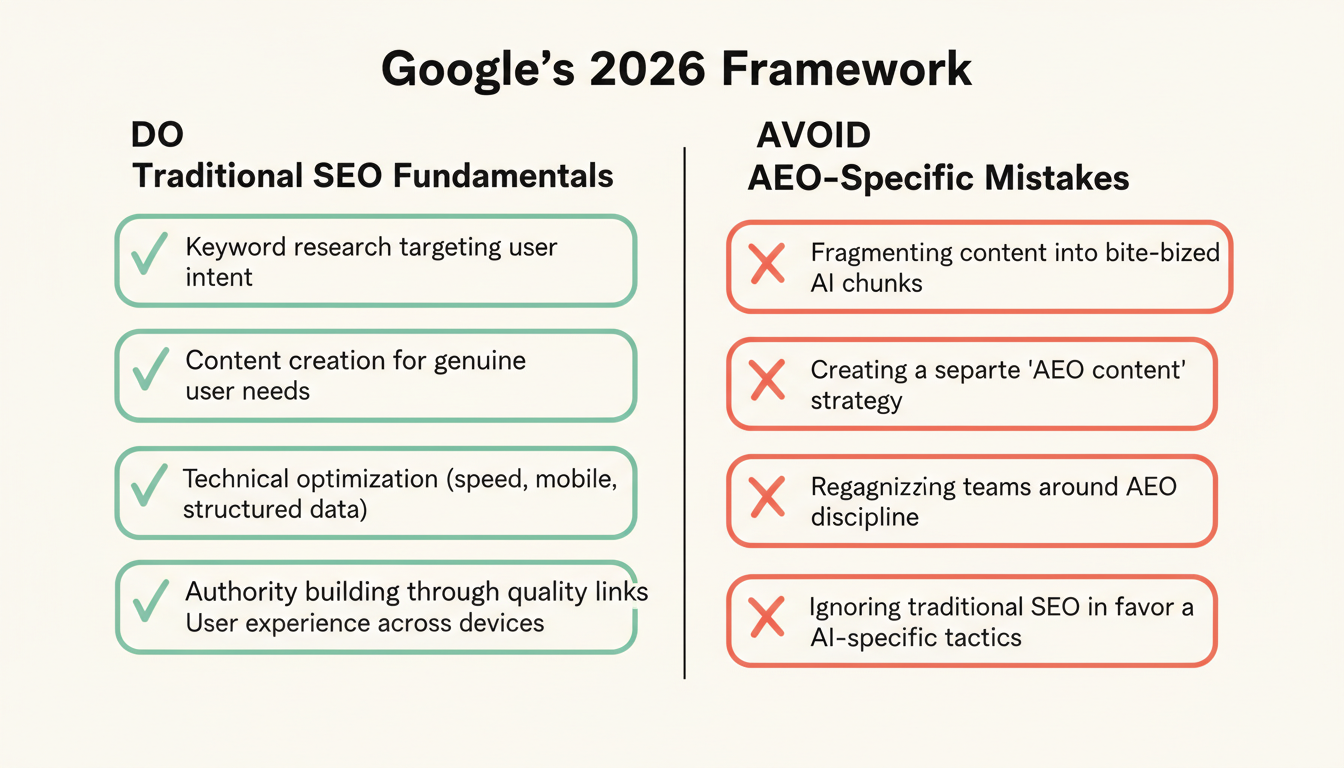
The fundamentals remain unchanged:
While optimization approaches don't change, monitoring should expand:
Don't restructure content, teams, or budgets around AEO as a separate discipline. Instead:
Before investing in enterprise AEO services, consider whether your needs are better served by strengthening traditional SEO fundamentals.
The AI search landscape continues evolving. Stay current on developments, but maintain healthy skepticism toward:
Google's "AEO = SEO" position specifically addresses Google's own AI features. But businesses also want visibility in ChatGPT, Perplexity, Claude, and other AI systems.
Non-Google AI platforms may weight different signals:
Despite platform differences, the practical optimization advice largely converges:
This overlap is why Google can credibly claim that good SEO serves AI visibility broadly—not just within Google's ecosystem. Whether you're targeting traditional search or optimizing content for generative AI, the core principles remain consistent.
Will AEO persist as a term? Probably, regardless of Google's position.
Even if AEO persists as terminology, Google's guidance matters because:
Understanding what is AEO in marketing helps clarify why Google's position is both accurate and important for preventing strategic missteps.
Google's message through Danny Sullivan and John Mueller is clear: AEO is not a replacement for SEO, not a separate discipline, and not a new strategic imperative. It's the same work, serving the same goals, measured with some additional metrics.
For marketers and businesses, this is liberating. You don't need to reinvent your approach for AI search. You need to execute traditional SEO fundamentals better—with awareness of how AI features change visibility and user behavior. Whether you're conducting an AEO marketing audit or planning your strategy, focus on proven SEO principles rather than chasing new acronyms.
The AEO vs SEO debate will continue in marketing circles. But Google has weighed in definitively: focus on quality content, user experience, and established best practices. That's what works for traditional rankings, AI Overviews, and every other way Google surfaces content to users.
By submitting this form, you agree to our Privacy Policy and Terms & Conditions.