
February 19, 2026


Google AI Overviews appear at the top of search results, delivering AI-generated summaries that pull from multiple sources across the web. In 2026, these overviews shape how users discover and consume information—appearing in approximately 15% of searches and growing. Getting your content cited in AI Overviews requires understanding what Google's AI systems prioritize and adapting your content strategy accordingly.
This guide covers the ranking factors behind AI Overview inclusion and the practical optimization strategies that drive visibility.
AI Overviews don't simply pull from top-ranking pages. Google uses multiple large language models (LLMs) that evaluate content differently than traditional ranking systems. The AI analyzes content for clarity, completeness, and trustworthiness—then synthesizes information from multiple sources into cohesive summaries.
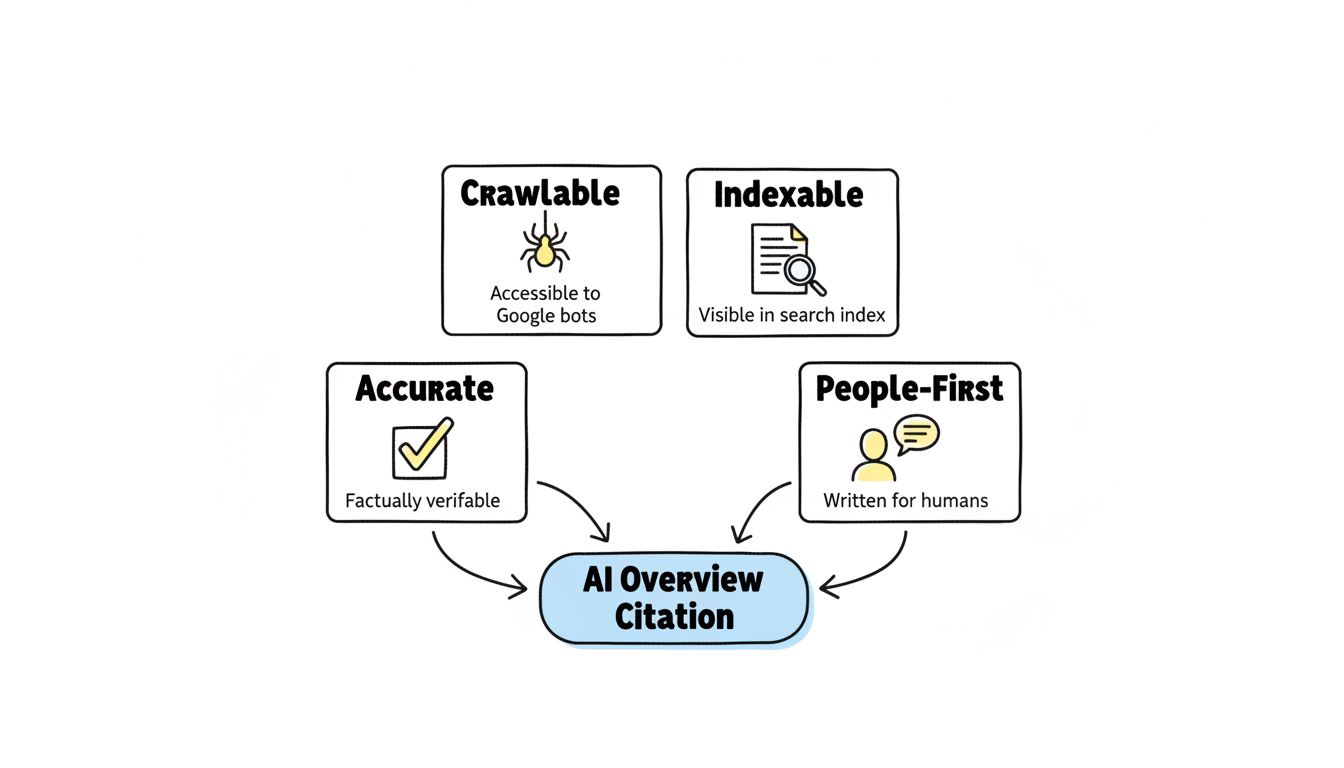
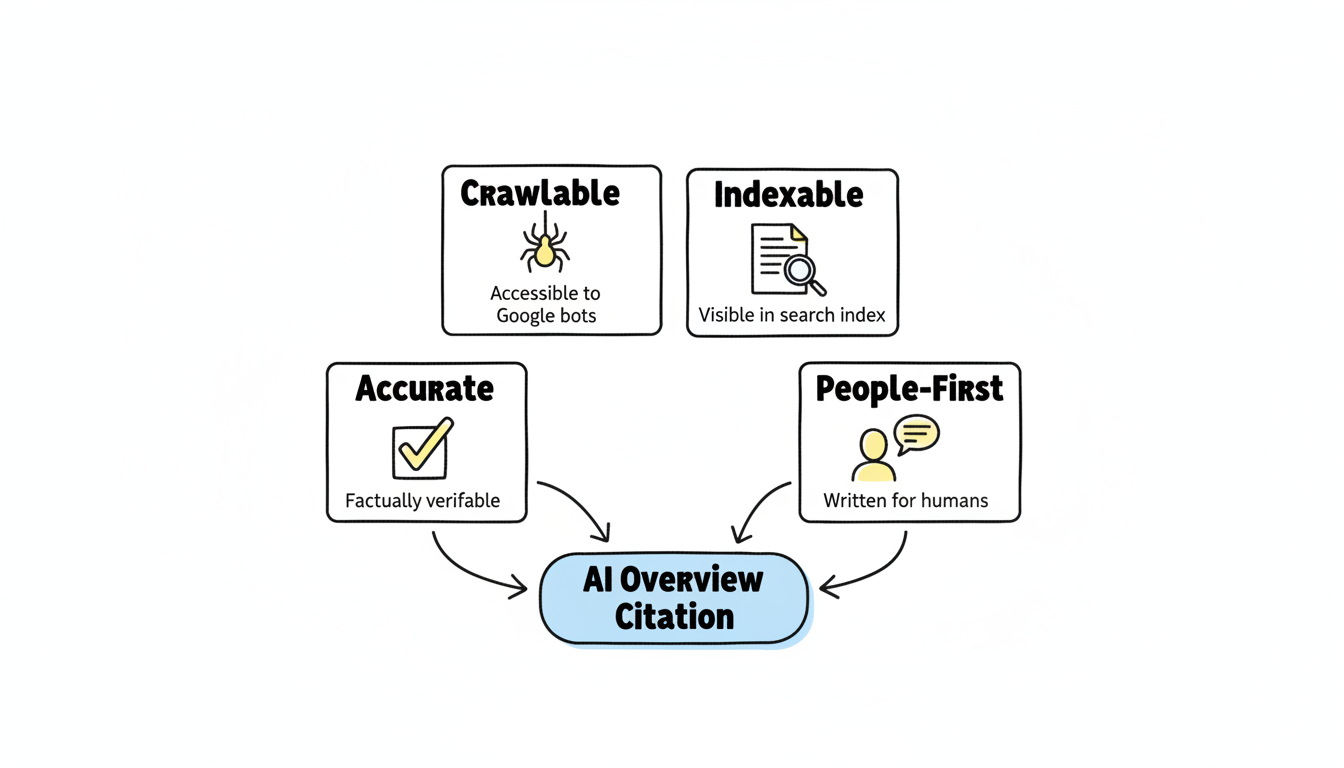
Content selected for AI Overviews must be crawlable, indexable, accurate, and written for people rather than search engines. Structured data must match visible content. Pages meeting these criteria become candidates for citation in AI-generated responses.
Understanding this selection process shapes every optimization decision that follows.
AI Overviews favor content that delivers complete answers without requiring users to search further. Generic, surface-level content fails this satisfaction test. Your content needs:
The AI evaluates whether your content resolves user needs thoroughly. Depth and precision matter more than length or keyword density. For strategies on search engine optimization with AI, focus on content that demonstrates both technical competence and user value.
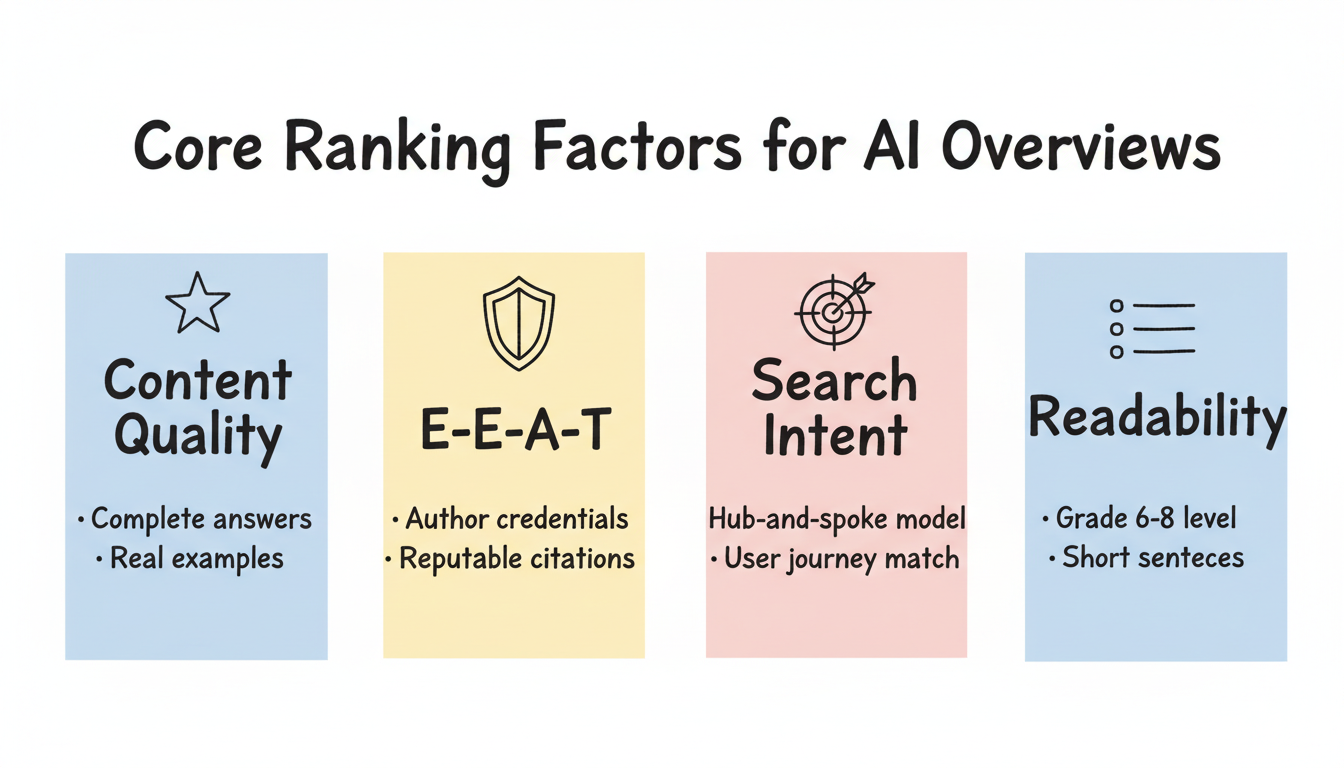
Experience, Expertise, Authoritativeness, and Trustworthiness determine whether AI systems trust your content enough to cite it. Demonstrate these signals through:
Content that clearly demonstrates trust and originality has better chances of AI Overview inclusion.
Google's AI evaluates how well content matches what users actually want to know. Matching search intent remains crucial—perhaps more so for AI Overviews than traditional rankings.
Use hub-and-spoke content models that meet initial user needs while providing paths to related topics. Research user journeys to understand what questions lead to what follow-up questions.
AI Overviews prefer content that's easy to understand for general audiences without being oversimplified. Research shows highly complex writing (Flesch-Kincaid Grade 11+) performs worse than accessible yet informative text (Grade 6-8).
Write clearly. Use shorter sentences. Break complex topics into digestible sections. The AI prefers content it can confidently extract and summarize.
Begin each article with a short, factual summary answering the main question. Concise introductions help content appear in AI Overviews—the AI often pulls from opening paragraphs when generating summaries.
Don't bury the answer. Lead with what users need to know, then expand with supporting detail.
Structure content around the questions users ask. H2 and H3 headings framed as questions help AI systems understand content organization and match it to relevant queries.
Instead of "Overview of Topic," use "What Is [Topic] and Why Does It Matter?"
FAQ sections provide structured Q&A content that AI systems extract efficiently. Research indicates that pages with well-structured FAQ blocks earn more AI Overview citations than equivalent content without them.
Each FAQ answer should provide complete, standalone responses. Don't create questions that require reading other sections to understand the answer. Understanding when disabling Google AI Overviews when and how to do so can help you control brand messaging in certain contexts.
Modular content sections help AI systems parse and extract information. Use:
These formats translate naturally into AI-generated summaries.
Schema markup helps Google understand content context and verify accuracy. While structured data alone doesn't guarantee AI Overview inclusion, it signals content organization and helps AI systems parse information correctly.
Implement relevant schema types: Article, FAQ, HowTo, Product, Review. Ensure markup matches visible content—discrepancies hurt credibility.
Core Web Vitals influence AI Overview visibility. Research shows technical performance metrics like INP (Interaction to Next Paint) and LCP (Largest Contentful Paint) correlate with citation frequency.
Pages that load slowly or perform poorly provide poor user experiences. AI systems factor this into content selection.
AI Overviews can only cite content that Google can access. Verify your content is crawlable by checking robots.txt and using Google Search Console's URL Inspection tool.
Compare rendered HTML with raw source code. If content loads via JavaScript and doesn't appear in the rendered view, crawlers can't see it—and neither can AI Overviews.
Research consistently shows domain authority—measured through traffic, backlinks, and trust metrics—strongly influences AI Overview inclusion. Established domains with demonstrated authority earn citations more frequently.
For newer domains, content quality and technical optimization can compensate for lower authority. But building genuine authority through backlinks and reputation remains important.
Include citations from reputable sources within your content. AI systems evaluate whether content references authoritative external information. Quotes from experts, links to studies, and references to established sources strengthen credibility.
AI systems evaluate brand presence across the web. PR coverage, customer stories, social media presence, and consistent messaging across channels help AI systems recognize your brand as authoritative.
Content that appears in isolation—without broader web presence supporting it—lacks the trust signals AI systems prioritize.
Determine whether your site appears in AI Overviews using available checker tools. Monitor which queries trigger your content and track changes over time. Consider leveraging AI citation tracking tools to monitor your brand mentions across multiple AI platforms beyond just Google.
AI Overview citations fluctuate more than traditional rankings. You can appear in the morning, disappear by afternoon, optimize, and return by evening. Continuous monitoring helps you understand patterns.
AI Overviews may drive less click-through traffic than traditional rankings, but they deliver highly qualified visitors. Consider both visibility in AI results and actual site engagement when measuring success.
Separate AI Overview performance from traditional ranking performance in your analytics. The strategies overlap but the outcomes differ.
Immediate actions:
Ongoing optimization:
AI Overviews represent a fundamental shift in how users find information. Rather than scanning multiple search results, users increasingly receive synthesized answers directly. Content that AI systems can confidently cite—complete, trustworthy, well-structured—gains visibility in this new paradigm.
The good news: many optimization factors for AI Overviews align with quality content fundamentals. Write thoroughly, structure clearly, demonstrate expertise, and maintain technical excellence. These practices serve both traditional rankings and AI citation—the foundation for search visibility in 2026 and beyond.
By submitting this form, you agree to our Privacy Policy and Terms & Conditions.



