February 19, 2026


Google's search results have transformed fundamentally. What began as featured snippets—highlighted answer boxes at position zero—has evolved into AI Overviews: comprehensive, AI-generated summaries that synthesize information from multiple sources and appear at the top of search results. Understanding this evolution and optimizing for the new reality determines whether brands capture visibility in AI-first search.
According to Serpstat's AI Overviews research, AI Overviews changed search faster than anyone expected. In less than twelve months, Google went from testing generative answers to deploying them across nearly a third of search results—an analysis of over 1 billion keywords revealed the scale of transformation.
Featured snippets established the foundation for AI-generated search summaries. Understanding this evolution helps optimize for where search is heading.
According to ClickRank's featured snippets guide, featured snippets are now the "seed data" for AI Overviews. If you win the list featured snippets AI overviews, you have a 75% higher chance of being the primary citation in the AI-generated summary. Optimizing for snippets remains the most reliable way to influence what AI tells users about your industry.
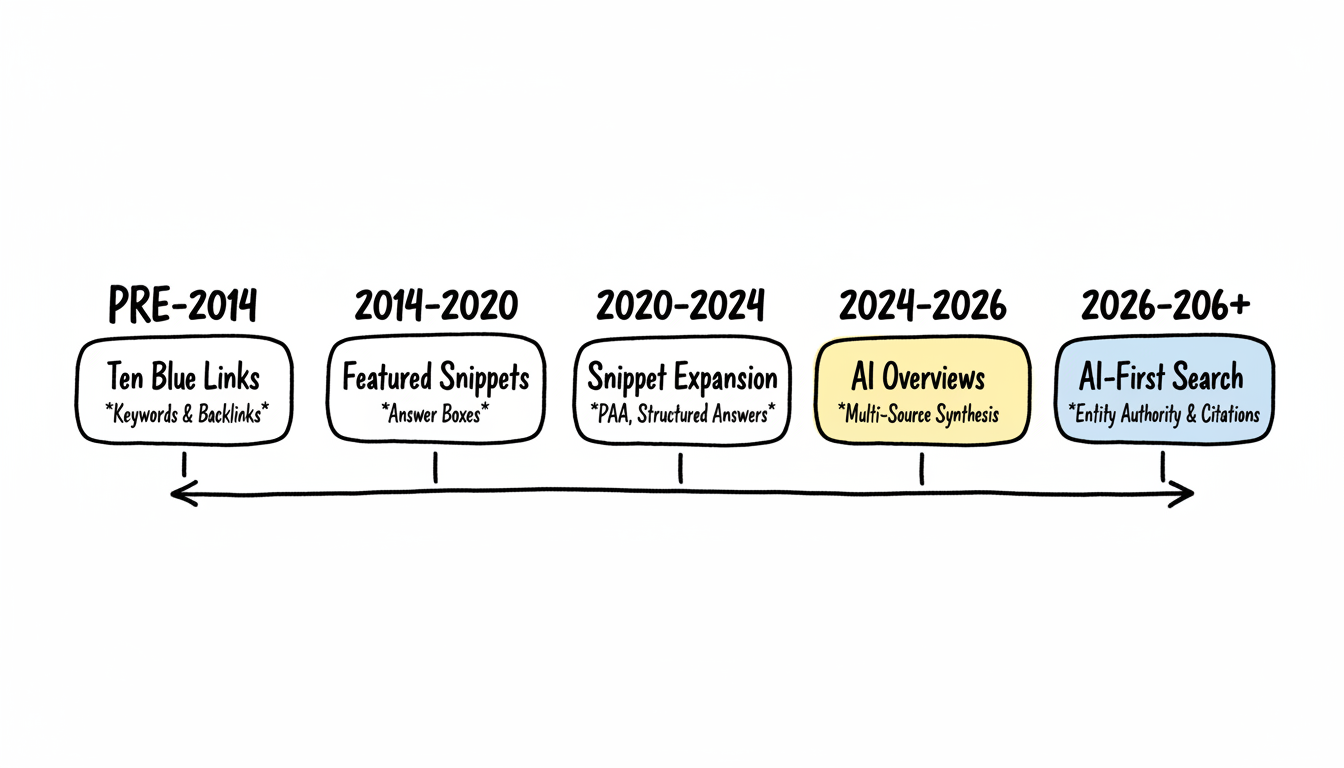
The evolutionary path:
Era | Format | Optimization Focus |
Pre-2014 | Ten blue links | Keywords and backlinks |
2014-2020 | Featured snippets emerge | Answer boxes, position zero |
2020-2024 | Snippet expansion | PAA, structured answers |
2024-2026 | AI Overviews (SGE) | Multi-source synthesis |
2026+ | AI-first search | Entity authority, citations |
According to NoGood's future of search analysis, Google's search results look almost unrecognizable compared to a few years ago. AI Overviews now dominate informational queries, featured snippets compete for attention with organic results, and the traditional "ten blue links" are often buried below the fold.
While featured snippets extracted content from a single source, AI Overviews synthesize information from multiple sources—requiring different optimization approaches.
According to Revv Growth's AI Overviews guide, AI Overviews are Google's AI-generated answer summaries that appear at the top of search results. When you search for something, Google's AI pulls information from multiple sources across the web, synthesizes it, and presents a cohesive answer right there on the search results page.
Key differences:
Featured Snippets (Legacy)
├── Single source citation
├── Direct content extraction
├── Clear position zero ownership
├── Consistent formatting
└── Relatively stable placements

AI Overviews (Current)
├── Multiple source synthesis
├── AI-generated summaries
├── Citation attribution varies
├── Dynamic formatting
├── Frequent testing and changes
└── Personalization factors
According to Search Engine Land's AI Overviews research, Google tracks how users behave and only shows AI Overviews in Search when they actually add value. If users don't engage with them, Google removes them—and applies that learning to similar queries.
AI Overviews have accelerated the zero-click search phenomenon, changing how visibility translates to traffic.
According to NoGood, 60% of searches now end without a click. Between AI Overviews dominating Google's SERPs, featured snippets answering questions immediately, and LLM responses providing comprehensive answers in chat interfaces, users increasingly get what they need without ever visiting a website.
Zero-click impact:
Metric | Pre-AI Overviews | Post-AI Overviews |
Zero-click searches | ~40% | ~60% |
AI citation visibility | N/A | Primary value driver |
Brand mention importance | Secondary | Critical |
Direct traffic reliance | Lower | Higher |
Impression value | Undervalued | Strategic asset |
According to ALM Corp's 2026 SEO trends, while the zero-click reality initially caused panic among SEOs, forward-thinking brands realized zero-click results represent branding opportunities, not just traffic losses. When your brand appears in an AI Overview, you're achieving top-of-SERP visibility that builds authority and awareness.
Despite AI Overviews, traditional featured snippets remain valuable and often serve as inputs to AI-generated summaries.
According to LinkedIn analysis by Julius Trujillo, featured snippets aren't "nice to have" in 2026—they're your brand's survival kit in an AI-first world. While AI Overviews handle complex queries, snippets still own the factual, high-intent queries. If you aren't winning the snippet, you're losing 35.1% of all potential clicks to a competitor who structured their data better.
Why snippets still matter:
According to ClickRank, featured snippets are more effective than ever because they are the "foundational nodes" for AI search. Even with the rise of AI Overviews, featured snippets provide a single-source citation that often receives a 40%+ click-through rate.
Winning AI Overview citations requires adapting traditional optimization for AI-first search. When developing your generative AI SEO optimization strategy, understanding the foundation requirements becomes essential.
According to WPBeginner's AI Overviews guide, to stay visible in Google AI Overviews, you must shift from simple keywords to "Consensus" and "Authority"—answering complex reasoning questions, building content clusters, getting mentioned on trusted sites, and using schema markup to help AI understand content.
Foundation requirements:
AI Overview Optimization Framework
├── Content Structure
│   ├── Answer-first paragraphs (40-50 words)
│   ├── Question-based headers (H2s)
│   ├── Lists and tables for extraction
│   └── Clear section takeaways
│
├── Authority Signals
│   ├── E-E-A-T demonstration
│   ├── Expert authorship
│   ├── Cross-platform mentions
│   └── Third-party validation
│
├── Technical Implementation
│   ├── Schema markup (FAQ, HowTo)
│   ├── Semantic HTML structure
│   ├── Fast page performance
│   └── Mobile optimization
│
└── Entity Development
    ├── Consistent brand identity
    ├── Knowledge Panel optimization
    ├── Cross-web consensus
    └── Topic authority building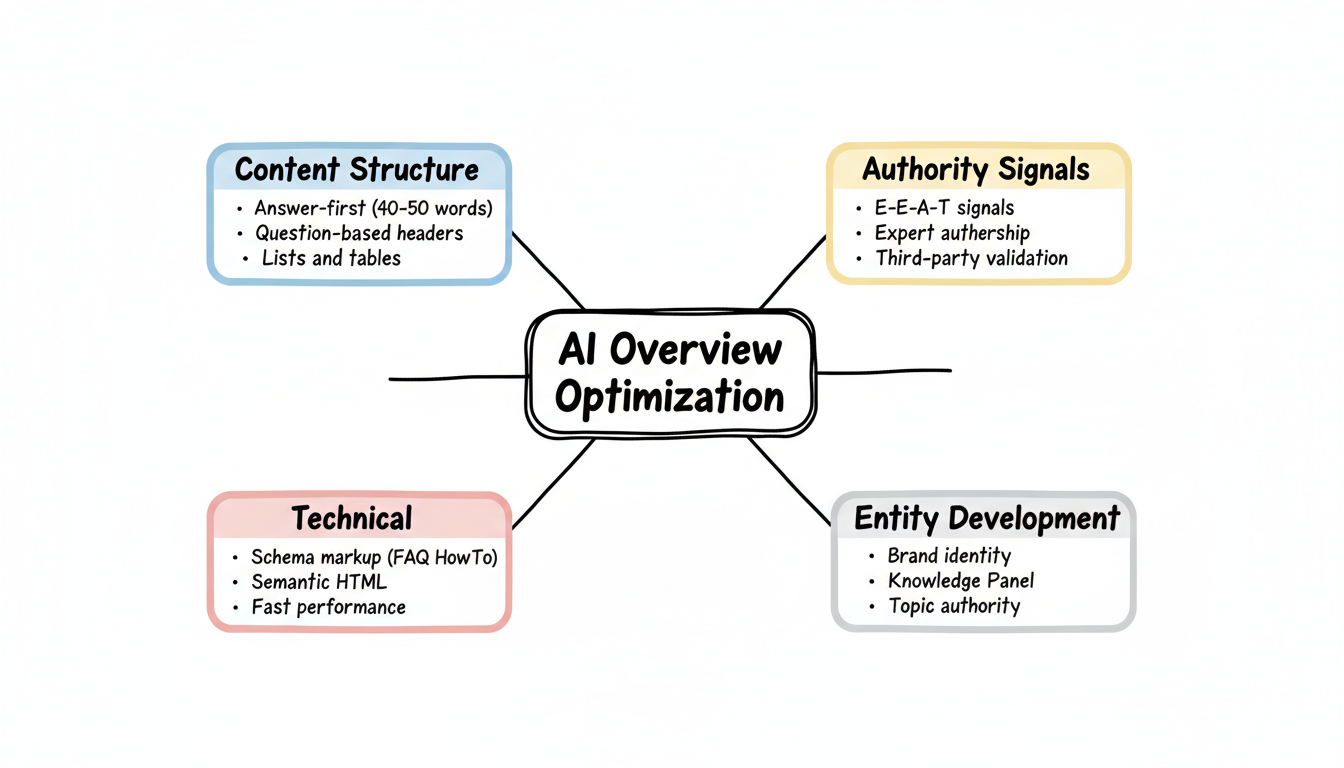
According to Synapse SEM's ranking guide, the webpages cited in AI Overviews are often the same ones Google ranks in first-page organic results. This tells us Google's AI model still relies on the same ranking factors, and traditional SEO tactics remain important for showing up.
Content structure determines whether AI can extract and cite your information.
According to Julius Trujillo's LinkedIn analysis, Google assigns an internal "answerability score" to your page. To score high, your first sentence must define the topic clearly without filler. Aim for 40-50 words that can stand alone if copied.
Answer-first implementation:
Element | Traditional Approach | AI-Optimized Approach |
Opening | Hook or context setup | Direct answer statement |
First paragraph | Background information | Complete standalone answer |
Headers | Topic descriptions | Question-format (What/How/Why) |
Supporting content | Narrative flow | Structured data points |
Closing | Summary | Definitive takeaway |
According to Greenlane Marketing's differentiation guide, one of the easiest ways to improve visibility in both AI Overviews and traditional SERP features is to make content more "answerable"—formatting it so search engines can easily identify and pull concise, helpful information.
Experience, Expertise, Authoritativeness, and Trustworthiness signals carry increased weight in AI-driven search.
According to WPBeginner, with millions of AI-generated articles flooding the web, Google uses E-E-A-T as its main spam filter. AI search prefers content that clearly comes from a human. To rank in AI Overviews, you must prove you are real by using "I" and "We," sharing personal stories, showing your work, and highlighting authors.
E-E-A-T optimization priorities:
Signal | Implementation | AI Impact |
Experience | First-person accounts, tested methods | Authenticity validation |
Expertise | Credentials, detailed knowledge | Source selection |
Authoritativeness | Industry recognition, citations | Entity trust |
Trustworthiness | Verifiable claims, accuracy | Citation confidence |
According to LinkedIn's 2026 predictions, E-E-A-T is becoming the new "PageRank." Search engines and AI assistants are no longer looking for the most optimized content—they're looking for content that demonstrates genuine expertise and human experience.
AI systems consider multiple related pages when generating responses, making content clusters strategically valuable. Organizations working with a geo-services agency often leverage content clustering as part of their comprehensive optimization approach.
According to WPBeginner, optimizing for "query fan-out" with content clusters helps AI Overviews identify your site as a comprehensive source. When AI needs to synthesize information across related subtopics, having interconnected content increases citation probability.
Cluster strategy elements:
According to Higher Education Marketing's SGE guide, early studies suggest Google's AI Overviews may cite content beyond the top organic rankings, particularly when pages clearly and directly answer a user's question. Well-structured, authoritative content can be surfaced even if it doesn't rank first in classic search.
Technical optimization ensures AI systems can effectively crawl, understand, and cite your content.
According to The Egg's AI Overviews guide, the presence and variety of schema markups contribute to improved AI visibility. The presence of FAQ schema and 3+ types of schema are more likely to be cited in AI responses.
Technical priorities:
Implementation | Purpose | Priority |
Schema markup | Machine-readable structure | Critical |
Heading hierarchy | Content organization signals | High |
List and table formatting | Extractable data presentation | High |
Fast load times | Efficient AI crawling | Medium |
Mobile optimization | Cross-device accessibility | Medium |
LLMS.txt | AI-specific instructions | Emerging |
According to Revv Growth, implementing proper schema markup (FAQ, HowTo, Article) helps search engines understand your content's structure and relevance, increasing the chances of being cited in AI-generated responses.
Tracking visibility in AI Overviews requires new monitoring approaches beyond traditional rank tracking.
According to The Egg, monitoring AI Overview volatility is essential—track performance and visibility closely as they change and shift frequently. Tools that track Share of AI Overview, compare with competitors, and display actual content and links cited within AI Overviews day by day provide actionable intelligence.
Monitoring framework:
Metric | What It Shows | Tools |
AI Overview presence | Whether you're cited | AI visibility platforms |
Citation context | How AI describes you | Sentiment monitoring |
Share of voice | Competitive position | Comparative tracking |
Citation frequency | Consistency of visibility | Time-series analysis |
Answer volatility | Placement stability | Daily monitoring |
According to Julius Trujillo, Google is constantly testing snippet and overview holders. If you win a spot, don't walk away. Monitor performance in Search Console—if CTR drops, it's time to rewrite your answer block to be shorter or more direct.
Avoiding common mistakes accelerates AI Overview visibility gains.
According to Revv Growth, burying the answer too deep in content is a critical mistake—AI systems look for immediate, clear responses. Other mistakes include lacking structured data, ignoring content freshness, and failing to demonstrate expertise.
Mistakes to avoid:
Success in 2026 requires optimizing for both traditional search and AI Overviews simultaneously. For organizations managing AI search optimization budget, understanding the dual approach helps allocate resources effectively.
According to Marketer Milk's SEO trends analysis, Google still dominates with 90% market share, and with AI Mode and AI Overviews, it's positioned to win the AI search race. Optimizing for Google will allow brands to show up in ChatGPT and Perplexity as well—the fundamentals still matter.
Dual optimization framework:
Layer | Traditional SEO Focus | AI Overviews Focus |
Technical | Crawlability, speed | Schema, structure |
Content | Keywords, depth | Answers, extractability |
Authority | Backlinks, domain | E-E-A-T, entity recognition |
Measurement | Rankings, traffic | Citations, share of voice |
According to ALM Corp, the metrics defining success now include impression share in target keywords, share of voice in featured snippets, brand mention volume across AI platforms, Knowledge Panel accuracy, and visibility tracking beyond click-through metrics.
Optimizing for Google AI Overviews requires understanding the evolution from featured snippets and adapting accordingly:
According to Siege Media's GEO analysis, 36.4% of content marketers reported traffic drops between 2024 and 2025 due to AI Overviews and AI search. Content might be great, but if it's not showing up in AI results, it's reaching a much smaller audience—making AI Overviews optimization essential for maintaining visibility.
By submitting this form, you agree to our Privacy Policy and Terms & Conditions.