
February 19, 2026


Generative AI search engines don't read content the way humans do. They scan for quotable paragraphs—self-contained answers they can extract and attribute. Understanding this fundamental difference determines whether your content gets cited in AI responses or gets ignored entirely.
The shift from ranking to citation changes everything about content optimization. Traditional SEO focused on getting pages to appear in search results. Generative engine optimization strategies focus on getting your content quoted when AI systems synthesize answers.
AI platforms like ChatGPT, Perplexity, and Google AI Overviews evaluate content differently than traditional search algorithms.
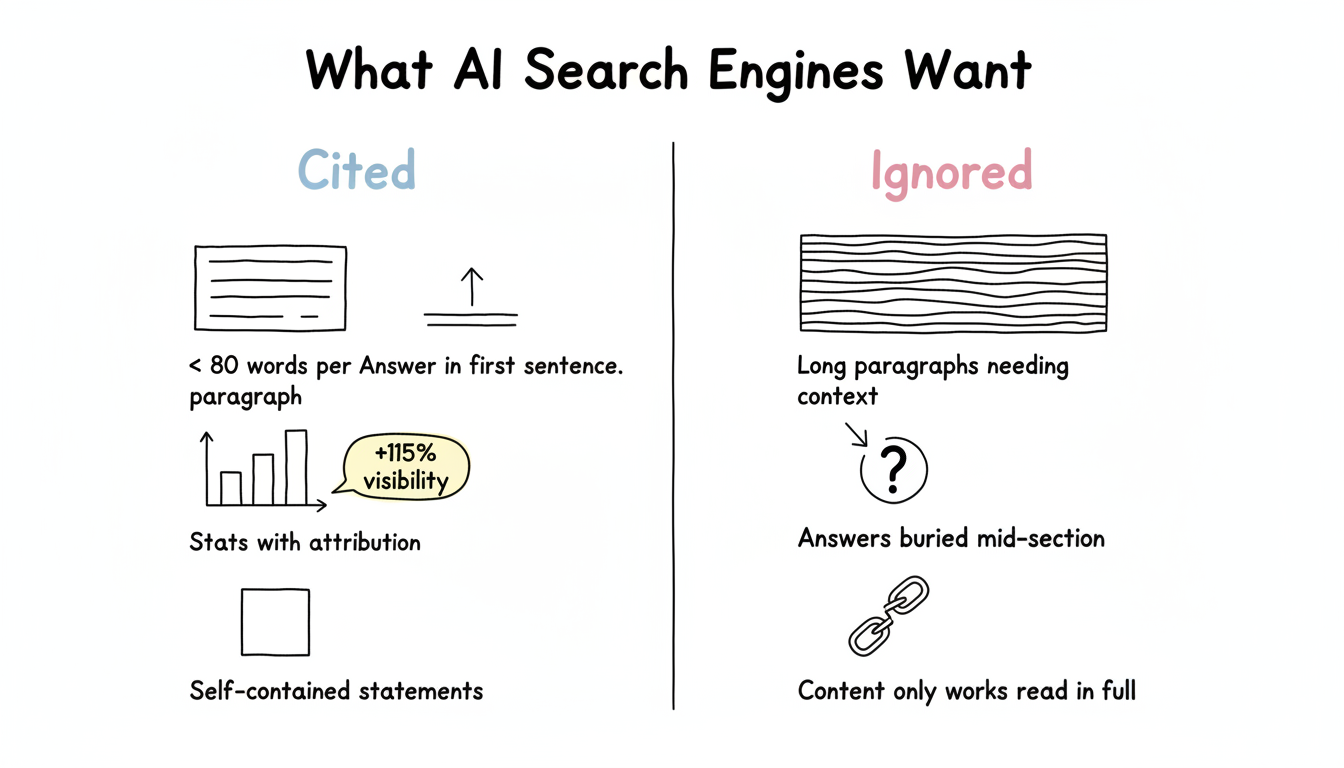
What AI systems look for:
Research shows that statistics with proper attribution increase citation visibility by 115%. AI systems prefer citing specific data points they can verify and attribute to sources.
What doesn't work:
Each AI platform has distinct preferences for the content it cites.
ChatGPT draws from its training data and, with browsing enabled, real-time web content. The platform favors:
Optimization approach:
Structure content as complete explanations that stand alone. ChatGPT extracts information from pages it considers authoritative on topics. Following SearchGPT optimization guide principles helps build the topical authority that increases citation likelihood.
Perplexity emphasizes real-time search with inline citations. The platform weights:
Optimization approach:
Update priority content frequently. Perplexity's recency bias means fresh content outperforms static pages. Front-load key information in the first 100 words where Perplexity often extracts citations. Learn more about Perplexity AI search optimization techniques.
Visual placement of citations influences roughly 20% of Perplexity's ranking weight. Position your most important, quotable statements prominently.
Google AI Overviews blend traditional search authority signals with AI-friendly content structure. The feature prioritizes:
Optimization approach:
Strong SEO fundamentals directly improve AI Overview visibility. Pages ranking on page one have higher probability of AI Overview citation. Maintain traditional SEO practices while adding AI-specific structural optimization following the Google AI Overviews optimization playbook.
Comprehensive search visibility in 2026 requires attention to four interconnected optimization approaches.
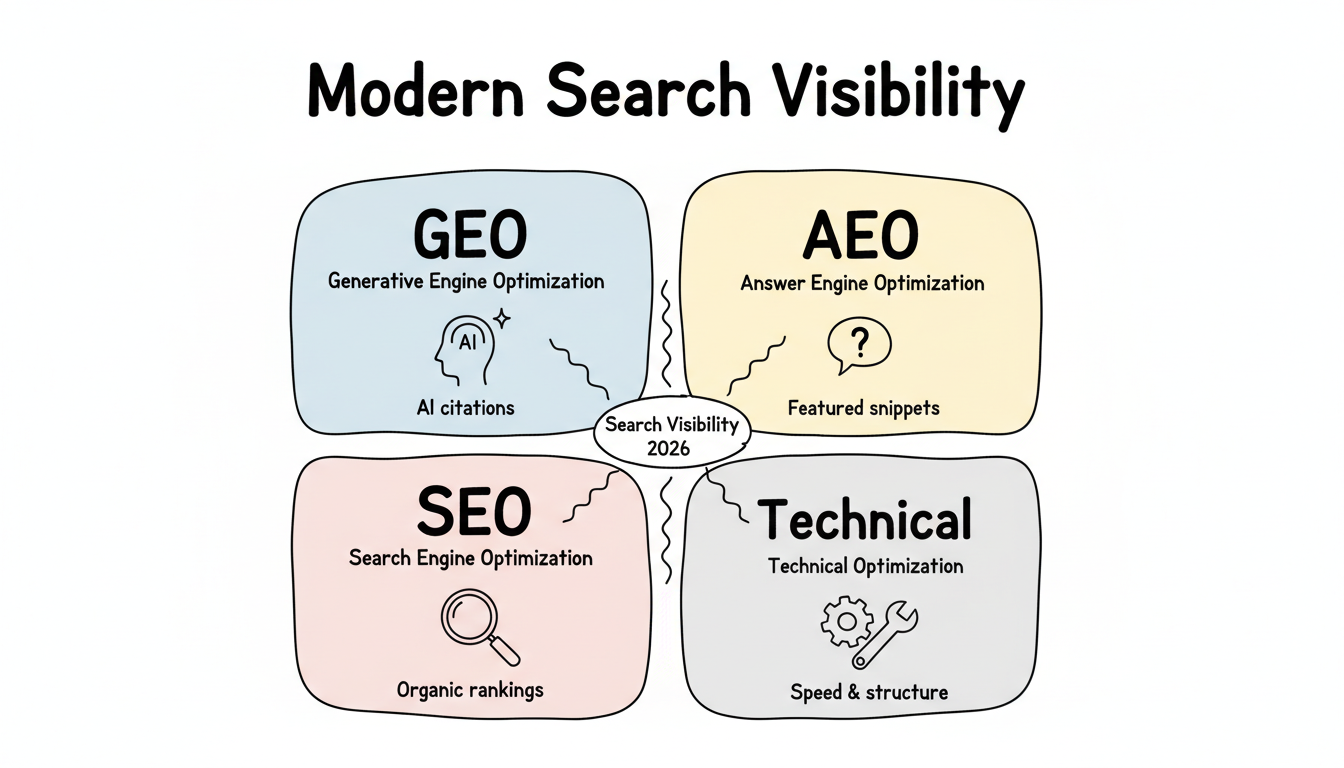
GEO focuses specifically on earning citations from AI platforms. Core tactics include:
GEO success means appearing when AI synthesizes answers from multiple sources.
AEO optimizes for direct answer selection—featured snippets, voice responses, and position zero results. Key requirements:
AEO wins without clicks. Users see your answer directly in search results.
Traditional SEO remains the foundation. Strong rankings correlate with AI citation probability. Essential elements:
Don't abandon SEO for newer approaches. The majority of web traffic still flows through traditional search.
Technical excellence supports all three optimization approaches:
Technical problems undermine both traditional rankings and AI visibility.
Format content so AI systems can easily extract and cite it.
Each paragraph should contain one clear idea, under 80 words, with the answer in the first sentence.
Example structure:
"[Direct answer to the section question]. [Supporting detail or context]. [Specific data point if relevant]. [Implication or application]."
This structure gives AI systems exactly what they need—a quotable, attributable statement.
Headers should match how users phrase questions. AI systems use headers to understand what each section answers.
Effective headers:
Less effective headers:
Clear, direct headers help AI systems match your content to user queries.
AI systems parse structured formats more reliably than prose. Use lists for:
Tables work well for comparisons across multiple dimensions—pricing tiers, platform features, strategy differences.
Track both traditional metrics and AI-specific indicators.
AI visibility metrics:
Tools for measurement:
Platforms like Otterly.AI, Semrush AI Toolkit, and emerging AI visibility trackers monitor citation frequency. Set up tracking before optimization so you can measure improvement.
Manual monitoring:
Test 10-20 queries your buyers ask across ChatGPT, Perplexity, and Google AI Overviews monthly. Document which brands get cited and how your content appears.
Start with changes that have the highest impact for lowest effort.
ChatGPT, Perplexity, and Google AI Overviews have different behaviors. Content optimized exclusively for one may underperform on others. Build broad authority that translates across platforms.
AI visibility and traditional rankings correlate. Pages that rank well organically have higher citation probability. Maintaining SEO fundamentals strengthens AI performance.
GEO authority compounds over time. Consistent investment produces accelerating returns. Short-term thinking limits potential.
AI platforms weight recency, especially Perplexity. Static content loses visibility to regularly updated competitors. Build systematic update processes.
By submitting this form, you agree to our Privacy Policy and Terms & Conditions.



