February 19, 2026


AI search optimization has moved from experimental line item to strategic investment category. Conductor's 2026 AEO/GEO CMO Investment Report reveals that enterprises allocated an average of 12% of their digital marketing budgets to AEO/GEO in 2025, with 94% planning to increase that investment in 2026. Organizations that approach budget planning strategically gain compound advantages over competitors spreading resources too thin or investing too slowly.
AI search budget decisions carry strategic consequences beyond typical marketing allocation choices.
The acceleration gap: High AEO/GEO maturity organizations are 2x more likely than medium-maturity organizations—and 3x more likely than low-maturity organizations—to significantly increase AI search investment in 2026. This acceleration creates compounding advantages that late movers struggle to overcome.
Proven impact: Nearly 97% of enterprise executives report AEO/GEO delivers measurable, positive business impact on the marketing funnel. This isn't speculative investment—organizations already investing report tangible returns that justify continued and expanded allocation.
Strategic priority shift: AEO/GEO now ranks as the top strategic marketing priority for 2026 among surveyed enterprise leaders. Budget allocation should reflect this strategic elevation rather than treating AI search as a subset of traditional SEO spend.
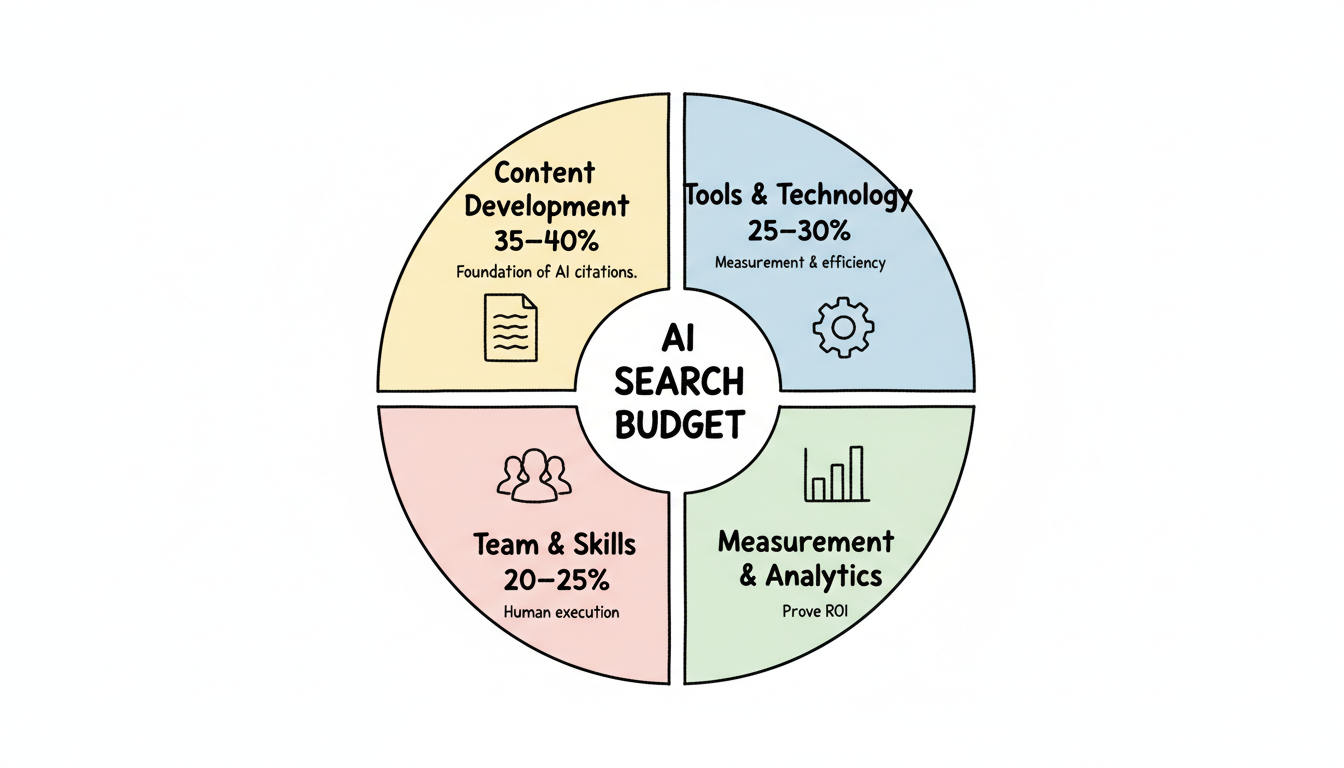
Divide AI search optimization budget across four investment categories.
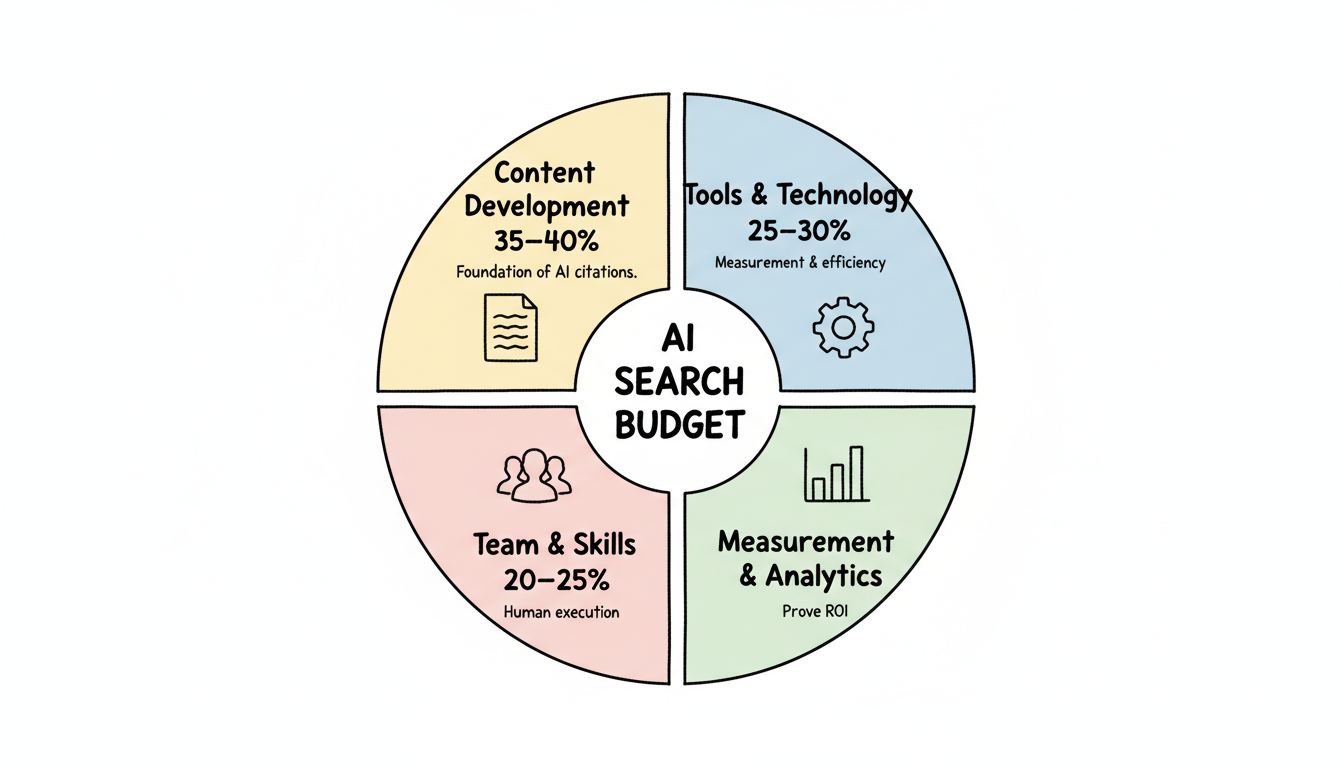
Technology enables measurement, monitoring, and operational efficiency.
Essential tool categories:
Category | Monthly Cost Range | Purpose |
AI visibility tracking | $20-500 | Monitor citations across platforms |
Content optimization | $79-200 | AI-specific content scoring |
All-in-one SEO platforms | $165-400 | Comprehensive SEO with AI features |
Analytics and reporting | $229+ | Automated performance reporting |
Content creation assistants | $20-200 | AI-assisted content development |
Tool selection priorities: Don't collect tools without purpose. According to research, organizations achieve 15-25% efficiency gains from AI tool investments representing 8-10% of total marketing budget. Select tools that eliminate repetitive tasks and enable measurement capabilities you lack internally. Organizations can leverage SEO automation tools to maximize efficiency gains while reducing manual workload.
Platform versus point solutions: All-in-one platforms like Semrush offer AI Visibility Toolkit features but cost more and add complexity. Specialized tools like Rankscale.ai provide granular multi-LLM tracking at lower cost. Your choice depends on team capability and integration requirements.
Content remains the foundation of AI citation potential.
Content investment areas:
Quality over volume: AI systems reward comprehensive, authoritative content over high-volume publishing. Budget for fewer, better pieces rather than more mediocre content. A single well-optimized pillar page generates more AI citations than dozens of thin supporting articles. Understanding how to optimize content for AI overview ensures your investment yields maximum citation potential.
Content maintenance allocation: Reserve 20-25% of content budget for updates and maintenance. AI systems increasingly weight freshness signals, and outdated content loses citation potential regardless of initial quality.
People execute strategy—tools and content require human direction.
Team investment options:
Build versus buy decisions: Organizations with existing strong SEO teams often benefit from training investments to add AI search capabilities. Organizations lacking SEO foundation may find agency partnerships more cost-effective than building from scratch. When evaluating external support, consider AEO agency selection criteria to ensure strategic alignment and proven expertise.
Critical skills to develop:
Measurement systems prove ROI and guide optimization.
Measurement investments:
Attribution complexity: AI search attribution requires investment beyond traditional SEO measurement. Users may discover your brand in an AI answer, refine through image search, compare on marketplaces, and convert weeks later through brand search. Budget for sophisticated attribution that captures AI's role in consideration. A comprehensive AEO measurement tracking guide helps establish baseline metrics and progressive KPIs.
Appropriate budget levels vary by organization scale and competitive intensity.
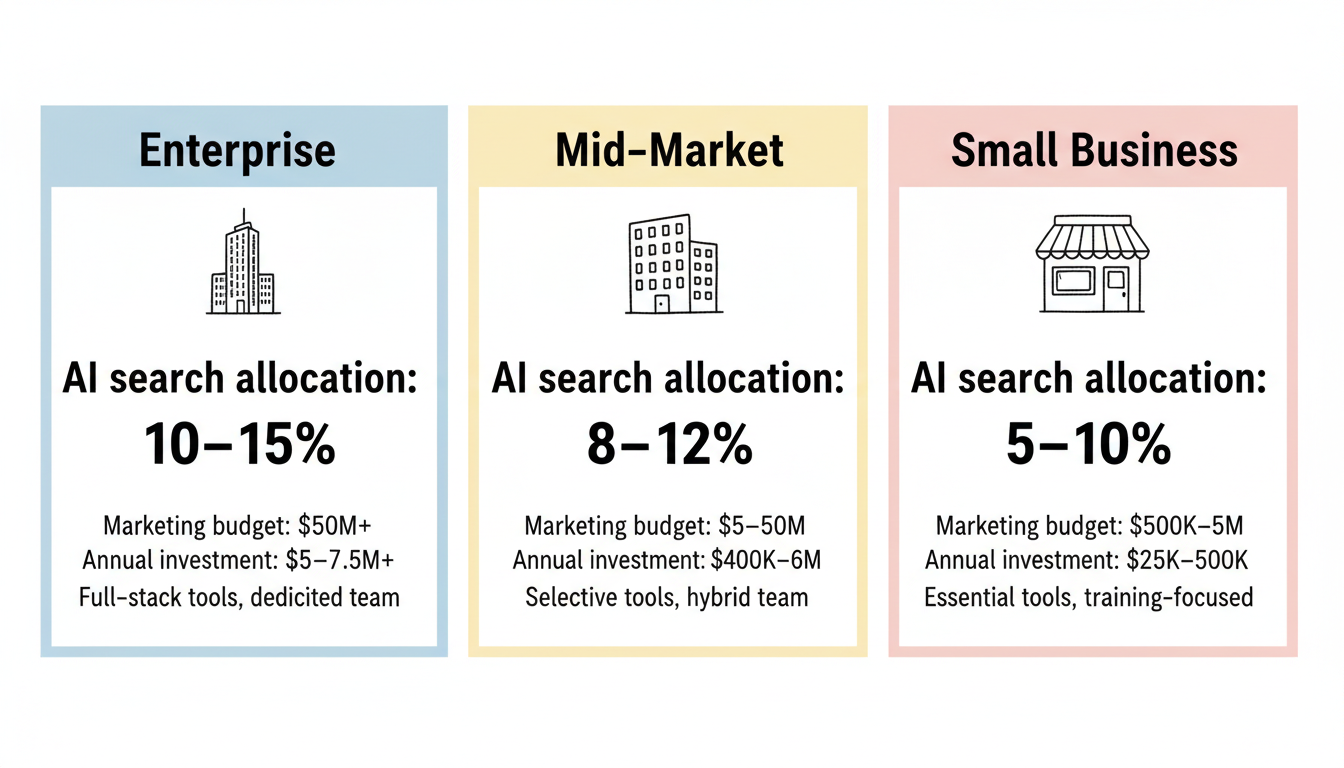
Enterprise organizations ($50M+ marketing budget):
Mid-market organizations ($5-50M marketing budget):
Small businesses ($500K-5M marketing budget):
Budget allocation should connect to measurable outcomes.
Leading indicators:
Lagging indicators:
ROI calculation challenges: AI search ROI resists simple calculation. Brand visibility in AI responses influences decisions across extended consideration periods. Budget for measurement systems that capture influence metrics beyond direct conversion attribution.
Investment timeline expectations: AI search optimization typically shows leading indicator improvements within 3-6 months and business outcome impact within 6-12 months. Budget planning should accommodate this timeline rather than expecting immediate returns. Reference an AI search optimization timeline roadmap when setting stakeholder expectations for progressive maturity.
Effective AI search budgets often come from strategic reallocation.
Candidates for reallocation:
Reallocation cautions: Don't gut traditional SEO to fund AI search. Pages ranking in Google's top 10 show approximately 0.65 correlation with LLM mentions. Strong organic presence supports AI visibility—they're complementary investments.
Incremental versus transformational: Organizations early in AI search maturity should budget for incremental progress toward capability building. Attempting transformational investment without foundation leads to waste. Build systematically before scaling.
Integrate AI search budget into annual planning cycles.
Planning timeline:
Quarterly review triggers:
Budget flexibility: Reserve 15-20% of AI search budget for opportunistic investment. The landscape evolves rapidly—rigid budgets prevent capitalizing on emerging opportunities or responding to competitive threats.
Avoid patterns that undermine AI search investment effectiveness.
Underfunding measurement: Organizations investing in content and tools without measurement cannot prove ROI or optimize allocation. Measurement investment enables all other investments to demonstrate value.
Tool proliferation: Collecting AI tools without integration creates fragmented data and operational overhead. Each tool should solve a specific problem and integrate with your measurement system.
Neglecting content maintenance: Initial content investment without ongoing updates degrades over time. AI systems increasingly favor fresh, current content—budget for maintenance from the start.
Ignoring team development: Tools and content require skilled operators. Organizations that invest in technology without team capability struggle to extract value from their investments.
Over-optimism on timelines: AI search builds over time. Budgets assuming immediate returns lead to premature abandonment. Set realistic expectations and fund for sustainable progress.
Enterprise organizations typically allocate 10-15% of digital marketing budgets to AI search, while mid-market companies allocate 8-12%, and smaller businesses 5-10%. The 2026 benchmark for enterprise averages 12% of digital marketing spend dedicated to AEO/GEO, with 94% of organizations planning to increase this allocation.
Ideally both. Some reallocation from traditional SEO activities makes sense—particularly from tactics with limited AI impact. However, strong traditional SEO supports AI visibility, so maintaining organic search investment while adding AI-specific budget delivers best results. Avoid cannibalizing effective SEO to fund AI experimentation.
Minimum viable investment requires at least one monitoring tool ($50-200/month), content creation capability (internal or outsourced), and measurement approach. Organizations can begin with $2,000-5,000 monthly for basic capability, though this limits competitive potential against well-funded competitors.
By submitting this form, you agree to our Privacy Policy and Terms & Conditions.