
February 19, 2026


AI search traffic converts at 4.4x the rate of traditional organic search. That single statistic explains why businesses are rushing to find GEO agencies—and why choosing the right partner matters enormously.
But the generative engine optimization market is young. Service definitions vary. Pricing models differ wildly. And many agencies are repackaging traditional SEO as "AI optimization" without the specialized capabilities the work actually requires.
This guide covers exactly what legitimate GEO agencies deliver, how engagements are structured, what you should pay, and how to evaluate whether a potential partner can actually improve your AI search visibility.
Generative Engine Optimization focuses on making your brand visible when AI systems—ChatGPT, Perplexity, Claude, Google AI Overviews—generate responses to user queries. Unlike traditional SEO, which optimizes for ranking positions, GEO optimizes for citations and brand mentions within synthesized AI answers.
Core GEO agency functions:
A genuine GEO agency differs from a traditional SEO agency in both methodology and measurement. SEO agencies track keyword rankings. GEO agencies track whether AI systems cite, mention, and accurately represent your brand when users ask relevant questions.
Most reputable GEO agencies structure engagements in three distinct phases. Understanding these phases helps you evaluate proposals and set realistic expectations.
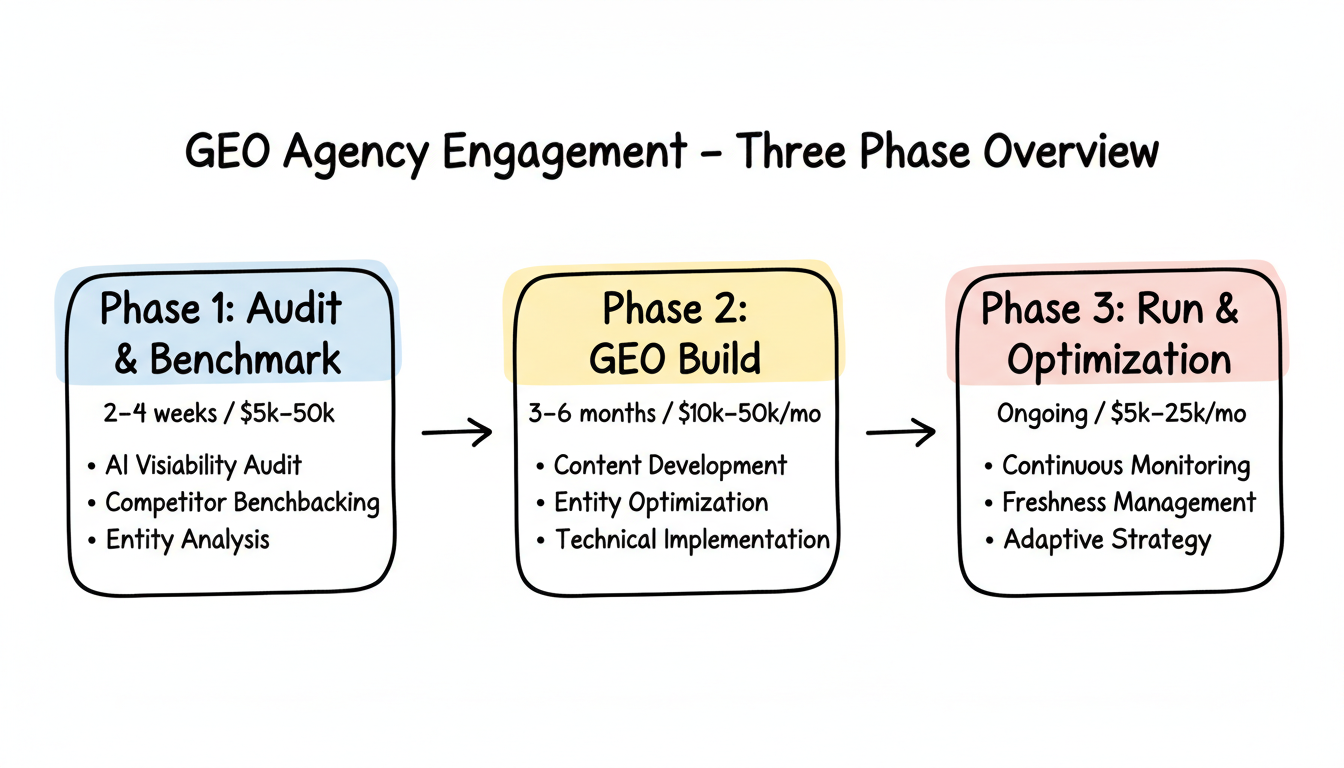
Duration: 2-4 weeks Investment: $5,000-$50,000+ depending on scope
The audit phase establishes your baseline. Without understanding current AI visibility, neither you nor the agency can measure improvement.
What a comprehensive GEO audit includes:
AI Platform Coverage Assessment:
Entity Recognition Analysis:
Content Extractability Review:
Competitive Benchmarking:
The audit deliverable should include specific, actionable recommendations—not vague suggestions. You should receive a prioritized roadmap with expected impact for each initiative. An AEO marketing audit provides the comprehensive assessment necessary for effective optimization.
Red flag: Agencies that skip the audit and jump directly to "optimization" are likely applying generic tactics without understanding your specific situation. Legitimate GEO requires baseline measurement.
Duration: 3-6 months Investment: $10,000-$50,000/month
The build phase implements the audit recommendations. This is where the actual optimization work happens.
Typical build phase deliverables:
Citation-Ready Content Development:
Entity Optimization:
Technical Implementation:
Authority Signal Development:
Content Transformation:
The build phase should show measurable progress. Agencies should provide regular reporting on citation improvements, not just activity metrics like "pages optimized." Understanding AI search content structure best practices is essential during this phase.
Duration: Ongoing Investment: $5,000-$25,000/month
The ongoing phase maintains and expands AI visibility. AI platforms evolve constantly—what works today may need adjustment tomorrow.
Ongoing optimization activities:
Continuous Monitoring:
Content Freshness Management:
Adaptive Optimization:
Reporting and Strategy:
Using an AEO ROI calculator helps track the financial impact of ongoing optimization efforts.
GEO pricing varies significantly based on scope, agency expertise, and market position. Here's what to expect:
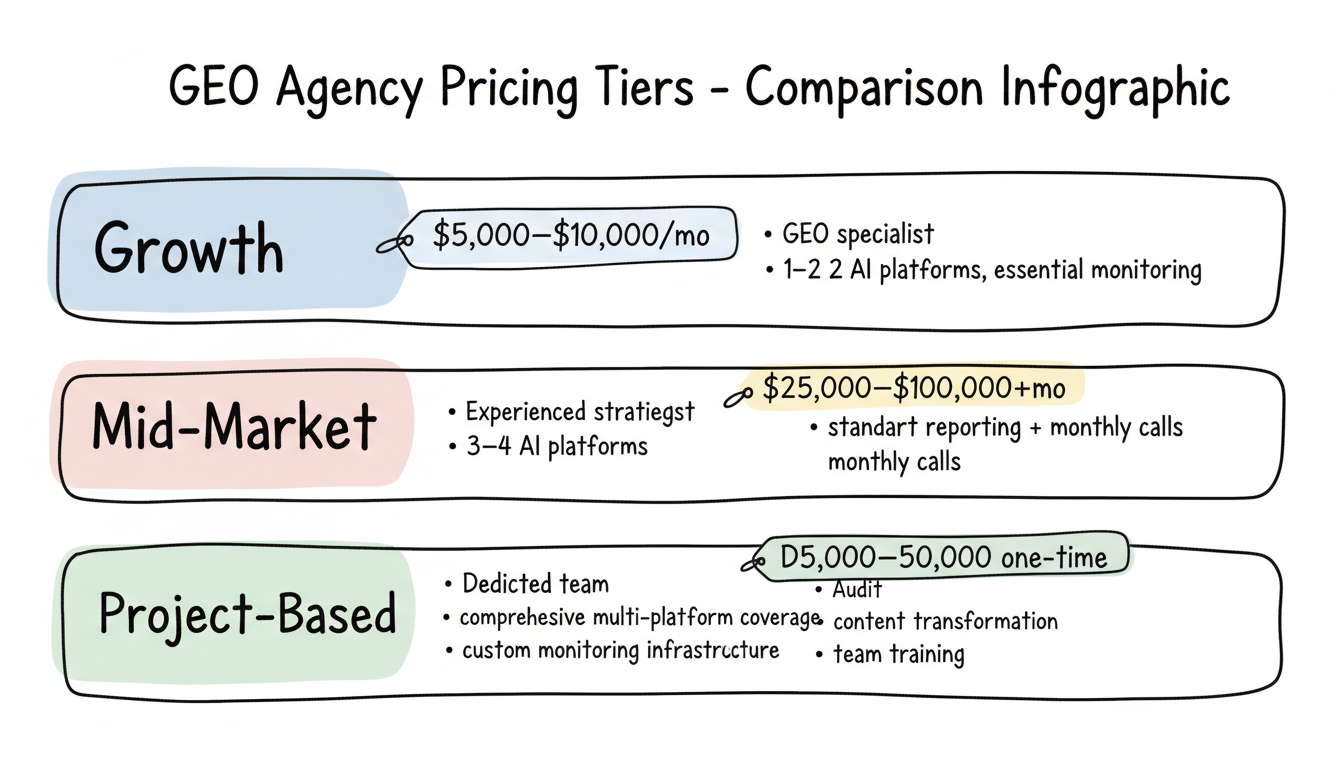
Investment: $25,000-$100,000+/month Best for: Large organizations with complex digital footprints
Enterprise programs include:
Investment: $10,000-$25,000/month Best for: Established businesses prioritizing AI visibility
Mid-market programs include:
Investment: $5,000-$10,000/month Best for: Growing businesses building AI presence
Growth programs include:
Investment: $10,000-$50,000 per project Best for: Specific initiatives or one-time optimizations
Project engagements might include:
Pricing red flags:
Legitimate GEO agencies should provide specific, measurable deliverables—not vague promises.
GEO Audit Report:
GEO Strategy Document:
Technical Specifications:
Monthly Reports:
Quarterly Reviews:
Depending on engagement scope:
Not every agency claiming GEO expertise actually has it. Here's how to separate genuine specialists from repackaged SEO agencies.
About methodology:
About experience:
About measurement:
Effective AI search KPI goal setting requires clear measurement frameworks from the outset.
Specialized tools and processes: Legitimate GEO agencies have developed specific methodologies for AI visibility measurement. They should be able to explain their tracking infrastructure and show you example reports.
Platform-specific expertise: Different AI platforms have different ranking factors. Agencies should demonstrate knowledge of how Perplexity differs from ChatGPT and how both differ from Google AI Overviews.
Citation-focused case studies: Case studies should include AI-specific metrics: citation frequency, share of voice in AI responses, brand mention accuracy. Traditional SEO metrics don't demonstrate GEO capability.
Technical depth: GEO requires understanding of entity optimization, structured data, AI crawler behavior, and content extractability. Agencies should demonstrate technical competence beyond traditional SEO, including knowledge of QAPage schema implementation.
Realistic timelines: GEO results build over time. Agencies promising immediate AI visibility likely don't understand the work. Legitimate agencies set realistic expectations and explain the compounding nature of authority building.
GEO success requires different metrics than traditional SEO. Understand what you should expect to see.
Citation Frequency: How often AI systems cite your content when responding to relevant queries. Track across multiple platforms and query categories.
Share of Voice: Your citation frequency relative to competitors. Measures competitive positioning in AI responses. Conducting regular AEO competitor analysis helps benchmark your performance.
Brand Mention Accuracy: Whether AI systems describe your brand correctly. Inaccurate mentions can harm more than help.
Citation Position: Where in AI responses your citations appear. Earlier positions typically indicate higher authority.
Referral Traffic: Traffic from AI platforms (perplexity.ai, bing.com/chat). Direct indicator of AI-driven discovery.
Content Extractability: How well AI systems can parse and quote your content. Measured through testing and iteration.
Entity Recognition: Whether AI systems correctly identify your brand, authors, and organizational structure.
Freshness Maintenance: Consistency of content update schedules and freshness signal performance.
Ultimately, GEO should drive business outcomes:
The best GEO agencies connect their metrics to your business objectives and report on meaningful outcomes. Understanding AI-powered search features helps contextualize performance data.
GEO is not a quick fix. Set realistic expectations:
Weeks 1-4: Audit and Strategy Baseline measurement, competitive analysis, strategy development.
Months 2-4: Initial Implementation Technical foundation, content optimization, entity building.
Months 4-6: Early Results Initial citation improvements, process refinement, expanded optimization.
Months 6-12: Compounding Growth Authority building produces accelerating returns. Citation frequency grows as AI systems learn to trust your brand.
Year 2+: Sustained Advantage Established AI authority creates durable competitive moat. Ongoing optimization maintains and expands position.
Agencies promising dramatic results in weeks either don't understand GEO or are misrepresenting capabilities. Staying informed about AEO future trends helps set appropriate expectations.
GEO extends SEO—it doesn't replace it. The best results come from integrated strategies that capture both traditional search and AI visibility. Agencies that position GEO as completely separate may miss synergies.
Content optimization matters, but GEO also requires technical implementation, entity optimization, and authority building. Content-only approaches leave significant opportunity untapped. Employing platform-specific content strategies ensures comprehensive coverage.
Without baseline measurement and ongoing tracking, you can't evaluate success. Agencies that don't prioritize measurement can't demonstrate ROI.
AI authority compounds over time. Brands that invest consistently see accelerating returns. Short-term thinking limits GEO potential.
Initial improvements can appear within 2-3 months as technical foundations and content optimizations take effect. Significant citation improvements typically emerge at 4-6 months. Authority building continues compounding for years.
Yes, if you have the expertise and bandwidth. GEO requires specialized knowledge of AI platform behavior, measurement infrastructure, and optimization techniques. Many organizations lack internal capabilities and find agency partnership more effective. Understanding search engine optimization using AI principles helps internal teams get started.
The best GEO agencies integrate with existing SEO work. They extend your current strategy rather than competing with it. Clear communication between GEO and SEO teams (internal or external) ensures coordinated effort.
Legitimate GEO agencies monitor platform changes and adapt strategies accordingly. Ongoing engagements include adaptation as AI systems evolve. This continuous adjustment is part of what you're paying for.
By submitting this form, you agree to our Privacy Policy and Terms & Conditions.



