
February 19, 2026


Understanding competitor positioning in AI search reveals opportunities and threats. AEO competitor analysis goes beyond traditional SEO competitive research—you're measuring who AI systems cite, how often, and in what contexts. This guide provides frameworks for benchmarking AI visibility against competitors and identifying actionable opportunities.
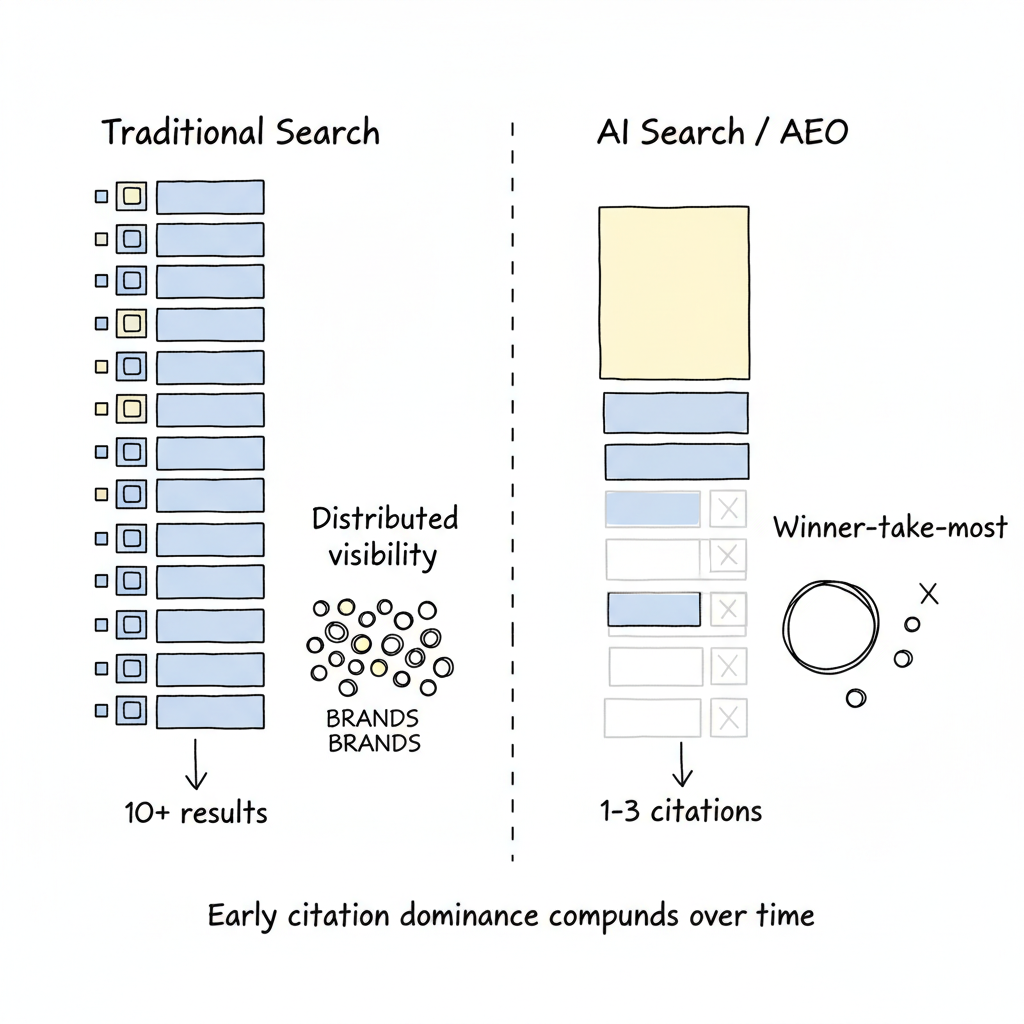
Traditional search shows 10+ results, distributing visibility broadly. AI search concentrates citations among fewer sources, creating winner-take-most dynamics.
Competitive implications:
The 2026 AEO landscape rewards organizations understanding and responding to competitive dynamics.
Systematic competitor analysis requires structured approaches across multiple dimensions.
Measure how often competitors appear in AI responses relative to your brand.
Citation share metrics:
Analysis approach:
This baseline reveals your competitive position and identifies leaders to study.
Identify which competitors own specific topic areas in AI perception.
Authority mapping process:
Strategic value: Topic authority maps reveal where competitors are vulnerable and where challenging them would be difficult.
Not all citations carry equal value. Assess citation quality across competitors.
Quality dimensions:
Example quality hierarchy:
High-quality citations indicate stronger AI perception of authority.
Follow this process for comprehensive competitor assessment.
AI competitors may differ from traditional SEO competitors.
Identification methods:
Common discovery: Media publishers and educational institutions often dominate AI citations over commercial competitors.
Create a systematic query set for ongoing monitoring.
Matrix dimensions:
Example matrix for SaaS:
Query Type | Awareness | Consideration | Decision |
Product | "What is [category]" | "Best [category] software" | "[Product] vs [Competitor]" |
Problem | "How to solve [problem]" | "Solutions for [problem]" | "Which tool for [problem]" |
Brand | "What is [brand]" | "[Brand] reviews" | "Is [brand] worth it" |
Comprehensive matrices ensure no blind spots in competitive monitoring, similar to how professionals using geo-optimization-tools track visibility across different generative engines.
Record current state before strategy changes.
Documentation elements:
Baseline documentation enables measuring improvement over time.
Study what competitors do to earn citations.
Content analysis factors:
Reverse-engineering successful competitor content reveals replicable patterns. Organizations exploring generative-ai-search-engine-optimization strategies often find that competitors earning consistent citations share common content characteristics.
Find opportunities where competitors underperform or leave openings.
Gap categories:
Coverage gaps: Topics competitors haven't addressed comprehensively.
Quality gaps: Areas where competitor content is outdated or superficial.
Format gaps: Question types competitors don't answer (how-to, comparison, etc.).
Platform gaps: AI platforms where competitors have weak presence.
Gap analysis prioritizes where effort will yield fastest results.
Track specific metrics for competitive comparison.
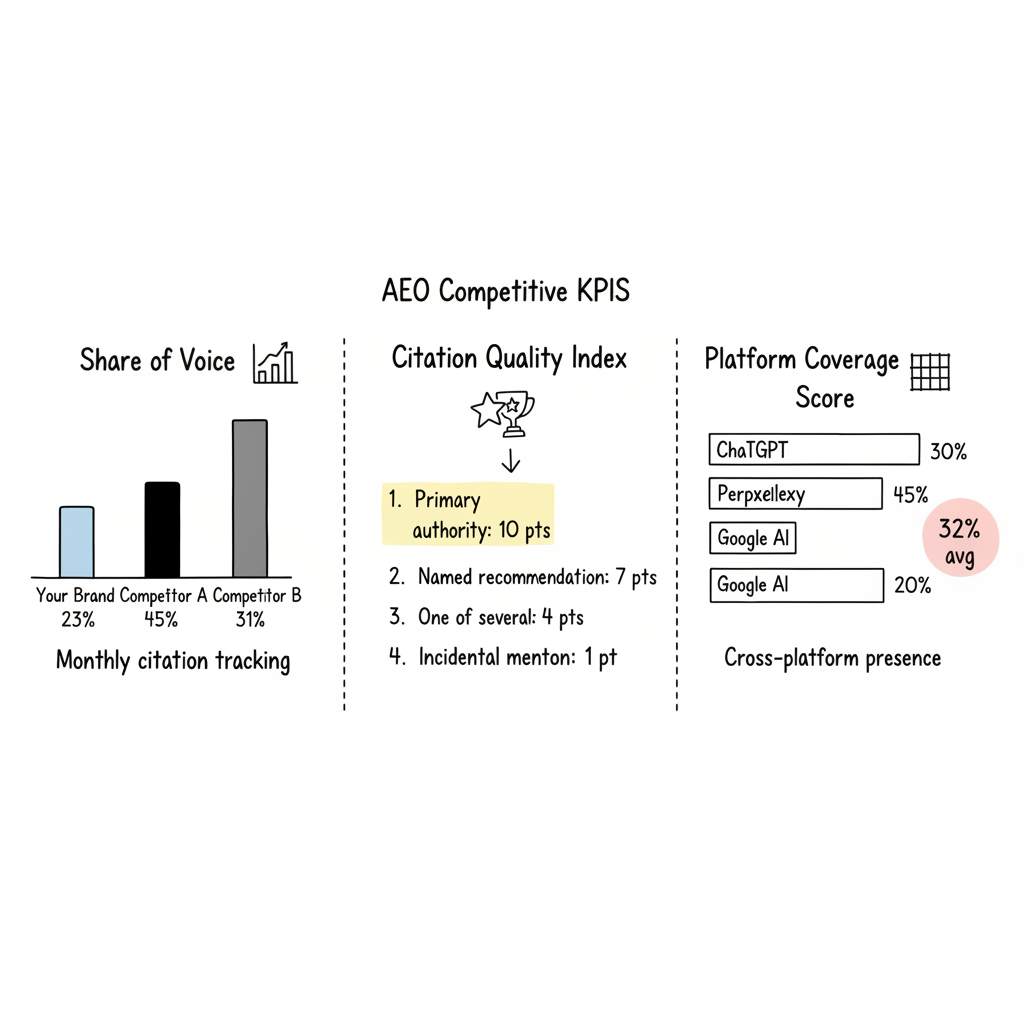
AI brand mention market share: Calculate your brand mentions divided by total competitor mentions across target queries.
Example calculation:
Track monthly to measure trajectory. Understanding aeo-metrics-kpis provides additional context for interpreting competitive performance data.
Quality-weighted citation score: Assign point values to citation types, calculate weighted scores.
Example scoring:
Weighted scores reveal quality differences masked by simple mention counts.
Cross-platform presence: Measure visibility consistency across AI platforms.
Example metrics:
Platform-specific weaknesses reveal optimization opportunities. Research comparing microsoft-copilot-vs-bing-ai citation patterns demonstrates how competitive positioning varies significantly across different AI search platforms.
Develop strategic responses based on competitive analysis.
When competitors hold dominant positions:
Counter-strategies:
Frontal assaults on established leaders rarely succeed. Find flanking opportunities.
When competitors have similar citation presence:
Competitive strategies:
Marginal advantages compound in peer competition situations.
When new competitors gain AI visibility:
Defensive strategies:
Early response prevents emerging competitors from gaining momentum.
Leverage available tools for efficient competitive monitoring.
Automated tools miss nuance. Supplement with:
Balance automation efficiency with manual depth.
Avoid these errors undermining competitive intelligence value.
Narrow competitor sets: Including only direct business competitors misses authoritative publishers and educational sources that dominate many AI queries.
Single-platform focus: Competitor positions vary across ChatGPT, Perplexity, and Google AI Overviews. Analyze all platforms.
Static analysis: One-time competitive audits become outdated quickly. Establish ongoing monitoring cadences.
Ignoring citation context: Counting mentions without assessing quality and context provides misleading signals.
Full competitive audits quarterly. Key query monitoring monthly. Emerging competitor alerts continuous. Increase frequency during strategic planning periods or when launching major initiatives.
Start with 3-5 top citation leaders in your space. Expand analysis as resources allow. Include one or two emerging competitors showing momentum.
Identify micro-topics or specific question types where leaders are weakest. Build authority in these niches first, then expand. Competing broadly against established leaders from a weak position rarely succeeds.
By submitting this form, you agree to our Privacy Policy and Terms & Conditions.



