February 19, 2026



Traditional keyword research focuses on search volume and ranking difficulty. AEO keyword research requires a different approach—identifying queries where AI systems seek authoritative sources to cite and where your organization can provide definitive answers. This guide outlines frameworks for discovering and prioritizing AEO keyword opportunities.
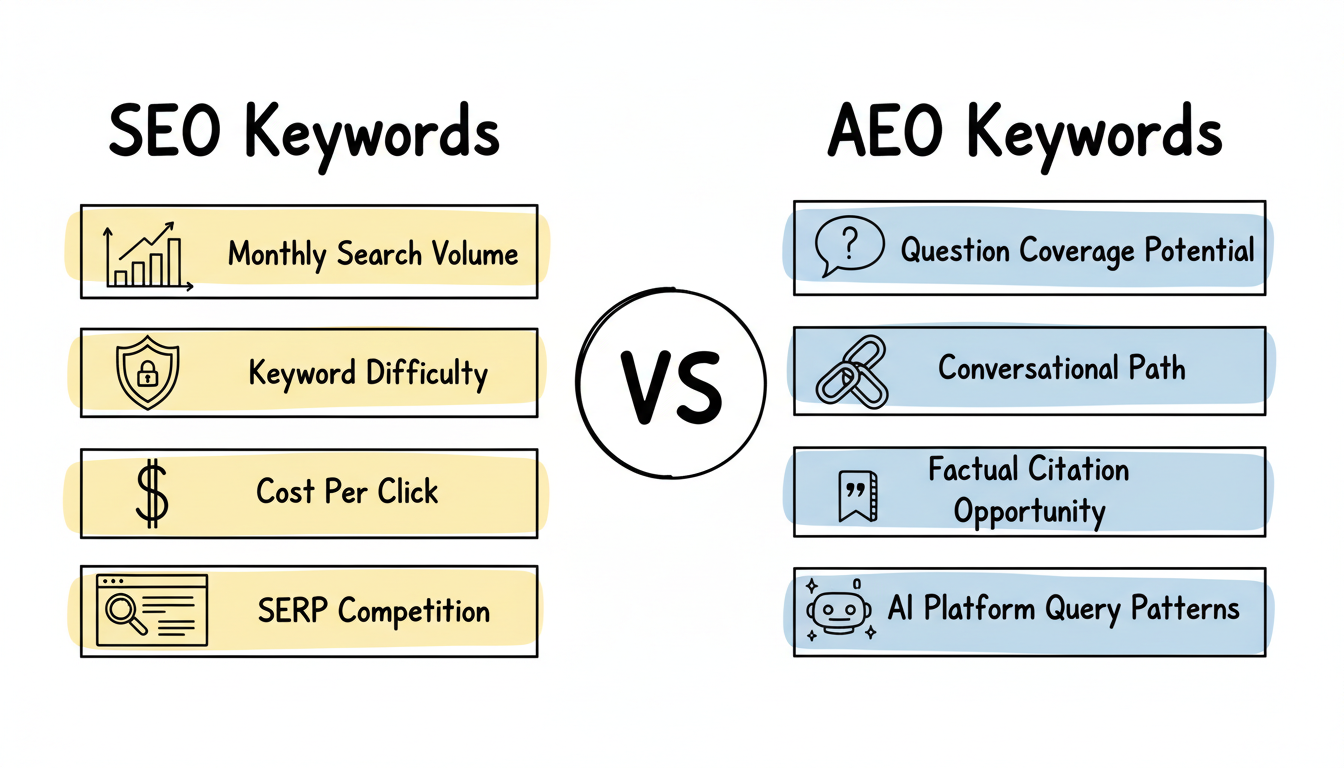
AEO keyword research extends beyond traditional search metrics.
Traditional SEO keyword factors:
AEO-specific factors:
While search volume still matters, AEO success depends more on becoming the authoritative answer for specific questions than ranking for high-volume terms.
Several frameworks help identify valuable AEO opportunities.
AI users ask questions conversationally. Start research by identifying questions your audience asks.
Question discovery sources:
Question categorization:
Map questions to your expertise areas and content capabilities.
AI query intent differs from traditional search intent. Users expect complete answers, not links to explore.
AI query intent categories:
Factual queries: Users want specific, accurate facts
Procedural queries: Users want step-by-step guidance
Evaluative queries: Users want recommendations
Exploratory queries: Users want comprehensive overviews
Prioritize intent categories matching your content strengths and business goals. Understanding these patterns helps inform your broader AI SEO strategy and positions your content for maximum citation potential.
2026 AEO emphasizes conversational paths—the follow-up questions users ask after initial queries.
Conversational path research:
Example conversational path:
Organizations covering complete conversational paths position themselves as comprehensive authorities AI systems cite repeatedly.
Follow this systematic process for AEO keyword discovery.
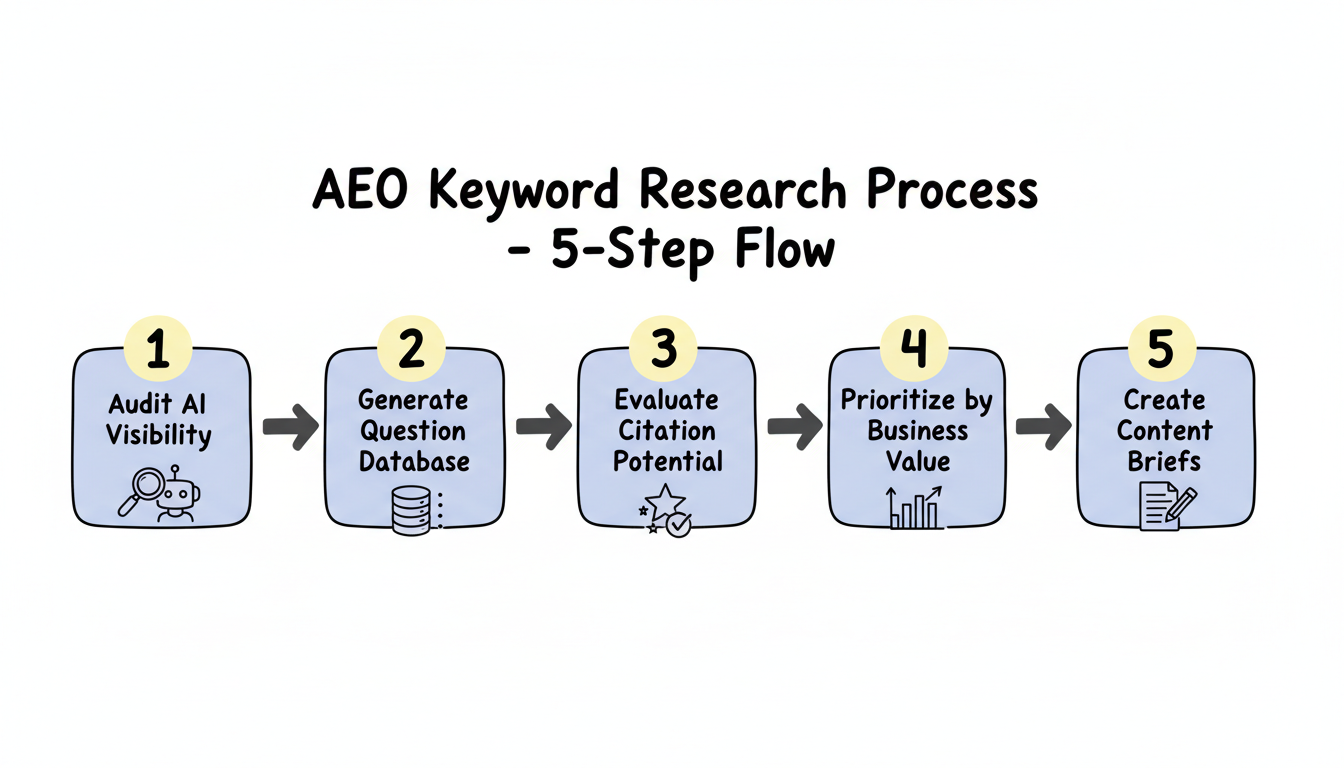
Before researching new opportunities, understand current positioning.
Visibility audit activities:
This baseline reveals where you already have authority and where opportunities exist. Consider leveraging AI citation tracking tools to monitor your visibility across multiple platforms systematically.
Build a comprehensive database of relevant questions.
Database building techniques:
Aim for 200-500 questions per major topic area initially.
Not all questions warrant AEO investment. Evaluate based on citation opportunity.
High citation potential indicators:
Lower citation potential:
Focus resources on winnable opportunities.
Balance citation potential with business outcomes.
Business value criteria:
Prioritize questions where AI visibility directly supports business goals. This prioritization should align with your AI SEO implementation checklist to ensure technical readiness matches content strategy.
Transform prioritized questions into actionable content plans.
Content brief elements:
Detailed briefs ensure content creation teams execute effectively.
Several tools support AEO keyword discovery.
These tools provide question data requiring AEO-specific interpretation.
Emerging AEO tools provide insights traditional SEO tools miss.
Don't underestimate manual research value.
Effective manual approaches:
Manual research often reveals opportunities tools miss.
Avoid these errors undermining AEO keyword strategy.
Over-relying on search volume: High-volume keywords may not generate AI citations if authoritative incumbents dominate.
Ignoring conversational context: Isolated keyword targeting misses conversational path opportunities where comprehensive coverage builds authority.
Neglecting expertise alignment: Targeting questions outside your demonstrated expertise rarely succeeds—AI systems evaluate source credibility.
Static research: AI platform behaviors evolve rapidly. Research conducted in early 2026 may need updating by mid-year.
Single-platform focus: Different AI platforms surface different questions. Research across ChatGPT, Perplexity, and Google AI Overviews.
Track performance for researched and targeted keywords.
Success metrics:
Regular measurement validates research effectiveness and guides iteration.
Start with 20-30 high-priority questions across your core expertise areas. Expand as you demonstrate success and build content production capacity.
No. Traditional SEO keywords remain valuable—many support AEO indirectly. Integrate AEO research with existing keyword strategies rather than replacing them.
Quarterly comprehensive reviews with monthly monitoring of AI platform changes. The field evolves rapidly, requiring ongoing research investment.
By submitting this form, you agree to our Privacy Policy and Terms & Conditions.