February 19, 2026


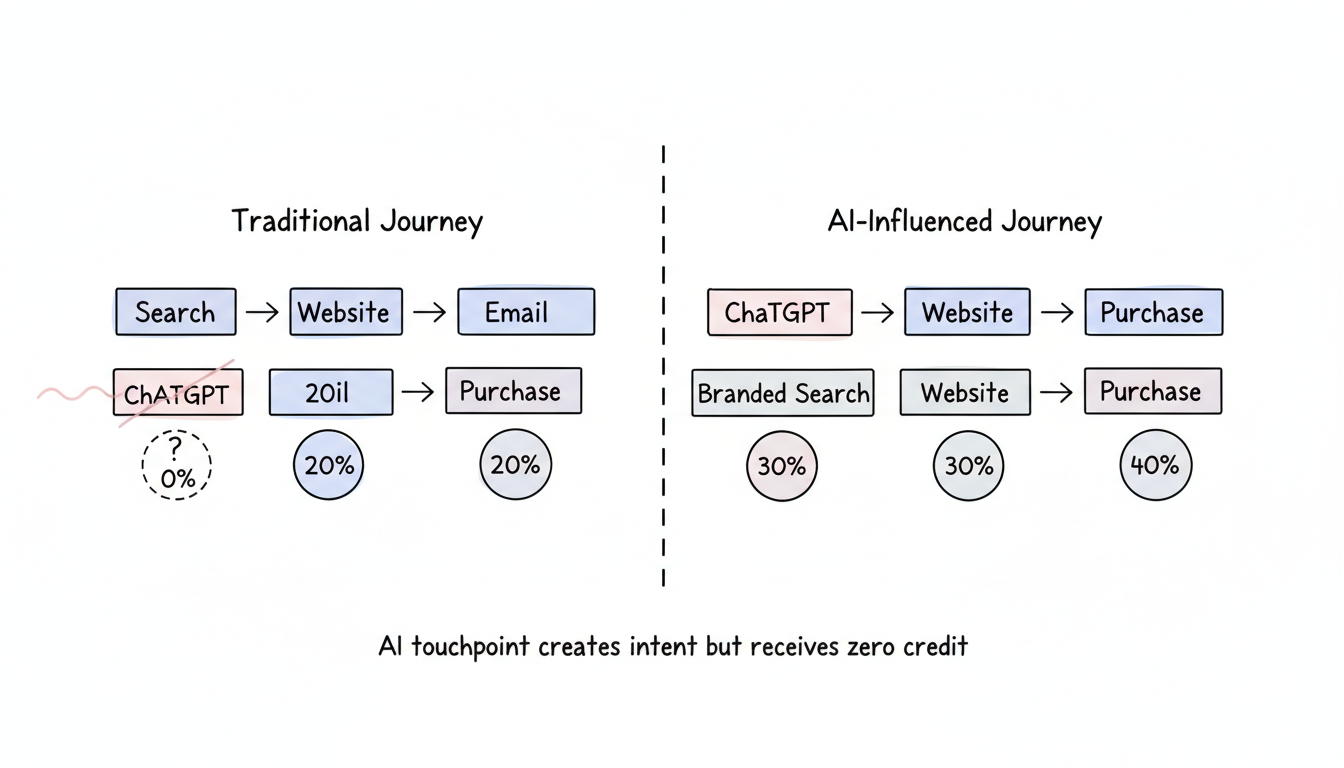
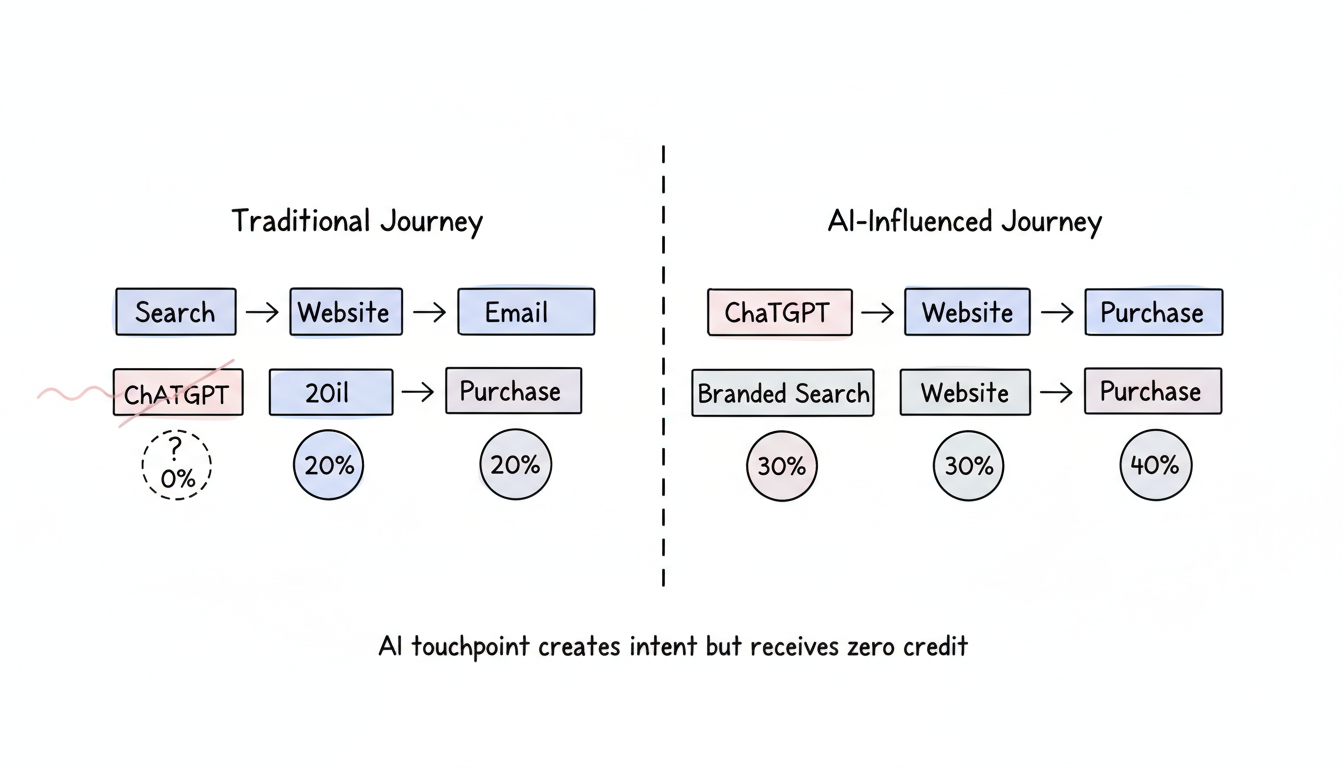
Traditional attribution models fail for AI search because they assume all valuable interactions generate clicks. When ChatGPT influences a purchase decision but the user arrives via branded search, standard attribution credits zero value to AI exposure. Building accurate AI search attribution requires new models, implementation approaches, and validation methods.
This guide covers the mechanics of attribution modeling specifically for AI search traffic.
Attribution models were built for a clickable web. AI search breaks fundamental assumptions.
Standard attribution limitations:
Model | How It Works | Why It Fails for AI |
Last-click | Credits final touchpoint | AI exposure rarely generates direct clicks |
First-click | Credits first touchpoint | Can't track AI discovery moments |
Linear | Equal credit across touches | Misses invisible AI touchpoints |
Time-decay | More credit to recent touches | AI influence may precede by days |
Position-based | 40/20/40 to first/middle/last | AI touchpoint often entirely missing |
The attribution gap:
Traditional Journey (Visible):
Search → Website → Email → Purchase
  ↓        ↓        ↓         ↓
 20%      20%      20%       40%  ← Credit assigned

AI-Influenced Journey (Partially Invisible):
ChatGPT → Branded Search → Website → Purchase
   ?           ↓              ↓         ↓
   0%         30%            30%       40%  ← AI gets no credit
The ChatGPT interaction that created purchase intent receives zero attribution because it didn't produce a trackable click.
Effective AI attribution combines trackable events with probabilistic estimation.
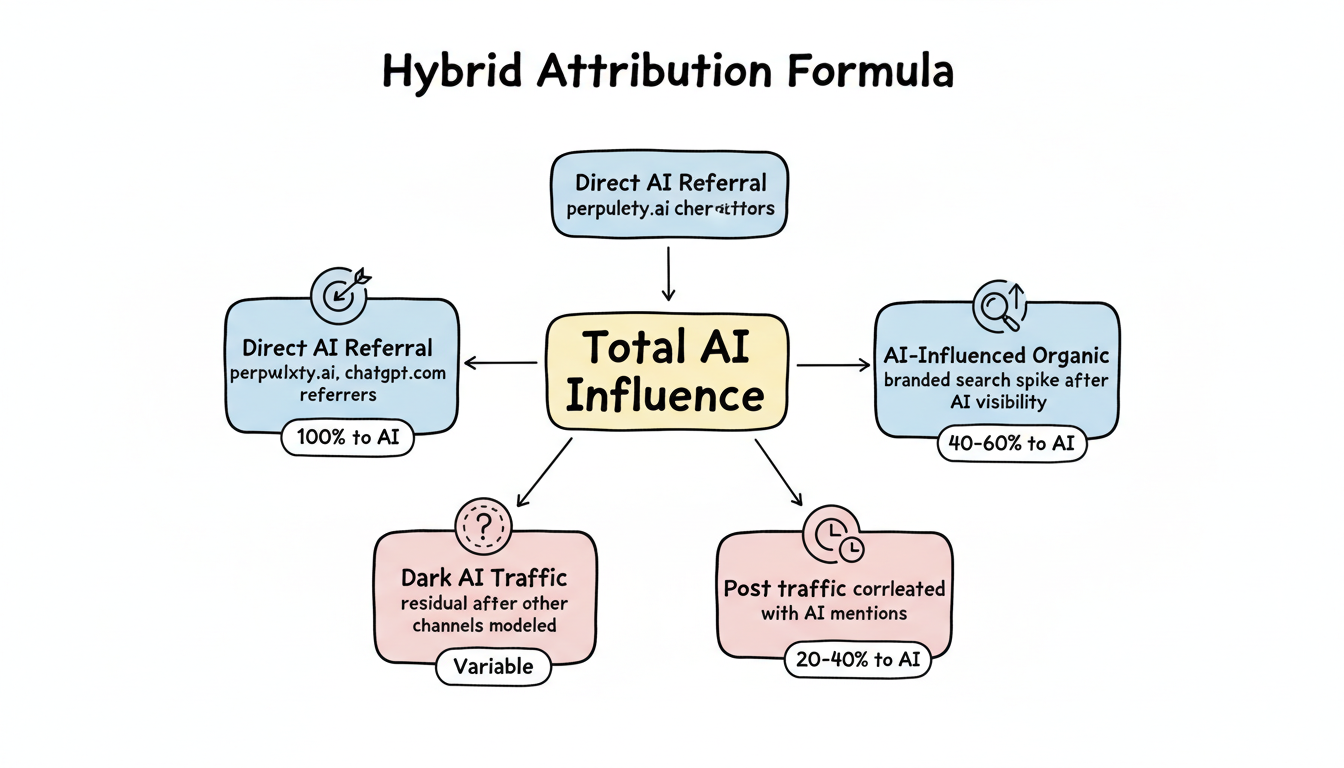
Hybrid attribution formula:
Total AI Influence =
  Direct AI Referral (trackable)
  + AI-Influenced Organic (estimated)
  + Post-AI Direct (modeled)
  + Dark AI Traffic (inferred)
Component definitions:
Component | How to Identify | Attribution Weight |
Direct AI Referral | Referrer contains perplexity.ai, chatgpt.com | 100% to AI |
AI-Influenced Organic | Branded search spike after AI visibility gains | 40-60% to AI |
Post-AI Direct | Direct traffic increase correlated with AI mentions | 20-40% to AI |
Dark AI Traffic | Residual attribution after other channels modeled | Variable |
Configure GA4 to capture AI-attributable traffic.
GA4 custom channel definition:
Channel: AI Search
Rules:
├── Source contains "perplexity"
├── Source contains "chatgpt" OR "chat.openai"
├── Source contains "claude.ai"
├── Source contains "copilot.microsoft"
└── Medium = "referral" AND source matches above
Create segments to isolate AI-influenced sessions. When implementing these segments, consider how to choose an AI SEO agency that can help configure proper tracking across AI platforms.
Segment Name | Definition |
Direct AI Traffic | Source matches AI platforms |
Probable AI Influence | New user + branded search + high intent behavior |
Post-AI Converters | AI session in past 30 days + conversion |
Recommended attribution windows for AI:
Conversion Type | Lookback Window | Rationale |
Lead generation | 30 days | AI research often precedes inquiry |
Demo request | 14 days | Shorter consideration cycle |
Purchase | 60 days | Complex B2B decisions take time |
Content download | 7 days | Lower commitment action |
Standard 7-day windows miss most AI influence. Extend based on your sales cycle.
Most AI interactions don't generate clicks. Track influence through proxy signals.
Zero-click attribution approach:
Zero-Click Attribution Model:
├── Monitor AI visibility metrics
│   └── Citations, mentions, answer presence
│
├── Correlate with business outcomes
│   ├── Branded search volume changes
│   ├── Direct traffic patterns
│   └── Conversion rate shifts
│
├── Apply statistical modeling
│   └── Time-series correlation analysis
│
└── Estimate AI contribution
    └── Probabilistic credit assignment
Understanding the relationship between GEO vs SEO vs AEO helps contextualize how different optimization strategies contribute to attribution complexity.
Correlation signals to track:
AI Visibility Change | Expected Business Signal |
New citation in ChatGPT | Branded search lift within 7 days |
Perplexity answer inclusion | Referral traffic increase |
AI Overview appearance | Organic CTR change |
Competitor citation loss | Relative traffic share gain |
Create a unified view of AI search attribution.
Dashboard components:
Metric | Source | Update Frequency |
Direct AI referrals | GA4 | Real-time |
AI-correlated branded search | GA4 + Search Console | Weekly |
Citation count by platform | Manual audit or tool | Weekly |
Estimated AI-influenced conversions | Model calculation | Weekly |
AI channel revenue attribution | Calculated metric | Monthly |
Attribution calculation example:
Monthly AI Search Attribution:

Direct AI Referrals:
├── Perplexity: 450 visits → 23 conversions
├── ChatGPT: 120 visits → 5 conversions
└── Copilot: 85 visits → 3 conversions
Total Direct: 31 conversions

AI-Influenced Organic (estimated):
├── Branded search increase: +2,100 visits
├── AI correlation factor: 35%
├── Estimated AI-influenced: 735 visits
└── Conversion rate: 4.2%
Total Influenced: 31 conversions

AI-Influenced Direct (estimated):
├── Direct traffic increase: +890 visits
├── AI correlation factor: 25%
├── Estimated AI-influenced: 223 visits
└── Conversion rate: 5.1%
Total Influenced: 11 conversions

Monthly AI-Attributed Conversions: 73
Verify attribution model accuracy with these approaches. For businesses tracking optimization impact across different AI platforms, reviewing AEO statistics and trends provides benchmarks for validating your attribution models.
Validation methods:
Method | How It Works | What It Validates |
Holdout testing | Block AI optimization for subset | True AI impact |
Time-series analysis | Pre/post AI visibility comparison | Correlation strength |
Survey attribution | Ask converters how they found you | Self-reported AI exposure |
Brand lift studies | Measure awareness in AI users vs non | Brand attribution |
Survey question example:
"Before visiting our website, did you research [solution category]
using any of these tools?"
□ ChatGPT
□ Google AI / AI Overviews
□ Perplexity
□ Microsoft Copilot
□ None of the above
Direct survey data calibrates your probabilistic models.
Choose the right model based on your measurement maturity.
Model progression:
Stage | Attribution Approach | Accuracy | Effort |
Foundation | Last-click + AI channel tracking | Low | Low |
Developing | Position-based with AI weighting | Medium | Medium |
Advanced | Data-driven with AI correlation | High | High |
Sophisticated | Algorithmic with continuous learning | Highest | Highest |
Stage-appropriate implementation:
Foundation Stage:
└── Track direct AI referrals only
    └── GA4 custom channel grouping

Developing Stage:
└── Add branded search correlation
    └── Weekly manual analysis

Advanced Stage:
└── Build predictive models
    └── Statistical time-series analysis

Sophisticated Stage:
└── Machine learning attribution
    └── Automated correlation detection
Start with foundation-level tracking. Add complexity as you validate correlations. Many organizations exploring ChatGPT search optimization find that advanced attribution models become essential as their AI search presence grows.
Building effective AI search attribution:
AI search attribution requires accepting uncertainty. Probabilistic models with validation provide directionally accurate measurement that improves over time with more data.
By submitting this form, you agree to our Privacy Policy and Terms & Conditions.