February 19, 2026


ChatGPT search optimization has become a critical discipline as OpenAI's conversational AI transforms how users discover information. With ChatGPT now serving over 400 million weekly active users and its integrated search capabilities pulling real-time information from the web, brands must understand how to earn citations within ChatGPT's generated responses.
This guide provides a comprehensive framework for optimizing content specifically for ChatGPT, examining how its citation system works, what factors influence source selection, and practical tactics for improving visibility within conversational AI search results.
Understanding ChatGPT's search mechanics reveals what optimization should target.
ChatGPT Search uses Bing's live index to retrieve real-time information when users ask questions requiring current data. When a user submits a query, ChatGPT determines whether the question needs web search (factual, time-sensitive, or current events topics) or can be answered from its training data.
For search-enabled queries, ChatGPT:
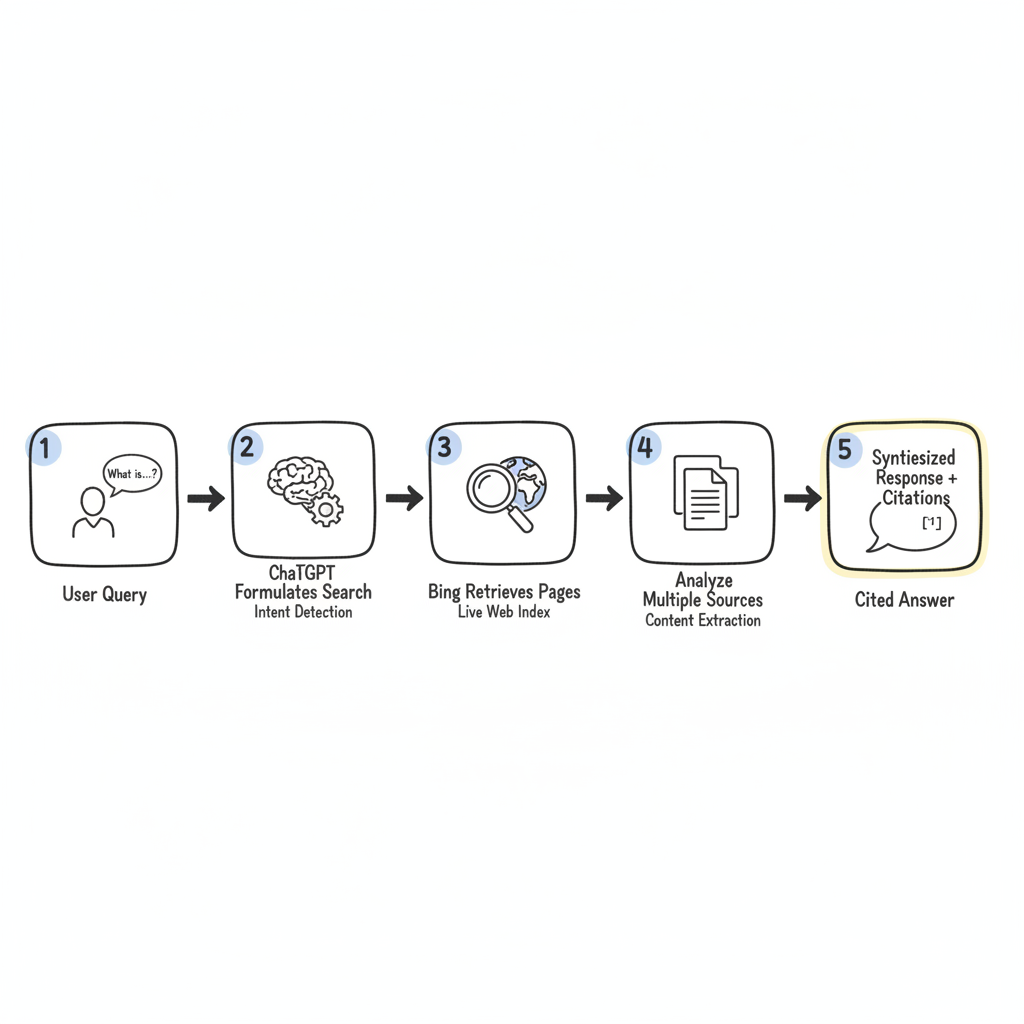
This architecture means optimization must address both discoverability and extractability—earning citations once retrieved.
Not all ChatGPT queries trigger web search. Research indicates approximately 24% of ChatGPT responses are generated without fetching online content, relying instead on training data.
Queries likely triggering web search:
Queries often using training data:
Understanding this distinction helps prioritize optimization efforts toward query types that actually retrieve web content, similar to how AEO optimization strategies target answerable queries.
Research into ChatGPT's citation patterns reveals specific factors influencing which sources get cited.
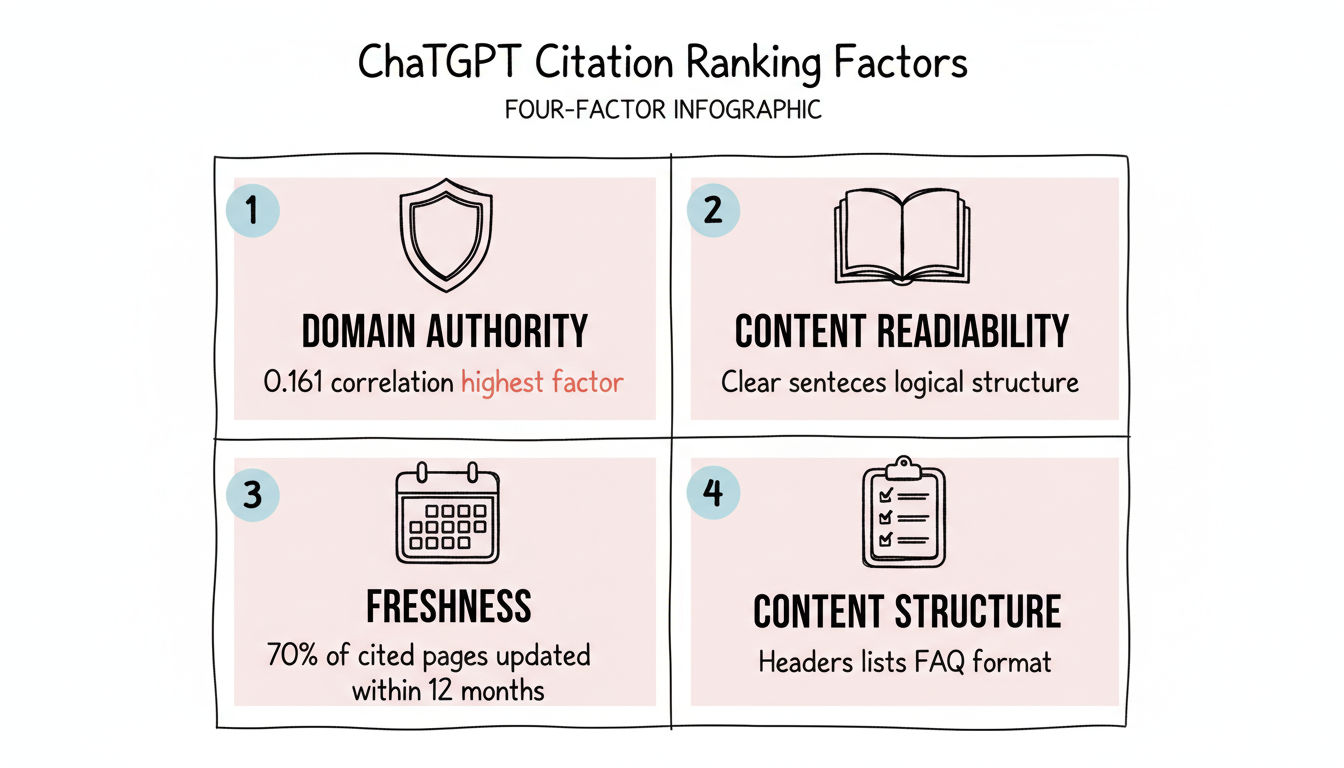
Studies analyzing ChatGPT citation behavior found Domain Rating shows the highest correlation (0.161) with earning citations. ChatGPT leans heavily on domain trust when selecting sources to cite.
What this means practically:
ChatGPT demonstrates preference for content that's easy to read and understand. Content scoring well on readability metrics—clear sentence structure, accessible vocabulary, logical organization—earns citations more frequently than dense, technical prose.
Readability optimization tactics:
These principles align with AEO content guidelines that emphasize clarity and extractability.
Content freshness significantly influences ChatGPT citations. Analysis shows over 70% of cited pages were updated within the previous 12 months. Stale content, even if comprehensive, loses citation priority to fresher alternatives.
Freshness strategies:
ChatGPT extracts specific passages to cite within generated responses. Content structured for easy extraction—clear answer statements, standalone paragraphs, defined sections—earns citations more readily than content requiring interpretation.
Structural elements ChatGPT prefers:
Translating these factors into actionable optimization requires systematic implementation.
ChatGPT matches user intent with source content. Optimization requires understanding how users phrase questions conversationally rather than as keyword searches, which differs from traditional AEO keyword research approaches.
Query research approaches:
Implementation: Structure content around natural question patterns. If users ask "What is the best way to..." create headers and sections directly addressing that formulation. Match conversational query patterns rather than keyword-focused alternatives.
ChatGPT synthesizes information from multiple sources but prefers citing comprehensive content that fully addresses topics. Thin content covering topics superficially loses citations to more thorough alternatives.
Comprehensive content characteristics:
Depth strategies:
ChatGPT evaluates sources based on apparent expertise. Brands demonstrating deep expertise in specific topics earn more citations than generalist sources covering topics superficially. This principle is central to modern GEO search optimization methodologies.
Topical authority building:
Entity clarity requirements: Ensure ChatGPT understands what your brand knows and does. Consistent positioning across properties—website, social profiles, business directories—helps ChatGPT recognize your expertise areas.
Technical factors determine whether ChatGPT can access and process your content effectively.
Crawler access configuration: Verify ChatGPT's crawler (GPTBot) can access your content. Check robots.txt to ensure you're not blocking access:
User-agent: GPTBot
Allow: /
Blocked access means zero ChatGPT visibility regardless of content quality.
Schema markup implementation: Structured data helps ChatGPT understand content structure and entity relationships. Prioritize:
Content accessibility:
Since ChatGPT Search retrieves through Bing, optimizing for Bing's index improves retrieval likelihood.
Bing-specific considerations:
Many sites optimize exclusively for Google, creating opportunities for ChatGPT visibility through Bing optimization attention.
Given ChatGPT's preference for fresh content, actively manage content currency.
Freshness optimization practices:
Freshness signals to implement:
Optimization without measurement produces uncertain results. Systematic monitoring reveals what's working.
Regular manual queries provide direct insight into ChatGPT visibility.
Manual monitoring process:
Recording what to track:
Dedicated AEO/GEO platforms provide systematic ChatGPT monitoring, similar to answer engine optimization tools available for other AI platforms.
Platform capabilities to seek:
Options range from enterprise solutions providing comprehensive coverage to accessible tools offering entry-level ChatGPT tracking. For comprehensive insights, consider using an AI search analytics dashboard that monitors multiple platforms.
Where possible, connect ChatGPT visibility to measurable business impact.
Attribution approaches:
Learning from common failures accelerates success.
Many focus exclusively on Google, missing ChatGPT's Bing-based retrieval. Sites invisible in Bing results won't appear in ChatGPT citations regardless of content quality.
Fix: Audit Bing indexation and visibility. Address any gaps between Google and Bing performance.
Content optimized purely for AI extraction without genuine user value typically underperforms. ChatGPT evaluates content quality based on helpfulness—purely mechanical optimization produces poor results.
Fix: Create genuinely valuable content that serves user needs. AI-friendly structure should enhance human readability, not replace it.
Static content, even if initially comprehensive, loses citation priority over time. Regular updates maintain competitive positioning, which is why monitoring AEO statistics trends can help identify content refresh opportunities.
Fix: Establish content refresh schedules. Prioritize updating high-value pages showing declining visibility.
Some sites inadvertently block ChatGPT's crawler, eliminating visibility entirely without realizing it.
Fix: Audit robots.txt for GPTBot directives. Ensure access is allowed for content you want cited.
ChatGPT citation patterns evolve gradually as content gets indexed and AI systems recognize authority signals. Expecting overnight changes leads to abandoned optimization efforts.
Fix: Plan for 2-4 month optimization cycles. Track trends rather than individual queries.
ChatGPT optimization fits within broader Answer Engine Optimization strategy rather than standing alone.
Strategies effective for ChatGPT—authority building, content structure, freshness—generally benefit other AI platforms too. Perplexity, Claude, and Google AI Overview SEO impact all share many preferences with ChatGPT.
Integration approach:
Implementing a multi-platform AI search strategy ensures coverage across the evolving AI search landscape.
ChatGPT visibility builds on SEO foundations. Domain authority, technical health, and content quality—traditional SEO pillars—determine ChatGPT citation likelihood.
Foundation priorities:
ChatGPT optimization shouldn't operate separately from content strategy. Integration ensures efficiency and consistency.
Alignment practices:
ChatGPT's search capabilities continue evolving, suggesting future optimization considerations. Understanding which is the best AI search engine 2026 helps inform strategic optimization priorities.
Emerging developments:
Organizations building ChatGPT optimization competency now position themselves for continued success as capabilities mature and competition intensifies.
ChatGPT Search retrieves real-time information through Bing's live index for search-enabled queries. For questions not triggering web search, responses draw from training data with knowledge cutoffs that update periodically with model versions.
Yes, significantly. Core optimization factors—domain authority, content structure, freshness, topical expertise—benefit visibility across multiple AI platforms. While platform-specific nuances exist, foundational optimization transfers well.
Technical fixes like crawler access may show results within weeks. Authority building and comprehensive visibility improvement typically require 2-4 months as ChatGPT's retrieval systems recognize changes.
Create content for users that's structured for AI extraction. Content designed purely for ChatGPT without genuine user value typically underperforms. The best approach serves both audiences through clear, comprehensive, authoritative content.
By submitting this form, you agree to our Privacy Policy and Terms & Conditions.