
February 19, 2026


Last Updated: January 2026
The AI search landscape has fundamentally transformed how we find information online. With ChatGPT now commanding 800 million monthly active users and Google Gemini reaching 650 million, the choice of AI search engine affects everything from daily research to business decision-making.
This guide compares the best AI search engines in 2026, breaking down their strengths, weaknesses, and ideal use cases to help you choose the right one for your needs.
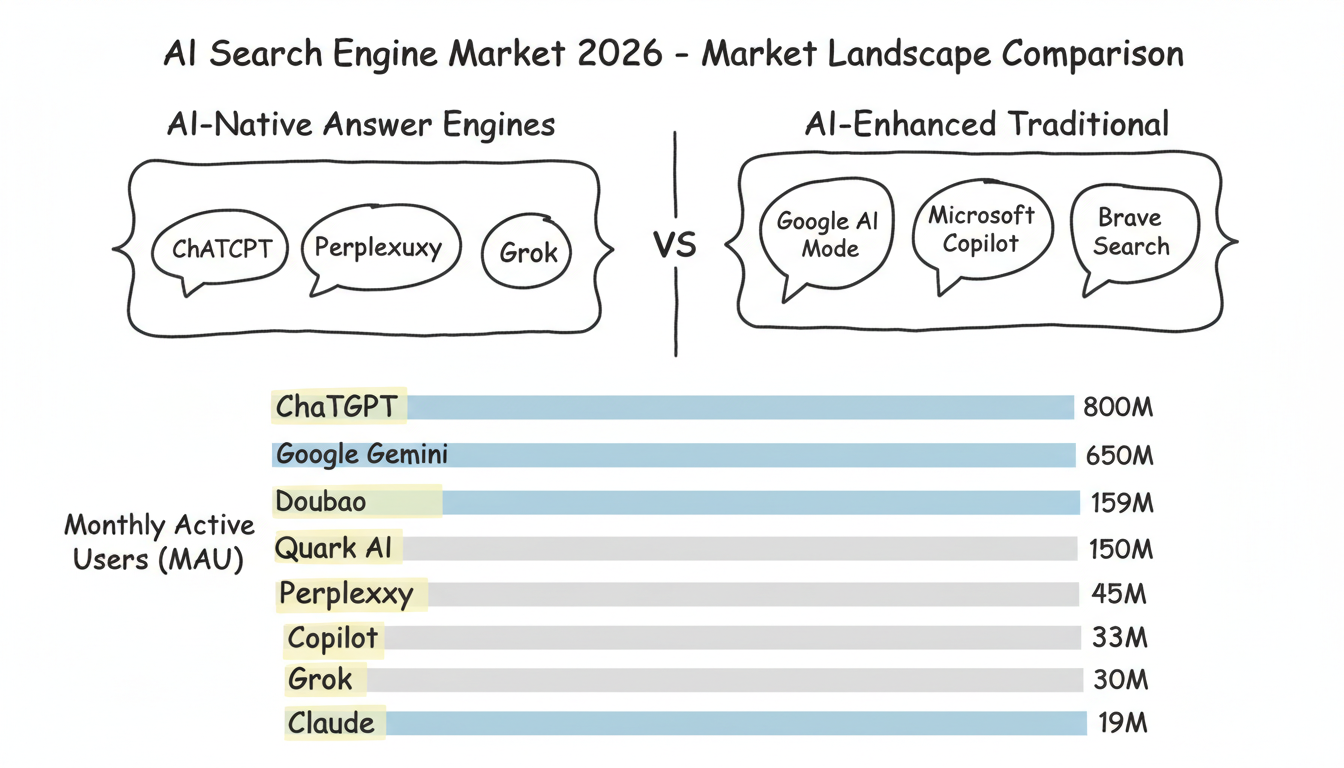
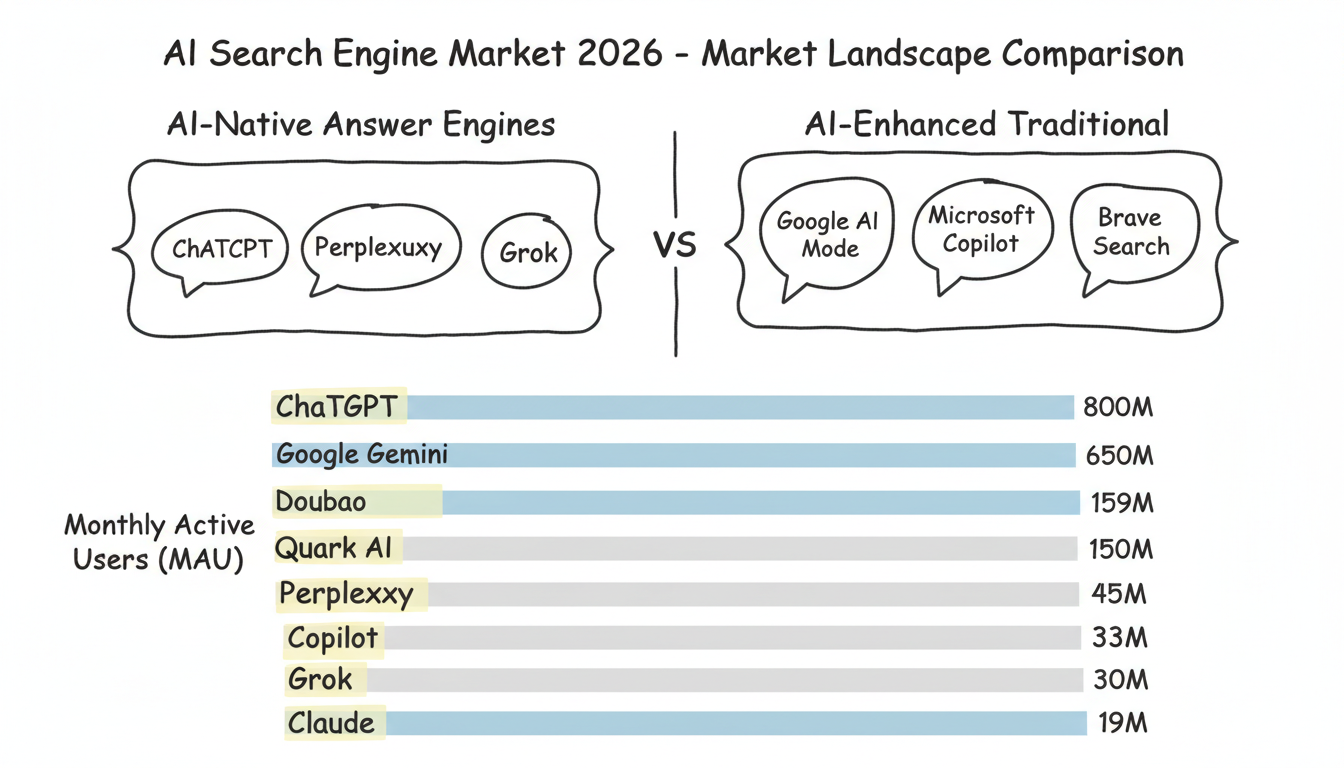
The market has crystallized into two distinct categories: AI-native "answer engines" built from the ground up for conversational Q&A, and AI-enhanced traditional search giants integrating generative layers atop classic search.
Rank | AI Search Engine | Monthly Active Users |
1 | ChatGPT (OpenAI) | 800 million |
2 | Google Gemini | 650 million |
3 | Doubao (ByteDance) | 159 million |
4 | Quark AI (Alibaba) | 150 million |
5 | Perplexity AI | 45 million |
6 | Microsoft Copilot | 33 million |
7 | Grok (xAI) | 30 million |
8 | Claude AI (Anthropic) | 19 million |
User numbers don't tell the whole story. The best AI search engine for you depends on what you're trying to accomplish.
Best for: General everyday queries, users already in the Google ecosystem
Google's AI Mode represents the search giant's response to AI-native competitors. It integrates generative AI directly into traditional search, providing AI-generated summaries alongside conventional results.
Strengths:
Weaknesses:
Understanding disabling Google AI Overviews when and how can help users who prefer traditional search results over AI-generated summaries.
Pricing: Free
Best for: Research, fact-checking, citation-heavy work
Perplexity has established itself as the "answer engine" leader for users who need trustworthy, verifiable information. Every claim links back to its source, making it invaluable for research and professional use.
Strengths:
Weaknesses:
Companies looking to maximize their visibility in Perplexity's results should consider implementing a comprehensive Perplexity AI optimization strategy to improve their rankings and citation frequency.
Pricing: Free tier available; Pro at $20/month for unlimited queries and advanced models
Best for: Creative work, coding, complex problem-solving, conversational research
ChatGPT has evolved from a chatbot into what many call a "creative OS." With GPT-4 and specialized reasoning models, it excels at generative tasks, complex coding, and nuanced conversation.
Strengths:
Weaknesses:
Pricing: Free tier available; Plus at $20/month; Pro at $200/month
Best for: Enterprise users, Microsoft 365 integration, productivity workflows
Microsoft Copilot integrates deeply with the Microsoft ecosystem, making it powerful for users embedded in Office 365 and Windows environments.
Strengths:
Weaknesses:
Pricing: Free tier; Pro at $30-36/month for full Microsoft integration
Best for: Document analysis, long-form content, safety-conscious users
Claude focuses on thoughtful, safe responses rather than real-time web search. It excels at processing lengthy documents and maintaining coherent long conversations.
Strengths:
Weaknesses:
Pricing: Free tier; Pro at $20/month
Best for: Customization, multi-app workflows, business professionals
You.com offers high customization with a multi-app interface, allowing users to tailor their search experience extensively.
Strengths:
Weaknesses:
Pricing: Free tier; Pro at $15/month
Best for: Privacy-conscious users
Brave Search prioritizes privacy, offering AI capabilities without tracking user behavior.
Strengths:
Weaknesses:
Pricing: Free
Best for: Developers, coding questions, technical research
Phind has carved out a niche as the dominant developer and code-specific AI search tool.
Strengths:
Weaknesses:
Pricing: Free tier available; paid plans for advanced features
Choose Perplexity. Its citation-first approach means you can verify every claim. The ability to toggle between models ensures you're getting the best available AI for your specific query.
Choose ChatGPT. Its conversational abilities and creative capabilities make it ideal for brainstorming, drafting, and iterating on creative projects.
Choose Google AI Mode if you're already in the Google ecosystem, or Perplexity if you prefer clearer sourcing.
Choose Brave Search. If avoiding tracking matters to you, Brave offers capable AI search without the data collection.
Choose Microsoft Copilot if your organization uses Microsoft 365. The integration alone justifies the choice for enterprise users.
Choose Phind for dedicated technical queries, or ChatGPT for coding within broader project contexts.
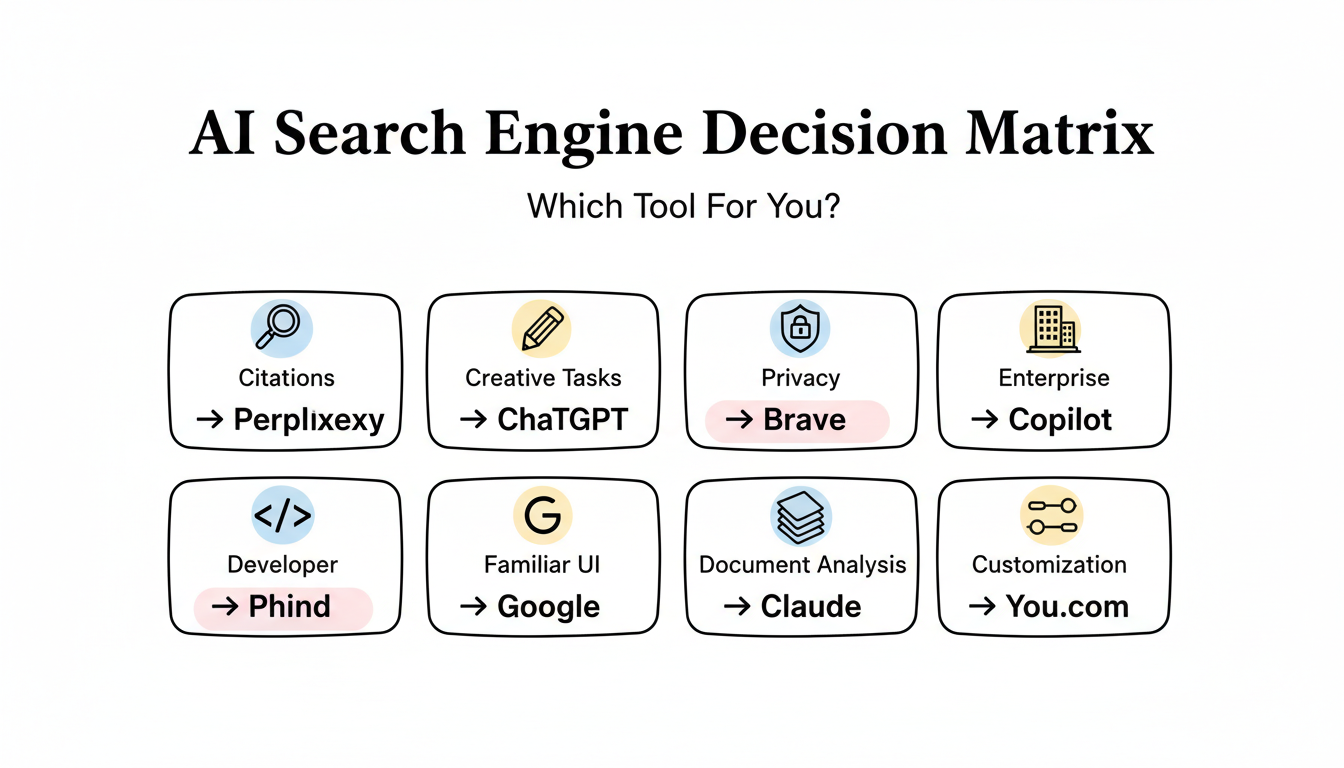
Your Priority | Best Choice |
Citation accuracy | Perplexity |
Creative tasks | ChatGPT |
Privacy | Brave Search |
Enterprise integration | Microsoft Copilot |
Developer focus | Phind |
Familiar interface | Google AI Mode |
Document analysis | Claude |
Customization | You.com |
The AI search market continues evolving rapidly. The distinction between "answer engines" like Perplexity and "creative engines" like ChatGPT represents a fundamental fork in how AI assists with information retrieval.
As businesses adapt to this new landscape, implementing generative engine optimization strategies has become essential for maintaining visibility across AI-powered search platforms.
For most users in 2026, the practical approach is maintaining access to multiple platforms:
The "best" AI search engine depends entirely on what you're trying to accomplish. Rather than choosing one, consider which combination serves your specific workflow.
No single AI search engine dominates all use cases in 2026. Perplexity leads for research and citation-heavy work. ChatGPT excels at creative tasks and complex reasoning. Google AI Mode offers familiarity and ecosystem integration. Microsoft Copilot serves enterprise users best.
The winners in this landscape are users who understand each platform's strengths and choose accordingly—not those who commit exclusively to any single tool.
By submitting this form, you agree to our Privacy Policy and Terms & Conditions.



