The AI search landscape has fragmented dramatically. Google no longer holds unchallenged dominance as ChatGPT, Microsoft Copilot, and specialized platforms capture meaningful market share. Organizations optimizing for AI visibility must understand how each platform operates, their distinct citation behaviors, and the optimization strategies that work best for each. This comprehensive comparison examines the three major AI search platforms shaping digital marketing in 2026.
The 2026 AI Search Market Landscape
Understanding current market dynamics provides context for platform-specific strategies.
Market Share Evolution
The AI search platform market share has shifted fundamentally from Google's historical dominance.
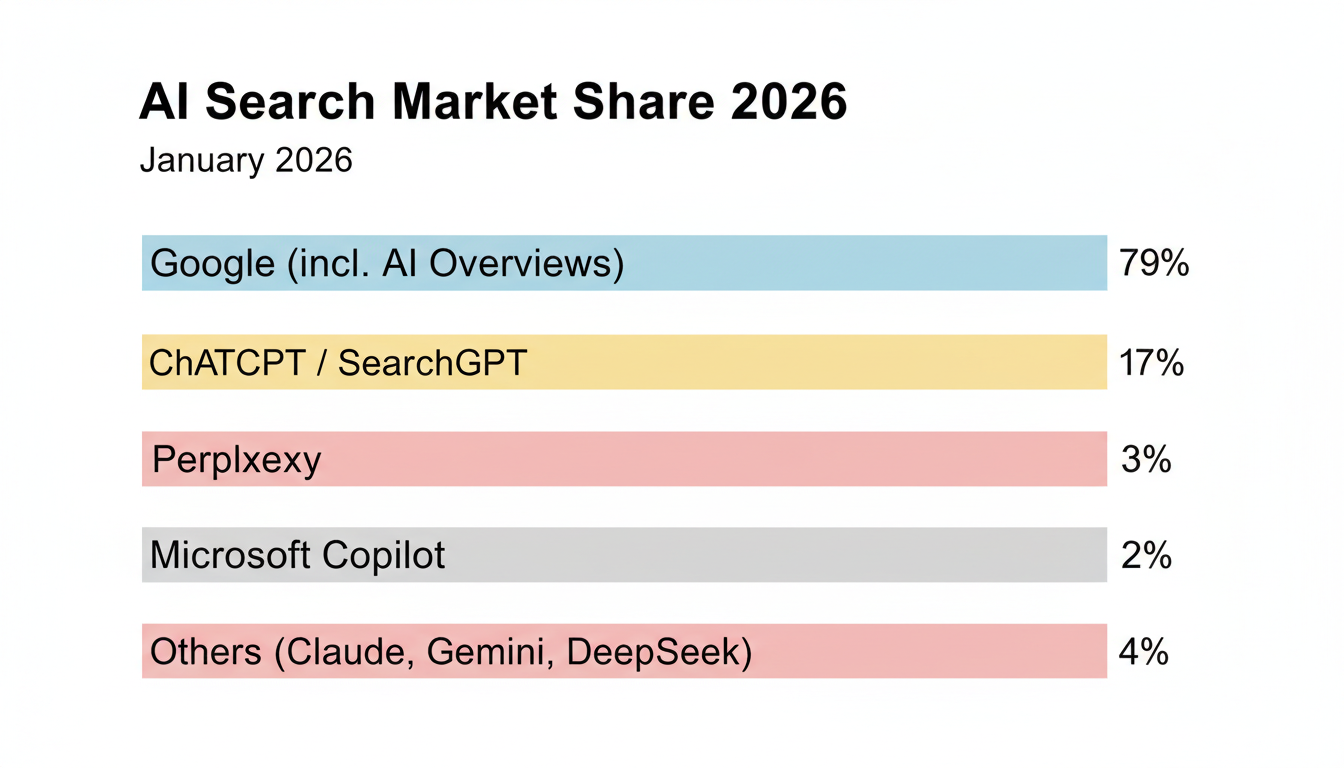
Current market positions (January 2026):
- Google (including AI Overviews): 78-80% of global search queries
- ChatGPT/SearchGPT: 17-18% query market share (first competitor to achieve double-digit share against Google in two decades)
- Microsoft Copilot: 1-2% market share despite GPT-4 technology
- Perplexity: 2% market share with 370% year-over-year growth
- Other platforms (Claude, Gemini standalone, DeepSeek): Combined ~4-5%
Key trend: ChatGPT's 800-900 million weekly active users demonstrate that AI assistants have achieved mainstream adoption beyond early adopter populations.
Engagement Patterns
Different platforms attract different engagement behaviors.
Average session duration:
- ChatGPT: 13 minutes average
- Google Search: 6 minutes average
Query characteristics:
- Google: Mix of navigational, informational, and transactional queries
- ChatGPT: Complex, multi-part conversational queries
- Copilot: Enterprise-integrated workflow queries
- Perplexity: Research and information discovery focused
These engagement differences inform content optimization strategies—longer sessions suggest more complex information needs.
Each major platform operates distinctly, requiring tailored optimization approaches.
Google AI Overviews
Google's AI integration reaches the largest audience but operates differently from standalone AI assistants.
Platform characteristics:
- Reach: 1.5 billion users monthly, appearing in nearly half of all search results
- Integration: Built atop traditional Google Search infrastructure
- Source selection: Strongly favors content already ranking well in organic search (90.5% of citations from top 10 results)
- Citation display: "Learn more" expandable sections with links to sources
How Google AI Overviews work:
Understanding how Google selects AI overview sources reveals the platform's citation logic. Google AI Overviews synthesize answers from multiple sources, typically drawing from pages that already rank well for the query. The system:
- Identifies queries suitable for AI-generated summaries
- Pulls information from top-ranking indexed pages
- Synthesizes an answer with source attribution
- Displays above traditional search results
Unlike ChatGPT, Google AI Overviews don't maintain conversation context—each query is independent.
Citation behavior:
Google AI Overviews demonstrate strong correlation with traditional rankings:
- 90.5% of citations come from pages ranking positions 1-10
- 9.5% from pages ranking 11-100
- Strong preference for content meeting traditional quality guidelines
- Schema markup and structured data influence citation likelihood
User behavior insights:
Research shows 88% of users click "show more" for truncated AI overviews, indicating that comprehensive coverage still drives engagement even within AI summaries. Organizations concerned about disabling Google AI overviews when and how should consider this overwhelming user acceptance.
Optimization priorities:
- Maintain strong traditional SEO: AI Overviews citation strongly correlates with organic rankings
- Featured snippet optimization: Significant overlap between featured snippet eligibility and AI Overview citation
- Structured data implementation: Schema markup increases citation probability
- Answer-first formatting: Clear, direct answers in opening paragraphs
- E-E-A-T compliance: Google's quality guidelines apply equally to AI Overview sources
ChatGPT and SearchGPT
OpenAI's ChatGPT has evolved from a conversational AI to a primary search tool for millions.
Platform characteristics:
- User base: 800-900 million weekly active users
- Market position: 17-18% of global query volume, 68% of AI chatbot market share
- Citation approach: Variable—parametric knowledge mode versus web search mode
- Interface: Conversational, multi-turn interactions
Dual operating modes:
ChatGPT operates in two distinct modes affecting citation behavior:
Parametric knowledge mode:
- Draws from training data (knowledge cutoff)
- No real-time web access
- Cites based on information absorbed during training
- Brand mentions reflect historical authority
Web search/SearchGPT mode:
- Real-time web access for current information
- Active source evaluation and citation
- Can discover recently published content
- More dynamic, current citations
Citation behavior:
ChatGPT's citation patterns differ from Google:
- Approximately 6.1 citations per answer (when citing)
- Prefers brand-owned content over third-party sources
- Values comprehensive, authoritative coverage
- Inline mentions within response text
- Variable link formatting and inclusion
Recent developments:
OpenAI's January 2026 developments include:
- ChatGPT Search with vision, voice, and deeper search capabilities
- Instant Checkout integration with Shopify and Etsy (agentic commerce)
- ChatGPT Health for medical information
- Enhanced complex query handling
These developments signal ChatGPT's evolution from search alternative to complete information and commerce platform. When comparing Perplexity vs ChatGPT SEO capabilities, these commerce integrations give ChatGPT distinct advantages for transactional queries.
Optimization priorities:
- Build comprehensive authority: Create definitive resources on target topics
- Ensure GPTBot crawler access: Verify robots.txt allows crawling
- Develop brand presence: Consistent mentions across authoritative sources strengthen training data influence
- Add citations and statistics: Princeton research shows adding citations and statistics boosts source visibility by over 40%
- Cover conversational paths: Address follow-up questions users naturally ask
Microsoft Copilot
Despite sharing GPT-4 technology with ChatGPT, Microsoft Copilot occupies a distinct market position.
Platform characteristics:
- Market share: 1-2% of AI chatbot market (single-digit percentage)
- Distribution: Integrated across Copilot.com, Bing, MSN, Microsoft Edge, and Microsoft 365
- Focus: Enterprise productivity and workflow integration
- Differentiation: Merchant-centric, data-ownership focused
Distribution advantages:
Microsoft Copilot benefits from integration across:
- Bing search results
- Microsoft Edge browser (default AI assistant)
- Microsoft 365 productivity suite
- MSN portal
- Windows operating system
This distribution creates touchpoints traditional AI assistants cannot match, particularly in enterprise environments where the choice of in-house vs agency AI search optimization matters significantly.
2026 developments:
Recent Copilot enhancements include:
- Copilot Checkout: Shopping and purchase completion within conversations
- Copilot Search: AI-powered semantic search across Microsoft 365 and connected systems
- Brand Agents: Conversational commerce agents for merchant sites
- Copilot Connectors: Third-party data integration
- AI Views: Summarized, actionable document and activity information
Citation behavior:
Microsoft Copilot leverages Bing's search index, creating citation patterns that:
- Draw from Bing-indexed content
- Integrate enterprise and web sources for Microsoft 365 users
- Include shopping and product information more prominently
- Provide commerce-enabled citations (direct purchase options)
Optimization priorities:
- Bing optimization: Copilot pulls from Bing's index—Bing SEO matters
- Product feed optimization: Microsoft Merchant Center participation enhances commerce visibility
- Enterprise content optimization: Microsoft 365 integration means internal content optimization matters for enterprise visibility
- Structured product data: Commerce features require clean product information
Direct comparison aids strategic decision-making.
User Base and Reach
Platform | Monthly Users | Market Position | Growth Trajectory |
Google AI Overviews | 1.5B+ | 78-80% search share | Stable/dominant |
ChatGPT/SearchGPT | 800-900M weekly | 17-18% query share | Growing (but share declining from 87% to 68% in AI chatbot category) |
Microsoft Copilot | Millions | 1-2% AI chatbot share | Growing through distribution |
Perplexity | Growing | 2% with 370% YoY growth | Fastest growing |
Citation Behavior Comparison
Factor | Google AI Overviews | ChatGPT | Microsoft Copilot |
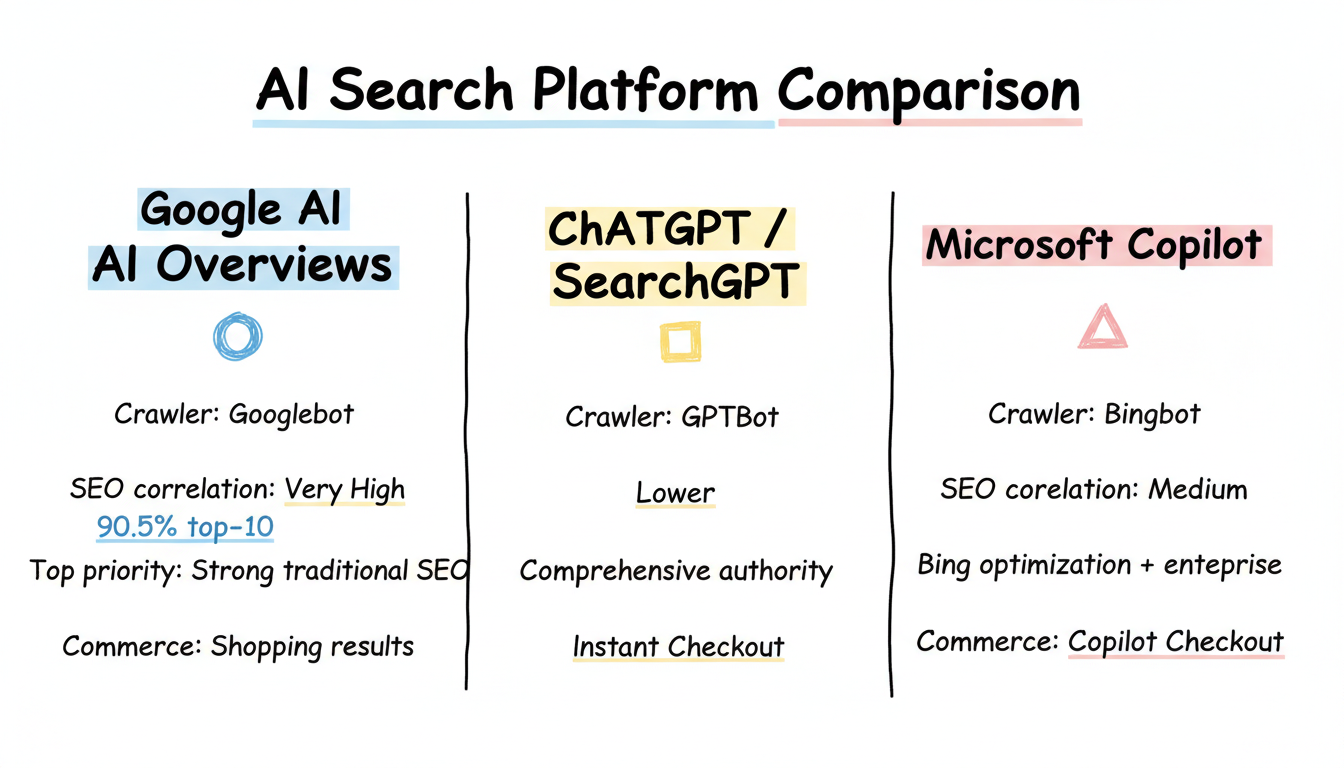
Citations per answer | Variable | ~6.1 average | Variable |
Source preference | Top organic rankings | Brand-owned content | Bing index + enterprise |
Real-time capability | Yes (indexed content) | Yes (browse mode) | Yes (Bing integration) |
Link format | Expandable sections | Inline mentions | Integrated in results |
Commerce integration | Shopping results | Instant Checkout | Copilot Checkout |
Technical Requirements
Requirement | Google AI Overviews | ChatGPT | Microsoft Copilot |
Primary crawler | Googlebot | GPTBot | Bingbot |
Schema importance | High | Medium | Medium |
Traditional SEO correlation | Very high (90.5% top 10) | Lower | Medium (Bing rankings) |
Content freshness weight | Medium | High (browse mode) | Medium |
Enterprise data integration | Limited | No | Yes (M365) |
Develop platform-specific approaches while maintaining foundational best practices.
Google AI Overviews Strategy
Foundation: Strong Traditional SEO
Google AI Overviews citation probability correlates directly with organic rankings. Organizations without strong SEO foundations cannot effectively optimize for AI Overviews.
Key tactics:
- Rank first, optimize second: Target top 10 rankings before focusing on AI Overview optimization
- Answer queries directly: Structure content with clear answers in first paragraphs
- Implement comprehensive schema: Use FAQ, HowTo, and relevant structured data
- Build authority: E-E-A-T signals that improve organic rankings also improve AI Overview citation
- Cover depth: 88% of users expand truncated overviews—comprehensive content wins
ChatGPT/SearchGPT Strategy
Foundation: Authority and Comprehensiveness
ChatGPT values comprehensive, authoritative content that thoroughly addresses topics.
Key tactics:
- Create definitive resources: Build comprehensive guides that become go-to references
- Include citations and statistics: Research shows 40%+ visibility improvement with data
- Allow GPTBot access: Verify technical accessibility for OpenAI's crawler
- Build brand mentions: Consistent presence across authoritative sources influences training data
- Cover conversational paths: Address natural follow-up questions
Microsoft Copilot Strategy
Foundation: Bing Optimization and Enterprise Integration
Copilot's unique position requires dual optimization for search and enterprise contexts.
Key tactics:
- Optimize for Bing: Copilot draws from Bing's index—Bing SEO matters
- Product feed quality: Clean Microsoft Merchant Center data for commerce visibility
- Structured product information: Enable commerce features with complete product data
- Consider enterprise context: Microsoft 365 users see blended internal/external results
Many optimizations benefit all platforms simultaneously.
Universal Best Practices
These foundational elements improve visibility across all AI search platforms:
Content quality:
- Comprehensive topic coverage
- Accurate, factual information
- Clear, well-organized structure
- Regular updates for freshness
- Expert authorship and credentials
Technical foundations:
- Fast page load speeds
- Mobile optimization
- Accessible content structure
- Clean URL architecture
- Proper heading hierarchy
Authority signals:
- Quality backlink profiles
- Brand mentions across authoritative sources
- Expert author attribution
- Industry recognition and credentials
- Consistent NAP (Name, Address, Phone) information
Crawler Access Configuration
Ensure all major AI crawlers can access your content:
User-agent: Googlebot
Allow: /

User-agent: GPTBot
Allow: /

User-agent: Bingbot
Allow: /

User-agent: PerplexityBot
Allow: /

User-agent: ClaudeBot
Allow: /
Blocking AI crawlers (intentionally or accidentally) eliminates visibility regardless of content quality.
Structured Data Implementation
Schema markup benefits all platforms to varying degrees. Organizations implementing generative AI for structured data can automate schema creation at scale.
Recommended schema types:
- FAQ schema for question-answer content
- HowTo schema for procedural content
- Article schema with author information
- Organization and LocalBusiness schema
- Product schema for commerce content
- Review and AggregateRating schema
Track visibility differently based on platform capabilities.
Google AI Overviews Measurement
- Google Search Console (partial data)
- Third-party rank tracking tools with AI Overview detection
- Manual SERP monitoring
- Integration with existing SEO analytics
ChatGPT Measurement
- Manual query testing across relevant topics
- Third-party AI visibility tools (Otterly.AI, Profound, BrightEdge)
- Brand mention monitoring
- Indirect traffic attribution analysis
Microsoft Copilot Measurement
- Bing Webmaster Tools
- Manual Copilot query testing
- Microsoft Merchant Center analytics (for commerce)
- Enterprise deployment analytics (Microsoft 365 environments)
Several AI search tools software comparison tools now track visibility across multiple AI platforms:
- Otterly.AI: Tracks citations across ChatGPT, Perplexity, Google AI Overviews, Gemini, and Copilot
- Ahrefs Brand Radar: AI visibility monitoring across major platforms
- BrightEdge: Enterprise AI visibility tracking with business impact connection
- Profound: Enterprise AI visibility with competitor benchmarking
Resource Allocation Framework
Prioritize platforms based on your specific situation, available resources, and strategic objectives.
Prioritize Google AI Overviews When:
- Existing strong organic search presence
- Limited resources for new optimization efforts
- Primary audience uses Google search
- B2C or high-volume query targets
- Content already optimized for featured snippets
- Strong E-E-A-T signals already established
Resource allocation example: Organizations with mature SEO programs should dedicate 50-60% of AI optimization resources to Google AI Overviews, leveraging existing rankings.
Prioritize ChatGPT When:
- Building long-term brand authority
- Targeting conversational, complex queries
- High-consideration purchase journeys
- Professional or B2B audiences
- Creating comprehensive educational content
- Industry thought leadership goals
Resource allocation example: B2B companies with long sales cycles should consider 40-50% allocation to ChatGPT optimization for authority building during research phases.
Prioritize Microsoft Copilot When:
- Enterprise B2B target audience
- E-commerce with strong product catalogs
- Organizations using Microsoft 365 extensively
- Targeting workflow-integrated discovery
- Selling to IT decision-makers
- Strong product data infrastructure
Resource allocation example: Enterprise software vendors should allocate 30-40% of resources to Copilot given its integration into Microsoft 365 environments where purchasing decisions occur.
Balanced Approach
Most organizations should invest across all platforms since:
- Foundational optimizations benefit all platforms
- Audience fragmentation requires multi-platform presence
- Platform market share continues shifting
- Diversification reduces dependency risk
- Cross-platform presence reinforces overall authority
- User behavior varies by query type and context
Recommended baseline allocation for diversified strategy:
- Google AI Overviews: 40-50%
- ChatGPT/SearchGPT: 30-35%
- Microsoft Copilot: 15-20%
- Emerging platforms (Perplexity, Claude): 5-10%
Adjust percentages based on audience analysis, existing platform strengths, and competitive positioning. Organizations exploring AEO services agency offerings should seek providers with demonstrated multi-platform expertise rather than single-platform specialists.
The competitive landscape continues evolving rapidly with significant changes expected through 2026-2027.
Expected developments:
- Continued fragmentation: No return to single-platform dominance expected
- Commerce integration deepening: All platforms building transactional capabilities
- Agentic features expanding: AI agents performing tasks beyond information retrieval
- Enterprise integration: More platforms connecting to organizational data
- Multimodal expansion: Video, image, and audio content citation increasing
Google:
- Deeper integration of AI Overviews into all query types
- Enhanced local and commerce AI features
- Tighter coupling between traditional rankings and AI citation
- Expanded Gemini capabilities across Google products
ChatGPT/OpenAI:
- Continued market share growth in complex queries
- Enhanced real-time web integration
- More sophisticated citation and attribution
- Deeper enterprise feature development
- Expanded agentic commerce capabilities
Microsoft Copilot:
- Stronger enterprise market penetration through Microsoft 365
- Enhanced commerce and transaction features
- Broader consumer reach through Windows integration
- Improved coordination between Copilot variants
Emerging Challengers:
- Perplexity expected to maintain rapid growth trajectory
- Claude (Anthropic) developing search capabilities
- Vertical-specific AI search platforms emerging
- Regional players gaining market share in specific geographies
Organizations maintaining flexible, multi-platform strategies position themselves to adapt as the landscape evolves. Those implementing search engine optimization using AI methodologies now will have the infrastructure to adapt as platforms release new features.
Strategic preparation recommendations:
- Build platform-agnostic content foundations
- Monitor emerging platforms for early adoption opportunities
- Develop measurement infrastructure supporting new platforms
- Maintain technical flexibility for rapid optimization adjustments
- Invest in authority signals that transfer across platforms
FAQs
Start with Google AI Overviews if you have existing SEO investment—optimizations transfer most directly. Add ChatGPT for authority building and Copilot if targeting enterprise audiences. Universal optimizations (content quality, technical accessibility, authority building) benefit all platforms. Most organizations benefit from a diversified approach given ongoing market share shifts.
Core optimizations overlap significantly. Quality content, technical accessibility, and authority signals benefit all platforms. Platform-specific tactics (ChatGPT's citations/statistics emphasis, Copilot's Bing integration, Google's ranking correlation) add incremental value on top of universal foundations. Approximately 70-80% of optimization effort benefits all platforms, with 20-30% requiring platform-specific approaches.
Should I block certain AI crawlers?
Generally no. Blocking AI crawlers eliminates visibility regardless of content quality. Only block if you have specific concerns about AI training that outweigh visibility benefits—and understand this creates competitive disadvantages. Organizations blocking GPTBot or other AI crawlers effectively opt out of the fastest-growing information discovery channel.
Use platform-specific tracking tools (Search Console, Bing Webmaster Tools) alongside cross-platform AI visibility tools (Otterly, BrightEdge, Profound). Manual testing provides qualitative insights automated tools may miss. Track both citation appearances and referral traffic where measurable. Establish baseline measurements before optimization to demonstrate improvement. Organizations implementing AI search traffic attribution systems can connect visibility to business outcomes more directly.
How quickly does AI search optimization show results?
Timeline varies by platform. Google AI Overviews improvements correlate with organic ranking improvements—similar timelines to traditional SEO. ChatGPT parametric knowledge requires content to influence training data (longer timeline). Real-time search modes on ChatGPT and Perplexity can show faster results for newly optimized content. Expect 3-6 months for meaningful visibility improvements across platforms.
Can small businesses compete with larger competitors in AI search?
Yes, particularly in specialized topic areas. AI search tends to cite authoritative, comprehensive content regardless of company size. Small businesses with deep expertise in specific niches can earn citations by creating definitive resources on their specialty topics. Focus on areas where you have genuine expertise rather than competing broadly against better-resourced competitors. Reviewing AEO marketing examples from various company sizes demonstrates that topical authority matters more than brand size.



