February 19, 2026


Schema markup has evolved from an SEO enhancement to an AI visibility requirement. In 2026, generative AI systems rely heavily on structured data to understand, verify, and cite content accurately. Understanding how to implement structured data specifically for AI interpretation determines whether your content gets cited in ChatGPT, Perplexity, Google AI Overviews, and other generative search platforms.
According to ALM Corp's schema guide, schema markup is a standardized vocabulary of code that helps search engines and AI systems understand content's meaning, context, and relationships. It's critical because AI-powered search relies heavily on structured data to comprehend, verify, and cite information. Without schema markup, content is significantly less likely to appear in AI-generated responses.
Generative AI systems process information differently than traditional search crawlers. Structured data provides the explicit signals AI needs to understand content accurately.
According to Backlinko's schema markup guide, AI systems like Google's AI Overviews, ChatGPT, Perplexity, and others rely heavily on structured data to understand, summarize, and cite content accurately. Schema markup gives search engines clearer signals about what content is and increases chances of being cited by AI-generated answers.
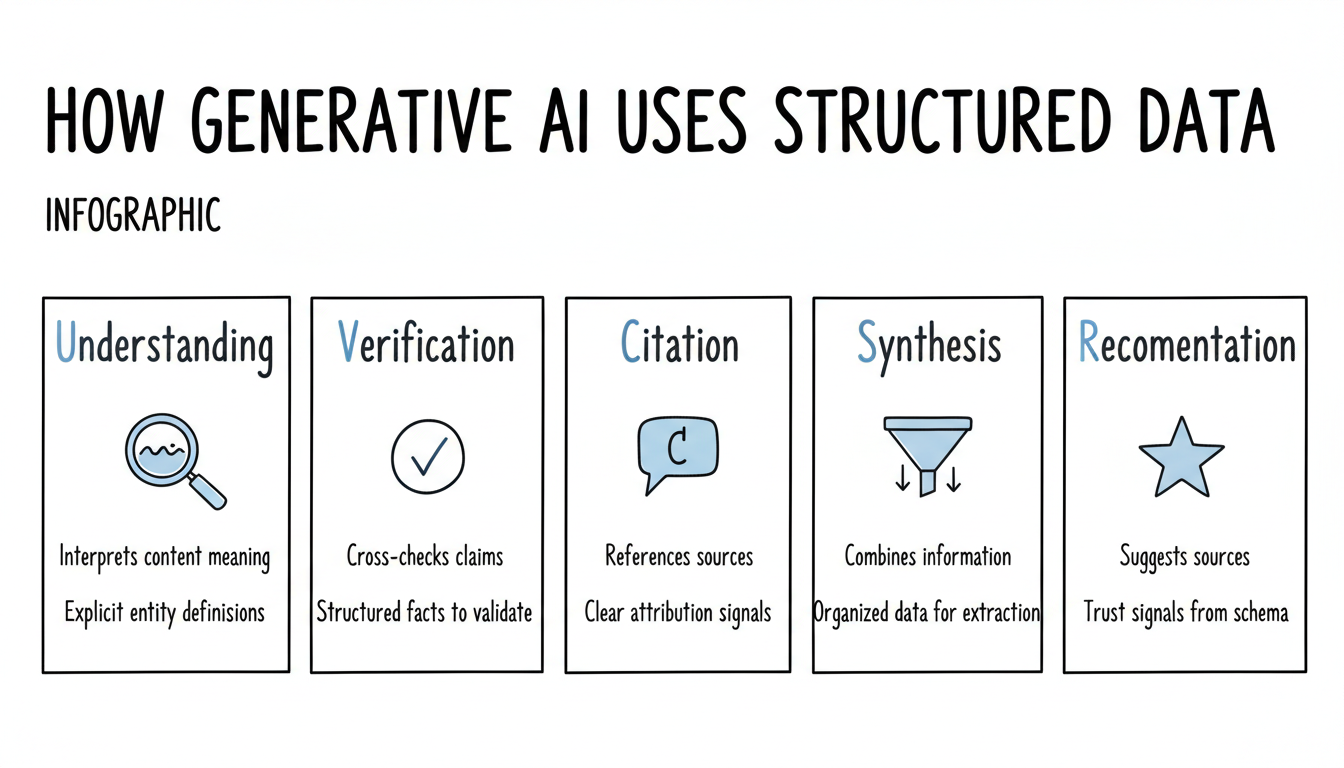
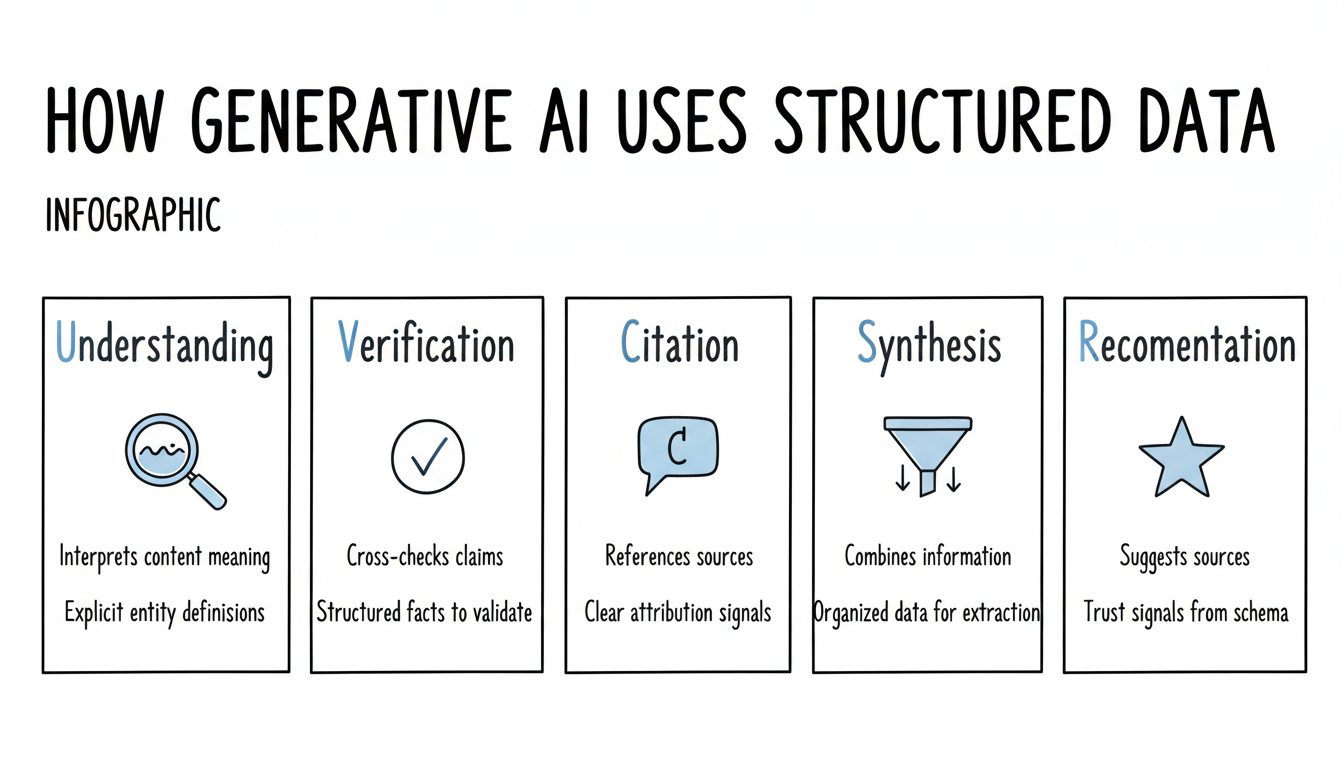
How AI uses structured data:
Function | What AI Does | Why Structured Data Helps |
Understanding | Interprets content meaning | Explicit entity definitions |
Verification | Cross-checks claims | Structured facts to validate |
Citation | References sources | Clear attribution signals |
Synthesis | Combines information | Organized data for extraction |
Recommendation | Suggests sources | Trust signals from schema |
According to Addlly AI's schema visibility guide, schema markup translates content into structured code that AI search engines understand and index immediately. It establishes brands as trusted entities, helping AI systems distinguish you from competitors.
JSON-LD has emerged as the standard format for implementing structured data that AI systems can process efficiently.
According to Wellows' schema best practices, JSON-LD is the preferred format for adding structured data, especially for Google. It is easy to manage, flexible, and less likely to cause technical issues.
JSON-LD advantages for AI:
JSON-LD Implementation
├── Clean separation from HTML
│   └── Added in <head> section
├── Machine-readable format
│   └── AI parses efficiently
├── Nested relationship support
│   └── Complex entity mapping
├── Easy validation
│   └── Standard testing tools
└── Update flexibility
    └── Modify without page changes
According to SEOProfy's LLM SEO guide, structured data tells search engines and language models exactly what each part of a page means. Instead of guessing, the crawler reads JSON-LD and knows "this block is an FAQ answer" or "this list is a step-by-step guide." A complete, validated schema turns pages into ready-made answers that LLMs can trust and cite.
Different schema types serve different AI visibility purposes. Selecting the appropriate schema for each page type maximizes citation potential, especially when optimizing for Google AI Overview visibility.
According to Dashspert's AI overview optimization guide, comprehensive and context-specific schema—such as Article, FAQ, Author, HowTo, Product, or Event schemas—guide AI models on exactly how material should be interpreted and categorized.
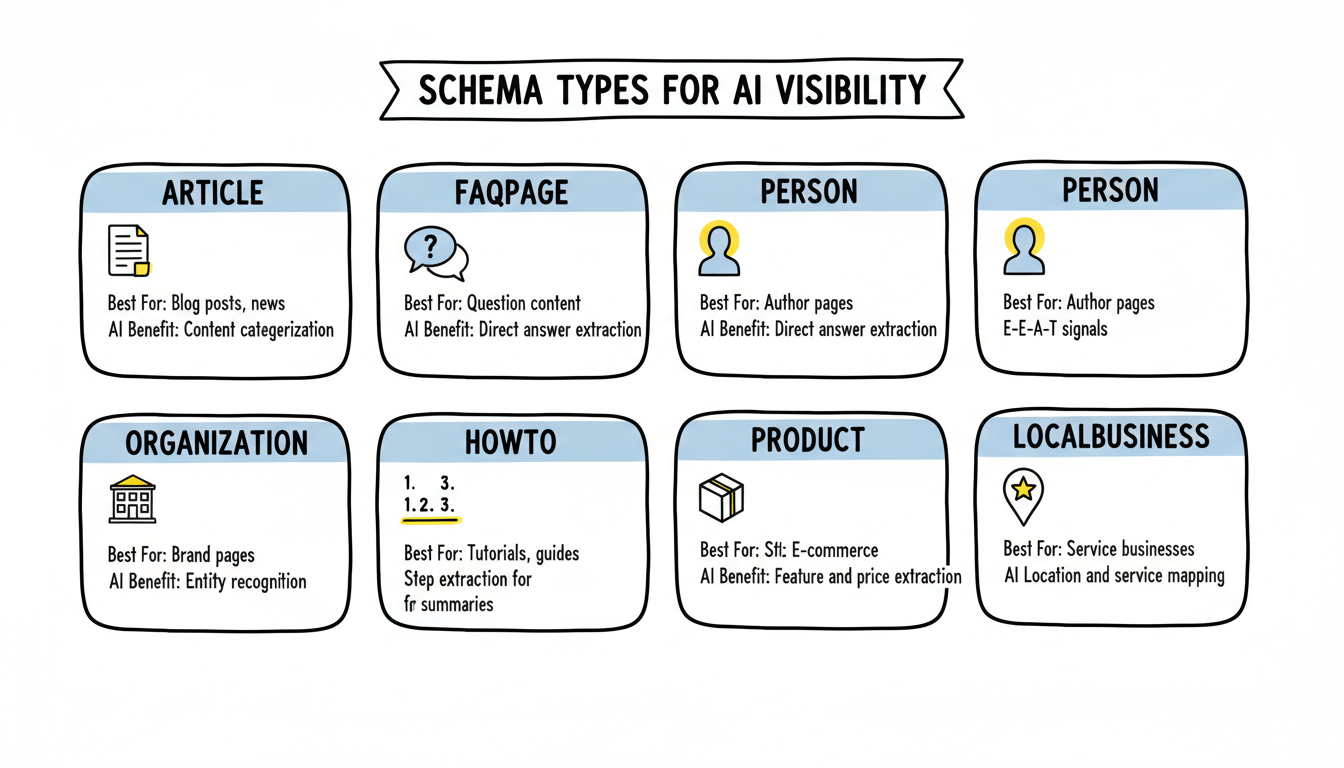
Priority schema types for AI:
Schema Type | Best For | AI Benefit |
Article | Blog posts, news | Content categorization |
FAQPage | Question content | Direct answer extraction |
HowTo | Tutorials, guides | Step extraction for summaries |
Organization | Brand pages | Entity recognition |
Person | Author pages | E-E-A-T signals |
Product | E-commerce | Feature and price extraction |
LocalBusiness | Service businesses | Location and service mapping |
According to The Digital Bloom's AI visibility report, JSON-LD structured data is Google's preferred format, and semantic HTML5 markup using proper tags like header, nav, main, article, footer, and time tags supports AI interpretation.
Implementation strategy determines how effectively AI systems can leverage your structured data. Working with AI SEO services can help ensure proper schema deployment across your entire site.
According to IDX Inc's authority flywheel strategy, structured data wins—implementing schema markup such as Article, FAQPage, and HowTo improves citation odds in AI Overviews. Machine-readable content using clear headings, lists, and Q&A formats feeds AI models directly and achieves higher citation rates.
Implementation best practices:
According to Wix App Market's JSON-LD tool description, JSON is the language LLMs love. Structured data helps Google, ChatGPT, Gemini, and other AI tools clearly understand business, services, and content, making it easier for them to recommend and reference websites.
Structured data supports entity recognition, which determines how AI systems identify and categorize your brand. This is a fundamental component of entity optimization for AI search strategies.
According to ALM Corp, Google's search algorithms now evaluate content through the lens of E-E-A-T (Experience, Expertise, Authoritativeness, Trustworthiness). Schema markup directly supports these signals by defining entities and their relationships clearly.
Entity schema elements:
Element | Implementation | AI Recognition Impact |
sameAs | Link to official profiles | Validates identity across web |
author | Named individuals with credentials | Establishes expertise |
publisher | Organization details | Confirms authority |
datePublished/Modified | Timestamps | Signals content freshness |
mainEntity | Core subject definition | Clarifies topic focus |
The relationship between structured data and AI systems continues to evolve as platforms develop. Understanding these shifts is essential for advanced GEO optimization efforts.
According to LinkedIn discussion on schema in 2026, Google's John Mueller addressed whether schema markup helps search engines and LLMs better understand content with "Yes, no, it depends." On one hand, schema provides explicit signals about content meaning. On the other hand, modern LLMs are sophisticated enough to extract context without explicit markup.
The balanced perspective:
According to Accountability Now's SEO types guide, schema markup is now table stakes. Not only does it help Google understand content, but it's also essential for AI and LLMs referencing brands. AI engines may skip pages without structured data.
Tracking how structured data affects AI citation requires monitoring specific metrics.
According to Data Mania's AI visibility tool analysis, over 72% of first-page results use schema markup. AI systems need structured data to understand content, making implementation essential for visibility.
Measurement approach:
Metric | What to Track | Tools |
Rich result appearances | Schema generating enhanced results | Search Console |
AI citation frequency | Mentions in AI responses | AI monitoring tools |
Entity recognition | How AI identifies your brand | Brand tracking |
Schema validation | Errors and warnings | Rich Results Test |
Competitive comparison | Schema sophistication vs competitors | SEO audit tools |
Leveraging generative AI's use of structured data requires strategic implementation:
According to Addlly AI, the digital landscape shifts rapidly in 2026. Search engines now demand clear structured data to function correctly. Implementing schema markup is the best defense against invisibility—it transforms web pages into trusted, verifiable resources for algorithms.
By submitting this form, you agree to our Privacy Policy and Terms & Conditions.