
February 19, 2026


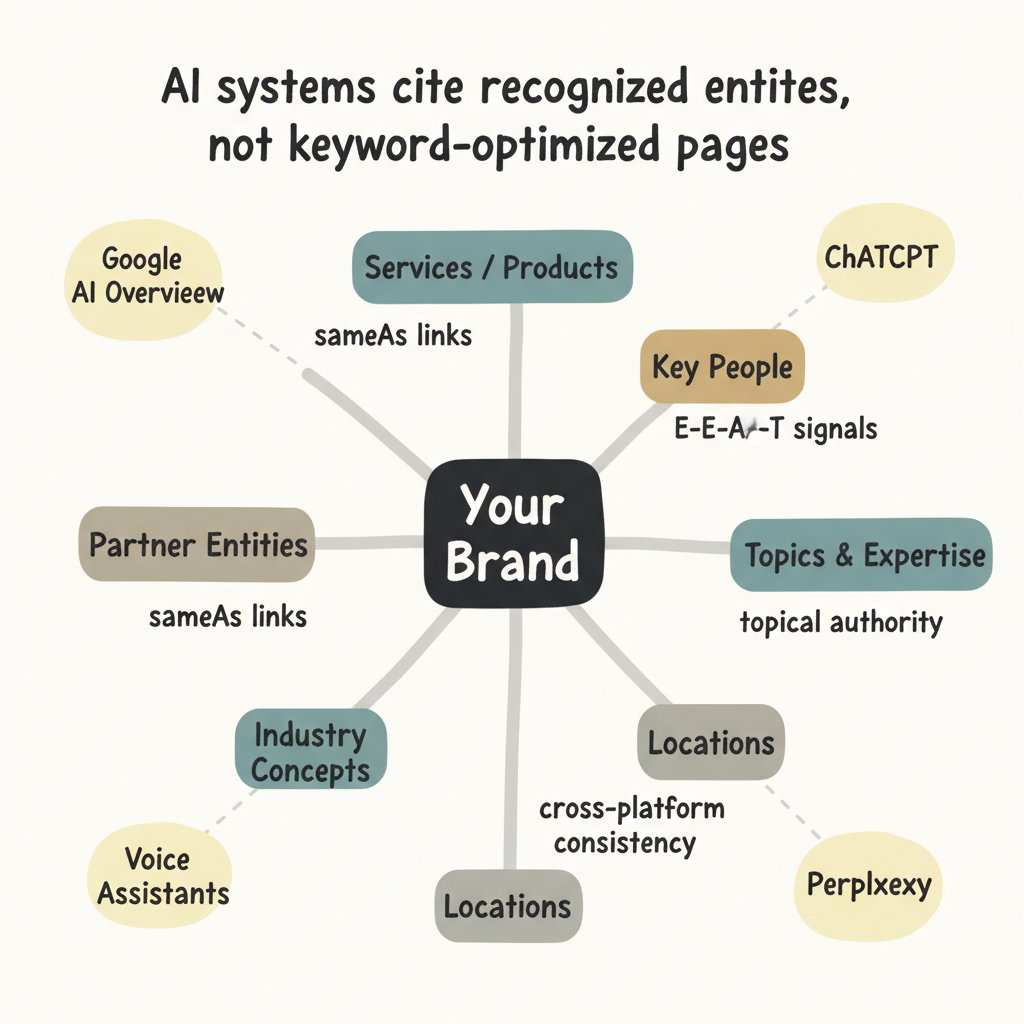
AI systems don't evaluate your content the same way traditional search engines do. Instead of matching keywords to queries, they recognize entities—people, brands, products, concepts—and determine which ones are authoritative enough to cite. Entity optimization is the practice of strengthening how AI systems understand and trust your brand as a distinct, citable entity.
According to IDX's Authority Flywheel analysis, entity SEO transforms your brand from a collection of keywords into a recognized concept within the AI Knowledge Graph. The brands that master this shift don't just rank—they become the sources AI systems cite when answering questions.
Entity optimization is the process of clearly defining and strengthening how search engines and AI systems understand your brand as a distinct, real-world entity. An "entity" isn't just a business—it can be a brand, company, person, product, service, location, concept, or organization.
According to Three29's GEO analysis, search engines like Google no longer treat websites as isolated collections of pages. Instead, they build massive knowledge graphs that map entities and the relationships between them. AI-powered search engines then rely on those entity relationships to generate answers, summaries, recommendations, and citations.
Key entity optimization questions AI systems evaluate:
Question | What AI Systems Look For |
Who is this entity? | Clear identity, consistent naming |
What does this entity do? | Defined services, products, expertise |
Why is this entity authoritative? | E-E-A-T signals, third-party validation |
How does this entity relate to topics? | Topical associations, semantic connections |
Where can this entity be verified? | Cross-platform consistency, citations |
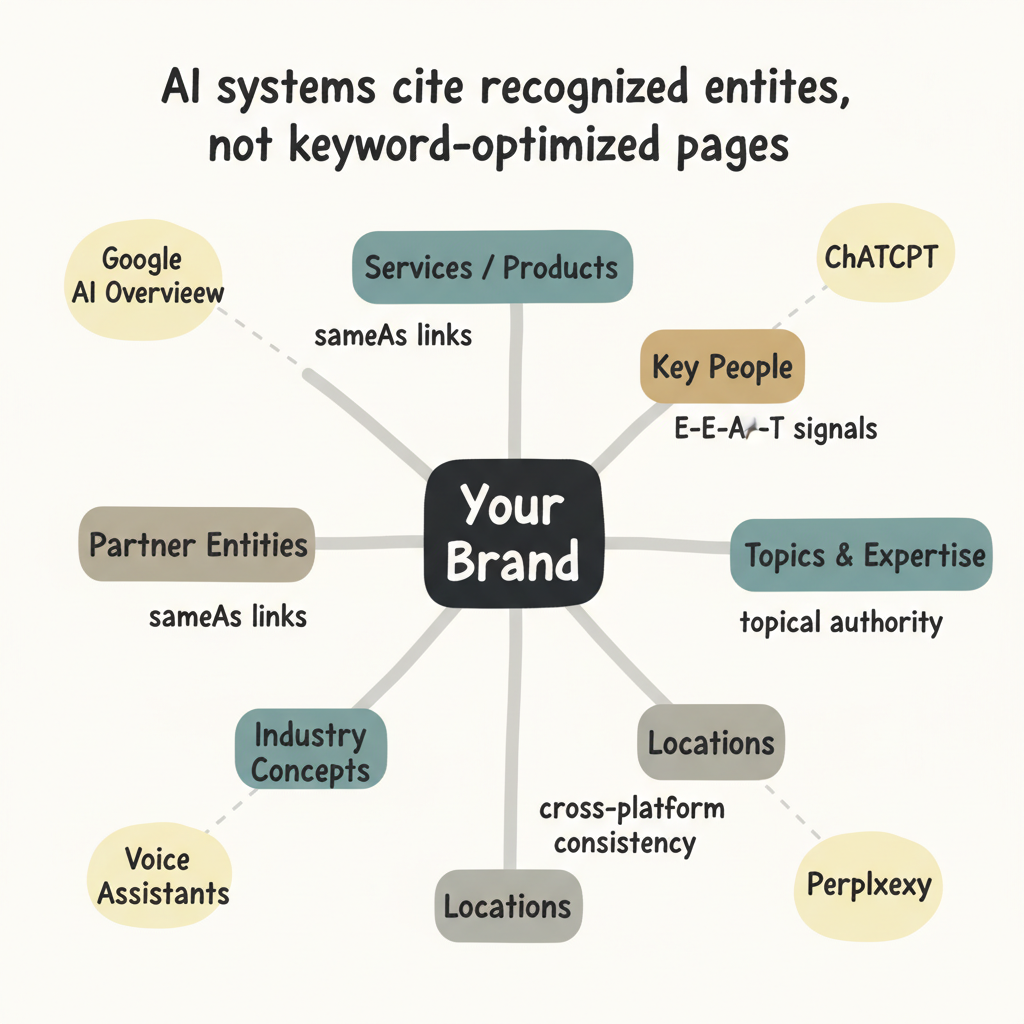
According to 1827 Marketing's B2B transformation roadmap, the shift from keyword-based SEO to entity-based optimization represents the single most critical technical transformation for visibility. Entities—not keywords—now determine which brands appear in Google's AI Overviews, ChatGPT responses, Perplexity citations, and voice assistant recommendations.
Impact metrics:
According to Search Engine Journal's 2026 predictions, AI-driven search systems are no longer ranking documents but evaluating entities, synthesizing answers, and choosing which brands they trust enough to cite. Visibility now depends on clean, authoritative data; deep topical coverage; and systems that make your content easy to retrieve, understand, and reuse.
According to 1827 Marketing, entity optimization requires four foundational pillars.
The first pillar is maintaining identical NAP (Name, Address, Phone), social handles, leadership bios, and service nomenclature across every touchpoint—from website to directories to partner listings.
Why it matters: When AI systems encounter conflicting signals about your brand's identity, they cannot confidently cite you as an authoritative source.
Consistency checklist:
According to Website Depot's SEO/AEO guide, entity-focused schema supports clear differentiation from similarly named brands, stronger association with topical expertise, improved citation likelihood in AI Overviews, and better alignment across knowledge systems.
Priority schema types for entity optimization:
Schema Type | Entity Signal | Implementation Priority |
Organization | Brand identity | Critical |
Person | Author/expert credibility | High |
Product | Product entity recognition | High for e-commerce |
LocalBusiness | Geographic entity signals | High for local |
Article | Content authorship | High for publishers |
FAQPage | Q&A entity associations | Medium |
According to ALM Corp's schema guide, schema markup is the primary method for getting your entities recognized in Google's Knowledge Graph. When you implement comprehensive Organization, Person, Product, or other entity schema with strong sameAs links to Wikipedia, Wikidata, and authoritative sources, you signal to Google that these entities should be included in their knowledge base.
According to Search Engine Journal, building authority signals that machines can verify requires structured data, consistent sourcing, and entity clarity. SEOs need to build authority signals machines can verify rather than relying on traditional trust proxies.
Authority signal components:
Understanding what is knowledge graph SEO is essential for building these authority signals effectively, as it helps you align your content strategy with how AI systems interpret topical expertise.
According to Three29, AI systems strategically build confidence in your brand entity by examining your website content and structure, business profiles and citations, schema and structured data, brand mentions across authoritative sites, PR articles, social platforms and third-party databases, and consistency of naming, descriptions, and positioning.
Validation touchpoints:
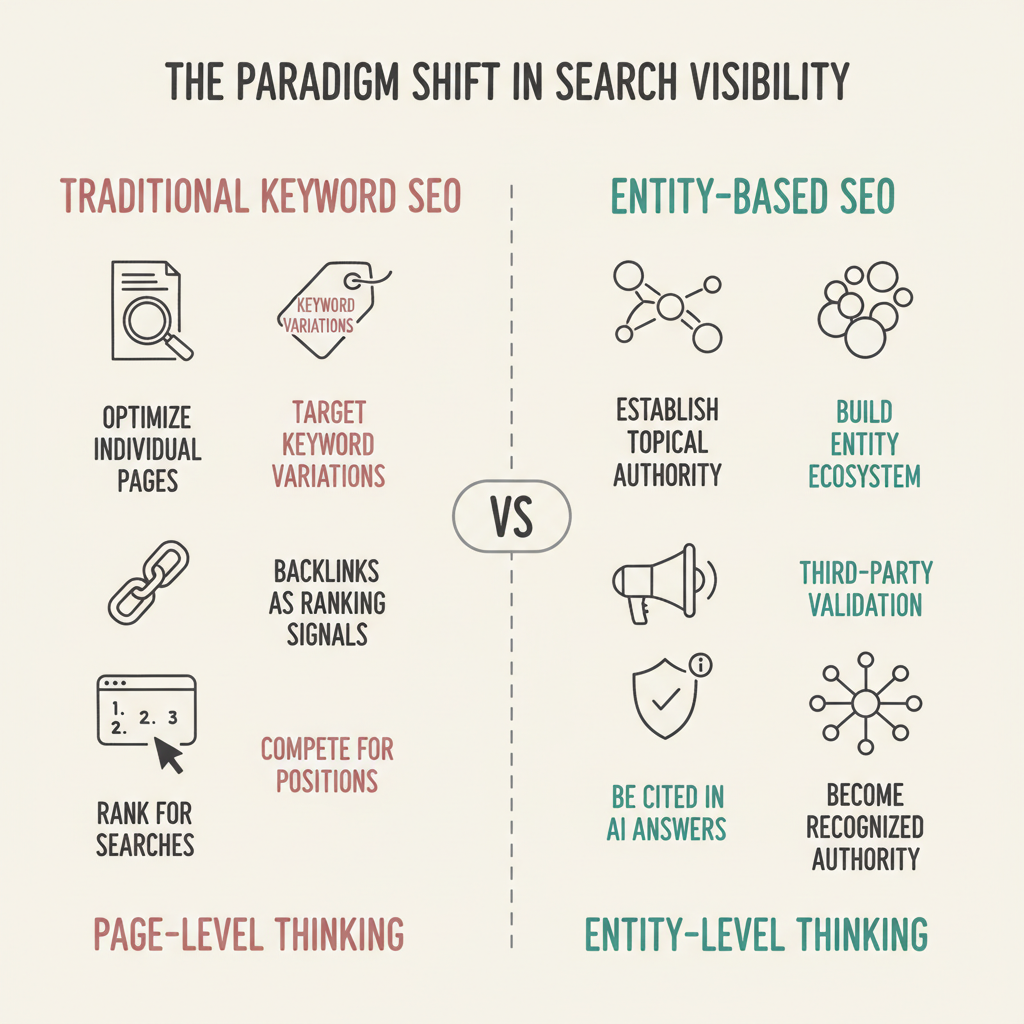
According to LinkedIn's 2026 SEO predictions, brands with entity-level recognition get preference in AI systems. Understanding AI SEO vs traditional SEO differences represents a fundamental change in optimization strategy.
Traditional Keyword SEO | Entity-Based SEO |
Optimize individual pages | Build entity ecosystem |
Target keyword variations | Establish topical authority |
Backlinks as ranking signals | Third-party validation as trust signals |
On-page optimization | Cross-platform consistency |
Rank for searches | Be cited in answers |
Compete for positions | Become recognized authority |
According to ALM Corp's AI search guide, entity optimization goes beyond traditional keyword targeting to focus on specific people, places, brands, products, and concepts. Instead of optimizing for "best smartphones 2025," optimize for specific entities like individual product names. AI models use entity recognition to understand context—mentioning recognized entities signals topical relevance and expertise.
According to ALM Corp's 2026 SEO trends analysis, developing a comprehensive Knowledge Graph presence is essential. For branded searches, your Knowledge Panel is your most valuable real estate. Following a knowledge graph optimization checklist ensures you don't miss critical implementation steps.
Knowledge Graph optimization steps:
According to IDX, becoming a Knowledge Graph node means combining link development, entity SEO, and Answer Engine Optimization (AEO) to position your brand as a trusted node in the AI Knowledge Graph. These steps move you from ranking for keywords to being cited as a source.
According to SeoProfy's LLM SEO guide, LLM optimization shifts the focus from ranking in traditional search engines to helping LLMs understand, select, and surface your content when users ask questions.
AI chatbot entity requirements:
According to LinkedIn's analysis, if your brand isn't visible where large language models learn, it doesn't exist to them. Entity presence must extend to the sources AI systems train on and reference.
According to Search Engine Journal, visibility metrics are shifting from rankings to retrieval-based measures. Setting up proper AI search KPI goal setting frameworks helps track entity optimization progress.
Entity strength indicators:
Metric | How to Measure | Target |
Knowledge Panel presence | Branded search results | Active and accurate |
AI citation frequency | Manual AI search audits | Increasing trend |
Brand mention volume | Media monitoring tools | Growth over time |
Entity disambiguation | Search for brand name | Clear differentiation |
Topical association | Related entities in KG | Strong connections |
Cross-platform consistency | Entity audit | 100% alignment |
According to ALM Corp, key metrics include impression share in target keywords, share of voice in featured snippets, brand mention volume across AI platforms, Knowledge Panel accuracy and completeness, and local pack appearance frequency.
According to Sitebulb's 2026 SEO predictions, mastering semantic SEO and intent clustering requires building content ecosystems that mirror how AI-driven search engines interpret meaning, not just keywords.
Mistakes that weaken entity signals:
According to NewzDash's 2026 predictions, Google's systems rely heavily on entity relationships to understand who is authoritative on what. This influences rankings, Discover eligibility, and AI citations. Conducting regular AEO competitor analysis helps identify gaps in your entity signals compared to industry leaders.
Week 1-2: Entity Audit
Week 3-4: Foundation Fixes
Week 5-6: Authority Building
Week 7-8: AI Visibility Optimization
Ongoing: Maintenance and Growth
Entity optimization is foundational to AI search visibility:
According to LinkedIn's SEO predictions, if your authors, experts, founders, and brand don't have a digital footprint, AI simply won't cite you. Entity optimization ensures your brand exists in the knowledge systems AI relies on for answers.
By submitting this form, you agree to our Privacy Policy and Terms & Conditions.



