February 19, 2026


Answer Engine Optimization claims are everywhere in 2026. Agencies promise AI visibility, consultants tout citation strategies, and tools advertise AI search tracking. But what do actual results look like? Which businesses have documented real ROI from AEO marketing strategies?
This guide examines documented AEO case studies across industries—SaaS, e-commerce, and local business—breaking down methodologies, timelines, and measurable outcomes. If you're evaluating whether AEO investment makes sense for your business, these real-world examples provide the evidence base you need.
The AEO industry faces a documentation problem. While traditional SEO has decades of case studies with standardized metrics (rankings, traffic, conversions), AEO is newer and metrics are less established.
For decision-makers evaluating AEO investment, case studies answer critical questions:
AEO case studies are harder to find than SEO case studies for several reasons:
Newer discipline: AEO emerged seriously in 2024-2025, leaving less time for documented results.
Attribution complexity: Connecting AI citations to revenue requires more sophisticated tracking than traditional SEO, though Google Analytics 4 AI search tracking has made this easier.
Platform opacity: Unlike Google Search Console, AI platforms don't provide publisher dashboards.
Competitive sensitivity: Companies achieving strong AI visibility often guard their methods.
Despite these challenges, documented case studies do exist. Let's examine the most instructive examples.
Before diving into specific case studies, understanding how to evaluate AEO results helps separate signal from noise.
Metric Category | Specific Metrics | Why It Matters |
Visibility | AI citation rate, Share of Voice | Did visibility actually improve? |
Traffic | AI referral visits, Overall organic growth | Did visibility translate to traffic? |
Engagement | Conversion rate, Time on site | Is AI traffic quality traffic? |
Revenue | Attributed revenue, ROI percentage | Does it justify investment? |
Watch for these issues in case studies:
Look for case studies that include:
Software companies have been early AEO adopters, with several documented success stories that demonstrate the effectiveness of B2B AEO marketing approaches.
According to iPullRank's documented results, a fintech platform achieved significant gains through integrated SEO and AEO optimization:
Challenge: Declining organic visibility as AI Overviews captured informational queries in financial services.
Approach:
Results (over 12 months):
Key Insight: The fintech case demonstrates that AEO and traditional SEO reinforce each other—content optimized for AI extraction also performed better in traditional rankings.
NoGood's documented work with SteelSeries provides another SaaS-adjacent example:
Challenge: Competition from larger brands in AI-generated product recommendations.
Approach:
Results (over 6 months):
Key Insight: Product-focused businesses can achieve AEO results by ensuring AI systems have accurate, well-structured product information to cite.
Company Type | Traffic Growth | Conversion Impact | Timeline |
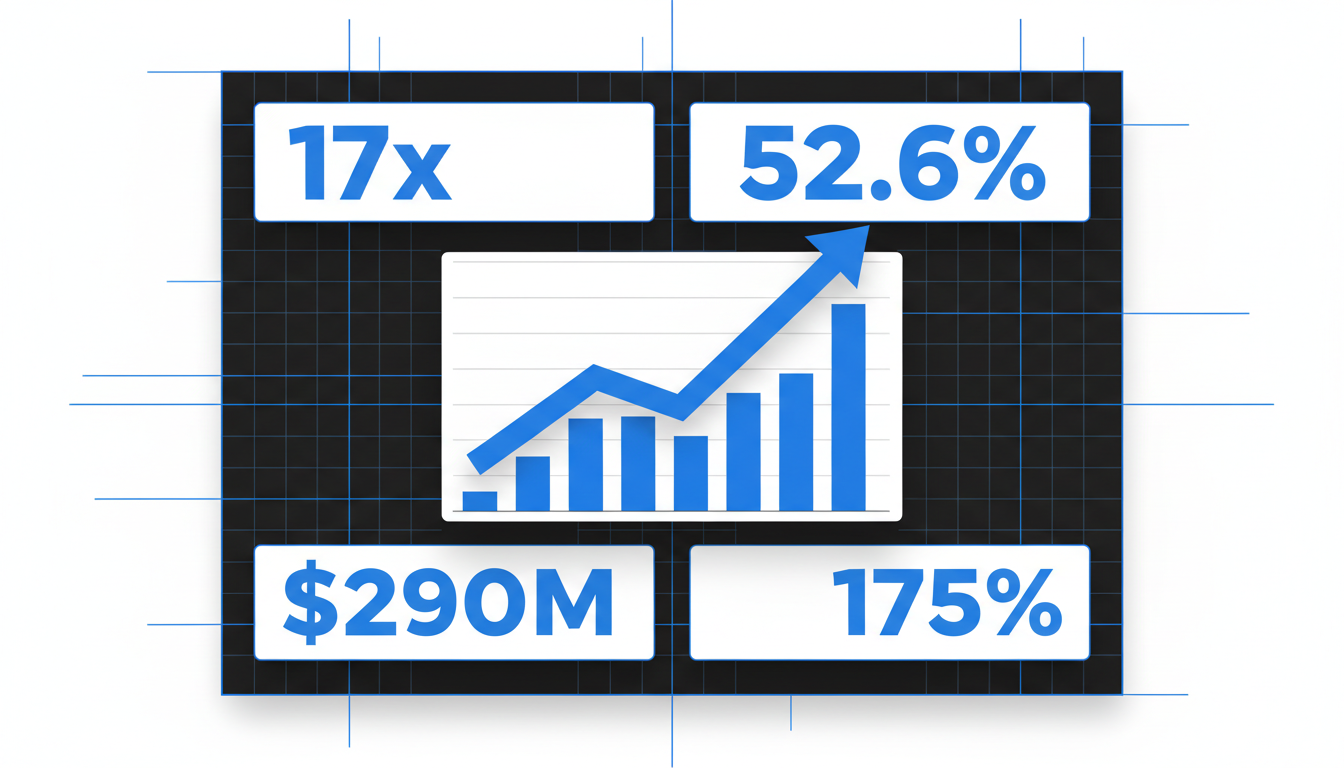
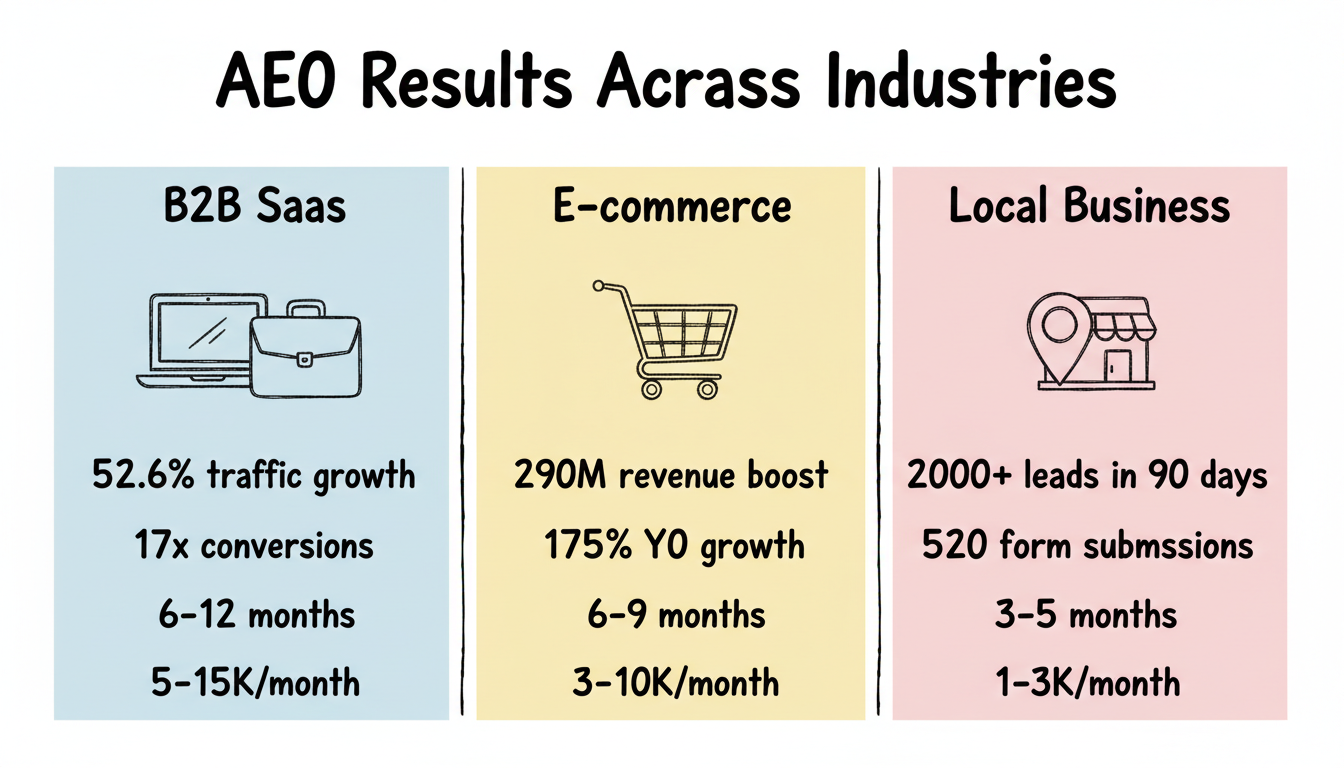
B2B Fintech | 52.6% | 17x improvement | 12 months |
Consumer Tech | N/A | 3.2x | 6 months |
Average SaaS | 30-50% | 2-5x | 6-12 months |
E-commerce presents unique AEO challenges—lower AI Overview rates but high commercial intent when AI does appear.
iPullRank's e-commerce case study documents results for a large marketplace:
Challenge: Competing for product visibility in AI-generated shopping recommendations and comparison content.
Approach:
Results (over 18 months):
Key Insight: At enterprise scale, AEO investment compounds—the $290M revenue attribution dwarfs the implementation investment.
E-commerce faces distinct AEO dynamics:
Lower AI Overview rates: According to industry research, e-commerce queries trigger AI Overviews only ~4% of the time, compared to 65-70% for B2B technology queries when comparing Google AI Overview vs traditional SERP performance.
High-value citations: When AI does recommend products, conversion intent is typically high.
Schema dependency: Product structured data is essential for AI systems to understand and recommend products accurately.
Review authority: AI systems heavily weight user reviews and ratings when making product recommendations, a key aspect of AI overview authority signals.
For e-commerce businesses, AEO ROI depends on:
Local businesses present compelling AEO opportunities, particularly for service queries where AI provides recommendations.
97 Switch's case study for The Albert restaurant demonstrates local business AEO potential:
Challenge: Competing for visibility in local dining recommendations, particularly in AI-assisted search.
Approach:
Results (documented period):
Key Insight: Local businesses can achieve significant results through coordinated local SEO and AEO efforts. The form submission metric (520) provides clear conversion attribution.
Another 97 Switch case study for 444Social, a property management company:
Challenge: Generating leads for rental properties through digital channels including AI search.
Approach:
Results:
Key Insight: For high-value transactions like real estate, even modest AI visibility improvements can generate significant revenue impact.
97 Switch's SideGigster case study shows B2B local service results:
Challenge: Generating leads for freelance and side gig opportunities.
Approach:
Results (over 90 days):
Key Insight: Even in niche markets, focused AEO efforts can generate substantial lead volume quickly (90-day timeframe).
Business Type | Key Metric | Result | Timeline |
Restaurant | Form Submissions | 520 | N/A |
Real Estate | Occupancy | 100% | N/A |
Lead Gen | Leads | 2,000+ | 90 days |
Different AI platforms show different citation patterns. Understanding platform-specific dynamics helps prioritize optimization efforts, especially when developing a multi-platform AI search optimization strategy.
According to iPullRank's telecom case study, optimizing for Google AI Overviews specifically produced:
Platform insight: Google AI Overviews draw heavily from already-ranking content. Traditional SEO excellence remains the foundation. Understanding Google AI Overview ranking factors is essential for success.
ChatGPT citation patterns differ from Google:
Perplexity's transparent source display creates unique dynamics:
The most successful case studies show optimization across platforms, leveraging AI search tools software to monitor performance:
Strategy | Google AI | ChatGPT | Perplexity |
Traditional SEO | Critical | Helpful | Helpful |
Schema Markup | Critical | Moderate | Moderate |
Content Freshness | Moderate | Moderate | Critical |
Authority Signals | Critical | Critical | Critical |
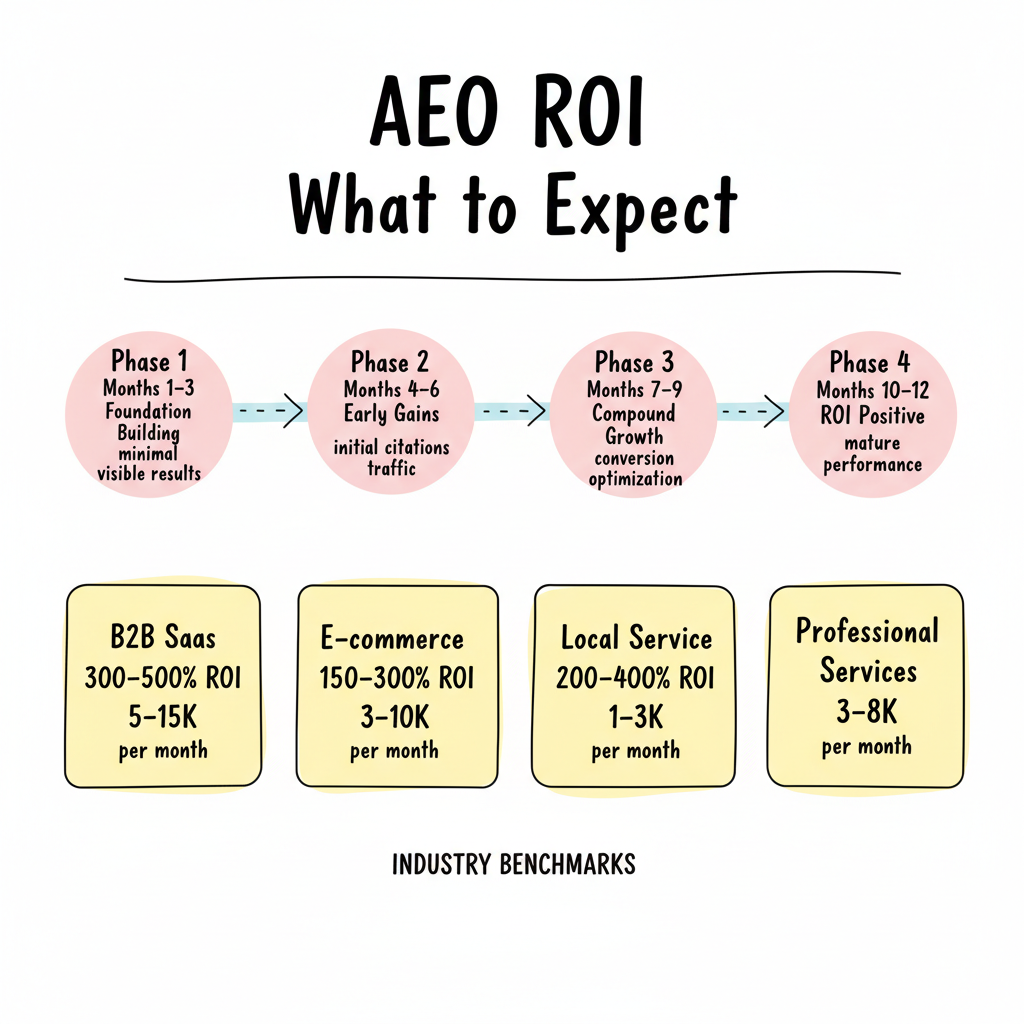
Based on documented case studies and industry analysis, here are realistic ROI expectations by sector when implementing comprehensive answer engine optimization strategies.
Industry | Typical Investment | Expected ROI | Timeline to Positive |
B2B SaaS | $5-15K/month | 300-500% | 4-6 months |
E-commerce | $3-10K/month | 150-300% | 6-9 months |
Local Service | $1-3K/month | 200-400% | 3-5 months |
Professional Services | $3-8K/month | 250-400% | 5-7 months |
Calculate your potential AEO ROI using this framework:
Revenue Attribution:
AI Referral Traffic × Conversion Rate × Average Order Value = Direct RevenueFull Attribution (including assisted):
(AI Citations × Estimated Reach × Brand Lift Factor × Conversion Rate × AOV) + Direct Revenue = Total AttributionBased on case study analysis, realistic first-year expectations:
Months 1-3: Foundation building, minimal visible results Months 4-6: Initial citation improvements, early traffic gains Months 7-9: Compound growth, conversion optimization Months 10-12: Mature performance, ROI positive
Most documented case studies show positive ROI by month 6-9 for committed programs. Businesses seeking faster results may benefit from AEO consulting services to accelerate implementation.
Document your AEO journey to measure ROI and inform ongoing optimization.
Before starting AEO work, document:
Visibility baseline:
Traffic baseline:
Revenue baseline:
Track these metrics monthly:
Metric | Measurement Method | Target Improvement |
Citation Rate | Manual or tool tracking | +5% monthly |
Share of Voice | Competitive monitoring | +2-3% monthly |
AI Referral Traffic | GA4 segmentation | +10% monthly |
Conversion Rate | Attribution modeling | Maintain or improve |
For credible case study development:
Understanding AI search ranking factors throughout your case study development ensures you're measuring the right signals and optimizing for sustainable growth.
Based on documented case studies, expect minimum 90 days for initial visibility improvements and 6-9 months for significant business impact. The SideGigster case (2,000+ leads in 90 days) represents faster results; the fintech case (17x conversions over 12 months) shows sustained growth. For detailed methodology guidance, explore comprehensive resources on how to use Google AI Overview effectively.
Yes. Local business case studies like The Albert restaurant (520 form submissions) and 444Social (100% occupancy) demonstrate that smaller businesses can achieve meaningful results. Lower investment requirements ($1-3K/month) make positive ROI achievable faster. Many small businesses benefit from affordable AEO services tailored to their budget constraints.
Use three methods: (1) Direct—track AI platform referral traffic through analytics, (2) Assisted—monitor users who interact with AI platforms before converting, (3) Brand lift—measure branded search increases correlating with AI visibility growth. Most case studies use a combination. Implementing landing page optimization for AI search can improve attribution accuracy.
Results vary by industry, competition, and execution quality. The benchmarks provided represent documented outcomes from committed programs. Your results will depend on starting position, investment level, and market dynamics. Use case studies as directional guidance, not guarantees. Understanding the broader context through resources like the generative engine optimization paper helps set realistic expectations.
Based on available case studies, B2B SaaS and professional services show strongest ROI due to high customer lifetime values and informational query patterns that trigger AI responses. E-commerce shows lower ROI percentages but larger absolute revenue numbers at scale. Building an effective AI search team structure appropriate to your industry can significantly impact outcomes.
By submitting this form, you agree to our Privacy Policy and Terms & Conditions.