February 19, 2026


Google's AI Overviews don't simply summarize top-ranking content—they evaluate authority and trust signals to determine which sources merit citation. In 2026, becoming an AI-cited source requires demonstrating credibility through specific signals that AI systems recognize and value.
This guide explains the authority signals that AI Overviews prioritize and how to build the trust factors that earn citations.
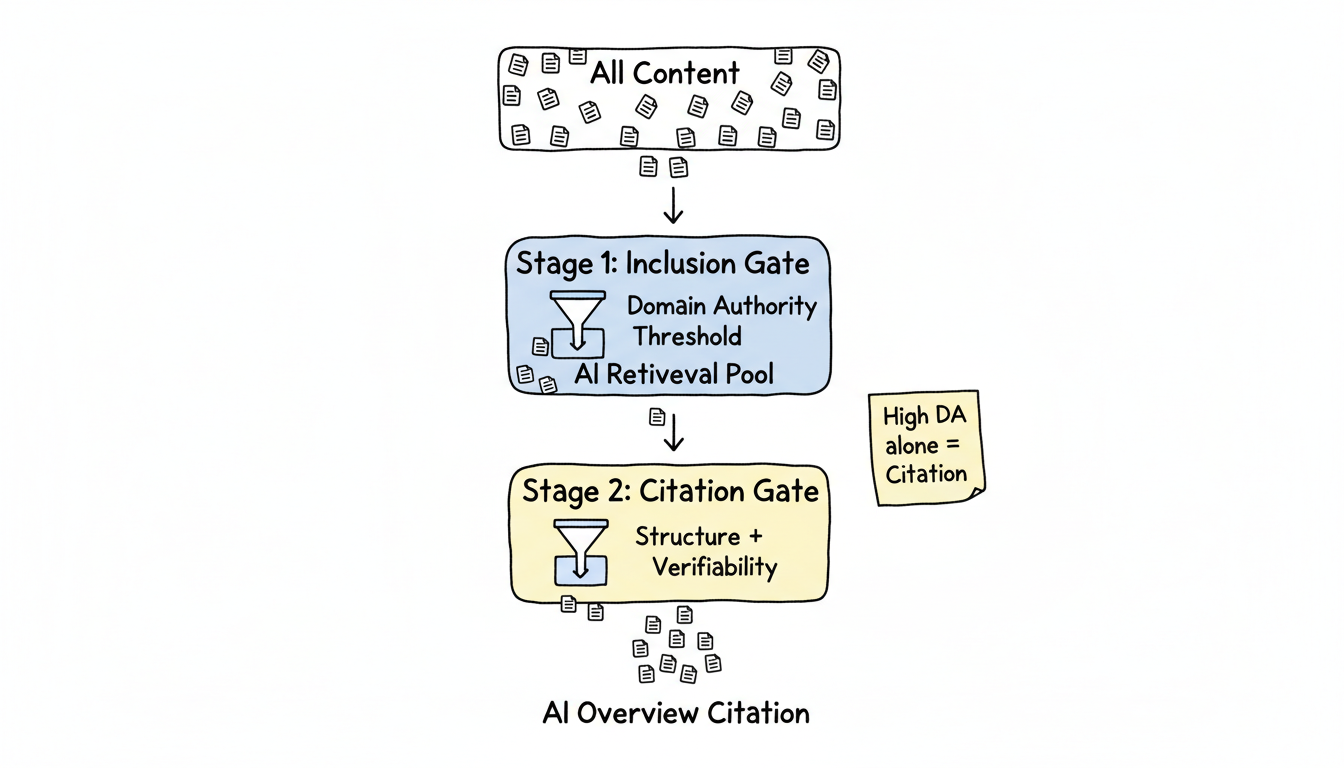
AI systems evaluate content through a two-stage filter before granting citations:
Domain Authority still matters as a prerequisite. If your domain authority is too low, content may never enter the AI retrieval layer. Traditional SEO factors remain important for initial visibility.
Once included in the retrieval pool, structure and verifiability become deciding factors. Well-structured, transparent content is far more likely to be cited than higher-DA content that's poorly formatted.
Key insight: High domain authority alone doesn't guarantee citations. Structure and credibility signals determine actual citation.
Google's E-E-A-T framework—Experience, Expertise, Authoritativeness, and Trustworthiness—has become critical for AI Overview visibility.
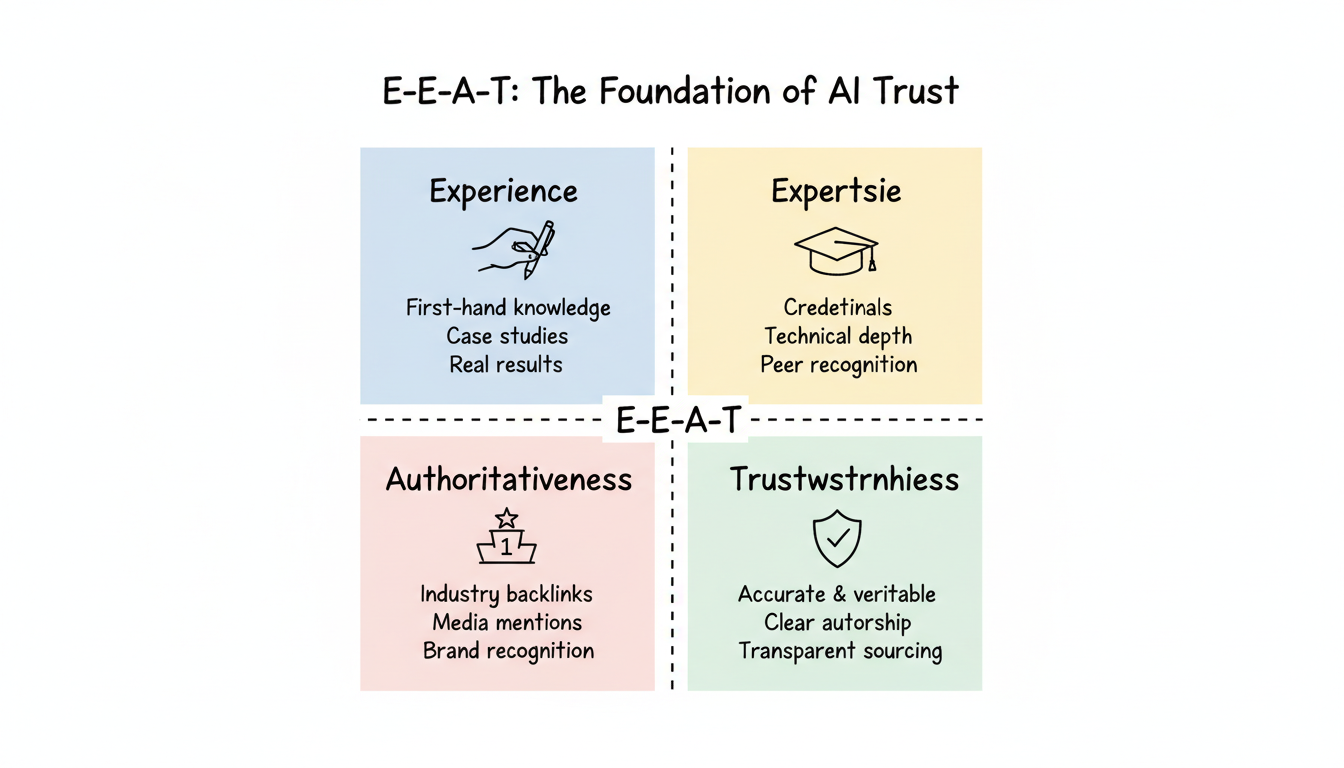
AI systems look for evidence of first-hand knowledge:
Strong experience indicators:
Weak experience signals:
Credentials and specialized knowledge matter:
Expertise demonstration:
Expert content example:
Weak (No Expertise) | Strong (Clear Expertise) |
"Many people find meditation helpful for stress." | "According to a peer-reviewed study in JAMA Internal Medicine, mindfulness meditation reduces stress markers by 38% among participants practicing daily for 15+ minutes." |
This transformation shows expertise through citation of authoritative research and specific data.
Recognition as a go-to source matters:
Authority indicators:
The authority shift: Brand mentions appear to play a larger role in AI-driven citation than links alone. Trust and brand recognition have become differentiators for inclusion.
Accuracy and transparency build trust:
Trust factors:
Research has identified specific factors that improve AI citation likelihood.
Including vetted data points significantly improves visibility:
Proper attribution dramatically impacts citation likelihood:
When developing your AI SEO strategy, proper citation practices become even more critical as search engines increasingly rely on verifiable data sources.
Writing style affects AI perception:
Before optimization:
"There are various ways to improve website speed, and some experts believe these can help with rankings."
After optimization:
"According to Google's Core Web Vitals documentation, websites loading in under 2.5 seconds (LCP threshold) see significantly higher search visibility. Key speed improvements include image optimization, efficient caching, and minimizing JavaScript execution time."
The revised version demonstrates authority through specific metrics, source citation, and confident factual presentation.
Strategic authority building improves citation likelihood over time.
Proprietary data serves as a citation magnet:
High-value data assets:
When you're the only source for specific data, AI systems must cite you to include that information.
Links still matter, but quality and relevance are paramount:
Modern link value:
E-E-A-T link quality checklist:
Build recognizable expertise through:
Different content types require different authority approaches.
Financial, health, and safety content requires heightened authority:
Signal | Importance | Implementation |
Author credentials | Critical | Display relevant qualifications prominently |
Source citations | Critical | Link to peer-reviewed research |
Medical/legal review | Important | Note professional review where applicable |
Update frequency | Important | Show last-reviewed dates |
Product and service content authority signals:
For businesses offering answer engine optimization services, demonstrating proven results through case studies becomes particularly important for establishing commercial authority.
Educational content authority requirements:
Track authority development over time:
Metric | Measurement | Target |
Domain Authority | Third-party tools | Gradual increase |
Brand mentions | Media monitoring | Growing frequency |
Citation appearances | AEO tracking tools | Increasing rate |
Backlink quality | Link analysis | Higher authority sources |
E-E-A-T signals | Content audit | Comprehensive coverage |
Identify and address these common weaknesses:
Missing author information:
Lack of citations:
Weak E-E-A-T signals:
Inconsistent information:
Understanding how Google AI Overview SEO strategy differs from traditional approaches helps identify these gaps more effectively.
Authority building is gradual. Initial improvements from E-E-A-T optimization can show results in weeks, but significant citation presence typically takes 6-12 months of consistent authority development.
Yes. While domain authority provides baseline visibility, smaller sites with exceptional E-E-A-T signals, original data, or unique expertise can earn citations. Focus on demonstrating genuine authority rather than competing on domain metrics.
Yes. Quality backlinks remain important both for traditional SEO and as authority signals to AI systems. Links from E-E-A-T-validated sites act as external confirmation of credibility.
No single signal dominates. AI systems evaluate holistic authority—combining E-E-A-T factors, citation patterns, content quality, and structural signals. Comprehensive authority building outperforms optimization of any single factor.
By submitting this form, you agree to our Privacy Policy and Terms & Conditions.