
February 19, 2026


Last Updated: January 2026
The way people search for information has fundamentally changed. With ChatGPT now serving over 800 million weekly active users and Google AI Overviews appearing on 25.11% of search queries, the question is no longer just "How do I rank on Google?" but "How do I become the answer that AI recommends?"
Welcome to the era of Answer Engine Optimization (AEO)—a strategic approach to ensuring your content becomes the trusted source that AI systems cite when users ask questions. This comprehensive guide covers everything you need to know to rank on ChatGPT, Perplexity, Google AI Overviews, and other AI-powered search platforms in 2026.
Answer Engine Optimization (AEO) is the practice of optimizing digital content to appear as direct answers in AI-powered search engines, chatbots, and voice assistants. Unlike traditional SEO, which focuses on ranking in search engine results pages (SERPs), AEO targets AI systems that synthesize information to provide users with immediate, conversational answers.
Answer engines include:
According to Gartner's 2024 predictions, traditional organic search traffic could decline by 25-50% by 2026 as users increasingly rely on AI-generated answers rather than clicking through to websites. Understanding why AEO matters for modern businesses is critical—it's not just an opportunity, it's a survival strategy.
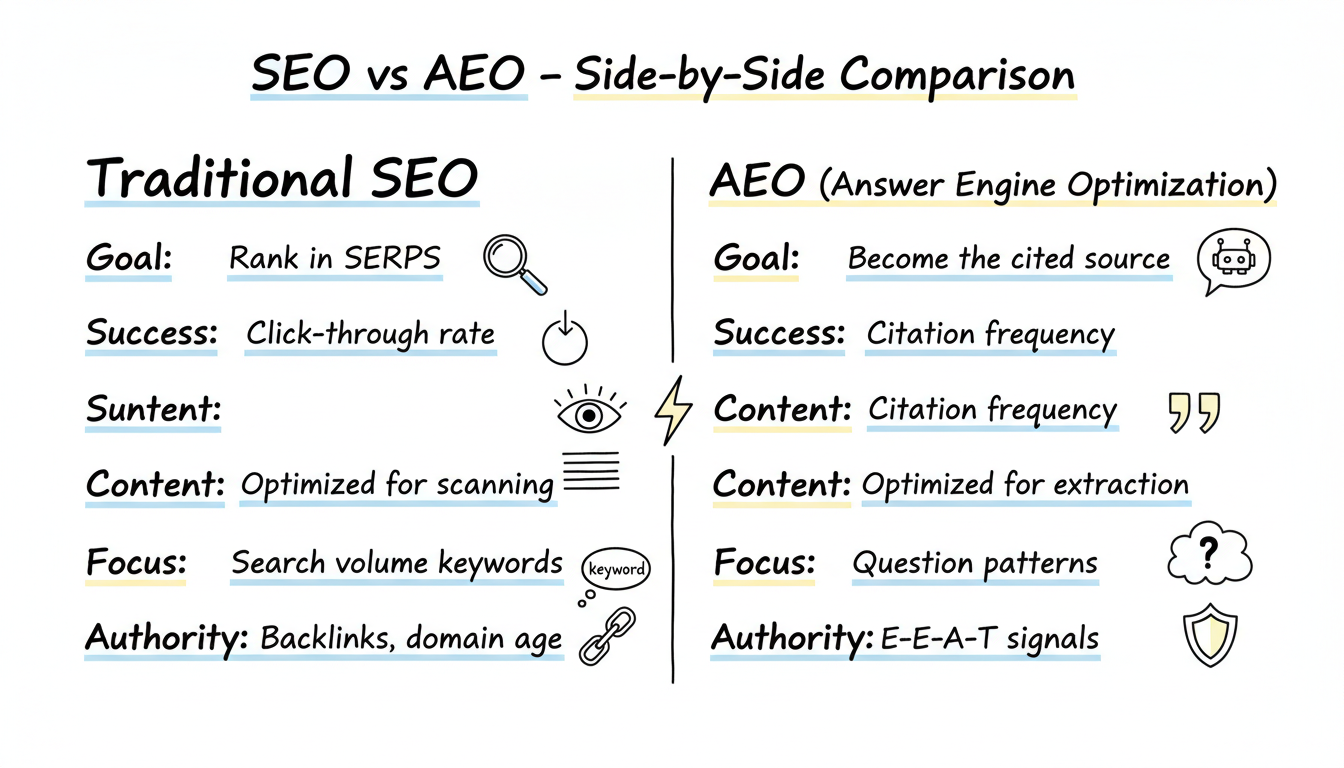
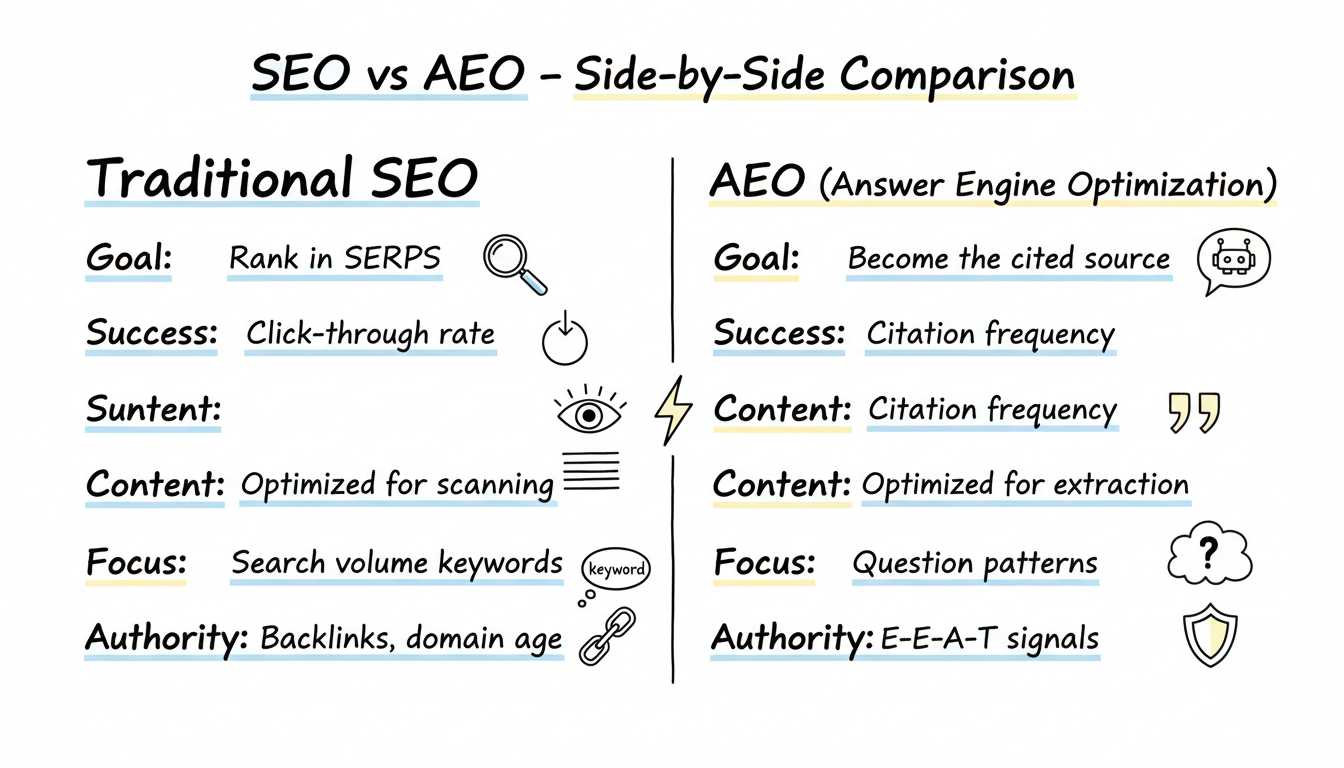
Aspect | Traditional SEO | Answer Engine Optimization |
Primary Goal | Rank in SERPs | Become the cited source |
Success Metric | Click-through rate | Citation frequency |
Content Format | Optimized for scanning | Optimized for extraction |
User Interaction | User visits your site | AI delivers your content |
Keyword Focus | Search volume | Question patterns |
Authority Signals | Backlinks, domain age | E-E-A-T, citations |
The digital marketing landscape now includes three overlapping but distinct optimization disciplines. Understanding the relationship between AEO, SEO, and GEO helps marketers allocate resources effectively.
Traditional SEO focuses on ranking websites in search engine results pages. Key tactics include:
SEO remains important because search engines still drive significant traffic, and many AI systems pull from search engine indexes. For those evaluating SEO vs AEO strategies, it's important to recognize they work in tandem.
AEO specifically targets AI systems that provide direct answers. The focus shifts to:
GEO is the broader umbrella term encompassing all optimization for AI-generated content experiences. Research from Princeton and other institutions has established GEO as including:
The relationship: Understanding what differentiates AEO vs GEO is crucial—GEO is the broadest category, AEO is a specific subset focused on answer engines, and SEO provides the foundational visibility that feeds into both.
Users are fundamentally changing how they seek information:
According to industry research compiled by Conductor, businesses optimized for AI search are seeing:
Understanding the major answer engines is crucial. A comprehensive AI search platform comparison reveals unique optimization opportunities for each system.
ChatGPT (OpenAI)
Google AI Overviews
Understanding how Google selects AI Overview sources helps you optimize for this high-visibility placement.
Perplexity AI
To optimize for answer engines, you must understand their underlying mechanisms. Learning how answer engines work provides the foundation for effective optimization.
Answer engines use sophisticated systems to retrieve relevant information:
When an AI decides which sources to cite, AI overview source selection criteria include:
It's important to understand the distinction:
Training Data: Information the AI learned during its training process. This shapes the AI's general knowledge but may be outdated.
Real-Time Search: Live web searches the AI performs to answer current questions. This is where AEO optimization has the most impact.
ChatGPT, for example, can access real-time web results through Bing when users ask about current events, recent developments, or specific websites.
Research from SurferSEO and other AEO-focused tools has identified quantifiable AI search ranking factors that influence AI citations.
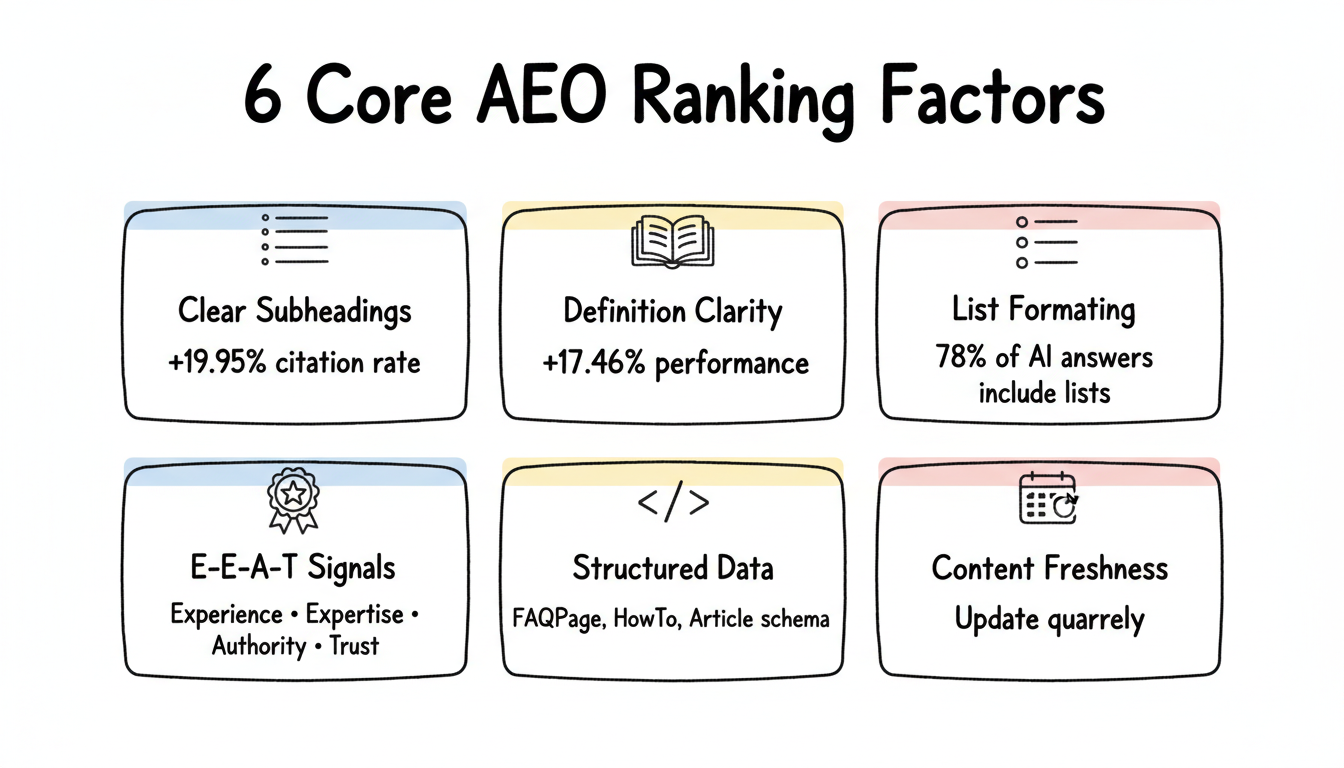
Content with descriptive subheadings optimized for AEO receives 19.95% better citation rates. Best practices:
Content that clearly defines concepts sees 17.46% better performance in AI citations:
According to AEO research, 78% of AI-generated answers include lists. Optimizing list-based featured snippets for AI Overviews improves citation chances:
Google's E-E-A-T framework (Experience, Expertise, Authoritativeness, Trustworthiness) heavily influences AI citation decisions:
Experience
Expertise
Authoritativeness
Trustworthiness
Schema markup for AI search optimization helps AI systems understand your content:
Additionally, QAPage schema for AI content provides another powerful structured data option for Q&A-focused pages.
AI systems prioritize recent content, especially for:
Update cornerstone content quarterly and time-sensitive content monthly.
Developing a multi-platform AI search strategy ensures comprehensive visibility across all answer engines.
ChatGPT uses Bing's search index for real-time queries. For detailed tactics, explore ChatGPT SEO strategies. Key approaches:
ChatGPT-Specific Content Format:
## [Question as Heading]

[Direct answer in 1-2 sentences]

[Expanded explanation with context]

[Supporting evidence or examples]

[Related considerations]
Google AI Overviews pull from Google's search index with additional AI processing. Consult the Google AI Overviews official platform guide for authoritative guidance:
Perplexity emphasizes accuracy and source diversity. Detailed Perplexity optimization strategies include:
Voice assistants (Siri, Alexa, Google Assistant) have specific requirements:
Effective AI search content structure serves both human readers and AI extraction algorithms.
Balancing content depth and brevity for answer engines requires strategic information hierarchy:
Organize content around the questions your audience asks:
Primary question → Main H1 and introduction Supporting questions → H2 sections Clarifying questions → H3 subsections Related questions → FAQ section
# [Primary Question/Topic]

[2-3 sentence answer to the primary question]

## What is [Topic]?

[Clear definition in 1-2 sentences]

[Expanded explanation with context]

## Why Does [Topic] Matter?

[Relevance and importance]

[Statistics and evidence]

## How to [Achieve/Implement Topic]

1. [Step one with explanation]
2. [Step two with explanation]
3. [Step three with explanation]

## [Topic] Best Practices

- [Best practice one]
- [Best practice two]
- [Best practice three]

## Common [Topic] Mistakes to Avoid

- [Mistake one and why it matters]
- [Mistake two and why it matters]

## Frequently Asked Questions

### [Question 1]?
[Concise answer]

### [Question 2]?
[Concise answer]

## Conclusion

[Summary and next steps]Implement these schema types for better AI comprehension:
FAQPage Schema:
{
  "@context": "https://schema.org",
  "@type": "FAQPage",
  "mainEntity": [{
    "@type": "Question",
    "name": "What is Answer Engine Optimization?",
    "acceptedAnswer": {
      "@type": "Answer",
      "text": "Answer Engine Optimization (AEO) is the practice of optimizing digital content to appear as direct answers in AI-powered search engines and chatbots."
    }
  }]
}
HowTo Schema:
{
  "@context": "https://schema.org",
  "@type": "HowTo",
  "name": "How to Optimize for Answer Engines",
  "step": [{
    "@type": "HowToStep",
    "name": "Research question patterns",
    "text": "Identify the questions your audience asks about your topic."
  }]
}
Article Schema:
{
  "@context": "https://schema.org",
  "@type": "Article",
  "headline": "Complete Guide to AEO",
  "author": {
    "@type": "Person",
    "name": "Author Name"
  },
  "datePublished": "2026-01-13",
  "dateModified": "2026-01-13"
}
Optimize your site structure for AI comprehension:
Understanding AEO optimization metrics enables data-driven improvement:
Direct Metrics:
Proxy Metrics:
Several tools have emerged to track AI search visibility. Review comprehensive AEO checker tools and best AEO tools reviews:
For detailed software comparisons, consult AEO tools and software guides and AEO optimization software reviews.
Create AI search performance reporting templates to track these metrics monthly:
Metric | Target | Source |
AI citations | Month-over-month growth | AI monitoring tool |
Question keyword rankings | Top 10 positions | SEO tool |
Featured snippets owned | Increase by 10% quarterly | Google Search Console |
Content freshness score | 90%+ updated within 6 months | Content audit |
Schema implementation | 100% of eligible pages | Technical audit |
Connect AEO efforts to business outcomes:
A B2B software company noticed declining organic traffic as users shifted to AI-assisted research. Despite strong traditional SEO, their content rarely appeared in ChatGPT or Google AI Overview responses.
They implemented comprehensive AEO optimization strategies:
After 6 months of AEO optimization, results mirrored patterns in winning AI Overview case studies:
AEO doesn't replace SEO—it builds on it. AI systems still largely pull from search engine indexes. Maintain strong technical SEO, backlink profiles, and keyword optimization alongside AEO efforts.
Content should serve human readers first. AI systems can detect thin, low-value content. Write comprehensive, genuinely helpful content that happens to be well-structured for AI extraction.
Ironic for an industry focused on being cited, but many AEO practitioners fail to cite their own sources. Proper attribution builds trust and models the behavior you want AI systems to follow.
Outdated content hurts AI visibility significantly. Establish regular update schedules and visibly display modification dates. Even minor updates with new dates signal freshness.
Don't optimize for ChatGPT while ignoring Google AI Overviews, or vice versa. Build a platform-agnostic approach that works across all answer engines. Effective resource allocation across multi-platform AI search ensures balanced visibility.
Ranking for questions users don't actually ask is pointless. Research actual question patterns through:
Schema markup, site speed, mobile optimization, and proper indexing are technical requirements, not optional enhancements. Technical issues prevent AI systems from accessing your content.
SEO focuses on ranking in traditional search engine results pages (SERPs), while AEO specifically targets optimization for AI-powered answer engines like ChatGPT, Perplexity, and Google AI Overviews. AEO emphasizes content structure, clear definitions, and citation-worthiness, while SEO focuses on rankings, click-through rates, and organic traffic. For a detailed comparison, see what is AEO vs SEO. Both disciplines overlap significantly, and successful digital marketing in 2026 requires attention to both.
You can track AI citations using specialized tools like Profound, Gracker.ai, or Conductor's AI visibility features. Additionally, manually testing queries related to your content in ChatGPT, Perplexity, and Google can reveal citation patterns. AI overview citation analysis tools monitor your analytics for referral traffic from AI platforms, and set up brand monitoring to track mentions in AI-generated responses.
AEO is particularly effective for industries where users seek informational, educational, or research-oriented content. B2B companies, SaaS providers, professional services, healthcare information, finance, and education see strong AEO results. Local businesses and e-commerce can also benefit, especially for product research and comparison content.
AEO results typically emerge within 2-4 months for content freshness and structural improvements. Building topical authority for AI citations takes 6-12 months of consistent effort. Quick wins come from restructuring existing high-performing content, while longer-term gains require sustained content development and authority building.
Using an AI search platform selection framework, start with Google AI Overviews if you already have strong organic search visibility, as optimizations transfer more directly. If you're building visibility from scratch, consider ChatGPT optimization first, as the Bing-powered search provides a different entry point. Ideally, pursue both simultaneously since many optimizations (clear structure, freshness, authority) benefit all platforms.
Schema markup is highly important for AEO success. Structured data helps AI systems accurately understand and categorize your content. FAQPage schema is particularly valuable for question-answer content, while HowTo and Article schemas help with instructional and editorial content. Implement schema on all eligible pages as a baseline AEO practice.
Yes, small businesses can compete effectively in AEO, especially for niche topics and local queries. AI systems value authority and relevance, not just scale. A small business with deep expertise in a specific area can outperform larger competitors with shallow content. Focus on your unique expertise, local knowledge, and specific audience questions.
Featured snippets are highly correlated with AI citations, especially for Google AI Overviews. Content that ranks for featured snippets demonstrates the clear, structured, authoritative characteristics AI systems seek. Optimizing long-tail keywords for featured snippet success is an effective proxy strategy for AEO, though not all AI citations come from featured snippet holders.
Ready to implement AEO for your organization? Follow this step-by-step plan. Organizations can also explore professional support through AEO agency services or AEO services consultation.
Understanding AEO competitor analysis provides baseline context:
Implement on-page AEO optimization fundamentals:
Build a knowledge graph optimization checklist and learn how to get a Google Knowledge Panel for enhanced authority signals.
Develop a comprehensive AEO strategy:
Explore creating authoritative lists for SearchGPT and implement SearchGPT social monitoring strategies for comprehensive coverage.
Consider AEO optimization techniques for conversion to maximize business impact.
Understanding AEO marketing budget allocation and AEO services pricing helps organizations plan investments. Compare AI SEO tools pricing when selecting technology solutions.
Evaluate in-house vs agency AI search models based on your organization's capabilities. Some organizations may pursue AEO marketing jobs to build internal expertise.
Beyond general strategies, platform-specific approaches deliver targeted results:
For organizations seeking deeper expertise:
Global organizations should consider Google AI Overview international and regional variations and GEO is the new SEO perspectives.
Understanding nuances between related concepts helps refine strategy:
Compare specialized platforms:
Stay ahead by understanding future platform-specific AI search trends for 2026 and exploring resources like the Forbes generative engine optimization guide.
For organizations working with specialized partners, review AEO services contract considerations and understand deliverables.
Answer Engine Optimization represents a fundamental shift in how we think about digital visibility. As AI-powered search becomes the primary way users find information, the brands and organizations that adapt their content strategies will capture the majority of attention and trust.
The key principles remain consistent: create genuinely valuable content, structure it for both human readers and AI extraction, build authority through expertise and trustworthiness, and maintain freshness through regular updates.
AEO isn't replacing traditional SEO—it's evolving it. The fundamentals of creating helpful, authoritative content have never been more important. What's changed is how that content needs to be structured, formatted, and maintained for a world where AI systems are the primary intermediaries between creators and audiences.
Start implementing AEO today. Audit your top content, implement schema markup, restructure for clarity, and establish freshness protocols. The organizations that move quickly will establish the authority and visibility that compounds over time, making it increasingly difficult for later adopters to catch up.
The future of search is answering questions, not just ranking for keywords. Make sure your content is the answer.
By submitting this form, you agree to our Privacy Policy and Terms & Conditions.



