
February 19, 2026


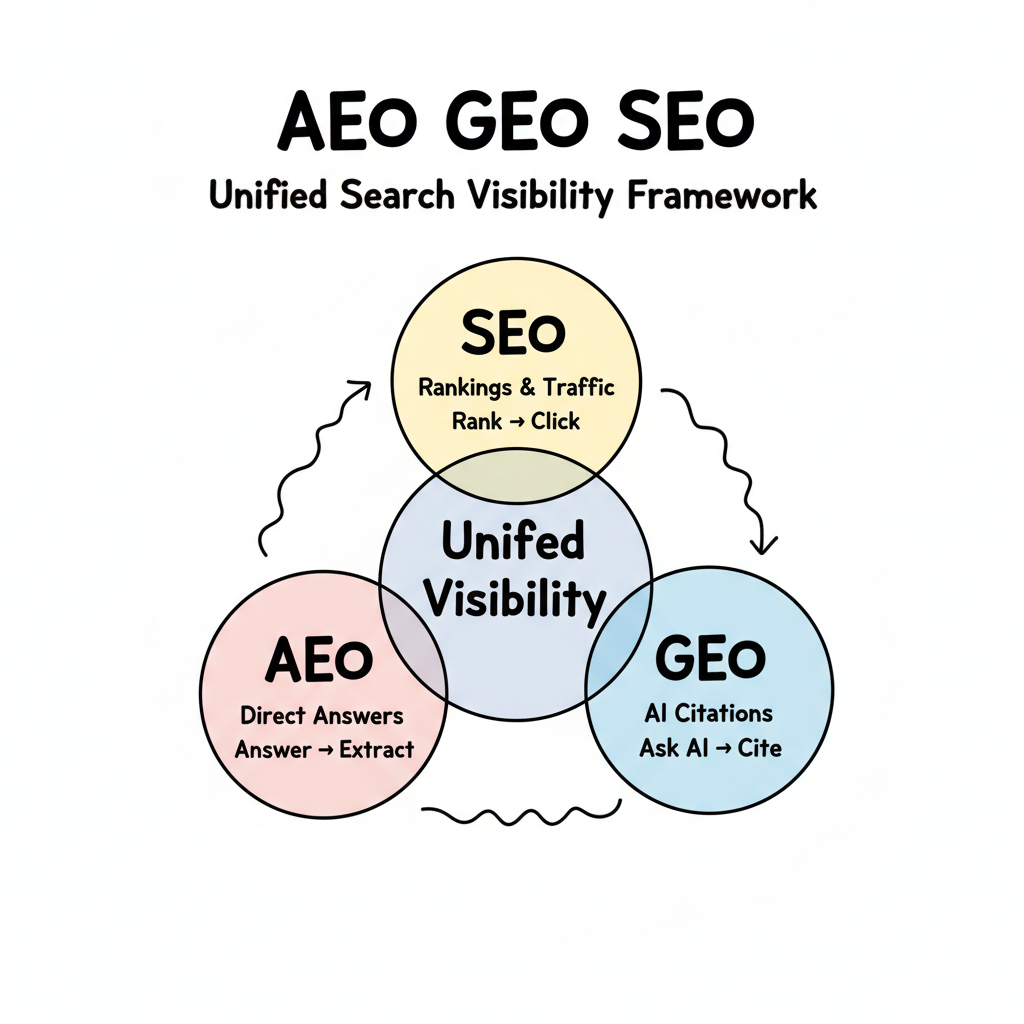
AEO captures direct answers. GEO earns AI citations. SEO builds ranking authority. The traditional approach treats these as separate specializations—but in 2026, the most effective strategies integrate all three into a unified visibility system.
The convergence isn't optional. Users don't think in terms of "SEO content" versus "GEO content." They ask questions and expect answers, whether that means browsing Google results, reading ChatGPT responses, or seeing featured snippets. Your content either appears across these experiences or loses to competitors who understand the integration.
Search discovery has fragmented into multiple channels that share underlying principles.
Traditional search (SEO): Users browse results and click through to websites. Rankings determine visibility. Traffic flows to high-ranking pages.
Answer engines (AEO): Users expect direct responses without clicking. Featured snippets, knowledge panels, and voice assistants deliver answers extracted from content.
Generative engines (GEO): Users ask AI platforms to research and synthesize information. ChatGPT, Perplexity, and Google AI Overviews construct responses by citing multiple sources.
These channels compete for the same user queries. Someone asking "best CRM for small business" might browse Google results, check a featured snippet, or ask ChatGPT directly. Your visibility strategy must address all three possibilities.
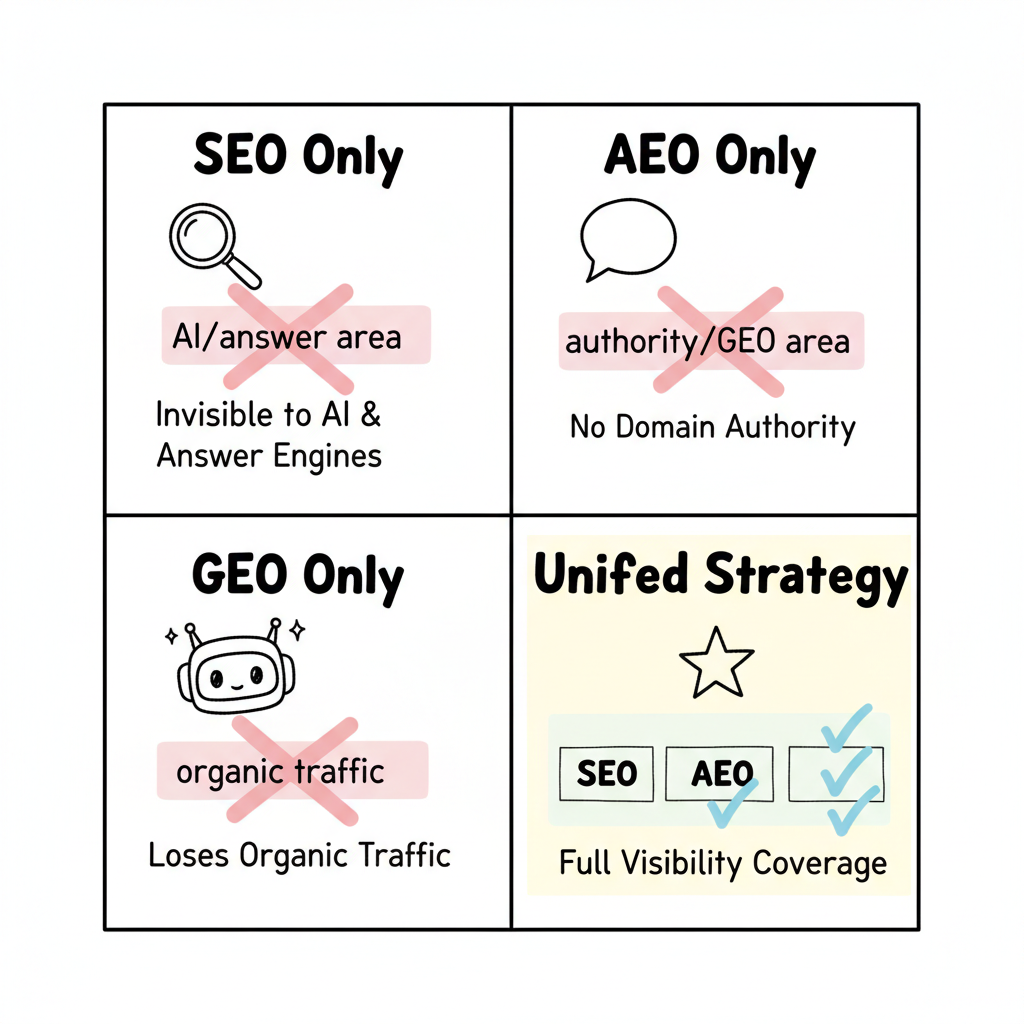
Treating AEO, GEO, and SEO as independent initiatives creates gaps.
SEO-only approach:
You rank well but get skipped when AI delivers answers directly. Users researching in ChatGPT never see your brand. Featured snippets go to competitors with better answer formatting.
AEO-only approach:
You capture featured snippets but lack the domain authority AI systems trust for citations. Without strong SEO fundamentals, your AEO wins don't translate to GEO visibility.
GEO-only approach:
You structure content for AI extraction but rank poorly in traditional search. The traffic that still comes from organic results flows to competitors instead.
The integration requirement:
When AEO, GEO, and SEO align, your brand stays visible across search engines, answer engines, and AI systems shaping how decisions get made. Gaps in any channel mean lost visibility to competitors who've integrated.
Effective integration starts with recognizing what all three approaches require.
AI systems, answer engines, and search algorithms all evaluate content quality. Shallow content underperforms everywhere. Comprehensive, accurate, authoritative content supports all three channels.
Quality indicators that matter across channels:
Experience, Expertise, Authoritativeness, and Trustworthiness affect visibility across all channels. Google's algorithms evaluate E-E-A-T for rankings. AI systems assess these signals when deciding what to cite. Answer engines select sources they consider authoritative.
Building E-E-A-T for unified visibility:
Site speed, mobile optimization, structured data, and crawlability support all three channels. Technical problems undermine SEO rankings, reduce AEO extraction accuracy, and limit how well AI systems can parse your content.
The shared foundation supports all channels, but each requires specific enhancements.
Keyword targeting:
Research what users actually search. Align content topics with query demand. Optimize titles, headers, and body content for target terms. Tools like free AI keyword research tools help identify opportunities across traditional and AI-powered search.
Backlink authority:
Earn links from relevant, authoritative sources. Domain authority from backlinks improves rankings and signals trustworthiness to AI systems.
Internal linking:
Connect related content to demonstrate topical depth. Help search engines understand content relationships and site architecture.
Content comprehensiveness:
Cover topics thoroughly enough to satisfy search intent. Thin content doesn't rank well or earn AI citations.
Answer-first formatting:
Place direct answers immediately after section headers. AI systems extract these positioned responses for featured snippets and voice answers.
FAQ schema:
Implement FAQ structured data to explicitly mark question-answer pairs. This helps answer engines identify extractable content.
Question-matching headers:
Write headers that match how users phrase questions. "How much do Reddit ads cost?" performs better than "Understanding Reddit advertising pricing structures."
Concise, quotable paragraphs:
Keep paragraphs under 80 words with one clear idea each. Answer engines quote content that stands alone when extracted. Optimizing for table featured snippets further enhances your answer engine visibility by presenting data in easily extractable formats.
Entity consistency:
Ensure your brand information matches across all web properties. AI systems cross-reference entities and distrust inconsistent information.
Content freshness:
Update priority content regularly. Understanding real-time vs static data optimization helps balance evergreen content with timely updates. Perplexity weights recency heavily—content updated within 2-3 days outperforms static pages for time-sensitive queries.
Citation-worthy statistics:
Include specific data points with clear attribution. AI systems prefer citing concrete numbers over vague claims.
Multi-source validation:
When other authoritative sources mention your brand positively, AI systems recognize the validation. PR and thought leadership investments improve GEO performance.
Build unified optimization systematically.
Audit current performance:
Track keyword rankings for SEO. Identify featured snippets you own or could capture for AEO. Test AI platform responses for GEO visibility.
Strengthen technical foundation:
Address site speed issues. Implement core structured data (Organization, Person, Article schemas). Ensure mobile optimization and crawlability.
Fix E-E-A-T gaps:
Audit author bios for expertise signals. Check entity consistency across properties. Identify opportunities for third-party validation.
Restructure priority pages:
Add answer-first formatting to existing high-value content. Implement FAQ sections for question-rich topics. Create self-contained sections AI can extract.
Expand topic coverage:
Develop cluster content around core topics. Build interconnected content that demonstrates topical authority. Address gaps in comprehensive coverage.
Add GEO-specific elements:
Update statistics with proper attribution. Establish content freshness schedules. Create original research worth citing.
Pursue backlink opportunities:
Create linkable assets (original research, tools, comprehensive guides). Develop relationships with industry publications. Earn mentions that build domain authority.
Develop thought leadership:
Participate in platforms AI systems trust (Reddit discussions, LinkedIn content, industry forums). Build author visibility beyond your own site.
Monitor and adapt:
Track performance across all three channels. Identify what's working and expand successful patterns. Adjust strategy based on platform changes.
Track metrics across all three channels in combined dashboards.
SEO metrics:
AEO metrics:
GEO metrics:
Combined insights:
Content performing well across all three channels represents your strongest assets. Content succeeding in one channel but not others indicates optimization opportunities.
Creating "SEO content" and "GEO content" as separate assets wastes resources. Single pieces of content can serve all three channels with proper structure.
AI citation probability correlates with traditional rankings. Strong SEO supports GEO and AEO success. Neglecting fundamentals weakens the entire system.
ChatGPT, Perplexity, and Google AI Overviews have some behavioral differences, but they share core requirements: authoritative, well-structured, accurate content from trustworthy sources.
Building unified visibility takes months of consistent effort. Quick tactical fixes produce temporary results. Sustainable advantage comes from systematic integration.
By submitting this form, you agree to our Privacy Policy and Terms & Conditions.



