Keyword research doesn't require an expensive subscription. While premium tools like Ahrefs and Semrush offer comprehensive capabilities, numerous free AI-powered and traditional tools can build a solid keyword strategy—especially for businesses just starting their SEO journey or operating on limited budgets.
This guide covers the best free keyword research tools available in 2026, including AI-powered options that leverage modern language models to surface search opportunities.
Google provides several powerful free tools that remain foundational for keyword research.
Google Keyword Planner
What it offers:
- Search volume estimates for any keyword
- Competition levels for paid advertising
- Related keyword suggestions
- Historical trends data
- Cost-per-click estimates
Limitations:
- Requires a Google Ads account (though you don't need to run ads)
- Search volume shown as ranges unless you're actively spending
- Focused on advertising metrics rather than organic SEO
Best for: Getting baseline search volume data and discovering related terms around a seed keyword.
Google Search Console
What it offers:
- Actual search queries driving traffic to your site
- Impressions and click data for keywords you already rank for
- Position tracking over time
- Click-through rate data
- Performance by page
Limitations:
- Only shows keywords where you already have some visibility
- Data limited to 16 months
- Cannot discover entirely new keyword opportunities
Best for: Finding keyword opportunities where you already have organic presence—low-hanging fruit for optimization.
Google Trends
What it offers:
- Relative search interest over time
- Geographic interest patterns
- Related queries and rising topics
- Comparison between multiple terms
- Seasonal trend identification
Limitations:
- Shows relative interest, not absolute search volume
- Data can be noisy for lower-volume terms
- Limited historical granularity
Best for: Understanding seasonal patterns and emerging trends, comparing term popularity.
Several AI-powered tools offer free tiers valuable for keyword research. As AI SEO vs traditional SEO continues to evolve, these platforms demonstrate how machine learning enhances keyword discovery beyond conventional approaches.
Perplexity AI
What it offers:
- AI-powered search with source citations
- Question-answering that reveals search intent
- Related questions and topics surfaced
- Real-time information access
- Free unlimited queries
How to use for keyword research:
- Enter a topic query and analyze related questions shown
- Review cited sources to understand what ranks
- Use follow-up questions to explore subtopics
- Note language patterns users employ
Best for: Understanding search intent, discovering question-based keywords, and identifying content gaps.
ChatGPT (Free Tier)
What it offers:
- Keyword brainstorming and expansion
- Intent analysis for keyword lists
- Content angle suggestions
- Competitor keyword analysis (with URLs provided)
- Clustering and categorization assistance
How to use for keyword research:
- Ask for keyword variations around a seed term
- Request intent classification for keyword lists
- Generate long-tail keyword ideas
- Create keyword clusters by topic
Limitations:
- No actual search volume data
- Training data has knowledge cutoffs
- Cannot access real-time search data
Best for: Brainstorming, organizing keywords, and generating content ideas. Understanding ChatGPT SEO capabilities helps maximize this free tool's research potential.
OmniSEO Free Tier
What it offers:
- Basic AI visibility tracking
- Keyword monitoring for AI platforms
- Citation tracking in AI responses
- Multi-platform coverage
Limitations:
- Limited query volume on free tier
- Basic reporting features
- Fewer platforms tracked than paid versions
Best for: Monitoring your visibility in AI search responses without paid tool investment.
Understanding what questions users ask helps identify valuable keyword opportunities.
AnswerThePublic
What it offers:
- Question variations (who, what, when, where, why, how)
- Preposition combinations
- Comparison queries
- Alphabetical suggestions
- Visual search wheels
Free tier limitations:
- Limited daily searches (typically 3 per day)
- Basic export options
- No historical data
Best for: Discovering question-based content opportunities and understanding user intent patterns.
AlsoAsked
What it offers:
- "People Also Ask" question mapping
- Hierarchical question relationships
- Topic clustering visualization
- Related question chains
- Export capabilities
Free tier limitations:
- Limited searches per month
- Basic features only
- Regional limitations
Best for: Building FAQ content, understanding question sequences, and comprehensive topic coverage.
Komo AI Search
What it offers:
- AI-powered search exploration
- Question discovery around topics
- Search pattern analysis
- Related topic identification
Best for: Discovering unconventional keyword angles and understanding how AI interprets topics.
These established free tools remain valuable for keyword research.
Ubersuggest Free Tier
What it offers:
- Search volume estimates
- SEO difficulty scores
- Related keyword suggestions
- Content ideas based on keywords
- SERP analysis basics
Free tier limitations:
- 3 searches per day
- Limited historical data
- Basic metrics only
Best for: Quick keyword checks when you don't need comprehensive data.
Keyword Surfer (Chrome Extension)
What it offers:
- Search volume shown directly in Google SERPs
- Related keywords in sidebar
- On-page word count for ranking pages
- Traffic estimates for ranking domains
- Free unlimited use
Limitations:
- Browser-only functionality
- Less detailed than paid tools
- Basic metrics
Best for: Checking search volume while browsing—convenient for ad-hoc research.
Wordtracker Scout (Chrome Extension)
What it offers:
- Keyword extraction from any webpage
- Keyword density analysis
- Related term suggestions
- Competitor keyword identification
Best for: Analyzing competitor pages to discover their target keywords.
Building a Free Keyword Research Stack
Combine multiple free tools to create comprehensive keyword research capability.
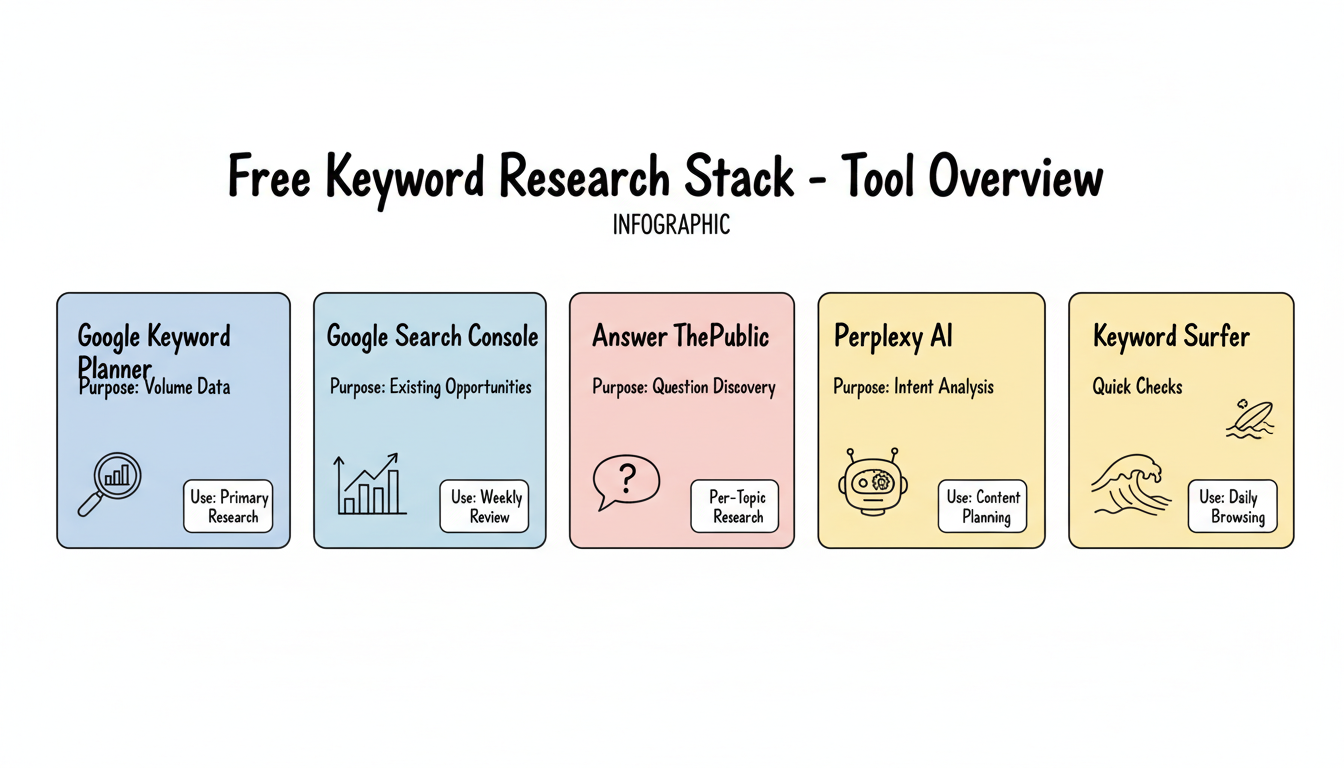
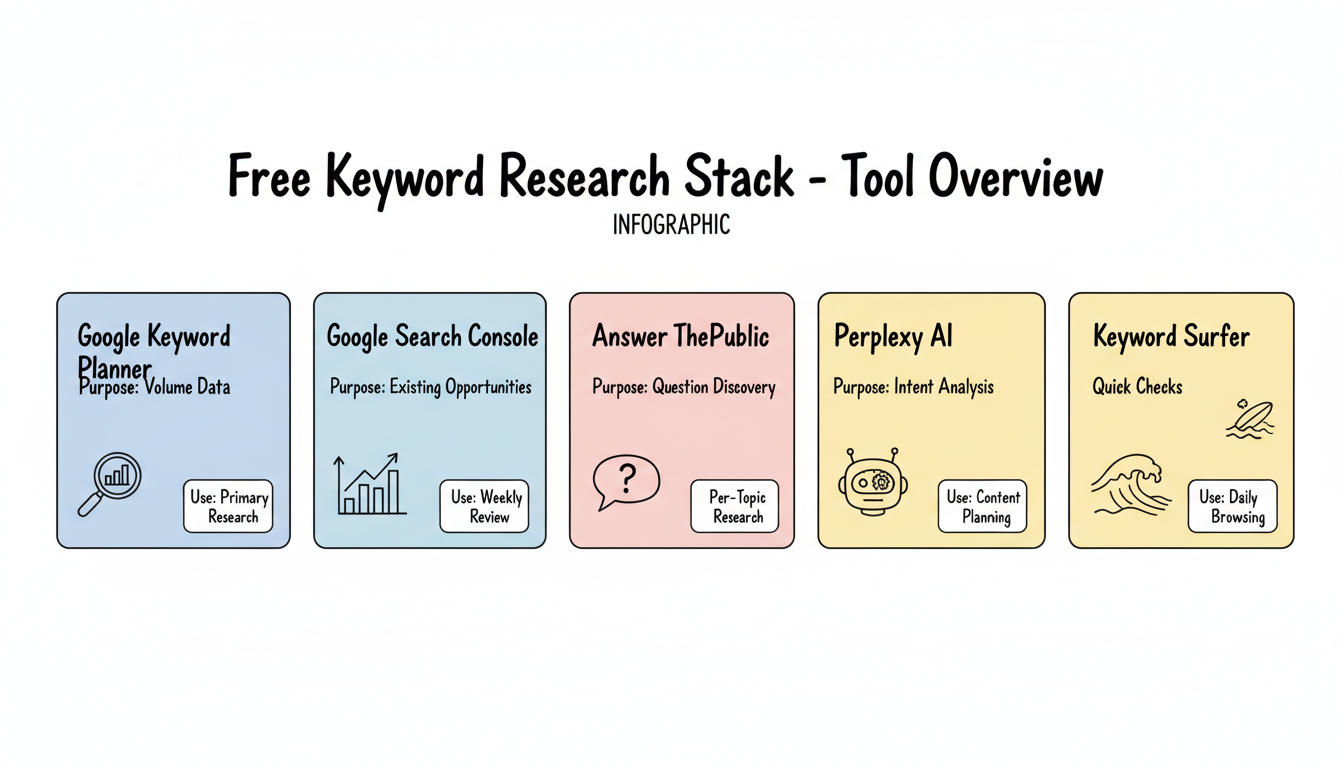
Recommended Free Stack
Tool | Purpose | Use Frequency |
Google Keyword Planner | Volume data | Primary research |
Google Search Console | Existing opportunities | Weekly review |
AnswerThePublic | Question discovery | Per-topic research |
Perplexity AI | Intent analysis | Content planning |
Keyword Surfer | Quick checks | Daily browsing |
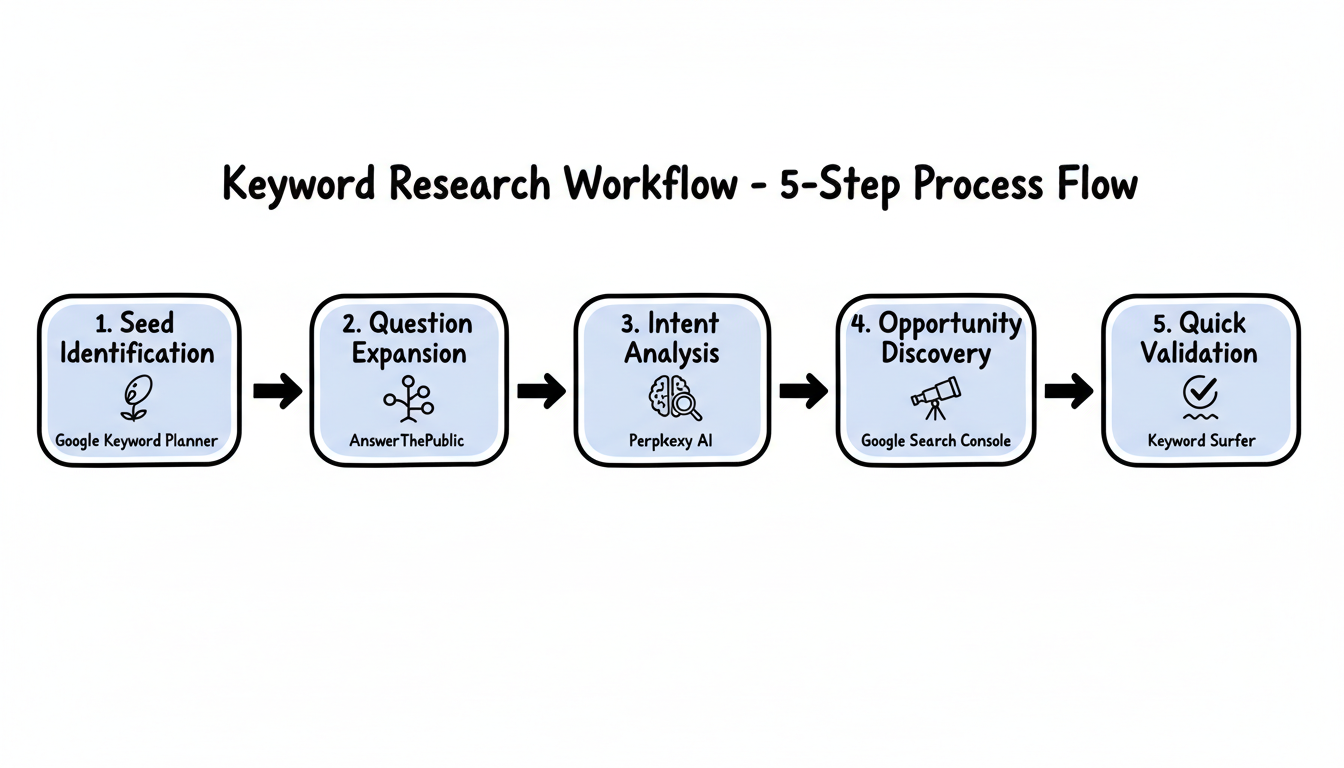
Workflow Example
- Seed identification: Use Google Keyword Planner to verify search volume for your primary topic
- Question expansion: Run the topic through AnswerThePublic to find question variations
- Intent analysis: Use Perplexity AI to understand how AI systems interpret the topic
- Opportunity discovery: Check Google Search Console for related terms you already rank for
- Quick validation: Use Keyword Surfer to verify volume as you browse SERPs
Free tools have limitations. Consider upgrading when:
- Scale demands it: Managing hundreds of keywords requires automation
- Competition analysis matters: Free tools lack detailed competitor data
- Historical data needed: Understanding long-term trends requires paid data
- Team collaboration: Multiple users need shared access and reporting
- Time is money: Manual work with free tools takes longer than paid alternatives
Comparing options like Surfer SEO vs Clearscope helps determine which paid platform best complements your free tool foundation when you're ready to scale.
Understand what free tools cannot provide:
Missing from free tools:
- Comprehensive backlink-adjusted difficulty scores
- Detailed SERP feature analysis
- Accurate traffic estimates
- Competitor keyword gap analysis
- Automated tracking and reporting
- API access for integration
Workarounds:
- Combine multiple free tools to approximate paid capabilities
- Accept less precision in metrics
- Invest more time in manual research
- Focus on fewer keywords with deeper research
FAQs
Yes, especially for smaller sites or those just starting. Free tools provide enough data for basic keyword strategy. The tradeoff is time—you'll spend more hours on manual research than you would with paid tools.
Google Keyword Planner provides the most reliable volume data since it comes directly from Google. However, it shows ranges rather than precise numbers unless you're actively advertising.
AI tools reveal search intent and related topics that traditional keyword tools miss. By analyzing how AI systems interpret and respond to queries, you understand what content users actually need—not just what terms they search. This insight feeds into how to optimize content for generative AI platforms and search engines alike.
Start with 2-3 tools that serve different purposes—one for volume data (Google Keyword Planner), one for questions (AnswerThePublic), and one for quick checks (Keyword Surfer). Add others as needed.