
February 19, 2026


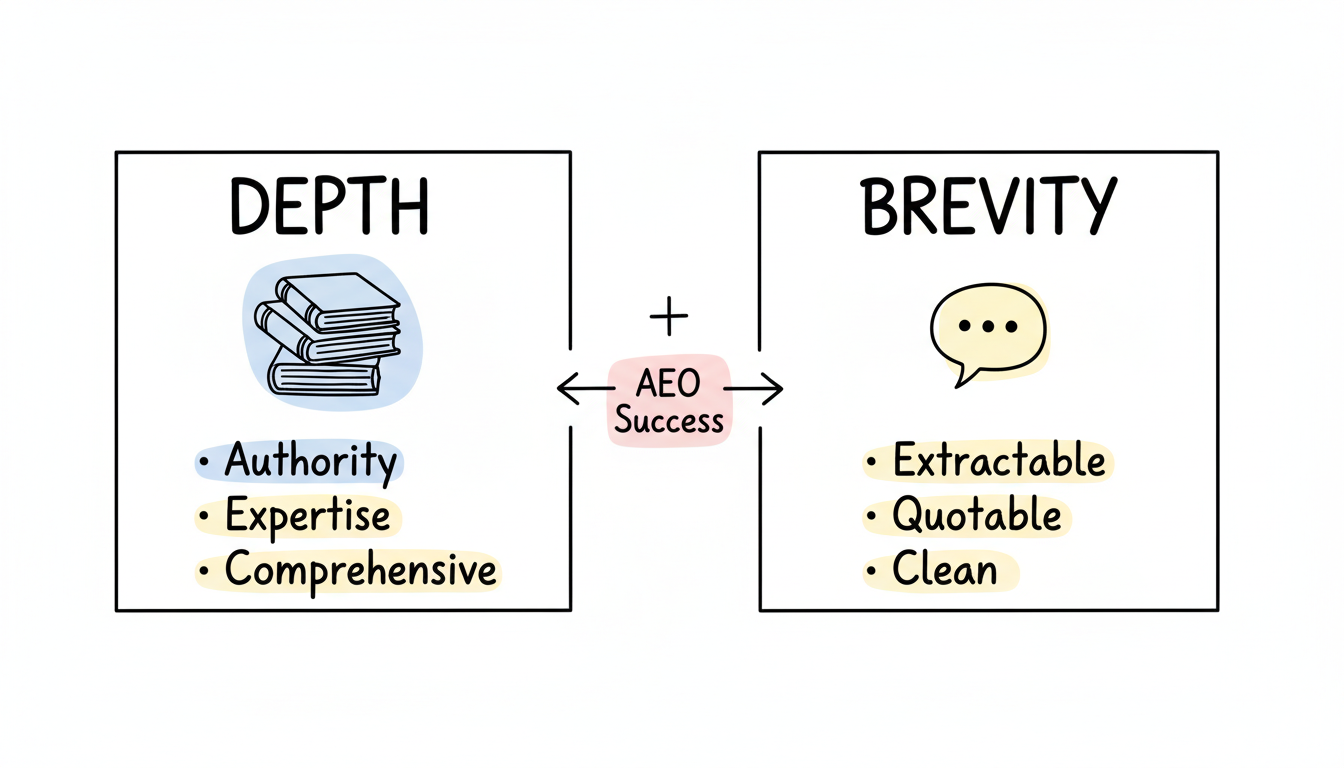
Traditional SEO rewarded comprehensive, long-form content. More words meant more keyword coverage, more backlink opportunities, and longer time-on-page metrics. Answer engine optimization introduces a different dynamic: AI systems extract concise answers from larger content pieces. The question isn't depth versus brevity—it's how to provide both strategically.
This guide explains how to balance comprehensive coverage with extractable brevity for maximum AEO performance.
AI systems create a dual requirement that seems contradictory at first.
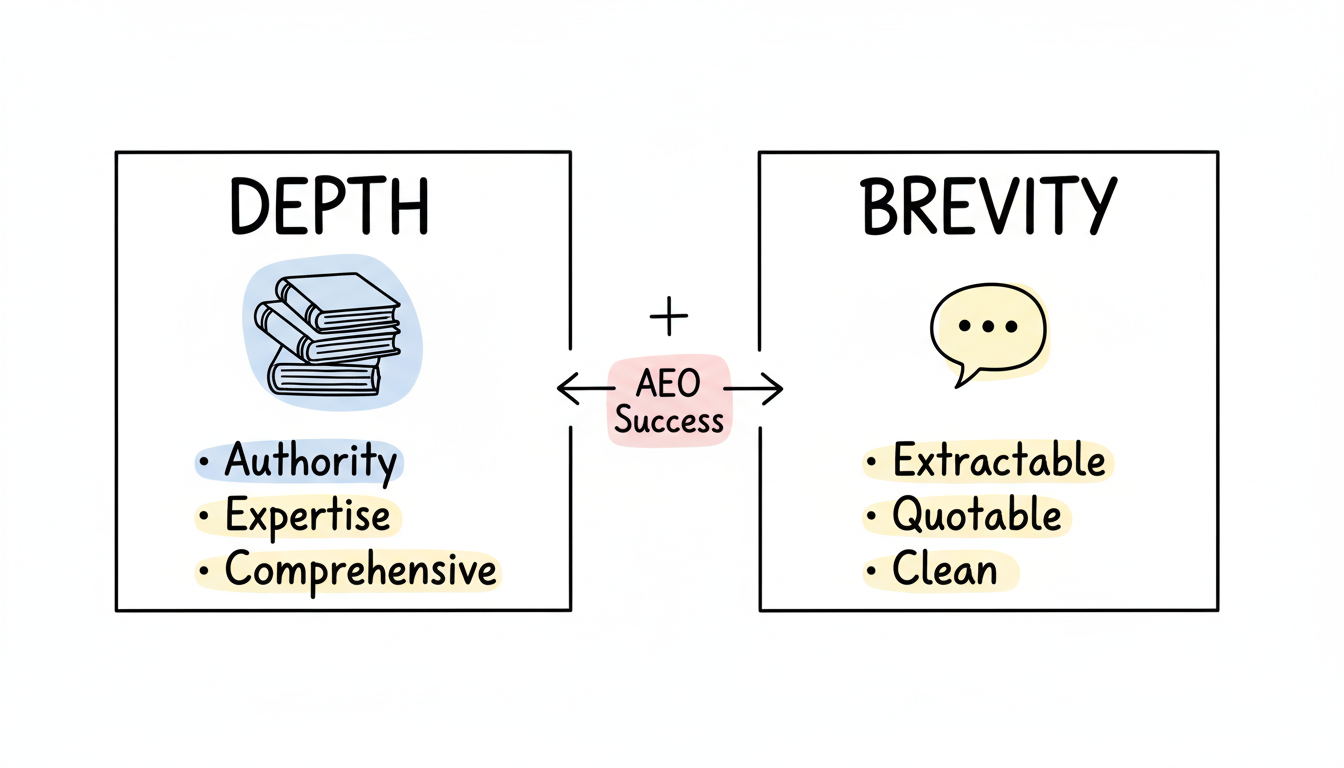
They need depth to recognize your content as authoritative and comprehensive. Thin content rarely gets cited because AI systems perceive it as lacking the expertise signals that warrant recommendation.
They need brevity to extract clean, quotable answers. Long, meandering paragraphs don't translate into crisp AI responses. Users asking quick questions don't want verbose citations.
The solution isn't choosing one over the other. It's architecting content that delivers both—comprehensive topic coverage structured as a collection of concise, extractable segments.
Understanding AI content processing reveals why both depth and brevity matter, especially when considering generative engine optimization strategies.
AI systems break content into chunks during processing. Each chunk gets evaluated independently for relevance to user queries. Long, dense paragraphs create problematic chunks—they contain multiple ideas, making relevance matching imprecise.
Short, focused paragraphs create clean chunks. Each addresses one idea. Relevance matching becomes accurate. The right content surfaces for the right queries.
AI systems assess source authority before citation. Comprehensive content signals expertise. Sites covering topics thoroughly—with multiple related articles, detailed explanations, and supporting evidence—earn higher authority scores than sites with superficial coverage.
Depth builds the authority that makes your concise answers worth citing.
When generating responses, AI systems pull specific passages—typically 1-3 sentences. These extracted segments become the citation. If your content lacks clean extraction points, AI systems may cite competitors whose content extracts more cleanly.
Brevity enables the extraction that depth earns the right to receive.
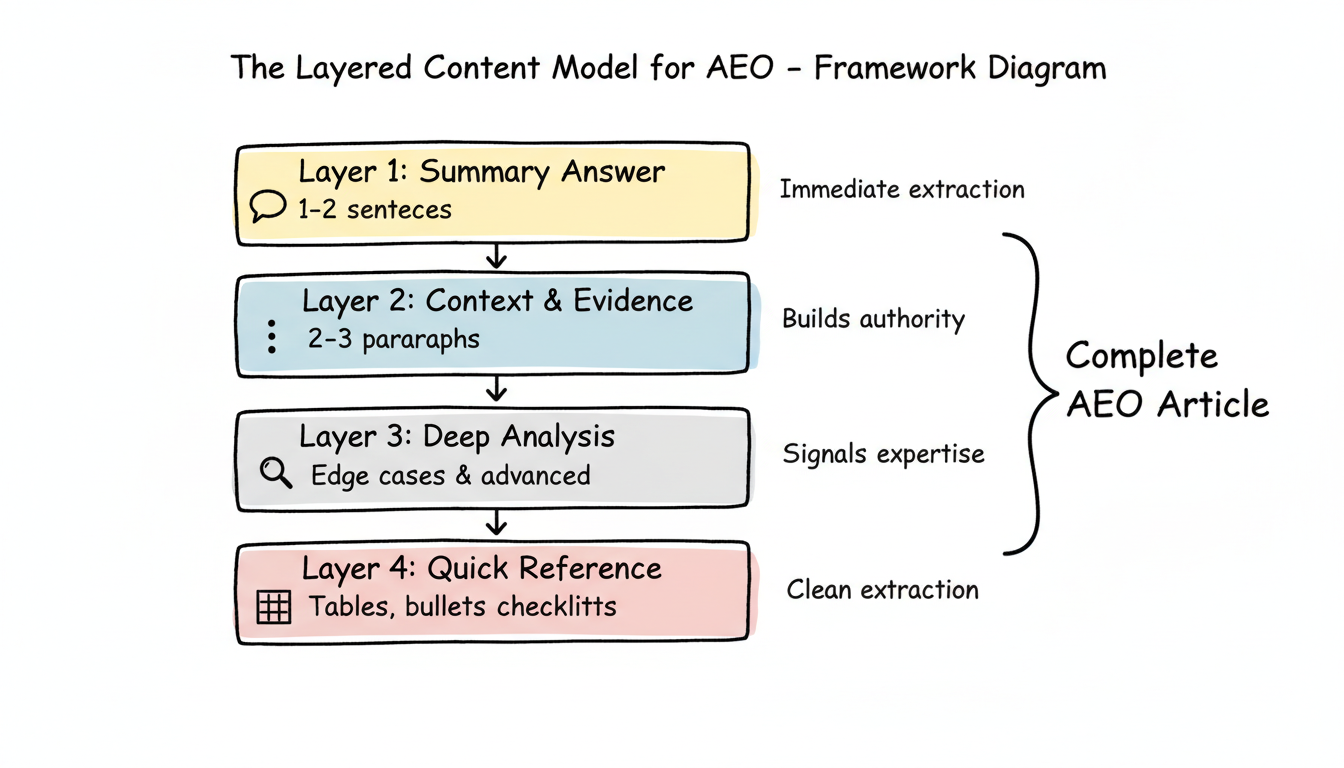
Effective AEO content uses a layered approach: comprehensive depth organized as extractable segments.
Open each major section with a direct, 1-2 sentence answer. This provides immediate extraction value.
Example:
"Content depth and brevity aren't competing goals—they're complementary strategies. Depth builds authority; brevity enables extraction."
This summary works as a standalone citation while introducing comprehensive exploration below.
Follow summaries with 2-3 paragraphs of context, evidence, and explanation. This layer provides the depth that establishes expertise.
Here you include:
For complex topics, add deeper sections covering edge cases, advanced tactics, and comprehensive analysis. This layer serves users seeking thorough understanding while signaling topic authority to AI systems, similar to approaches used in AI overview website optimization.
Close sections with bulleted summaries, tables, or checklists. These formats extract cleanly and serve users who skim.
Research and practice suggest specific length guidelines for different content elements.
Comprehensive articles typically perform best at 1,500-2,500 words for primary topics. This provides sufficient depth for authority while remaining focused enough for coherent coverage.
However, length alone doesn't determine success. A 2,000-word article with poor structure may underperform a 1,200-word article with excellent extraction architecture.
Individual H2 sections work best at 200-400 words. This provides meaningful depth without creating overwhelming chunks that AI systems struggle to process.
Paragraphs optimized for AI extraction typically contain 40-80 words. This creates chunks that:
Key statements intended as citation candidates should be 15-30 words. Longer sentences get truncated. Shorter sentences may lack context.
Citation-ready sentence: "Organizations implementing AEO see 25-35% higher conversion rates because their content surfaces at the moment users seek specific answers."
Apply these tactics to balance depth and brevity effectively, especially when optimizing content for platforms like WordPress AEO optimization.
Begin each section with a direct answer to the implicit question. Don't build up to conclusions—lead with them. Reserve explanation and evidence for subsequent paragraphs.
Traditional approach: "Many factors influence content performance. Consider your audience, goals, and competitive landscape. Research shows that comprehensive content often performs better, but there are exceptions. Generally speaking, depth matters for AEO."
AEO approach: "Depth matters for AEO because AI systems cite authoritative sources, and comprehensive coverage signals expertise. However, that depth must be organized for extraction—long paragraphs hurt citation rates even when content quality is high."
The second version delivers an extractable answer immediately, then provides context.
Structure sections around questions users ask. This creates natural extraction boundaries—each section answers one question comprehensively but concisely.
Questions to structure content around:
Add explicit extraction points throughout content:
These landmarks give AI systems clear citation candidates.
Avoid content that swings between exhaustive and superficial treatment. If one section gets 500 words, don't give parallel sections 50 words. Inconsistent depth creates uneven authority signals.
Evaluate your content against these criteria:
Element | Check |
Summary answers | Does each section open with 1-2 sentence answer? |
Paragraph focus | Does each paragraph address one idea? |
Extraction candidates | Are there 3-5 clean citation-ready sentences per page? |
Overall comprehensiveness | Does the article cover the topic thoroughly? |
Section balance | Are sections roughly equal in depth? |
No. Write comprehensive content, but organize it for extraction. Total length matters less than structure. A 2,000-word article with excellent extraction architecture outperforms a 500-word article with poor structure, particularly when you understand the fundamental differences in AEO vs SEO approaches.
Content is too long when sections lose focus, paragraphs address multiple ideas, or coverage becomes repetitive. Length itself isn't the problem—unfocused length is.
By submitting this form, you agree to our Privacy Policy and Terms & Conditions.



