February 19, 2026


Google AI Overviews cite sources to support their generated answers—but which sources get selected, and why? Understanding citation patterns reveals what it takes to earn visibility in AI-generated search results. The selection process isn't random; it follows identifiable patterns that favor specific types of content and authority signals.
This analysis examines who gets cited in AI Overviews and the factors that determine source selection.
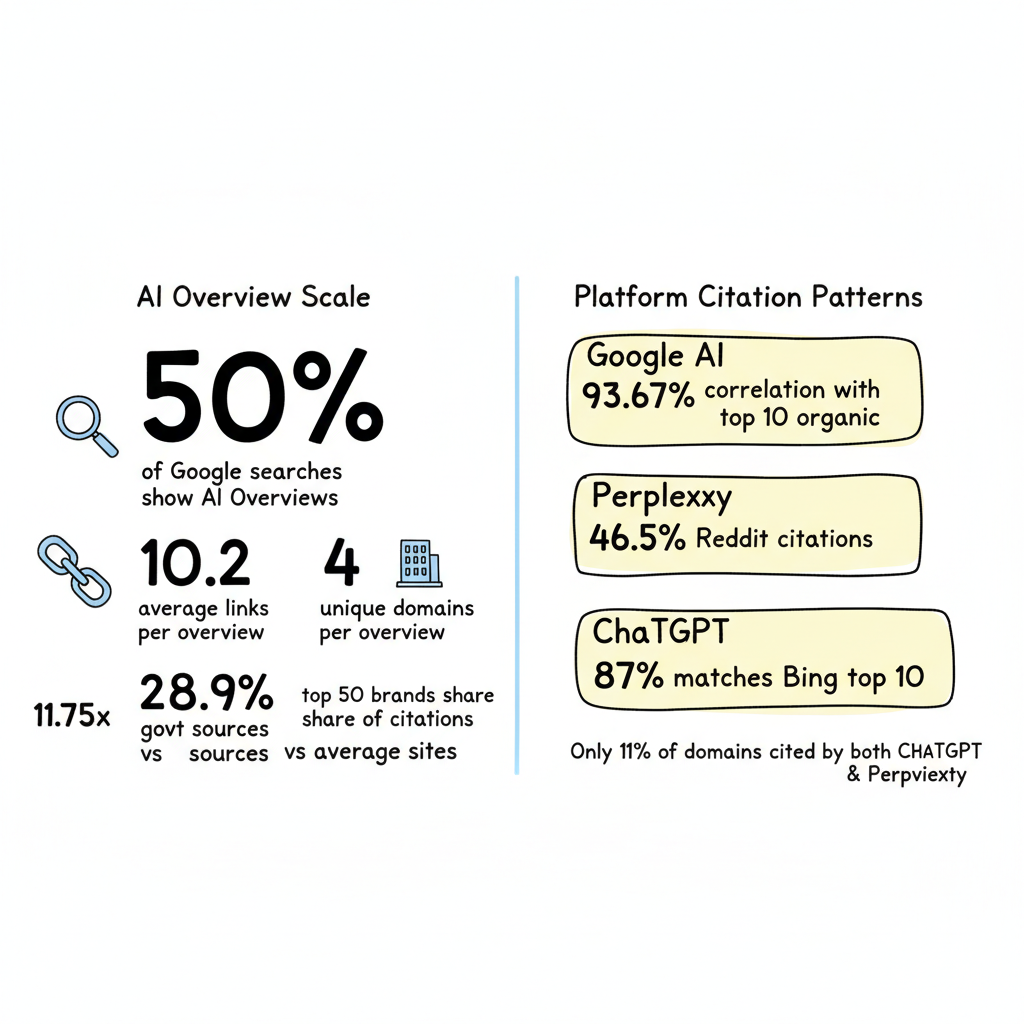
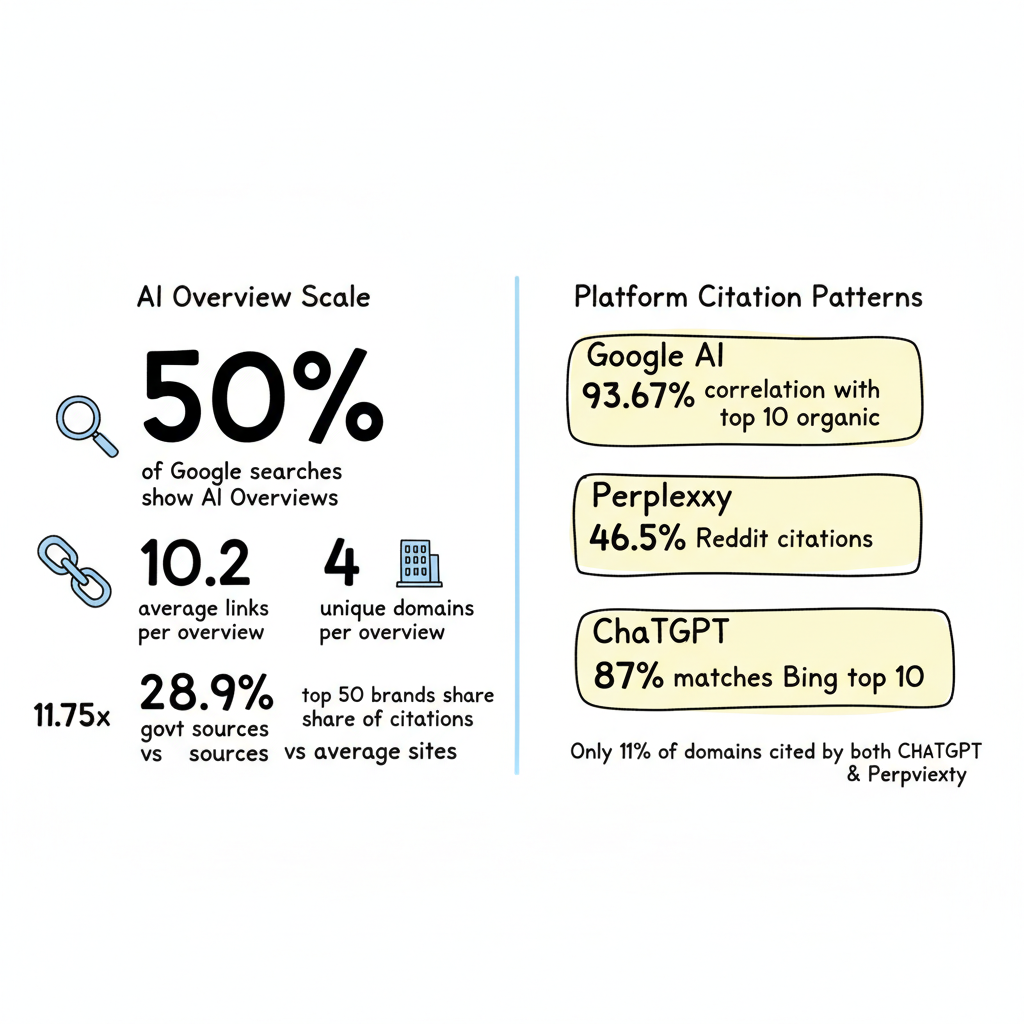
AI Overviews now appear in over 50% of Google searches, up from 18% in early 2025. Each overview typically includes 10.2 average links from 4 unique domains. These citations represent a new form of search visibility entirely different from traditional blue link rankings.
The sources Google's AI chooses to cite determine which brands gain visibility in this expanding search format. Understanding citation patterns has become essential for maintaining search presence as generative AI in SEO continues to reshape how users discover content.
Research analyzing thousands of AI Overview responses reveals clear winners in the citation game.
The most frequently cited domains share common characteristics:
Different AI platforms show distinct preferences:
Google AI Overviews: Maintains 93.67% correlation with top 10 organic results—the strongest connection to traditional search rankings among AI platforms.
Perplexity: Emphasizes Reddit content heavily, with Reddit accounting for 46.5% of citations. Real-time indexing of over 200 billion URLs prioritizes current information.
ChatGPT: Citations match Bing's top 10 results 87% of the time. Heavy reliance on Wikipedia and parametric knowledge.
Cross-platform optimization matters because only 11% of domains are cited by both ChatGPT and Perplexity. Success on one platform doesn't guarantee visibility on others. When developing universal AI search tactics, understanding these platform differences becomes critical.
Google hasn't published an official citation algorithm, but extensive analysis reveals consistent selection criteria.
E-E-A-T signals matter more for AI citations than traditional rankings:
Domain authority in niche: Sites with established expertise in specific topics get cited preferentially. A B2B SaaS company writing about marketing automation receives citations over general blogs covering the same topic.
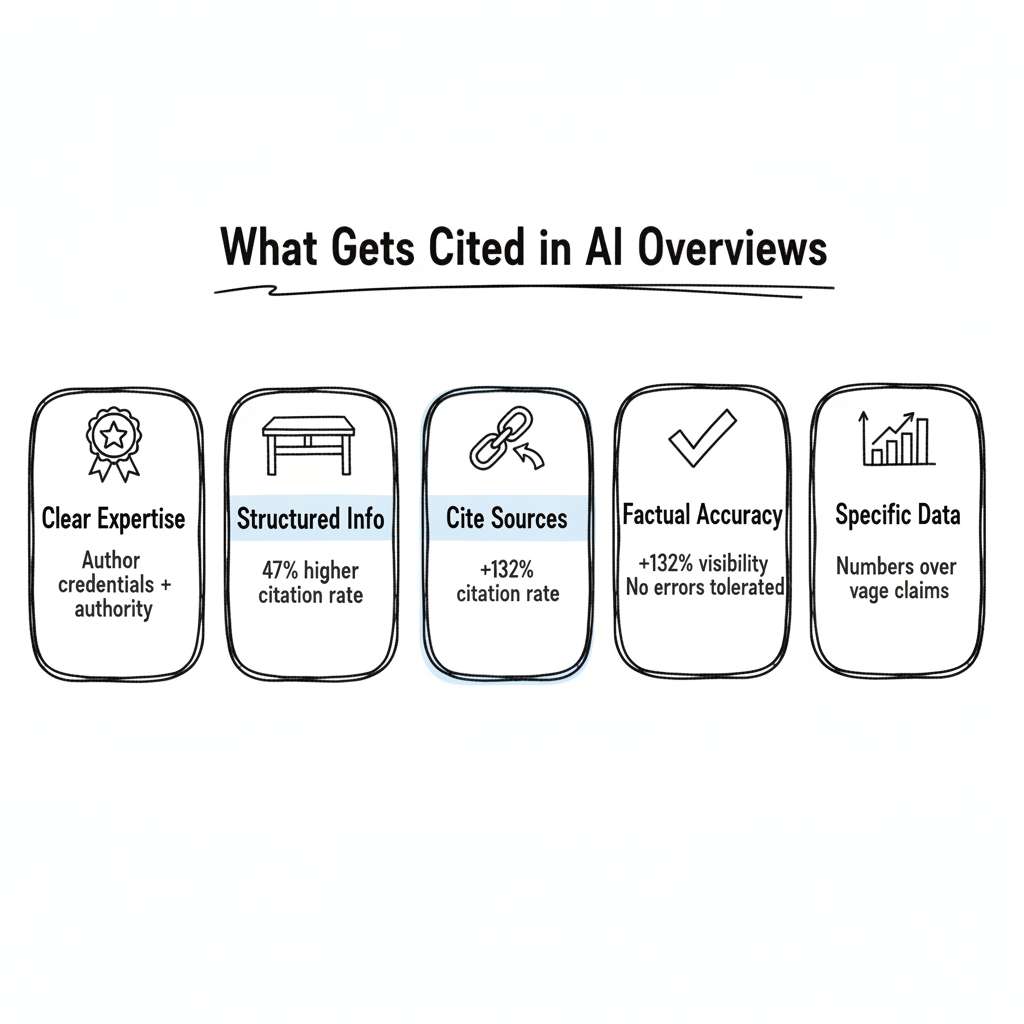
Author credibility: Pages with clear author bios establishing expertise earn more citations. AI systems recognize and weight authorship signals.
Backlink profile: Links from authoritative sources signal trustworthiness. AI systems consider the same authority metrics as traditional rankings.
Consistent publishing history: Sites with long-term presence on topics demonstrate expertise through accumulated content.
Certain content types earn citations more frequently:
Structured information: Tables, lists, and clearly organized content gets extracted more easily. Pages using comparison tables with proper markup see 47% higher AI citation rates.
Direct answers: Content that clearly answers questions in extractable formats gets cited. AI systems prefer content that doesn't require interpretation.
Factual specificity: Vague generalizations don't get cited. AI models favor specific claims backed by data or expert expert opinion.
Cited sources: Pages that reference authoritative external sources—studies, research, expert quotes—earn more citations. Adding trusted citations generated a 132% visibility increase in testing.
Research reveals counterintuitive findings:
Position doesn't equal citation: 76% of AI Overview citations come from pages in Google's top 10, but only 15% of AI Overview citations overlap with what traditional organic rankings would predict. Only 4.5% of AI Overview URLs directly matched a Page 1 organic URL.
Depth over rank: Google draws from deeper pages on authoritative domains. A page ranking position 8 might get cited while position 1 doesn't—if the content structure is more extractable.
Brand search volume matters most: Brand search volume—not backlinks—shows the strongest correlation with AI citations at 0.334. This means brand-building activities directly impact AI visibility.
Technical implementation influences citation likelihood.
Structured data helps AI systems understand content context. When optimizing FAQ schema for Google AI Overviews, specific implementation patterns significantly improve citation likelihood.
Essential schema types:
Testing shows well-implemented schema correlates with AI Overview appearance, while sites with poor or no schema fail to appear even when ranking well organically.
AI systems prioritize content they can easily digest:
Parsing-friendly format: Restructure content into standalone paragraphs where each section answers a specific question completely.
Clear heading hierarchy: Logical heading structure helps AI systems map content organization and extract relevant sections.
Extractable answers: Start sections with direct answers, then expand with supporting detail. Don't bury key information.
Sites that rank well in traditional search sometimes fail to earn AI citations. Common issues include:
Unclear content structure: Pages optimized for engagement but not extraction confuse AI systems trying to identify citable information.
Missing authority signals: Strong keyword optimization without corresponding E-E-A-T signals creates a mismatch AI systems detect.
Thin content: Surface-level coverage that ranks for keywords doesn't provide the depth AI systems need for confident citations.
Outdated information: AI systems weight freshness signals. Content that hasn't been updated loses citation opportunities.
No external validation: Pages without references to authoritative external sources lack the verification AI systems look for.
Based on citation pattern analysis, content that gets cited consistently:
Understanding the distinction between SEO vs AEO vs GEO helps align your content strategy with citation requirements across different optimization approaches.
Track citation visibility using available tools:
Compare your citation frequency against competitors to understand relative performance and identify improvement opportunities.
AI Overview citation patterns continue evolving. After Google's March 2025 core update, AI Overviews became less likely to cite pages in Google's top 10 organic results—suggesting increasing independence of AI citation selection from traditional ranking.
Industry analysis projects that by mid-2026, dominant citation positions will calcify around early adopters. Sites establishing citation patterns now gain advantages that become harder for competitors to overcome.
The shift from ranking-focused to authority-focused visibility requires adapting content strategies. Understanding who gets cited and why provides the foundation for earning AI Overview visibility in 2026 and beyond.
By submitting this form, you agree to our Privacy Policy and Terms & Conditions.