February 19, 2026


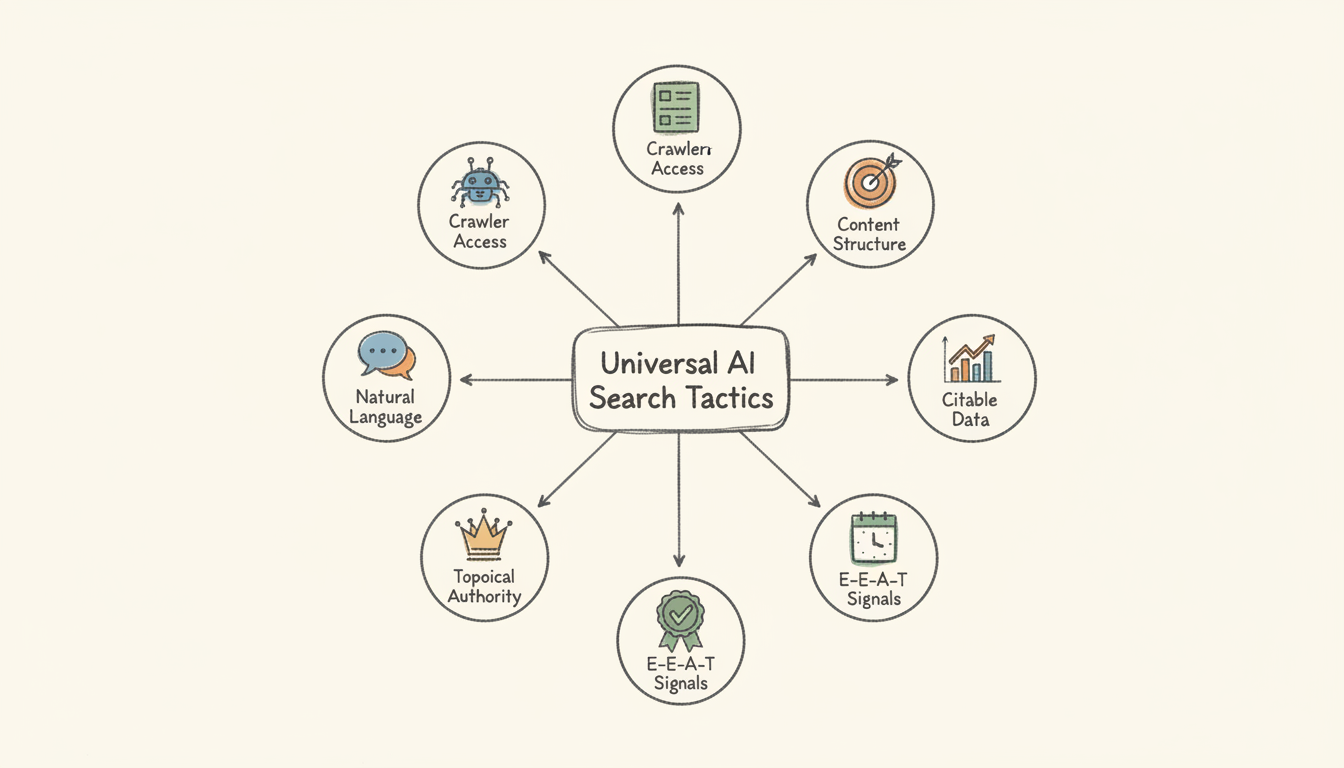
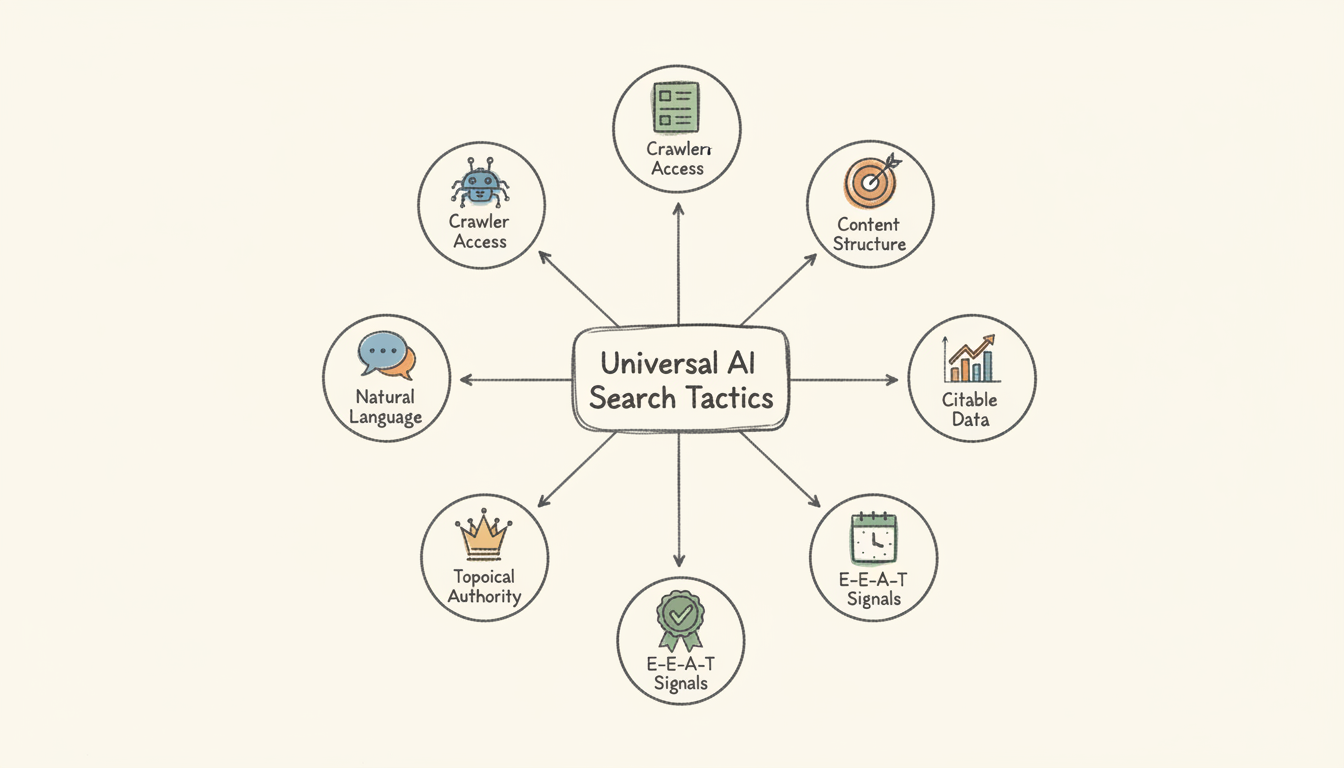
While each AI search platform has unique characteristics, certain optimization tactics work universally across ChatGPT, Google AI Overviews, Perplexity, Microsoft Copilot, and Claude. These fundamental techniques improve your content's likelihood of being cited regardless of which AI system processes it. Master these universal tactics before investing in platform-specific optimizations.
AI search platforms share core mechanisms despite their differences.
What all AI search platforms have in common:
Shared Element | Why It Matters |
Web crawlers | All need to access and index your content |
Language model processing | All interpret content for relevance |
Citation requirements | All need to attribute claims to sources |
Quality signals | All evaluate authority and trustworthiness |
User intent matching | All try to answer the actual question |
These shared foundations mean one set of tactics provides benefits across every platform simultaneously.
If AI systems can't crawl your content, nothing else matters.
Universal crawler access checklist:
Crawler Access Requirements:
├── robots.txt allows AI crawlers
│   ├── GPTBot (ChatGPT)
│   ├── Googlebot (Google AI)
│   ├── Bingbot (Copilot)
│   ├── PerplexityBot
│   └── ClaudeBot (Anthropic)
│
├── No crawler-blocking barriers
│   ├── No login walls on target content
│   ├── No aggressive rate limiting
│   └── No JavaScript-only content loading
│
└── Fast response times
    └── <3 second server response
Quick audit:
AI systems extract information more reliably from well-structured content.
Universal structure patterns:
Structure Element | Implementation | Platform Benefit |
Clear headings (H2/H3) | One topic per section | All platforms parse structure |
Definition format | "X is Y that Z" | Directly extractable answers |
Numbered lists | Steps, rankings, comparisons | Clean data extraction |
Tables | Structured data presentation | Comparison queries |
FAQ format | Q: / A: explicit structure | Direct question matching |
Example definition format:
Weak: "SEO involves many factors including keywords, links, and technical elements."

Strong: "Search engine optimization (SEO) is the practice of improving website visibility
in search results through technical improvements, content optimization, and authority building."
The strong version provides a complete, extractable definition AI systems can quote directly. This structured approach also supports your broader AEO strategy framework, ensuring content performs well across traditional and AI-powered search channels.
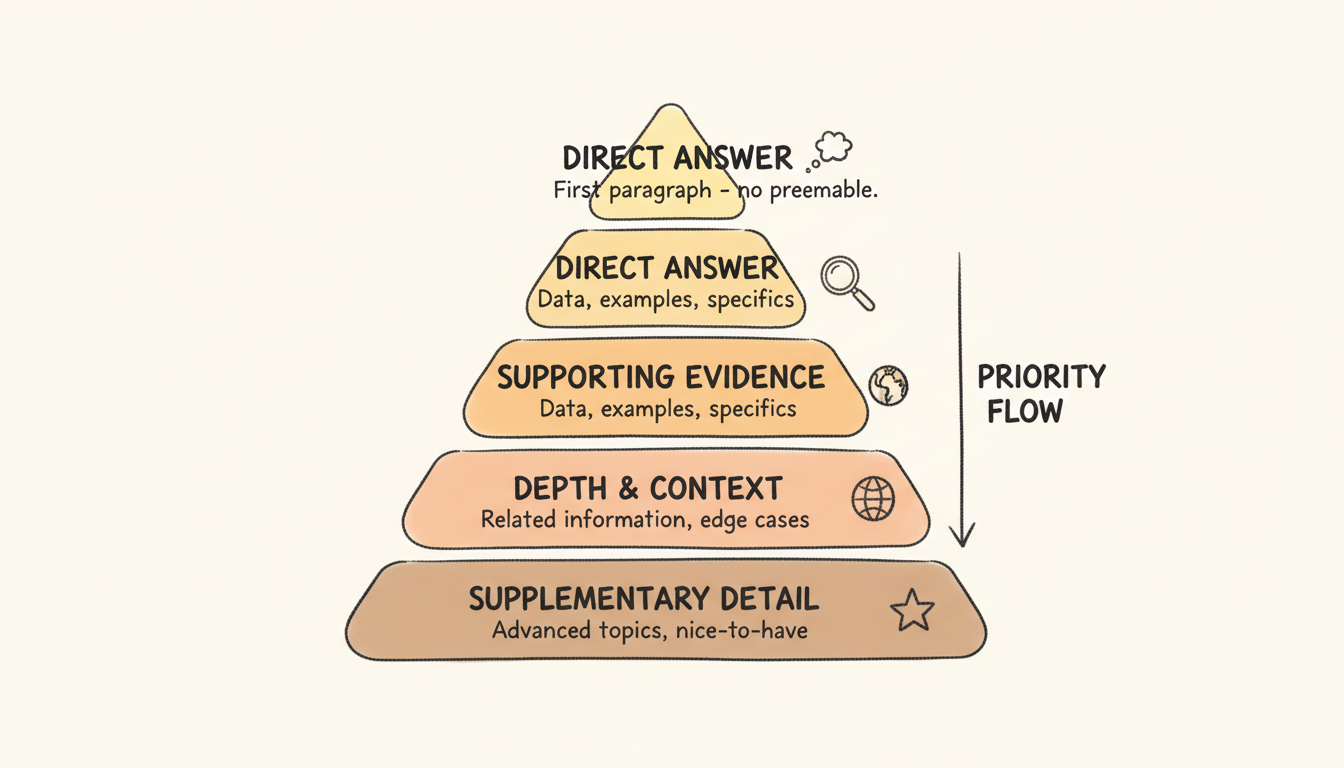
All AI systems prefer content that answers questions immediately.
The inverted pyramid for AI:
Content Structure for AI Extraction:
├── First paragraph: Direct answer to the query
│   └── No preamble, background, or buildup
│
├── Second section: Supporting evidence
│   └── Data, examples, specifics
│
├── Middle sections: Depth and context
│   └── Related information, edge cases
│
└── Final sections: Supplementary detail
    └── Nice-to-have, advanced topics
Practical application:
Query Type | First Sentence Should... |
"What is X?" | Define X immediately |
"How to X?" | State the first step |
"Best X for Y?" | Name the recommendation |
"X vs Y?" | State the key difference |
"Cost of X?" | Provide the number/range |
Users—and AI systems—want answers, not introductions about why the topic matters.
AI systems cite content that contains specific, attributable information.
What triggers citations:
Content Type | Citation Likelihood | Example |
Specific statistics | High | "73% of marketers report..." |
Named entities | Medium-high | "According to Forrester..." |
Unique research | High | "Our analysis of 500 campaigns..." |
Expert quotes | Medium-high | "As Jane Smith, CMO, notes..." |
Process steps | Medium | "Step 1: Configure settings..." |
Generic claims | Low | "Many businesses struggle with..." |
Making content citable:
Weak (uncitable): "Social media marketing is important for businesses."

Strong (citable): "Social media marketing drives 23% of e-commerce traffic
globally, with Instagram generating the highest conversion rate at 1.85%
compared to Facebook's 1.21% (2026 benchmark data)."
The strong version contains specific data that AI systems can attribute to your source.
Experience, Expertise, Authoritativeness, and Trustworthiness signals influence all AI platforms.
Universal E-E-A-T implementation:
Signal | Implementation |
Experience | Case studies, "we tested," methodology details |
Expertise | Author credentials, industry-specific terminology, depth |
Authoritativeness | Citations from other sources, backlinks, brand mentions |
Trustworthiness | Clear attribution, balanced perspectives, transparency |
On-page E-E-A-T elements:
E-E-A-T Content Elements:
├── Author byline with credentials
│   └── "By [Name], [Role], [Company]"
│
├── Publication/update dates
│   └── Current date demonstrates freshness
│
├── Methodology transparency
│   └── "This analysis reviewed 200 campaigns..."
│
├── Source citations
│   └── Link to original data sources
│
└── About/credentials page
    └── Linked from author byline
AI systems prefer current information, especially for rapidly evolving topics. When implementing search engine optimization using AI, freshness becomes even more critical as AI models prioritize recent, accurate information.
Freshness signals that matter:
Signal | Implementation |
Visible date | Publication and "last updated" dates |
Current year references | "In 2026, the landscape..." |
Recent data | Statistics from within past 12 months |
Updated examples | Current tools, platforms, practices |
Timely context | References to recent developments |
Freshness maintenance schedule:
Content Update Cadence:
├── High-change topics (AI, tech)
│   └── Quarterly reviews, update as needed
│
├── Medium-change topics (marketing tactics)
│   └── Bi-annual reviews
│
├── Low-change topics (fundamentals)
│   └── Annual reviews
│
└── Always update
    ├── Broken links
    ├── Outdated statistics
    └── Changed product names/features
AI systems recognize when domains demonstrate comprehensive expertise.
Building topical coverage:
Approach | Benefit |
Pillar content | Establishes main topic authority |
Cluster articles | Demonstrates depth across subtopics |
Internal linking | Shows content relationships |
Consistent terminology | Reinforces topical association |
Content cluster structure:
Topic Authority Structure:
├── Pillar: "Complete Guide to X"
│   └── Comprehensive overview (3000+ words)
│
├── Cluster 1: "X for [Use Case A]"
│   └── Specific application
│
├── Cluster 2: "X vs [Alternative]"
│   └── Comparison content
│
├── Cluster 3: "How to Implement X"
│   └── Practical guide
│
└── Supporting: "X [Specific Detail]"
    └── Targeted depth pieces
This structure signals to AI systems that your domain has comprehensive expertise on the topic. For SaaS companies specifically, implementing AEO for SaaS companies within this cluster framework maximizes visibility across AI platforms.
AI search users phrase queries conversationally. Understanding the differences between platforms—such as ChatGPT vs Perplexity comparison—helps you optimize for the natural language patterns each platform favors.
Query pattern optimization:
Traditional SEO | AI Search Optimization |
"best CRM software" | "What's the best CRM for small businesses?" |
"CRM pricing" | "How much does CRM software cost?" |
"CRM features" | "What features should I look for in a CRM?" |
Implementation:
Universal tactics that work across all AI search platforms:
These universal tactics provide the foundation for AI search visibility. Once implemented, platform-specific optimizations can build on this baseline for incremental gains.
By submitting this form, you agree to our Privacy Policy and Terms & Conditions.