February 19, 2026


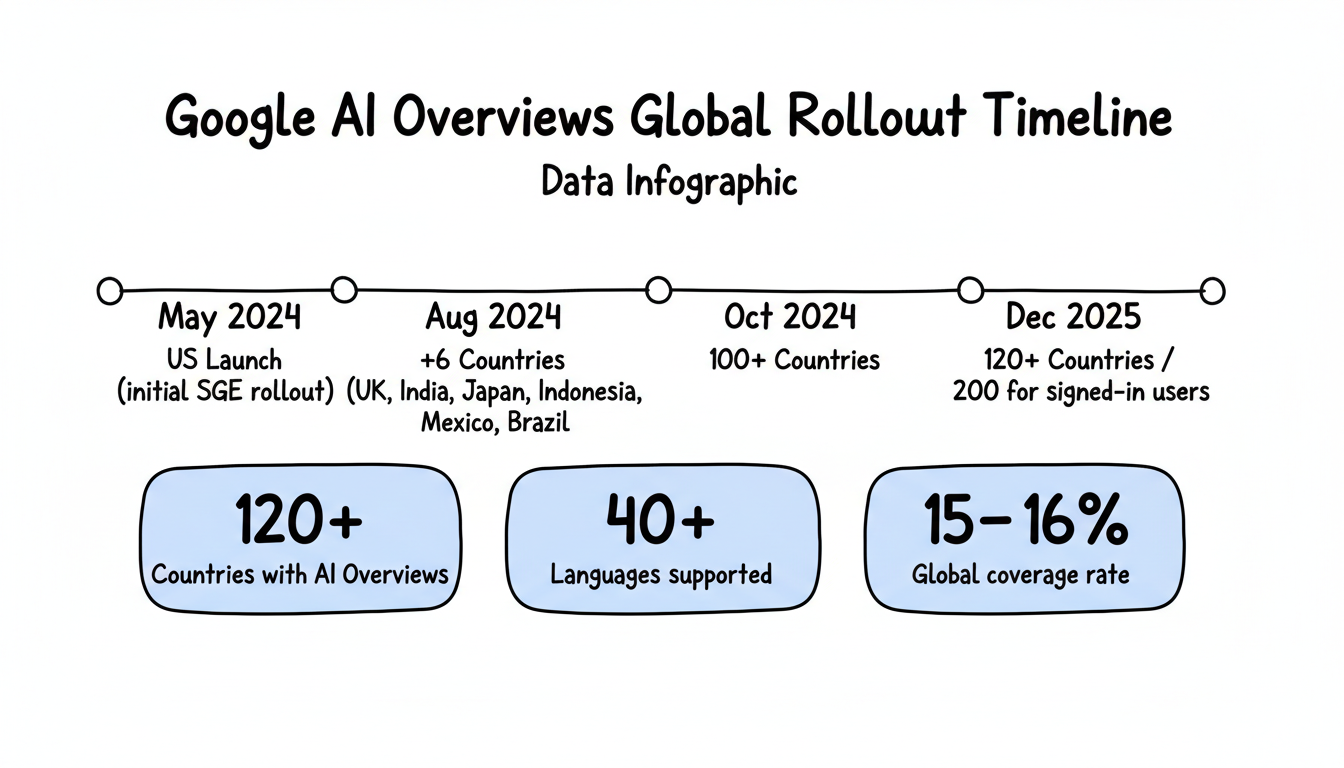
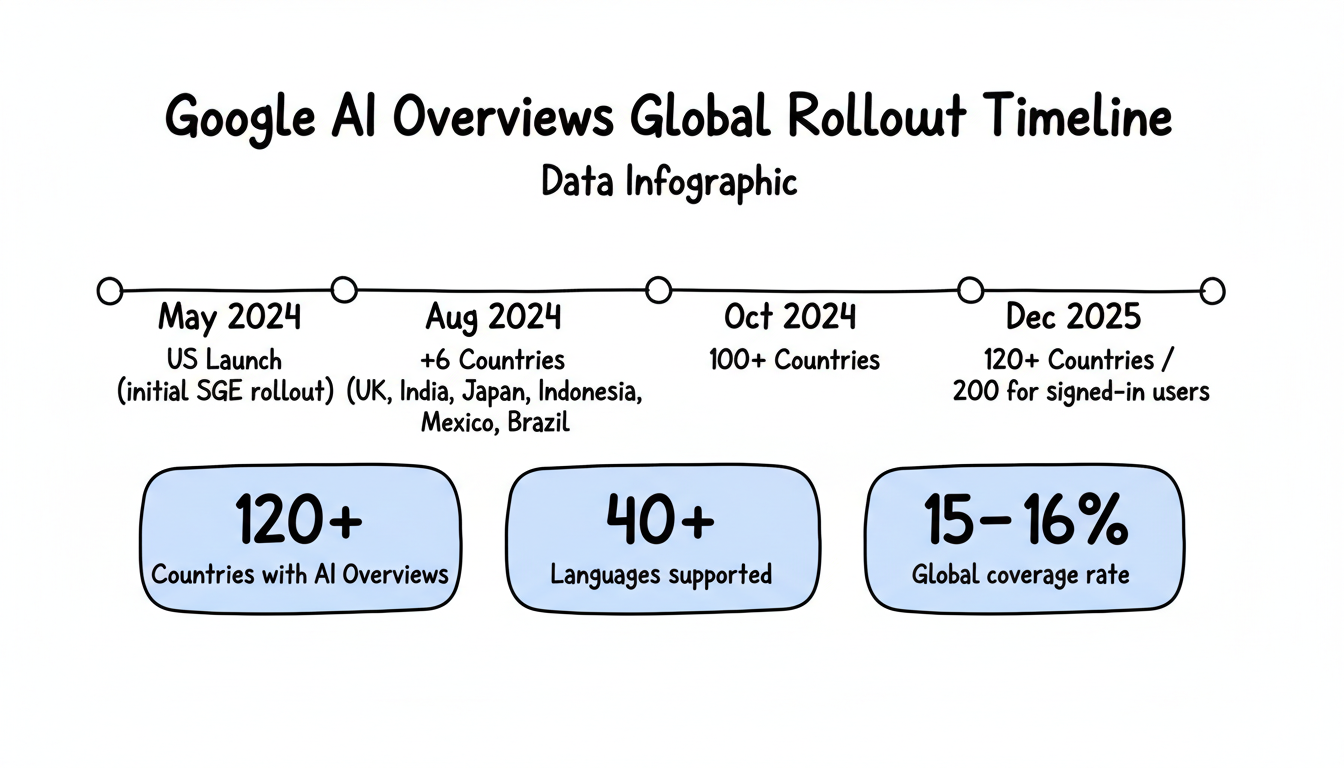
Google AI Overviews have expanded dramatically since their US launch in May 2024, now reaching 120+ countries with support for 40+ languages. However, significant variations exist in availability, behavior, and optimization requirements across regions. Organizations targeting international audiences need strategies that account for these differences rather than assuming uniform global deployment.
AI Overviews have expanded rapidly but unevenly across global markets.
Rollout progression:
Language support includes:
The expansion continues, but feature parity across regions remains inconsistent.
Google follows predictable patterns when rolling out AI Overview updates.
Typical rollout sequence:
Understanding this pattern helps organizations anticipate when new features will reach their target markets. Updates often take 2-4 weeks to propagate from US launch to global availability.
The EU presents unique considerations due to regulatory requirements.
EU-specific implementations:
Optimization implications:
Organizations targeting EU markets should maintain strong traditional SEO alongside AI optimization given these access limitations. Understanding the differences between AI SEO vs traditional SEO becomes particularly important in these regulated markets.
AI Overview coverage—the percentage of queries triggering AI responses—varies significantly by region.
Coverage observations:
Factors affecting regional coverage:
Coverage differences mean optimization ROI varies by target market.
AI Overview behavior differs based on query language.
Language factors:
Multilingual optimization:
Organizations with multilingual audiences should optimize each language version independently rather than translating from a single source. This approach aligns with proven generative engine optimization strategies that emphasize content quality and relevance.
Advertising within AI Overviews has expanded to select markets.
AI Overview ads availability (December 2025):
Implications for optimization:
Monitor ad expansion announcements for your target markets.
Effective international AI optimization requires region-specific approaches.
Regional strategy elements:
Market research: Understand which queries trigger AI Overviews in each target market. Coverage and triggers vary significantly.
Local authority building: Regional publications, local partnerships, and country-specific citations strengthen authority signals in each market.
Cultural alignment: Content must align with regional expectations, communication styles, and information-seeking patterns.
Regulatory awareness: Health, financial, and legal content faces varying restrictions by jurisdiction.
Track AI visibility across target markets systematically. Understanding AI Overview source selection patterns helps identify which content types succeed in different regions.
Monitoring approaches:
Platform limitations:
Establish monitoring baselines for each priority market rather than relying on global aggregates.
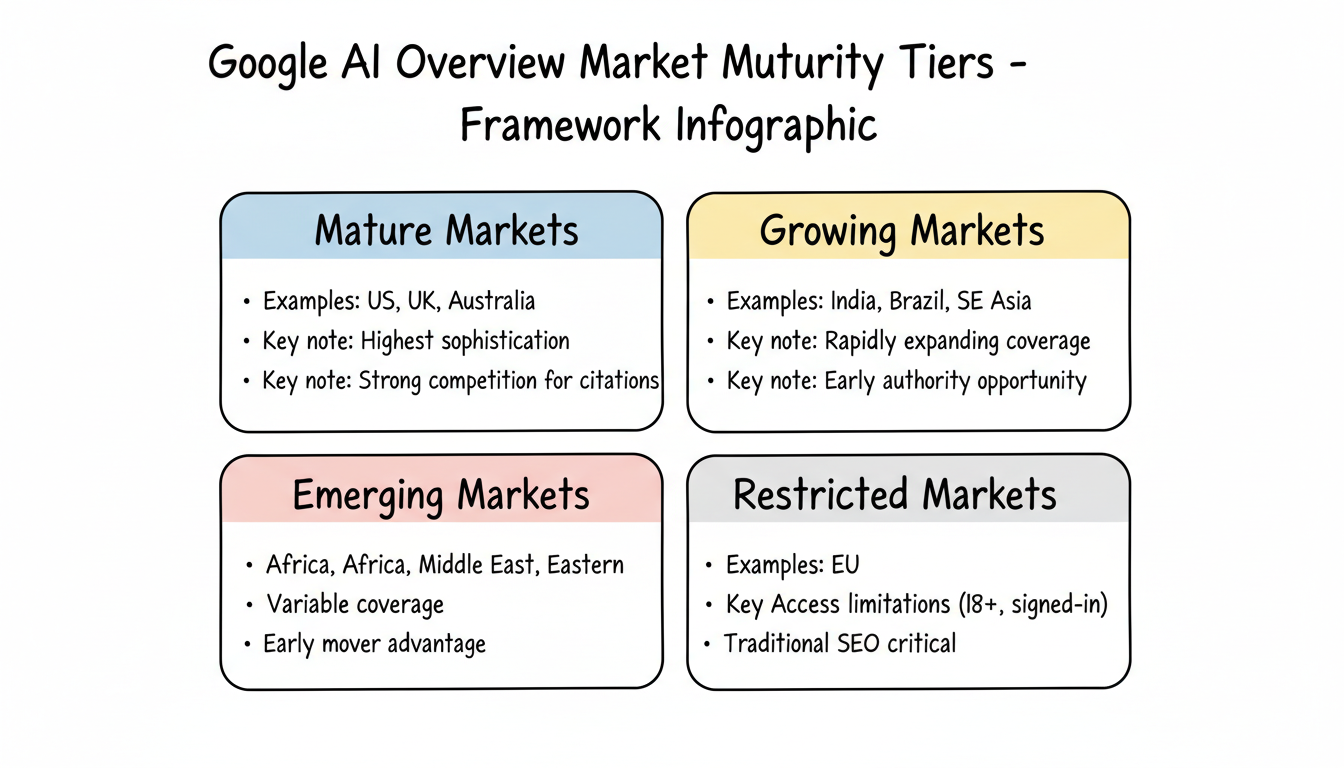
Different market types require different optimization emphasis.
Mature markets (US, UK, Australia):
Growing markets (India, Brazil, Southeast Asia):
Emerging markets (Africa, Middle East, Eastern Europe):
Restricted markets (EU, certain regulated sectors):
Technical requirements for international AI optimization.
Technical priorities:
Content delivery:
Anticipate continued global expansion of AI Overview capabilities. Organizations may benefit from consulting an AEO marketing consultant to navigate these complex international optimization requirements.
Expected developments:
Preparation strategies:
Organizations investing in international AI optimization before full global parity position themselves for advantage as features expand.
AI Overviews are available in 120+ countries directly and 200 countries for signed-in Google users. However, coverage varies significantly—some regions see AI responses for many queries while others see them rarely. Availability doesn't guarantee consistent appearance across query types.
No. English-language queries generally show the most sophisticated AI Overview responses. Other major languages have good support, but response quality and citation patterns may differ. Some languages have limited AI Overview functionality or simpler implementations.
Yes. Regional optimization should account for local coverage patterns, language-specific content requirements, regulatory considerations, and competitive landscapes. A strategy effective in the US may not transfer directly to EU or Asian markets.
By submitting this form, you agree to our Privacy Policy and Terms & Conditions.