
February 19, 2026


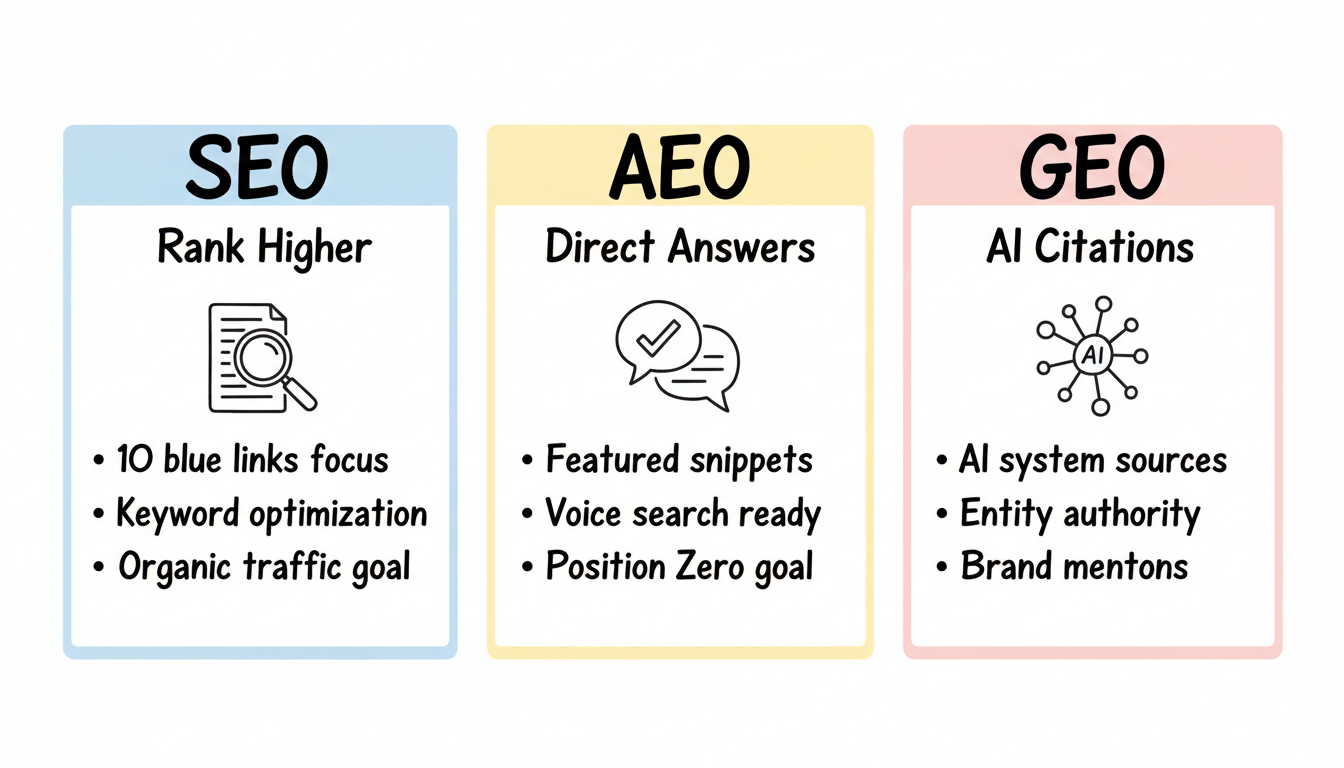
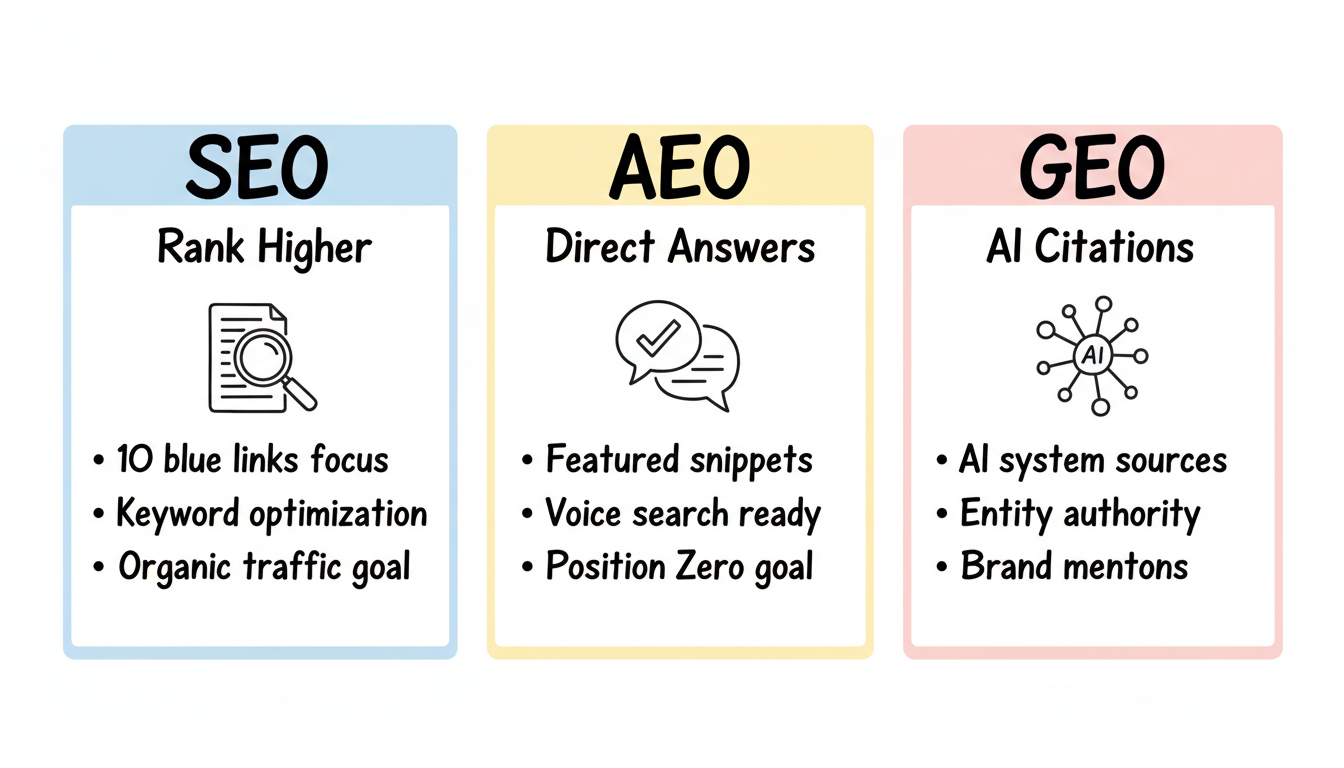
The search optimization landscape has fractured into three distinct disciplines. Traditional SEO, Answer Engine Optimization (AEO), and Generative Engine Optimization (GEO) each serve different purposes in how users discover information. Understanding when to prioritize each approach—and how they work together—has become essential for 2026 marketing strategy.
This comprehensive comparison breaks down what differentiates SEO, AEO, and GEO, when each matters most, and how to allocate resources across all three.
Before comparing strategies, let's establish clear definitions for each approach.
SEO is the original discipline of optimizing content to rank higher in traditional search engine results. The goal is positioning your pages among the "10 blue links" that appear when users search Google, Bing, or other search engines.
Core SEO activities:
SEO has dominated digital marketing for over two decades. It remains foundational—but no longer sufficient alone.
AEO focuses on making your content the direct answer that search engines extract and display. Rather than ranking among results, AEO aims to become the featured snippet, voice search response, or People Also Ask answer.
Core AEO activities:
AEO recognizes that users increasingly get answers without clicking through to websites. Position Zero matters more than Position One for certain query types.
GEO optimizes content for citation and synthesis by AI systems. When ChatGPT, Perplexity, or Google AI Overviews generate responses, GEO aims to make your content a trusted source they reference.
Core GEO activities:
GEO acknowledges that AI systems synthesize information differently than traditional search—and that being cited by AI is increasingly valuable.
Understanding the differences clarifies when each approach applies.
Aspect | SEO | AEO | GEO |
Primary goal | Rank higher in search results | Become the extracted answer | Get cited by AI systems |
Success metric | Search rankings, organic traffic | Featured snippets, voice answers | AI citations, brand mentions |
User interaction | Click through to website | Get answer without clicking | See brand in AI response |
Value creation | Website visits | Brand visibility, authority | AI-driven awareness, trust |
Element | SEO | AEO | GEO |
Content format | Comprehensive, keyword-optimized | Q&A structured, concise | Authoritative, citation-worthy |
Schema markup | Basic (Article, Organization) | FAQ, HowTo, QAPage | Complete entity markup |
Authority signals | Backlinks, domain authority | Trusted sources, relevance | E-E-A-T, Knowledge Graph presence |
Content length | Variable, often 1500-3000 words | Extractable 40-60 word answers | Comprehensive coverage |
Platform Type | SEO Priority | AEO Priority | GEO Priority |
Google organic | Primary target | Secondary | Secondary |
Featured snippets | Secondary | Primary target | Secondary |
Voice assistants | Low | Primary target | Low |
ChatGPT | Low | Low | Primary target |
Perplexity | Low | Low | Primary target |
Google AI Overviews | Secondary | Secondary | Primary target |
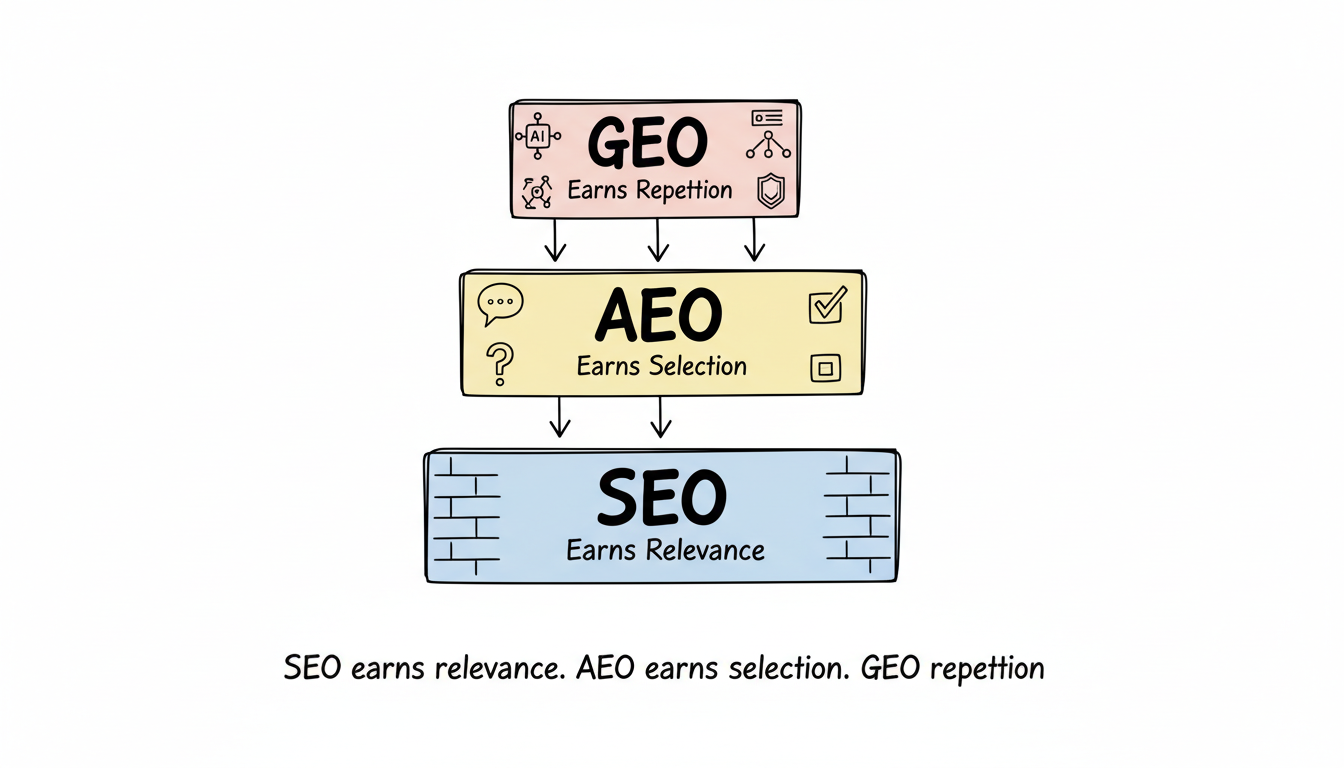
SEO, AEO, and GEO aren't competing strategies—they're layered disciplines that build on each other.
Traditional SEO remains the foundation. Without basic search visibility, neither AEO nor GEO can perform effectively. Research shows that 93.67% of Google AI Overview citations come from pages already ranking in the top 10 organic results. You can't skip SEO and expect AEO or GEO success.
SEO provides:
AEO builds on SEO by formatting content for direct answer extraction. Once you rank, AEO techniques help you capture featured snippets and voice search answers.
AEO adds:
GEO extends both SEO and AEO by optimizing for AI system citations. The authority built through SEO and the structured content from AEO both contribute to GEO performance.
GEO contributes:
A helpful framework: SEO earns relevance. AEO earns selection. GEO earns repetition.
SEO makes you relevant for queries. AEO makes you the selected answer. GEO makes AI systems repeatedly cite and reference you across conversations and platforms.
Different business situations call for different prioritization.
You're building from scratch. New websites need SEO fundamentals before AEO or GEO can work. Establish basic rankings, build domain authority, and create indexable content first.
Your audience uses traditional search. Not all demographics have adopted AI search tools. If your audience primarily uses Google's standard results, traditional SEO delivers the most value.
Local business visibility matters. Local SEO remains dominant for "near me" and location-based queries. Google Business Profile optimization and local citations outweigh AI search for local discovery.
You need measurable traffic. SEO provides the clearest analytics path—rankings, clicks, conversions. If stakeholders require traditional metrics, prioritize SEO for reportable outcomes.
Your content answers specific questions. How-to queries, definitions, specifications, and factual questions trigger featured snippets. If your content provides definitive answers, AEO captures Position Zero.
Voice search matters to your audience. Smart speaker users and mobile voice searchers receive single answers. AEO ensures your content becomes that spoken response.
You're already ranking well. AEO optimizations help pages already in the top 10 capture featured snippets. If you rank but don't own snippets, AEO provides incremental gains.
Quick reference content is your strength. Calculators, conversions, specifications, and reference materials benefit most from AEO formatting. Users want immediate answers—give them extractable responses.
Your audience uses AI search tools. Professionals increasingly research via ChatGPT and Perplexity. Technical audiences, researchers, and early adopters over-index on AI search—GEO reaches them.
Brand mentions in AI responses matter. For competitive categories, being cited when users ask AI "what's the best X" drives awareness and trust. GEO builds AI share of voice.
You have original data or research. AI systems cite sources with unique information. If you publish proprietary data, original research, or novel insights, GEO amplifies that advantage.
Long-term positioning is the goal. GEO investments compound over time as AI systems index and reference your authority. Early movers establish positions before competitive saturation.
Industry data suggests optimal allocation varies by business maturity and goals.
Discipline | Allocation | Rationale |
SEO | 40-50% | Maintain rankings, protect existing traffic |
AEO | 20-25% | Capture snippets for ranking pages |
GEO | 25-30% | Build AI visibility for future traffic |
Established sites can leverage existing authority for faster AEO and GEO returns.
Discipline | Allocation | Rationale |
SEO | 60-70% | Build foundation, establish rankings |
AEO | 15-20% | Format content for snippets as rankings improve |
GEO | 10-15% | Plant seeds for future AI visibility |
New sites need SEO fundamentals before advanced tactics pay off.
Discipline | Allocation | Rationale |
SEO | 35-40% | Maintain baseline visibility |
AEO | 20-25% | Capture available snippet opportunities |
GEO | 35-45% | Maximize AI search visibility |
Industries where users actively use AI search (tech, finance, professional services) should weight GEO more heavily.
Research indicates 37% of B2B marketers are prioritizing GEO and AEO investments for 2026. Marketing budget allocation frameworks increasingly recommend 25-30% of content marketing spend toward AI search optimization.
Understanding how each discipline affects traffic helps set expectations.
Traditional SEO drives measurable organic traffic with clear attribution. Google Analytics tracks clicks, sessions, and conversions. However, overall organic search traffic faces pressure—Gartner predicts 25% decline in traditional organic search traffic by 2026 as AI search grows.
AEO success often reduces clicks. When users get answers directly from featured snippets, they don't need to visit your site. Studies show AI Overviews cause 34.5% drop in Position 1 click-through rates. AEO trades clicks for visibility and brand authority.
GEO traffic is hardest to measure. When ChatGPT mentions your brand, users might later Google you directly—but that branded search appears as SEO traffic, not GEO. Attribution models must account for this branded search lift to capture GEO value.
The healthiest approach accepts that:
Tracking all three together—organic traffic, snippet visibility, and AI citations—provides the complete picture.
Here's how to implement all three disciplines effectively.
Technical baseline:
Content foundation:
Content formatting:
Technical implementation:
Understanding how to implement schema markup for AI search optimization is critical for both AEO and GEO success.
Entity establishment:
Content authority:
For businesses looking to establish themselves in AI search results, developing entity-based SEO and topical authority creates a foundation that AI systems recognize and cite.
Cross-platform presence:
Track different metrics for each discipline.
Metric | Tool |
Organic rankings | SEMrush, Ahrefs, Search Console |
Organic traffic | Google Analytics |
Domain authority | Moz, Ahrefs |
Backlink profile | Ahrefs, Majestic |
Metric | Tool |
Featured snippet captures | SEMrush, Ahrefs |
PAA appearances | SERP tracking tools |
Voice search answers | Manual audits |
Schema validation | Google Rich Results Test |
Metric | Tool |
AI citation frequency | Otterly AI, Scrunch AI |
AI share of voice | Semrush AI Toolkit, Ahrefs Brand Radar |
Brand mention accuracy | Manual audits |
Cross-platform visibility | Multi-platform tracking |
For comprehensive performance tracking, consider implementing an AI search analytics dashboard that consolidates visibility metrics across traditional search, featured snippets, and AI citations.
Create a combined view that tracks:
The current moment presents a strategic opportunity. AI search adoption is accelerating, but competitive saturation hasn't peaked. Businesses establishing GEO visibility now build advantages that compound as AI search grows.
However, this window won't remain open indefinitely. As more businesses optimize for AI citation, the competition intensifies. Early movers gain positions in AI system training data and citation patterns that late entrants must work harder to achieve.
The businesses that integrate all three disciplines—maintaining SEO fundamentals while adding AEO formatting and building GEO authority—position themselves for success regardless of how search evolves.
No. SEO remains foundational. Research shows 93.67% correlation between top organic rankings and AI Overview citations. GEO builds on SEO—it doesn't replace it. Continue SEO while adding AEO and GEO layers.
It depends on your audience's search behavior. B2B and technical audiences increasingly use AI search tools, making GEO more valuable. Local service businesses still rely primarily on traditional SEO. Consumer products benefit from balanced investment across all three.
GEO results take longer than SEO or AEO. AI system citation patterns develop over months as your content gets indexed and recognized as authoritative. Expect 3-6 months for initial visibility improvements, with compounding returns over 12+ months.
Yes, especially in niche topics. AI systems cite authoritative sources regardless of company size. Small businesses with genuine expertise and original insights can earn citations that larger competitors miss. Focus on topics where you have unique knowledge.
AEO and GEO are converging. The techniques that win featured snippets increasingly overlap with those that earn AI citations. However, voice search and traditional snippet optimization remain distinct AEO priorities. Continue AEO while expanding to GEO.
Track visibility across all three channels simultaneously. Monitor organic rankings for SEO health, featured snippet captures for AEO performance, and AI citation frequency for GEO success. If organic traffic declines but branded searches increase and AI citations grow, your strategy is working—traffic is shifting channels, not disappearing. Use unified dashboards that aggregate metrics from all three disciplines for a complete performance picture.
By submitting this form, you agree to our Privacy Policy and Terms & Conditions.



