February 19, 2026


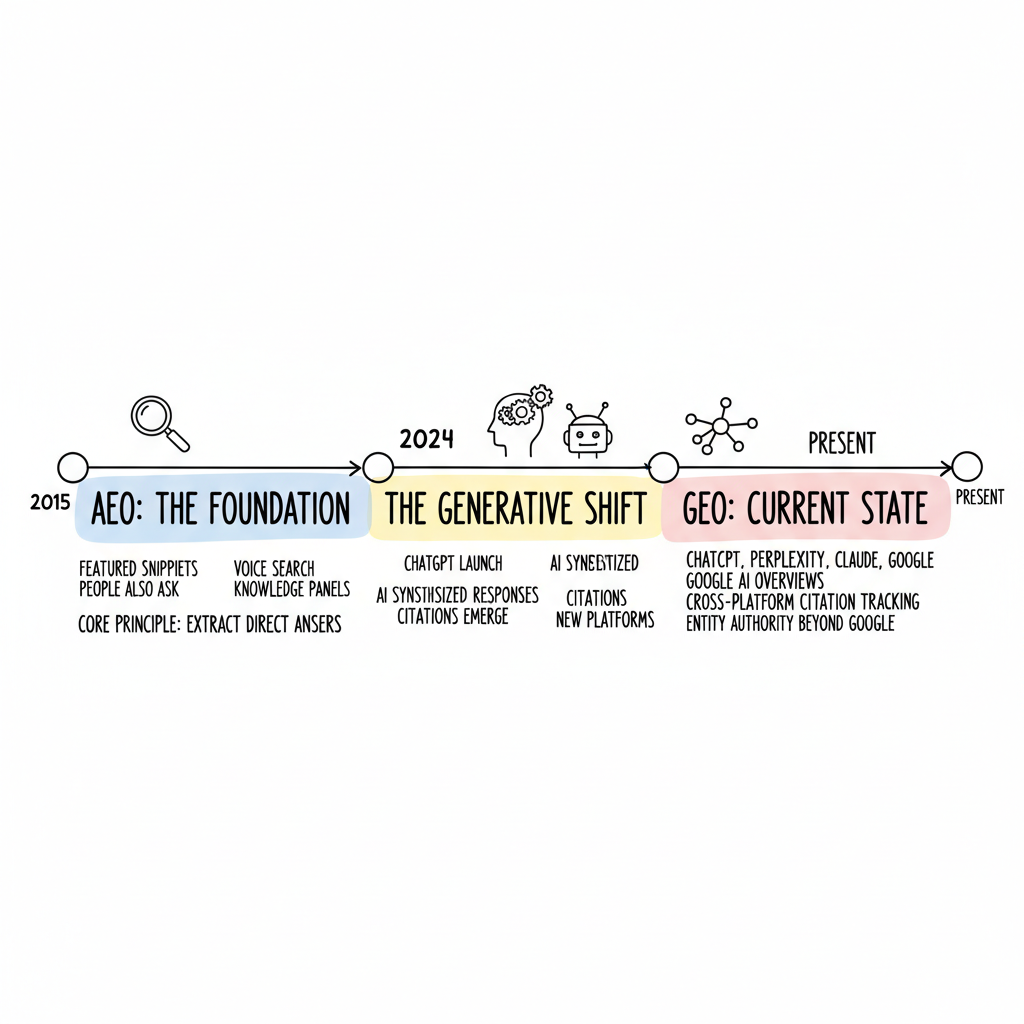
Answer Engine Optimization (AEO) and Generative Engine Optimization (GEO) represent different stages in the evolution of AI search optimization. Understanding this relationship helps organizations build on existing AEO investments while preparing for generative AI visibility.
This guide explains how AEO evolved into GEO and provides a practical migration path for organizations making the transition.
Answer Engine Optimization emerged as featured snippets, voice search, and direct answer boxes became prominent in search results. AEO focused on getting content extracted as the definitive answer to user queries.
Original AEO targets:
Core AEO principle: Structure content so machines can extract and display it as the direct answer.
When ChatGPT launched in late 2022, search behavior began shifting. Users started asking AI assistants directly instead of searching Google. These systems didn't just extract answers—they generated synthesized responses from multiple sources.
What changed:
Generative Engine Optimization addresses this new reality. GEO targets citation in synthesized AI responses across multiple platforms, not just extraction in featured snippets.
GEO expands AEO to include:
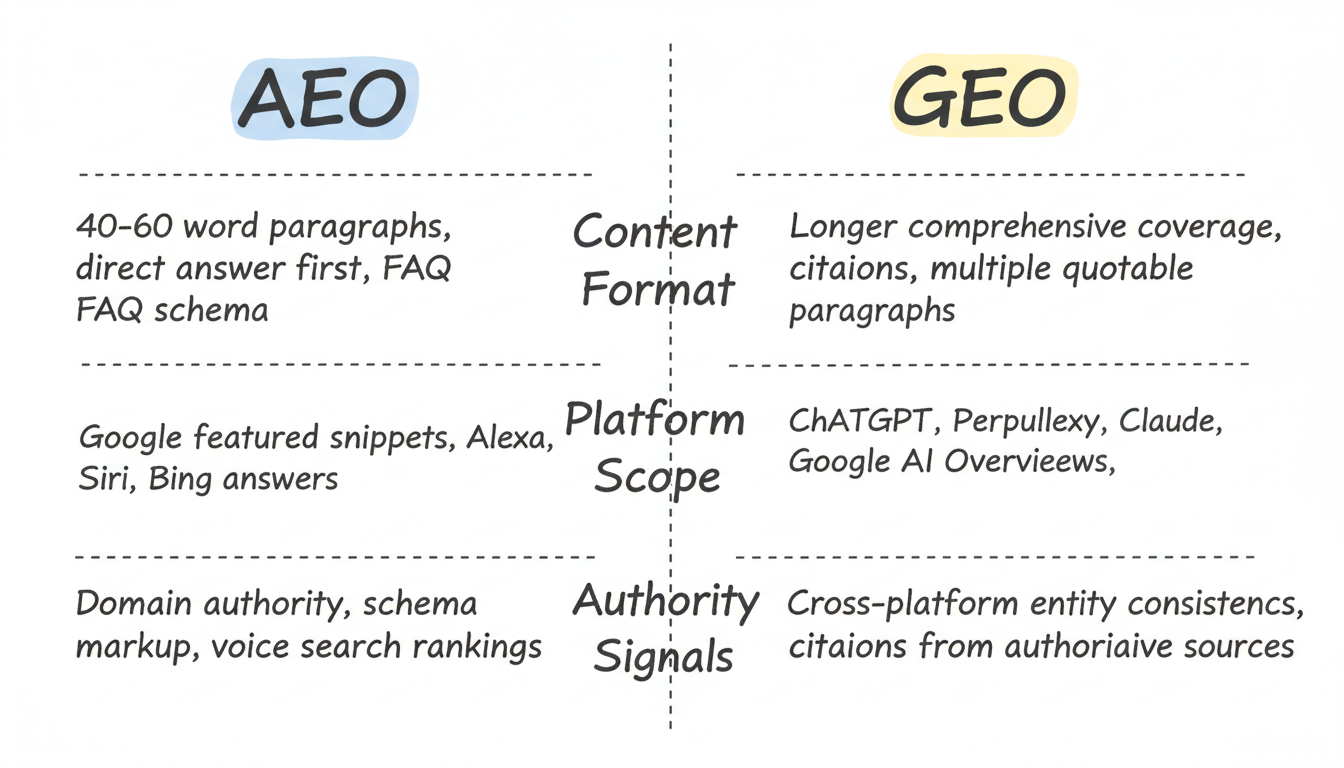
While AEO vs GEO: Key Differences share foundational techniques, practical differences matter for implementation.
AEO content optimization:
GEO content optimization:
Practical implication: AEO-optimized content often needs expansion for GEO success. A 50-word featured snippet answer may be too thin for generative AI citation.
AEO platforms:
GEO platforms (adds):
Practical implication: GEO requires monitoring multiple platforms. AEO success in Google doesn't guarantee GEO success in ChatGPT.
AEO authority signals:
GEO authority signals (adds):
Practical implication: GEO requires broader authority building beyond Google's ecosystem, which is where knowledge graph optimization becomes critical for establishing entity relationships across platforms.
Organizations with existing AEO programs can systematically expand into GEO.
Before expanding, understand what you have:
AEO asset inventory:
GEO baseline assessment:
This audit reveals where AEO success translates to GEO success—and where gaps exist. Consider conducting a comprehensive AEO content audit to identify optimization opportunities.
Start with content that already performs in AEO and optimize for GEO:
Expansion tactics:
Example transformation:
Original AEO content (featured snippet optimized): "Email marketing ROI averages $42 for every $1 spent, making it one of the highest-return digital channels."
Expanded for GEO: "Email marketing ROI averages $42 for every $1 spent according to DMA research, making it one of the highest-return digital channels. This return exceeds social media advertising (typically $2-5 per dollar) and paid search (average $2-3 per dollar). The high ROI results from low distribution costs, direct audience access, and measurable conversion paths. Organizations implementing segmentation and personalization often exceed the $42 average, with some B2B companies reporting returns above $70 per dollar invested."
The expanded version provides more citable information, supporting evidence, and context for AI synthesis.
AEO focuses primarily on Google. GEO requires broader authority:
Authority expansion actions:
Why this matters: Generative AI systems evaluate source credibility differently than Google. Broader presence increases citation likelihood.
AEO monitoring focuses on Google features. GEO requires multi-platform tracking:
Monitoring expansion:
Measurement differences:
Tools like those covered in our Google AI Overviews optimization playbook can help track visibility across multiple AI platforms effectively.
GEO doesn't replace AEO—it extends it. Maintain both:
Ongoing AEO maintenance:
GEO additions:
Featured snippets and voice search still drive traffic. Don't sacrifice AEO success while building GEO capabilities.
Content ranking in featured snippets may not get cited by ChatGPT. Platform-specific optimization remains necessary.
ChatGPT, Perplexity, and Google AI Overviews weight factors differently. One-size-fits-all optimization underperforms.
Integration works better than parallel programs. The same content team should handle both AEO and GEO.
For organizations balancing AEO and GEO:
Current State | Recommended Allocation |
Strong AEO, no GEO | 60% AEO maintenance, 40% GEO development |
Moderate AEO, no GEO | 50% AEO improvement, 50% GEO development |
Strong AEO, emerging GEO | 40% AEO, 60% GEO expansion |
Mature both | 30% AEO, 70% GEO (as AI search grows) |
Adjust quarterly based on traffic sources and business impact.
Answer Engine Optimization and Generative Engine Optimization represent evolution, not replacement. AEO built the foundation—structured content, FAQ formatting, direct answers—that GEO extends.
The migration path: Audit existing AEO assets, expand successful content for GEO, build cross-platform authority, implement multi-platform monitoring, maintain both capabilities.
The strategic reality: Organizations with strong AEO programs have advantages in GEO. The foundational skills transfer. The expansion requires additional scope, not entirely new capabilities.
By submitting this form, you agree to our Privacy Policy and Terms & Conditions.