February 19, 2026


Google AI Overviews represent a fundamental shift in how search results appear. Rather than relying on speculation or third-party theories, this guide consolidates Google's official documentation, stated guidelines, and public communications about how AI Overviews work and what content creators should focus on to earn visibility.
Understanding what Google officially recommends—versus what SEO practitioners theorize—provides the clearest path to sustainable AI Overview visibility.
Google has released extensive documentation about AI Overviews through official blog posts, help center articles, developer documentation, and public statements from search leadership.
According to Google's official documentation, AI Overviews are "AI-powered snapshots of key information" designed to help users "quickly find what they're looking for."
Key official characteristics:
Aspect | Google's Official Position |
Purpose | Help users understand topics faster and discover relevant content |
Source attribution | Links to supporting sources included in or below overviews |
Query types | Complex questions requiring synthesis across multiple sources |
Content basis | Information from high-quality web sources |
Google explicitly states that AI Overviews are not meant to replace traditional search results but to complement them for queries where synthesized answers help users. This aligns with broader answer engine optimization principles focused on providing direct, authoritative responses.
Google has documented AI Overview availability across markets:
Current status (as of 2026):
Google's official Search Central blog provides updates on availability changes. Check Google's documentation directly for current market coverage.
Google has published specific guidance on content quality for AI systems, extending existing quality guidelines to AI-powered features. Understanding these guidelines is essential for any Google AI Overview SEO strategy.
Google's official Search Quality Rater Guidelines define E-E-A-T (Experience, Expertise, Authoritativeness, Trustworthiness) as fundamental to content quality assessment.
Google's official E-E-A-T components:
Component | Google's Definition | Official Guidance |
Experience | First-hand experience with the topic | "Content that demonstrates first-hand experience can be more trustworthy" |
Expertise | Knowledge and skill in the topic area | "Expertise of the content creator matters, especially for YMYL topics" |
Authoritativeness | Reputation as a go-to source | "Is this creator or website known as a go-to source for the topic?" |
Trustworthiness | Overall trustworthiness assessment | "Trust is the most important member of the E-E-A-T family" |
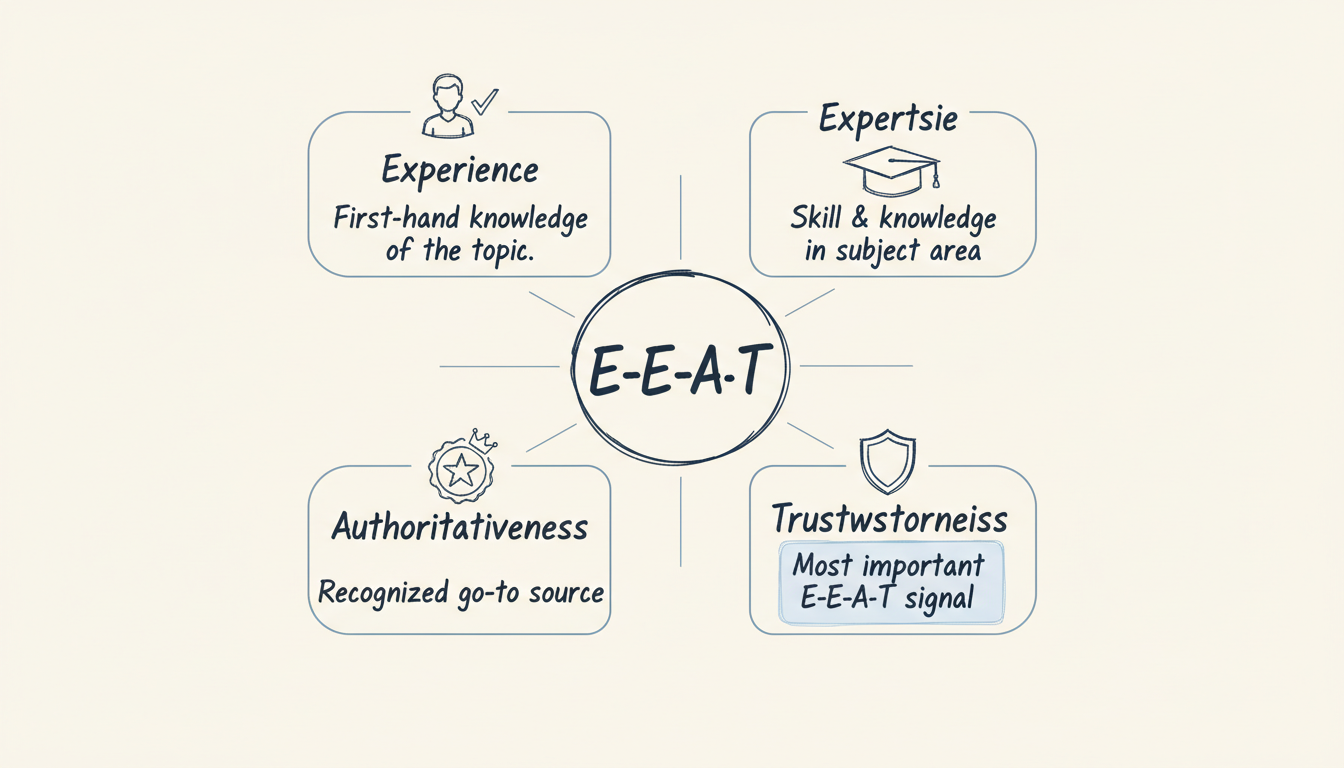
Google states that E-E-A-T applies to all content but is particularly important for "Your Money or Your Life" (YMYL) topics including health, finance, safety, and civic information.
Google's Helpful Content System, documented in Search Central, directly impacts AI Overview eligibility.
Official helpful content criteria:
Google's documentation specifies content should:
Content that Google officially discourages:
This connects directly to AEO strategy best practices that prioritize user intent over keyword stuffing.
Google maintains elevated standards for YMYL (Your Money or Your Life) content in AI Overviews.
Google's official YMYL categories:
Category | Examples | Standard |
Health and safety | Medical, drug, mental health information | Highest scrutiny |
Financial information | Financial advice, investment, taxes | Expert sources prioritized |
Civic information | Voting, government, legal information | Verified official sources |
News and current events | Breaking news, public interest topics | Journalistic standards |
Groups of people | Information about protected groups | Factual, respectful content |
For YMYL topics, Google officially states that expertise and authoritativeness carry additional weight in AI Overview source selection.
Google provides specific technical guidance for ensuring content is accessible to AI systems. Following these standards is fundamental for generative engine optimization strategies.
Google's official structured data documentation specifies requirements for AI feature eligibility.
Google-endorsed schema types:
Schema Type | Official Status | Documentation Location |
Article | Fully supported | developers.google.com/search/docs/appearance/structured-data/article |
FAQPage | Fully supported | developers.google.com/search/docs/appearance/structured-data/faqpage |
HowTo | Fully supported | developers.google.com/search/docs/appearance/structured-data/how-to |
Product | Fully supported | developers.google.com/search/docs/appearance/structured-data/product |
Review | Fully supported | developers.google.com/search/docs/appearance/structured-data/review |
Official implementation requirements:
Google's documentation specifies:
Implementing schema correctly supports what is knowledge graph SEO objectives by helping Google understand entity relationships.
Google's official documentation on crawling applies to AI Overview eligibility.
Official technical requirements:
Requirement | Google's Documentation |
Googlebot access | Allow Googlebot in robots.txt |
Page indexability | No noindex directive on eligible pages |
Mobile-friendliness | Pages must be mobile-friendly |
Page experience | Core Web Vitals and security (HTTPS) |
Content accessibility | Text content accessible without JavaScript barriers |
Google's robots.txt guidance for AI:
Google has documented that Googlebot crawls content for AI features. Sites blocking Googlebot also block AI Overview eligibility. Google-Extended is a separate control specifically for AI training, not AI Overview inclusion.
# Google's documented user-agents
User-agent: Googlebot
Allow: /

# Separate AI training control (does not affect AI Overviews)
User-agent: Google-Extended
Disallow: / (if opting out of training data)
Google's official Page Experience documentation affects AI Overview eligibility.
Core Web Vitals thresholds (official):
Metric | Good | Needs Improvement | Poor |
LCP (Largest Contentful Paint) | ≤2.5s | 2.5s-4s | >4s |
INP (Interaction to Next Paint) | ≤200ms | 200ms-500ms | >500ms |
CLS (Cumulative Layout Shift) | ≤0.1 | 0.1-0.25 | >0.25 |
Google states that page experience signals are among many factors considered but are not the sole determinant of AI Overview inclusion.
Official Google documentation provides guidance on content formatting that AI systems can effectively process. These principles directly support featured snippet optimization AI efforts.
Google's helpful content guidelines emphasize structural clarity.
Officially recommended practices:
Google's documentation on featured snippets (which preceded AI Overviews) emphasizes direct answers.
Google's guidance on question-answering content:
This approach complements strategies for long-tail keywords for featured snippet success by providing comprehensive yet focused answers.
Google has emphasized factual accuracy across multiple official communications.
Official position on accuracy:
Understanding AI overview citation analysis can help content creators identify patterns in source selection.
Google provides official tools for validating content alignment with their guidelines. These tools are critical for implementing an effective AEO implementation roadmap.
Google Search Console provides official data on search performance.
Relevant reports for AI Overview optimization:
Report | Purpose | Access |
Search results | Traffic and impression data | Search Console → Performance |
Page experience | Core Web Vitals assessment | Search Console → Experience |
Enhancements | Structured data validation | Search Console → Enhancements |
Indexing | Crawling and indexing status | Search Console → Indexing |
Google's Rich Results Test validates structured data implementation.
Official testing process:
Google's PageSpeed Insights provides Core Web Vitals assessment.
Testing for AI Overview readiness:
Stay informed through Google's official information sources.
Source | Content Type | URL Pattern |
Google Search Central Blog | Announcements, guidance | developers.google.com/search/blog |
Search Central Help | Documentation | support.google.com/webmasters |
Structured Data Docs | Technical specs | developers.google.com/search/docs/appearance/structured-data |
Search Quality Guidelines | Rater guidelines (public) | Published PDF from Google |
Google communicates AI Overview updates through:
Understanding Google's official position on AI Overview optimization.
Google's official guidance focuses on quality fundamentals.
Officially supported practices:
Practice | Google's Position | Documentation |
Creating helpful content | Explicitly encouraged | Helpful Content documentation |
Demonstrating expertise | Core quality signal | E-E-A-T guidelines |
Implementing structured data | Officially supported | Schema.org documentation |
Ensuring accessibility | Required | Page Experience documentation |
Maintaining accuracy | Expected | Quality Guidelines |
Many AEO tools focus on measuring these officially supported signals rather than attempting to reverse-engineer Google's algorithms.
Google has not officially endorsed "AI Overview optimization" as a separate discipline.
Google's implicit guidance:
This means that Google's official position is that the best approach to AI Overview visibility is following existing quality guidelines rather than attempting to reverse-engineer AI Overview selection. Understanding what is AEO in marketing helps contextualize these practices within broader digital strategies.
Translate Google's official documentation into actionable steps.
Review your content against Google's documented criteria:
Area | Official Requirement | Audit Question |
Helpfulness | People-first content | Does this help users accomplish their goal? |
Expertise | Demonstrated knowledge | Does content show genuine expertise? |
Accuracy | Factual information | Are claims accurate and verifiable? |
Accessibility | Technical access | Can Googlebot access and parse this content? |
Experience | Page experience signals | Do Core Web Vitals meet thresholds? |
For organizations considering external help, evaluating enterprise AEO services or weighing in-house vs agency AI search approaches can accelerate implementation.
Google's stated priorities (from documentation weight):
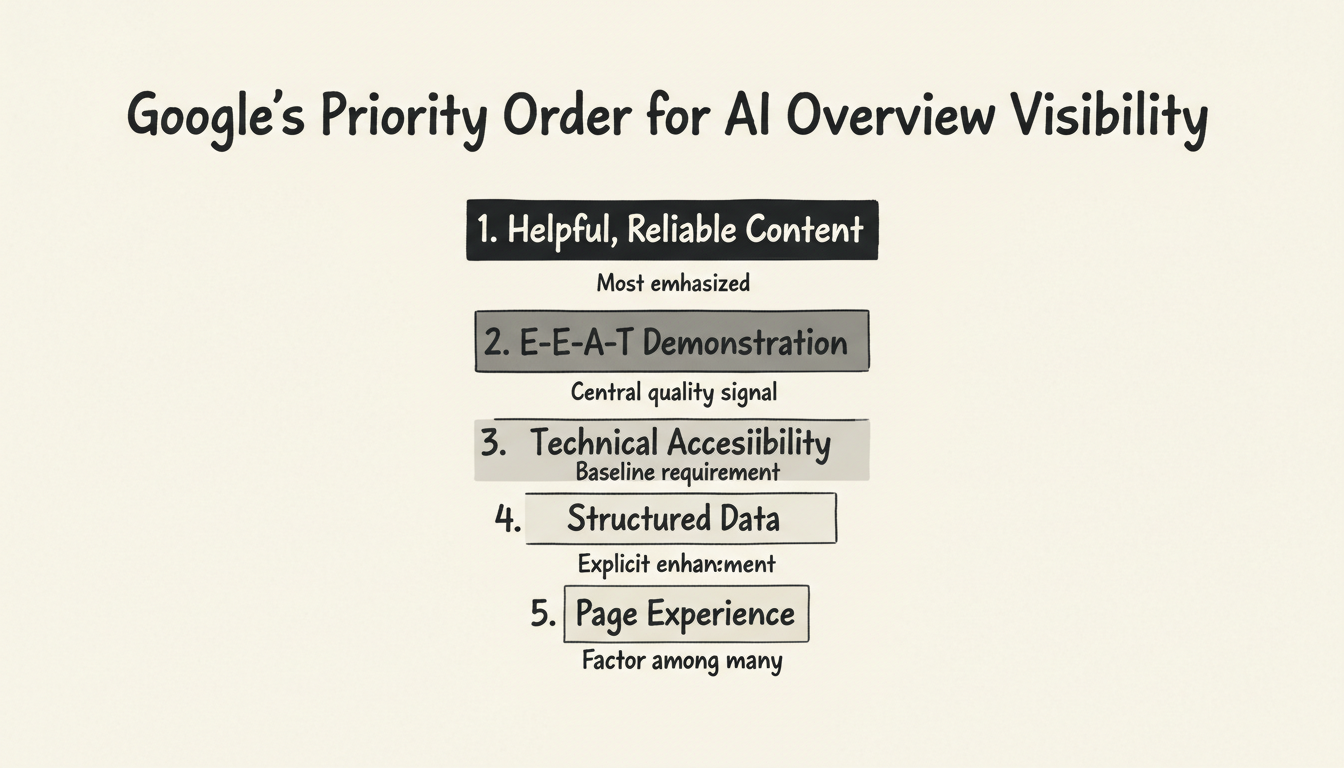
Examining AEO success stories case studies reveals how organizations prioritize these elements effectively.
Google's AI features continue evolving. Official sources provide the most accurate information on changes.
Monitoring cadence:
Base your AI Overview strategy on Google's documented guidance:
Google's official guidance essentially states: create genuinely helpful content demonstrating real expertise, ensure technical accessibility, and focus on serving users rather than optimizing for specific search features.
Following Google's documented standards provides the most sustainable path to AI Overview visibility—because those standards reflect what Google's systems are designed to surface.
By submitting this form, you agree to our Privacy Policy and Terms & Conditions.