February 19, 2026



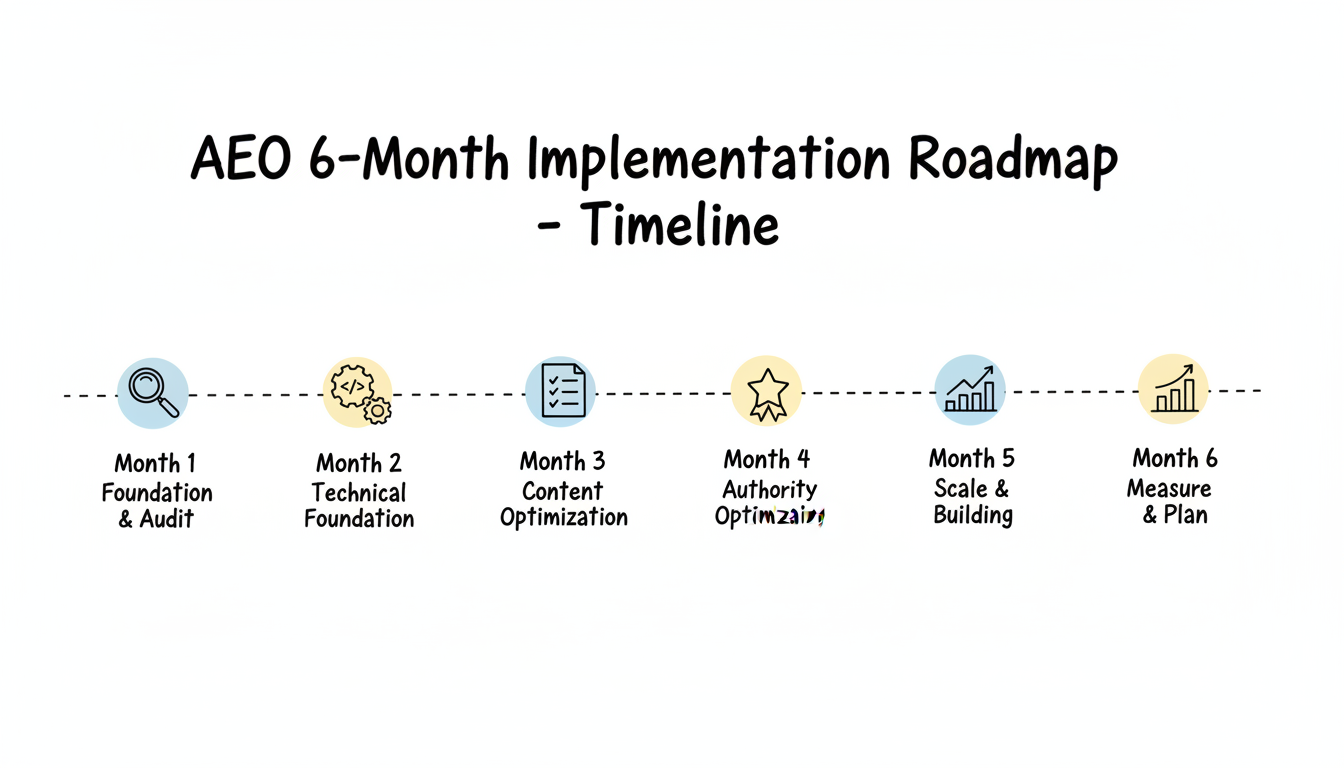
Successful AEO programs follow structured implementation phases. Jumping into optimization without proper foundation leads to wasted effort and unclear results. This roadmap provides month-by-month actions to systematically build AI search visibility.
Use this guide to plan resources, set realistic milestones, and ensure each phase builds on previous work.
The first month establishes your starting point and strategic direction.
Technical audit tasks:
Task | Purpose | Output |
AI crawler access check | Verify GPTBot, ClaudeBot, PerplexityBot can crawl | robots.txt recommendations |
Schema markup audit | Assess existing structured data | Gap analysis document |
Page speed assessment | Identify performance barriers | Priority fix list |
Mobile rendering check | Ensure mobile-first compatibility | Issue documentation |
Visibility baseline tasks:
Consider using AI citation tracking tools to automate the monitoring of your brand mentions across different AI platforms from the start.
Strategic planning deliverables:
End of Month 1 checkpoint:
Month two focuses on removing technical barriers to AI discovery.
Robots.txt configuration:
# Allow AI crawlers
User-agent: GPTBot
Allow: /

User-agent: ClaudeBot
Allow: /

User-agent: PerplexityBot
Allow: /
Schema markup priorities:
Week | Schema Type | Implementation Scope |
Week 1 | Organization | Company-wide |
Week 2 | FAQ | Top 10 FAQ pages |
Week 3 | Article | Blog posts |
Week 4 | HowTo | Procedural content |
Site architecture tasks:
End of Month 2 checkpoint:
Month three transforms existing content for AI extraction.
Page-level optimization sequence:
This is where understanding different SearchGPT content format approaches becomes critical for structuring your pages effectively.
Optimize in this order:
Priority | Content Type | Reason |
1 | Product/service pages | Highest conversion value |
2 | Core how-to guides | High query match potential |
3 | FAQ and help content | Natural Q&A format |
4 | Industry definitions | Informational query targets |
5 | Case studies | Authority and trust signals |
Realistic month 3 targets:
End of Month 3 checkpoint:
Month four expands beyond on-site optimization.
Authority building tasks:
Activity | Target | Purpose |
Industry publications | 2-3 pitches | Expert mentions |
Podcast appearances | 1-2 bookings | Brand citations |
Data-driven content | 1 release | Citation-worthy research |
Partner collaborations | 2-3 mentions | Cross-referencing |
Expert positioning tasks:
Building authority through knowledge graph optimization helps establish your entity relationships that AI systems reference.
Cross-platform optimization:
Understanding the future of platform-specific AI search in 2026 will help you allocate resources to the platforms with highest ROI potential.
End of Month 4 checkpoint:
Month five expands successful patterns.
Analysis and replication:
Expanded content targets:
Build repeatable processes:
Refinement tasks:
End of Month 5 checkpoint:
Month six assesses results and plans the next phase.
Performance assessment:
Metric | Baseline | Month 6 | Change |
Citation frequency | [baseline] | [current] | [delta] |
Keywords with visibility | [baseline] | [current] | [delta] |
AI referral traffic | [baseline] | [current] | [delta] |
Competitive position | [baseline] | [current] | [delta] |
ROI calculation:
Strategic decisions:
End of Month 6 checkpoint:
Plan resources realistically for each phase.
Typical resource requirements:
Month | Internal Hours/Week | External Support |
1 | 10-15 | Audit support |
2 | 8-12 | Technical implementation |
3 | 12-20 | Content optimization |
4 | 8-12 | PR/outreach support |
5 | 15-25 | Scaling content work |
6 | 5-10 | Analysis and planning |
Avoid these roadmap pitfalls.
Timing mistakes:
Resource mistakes:
Follow this implementation roadmap for structured AEO success:
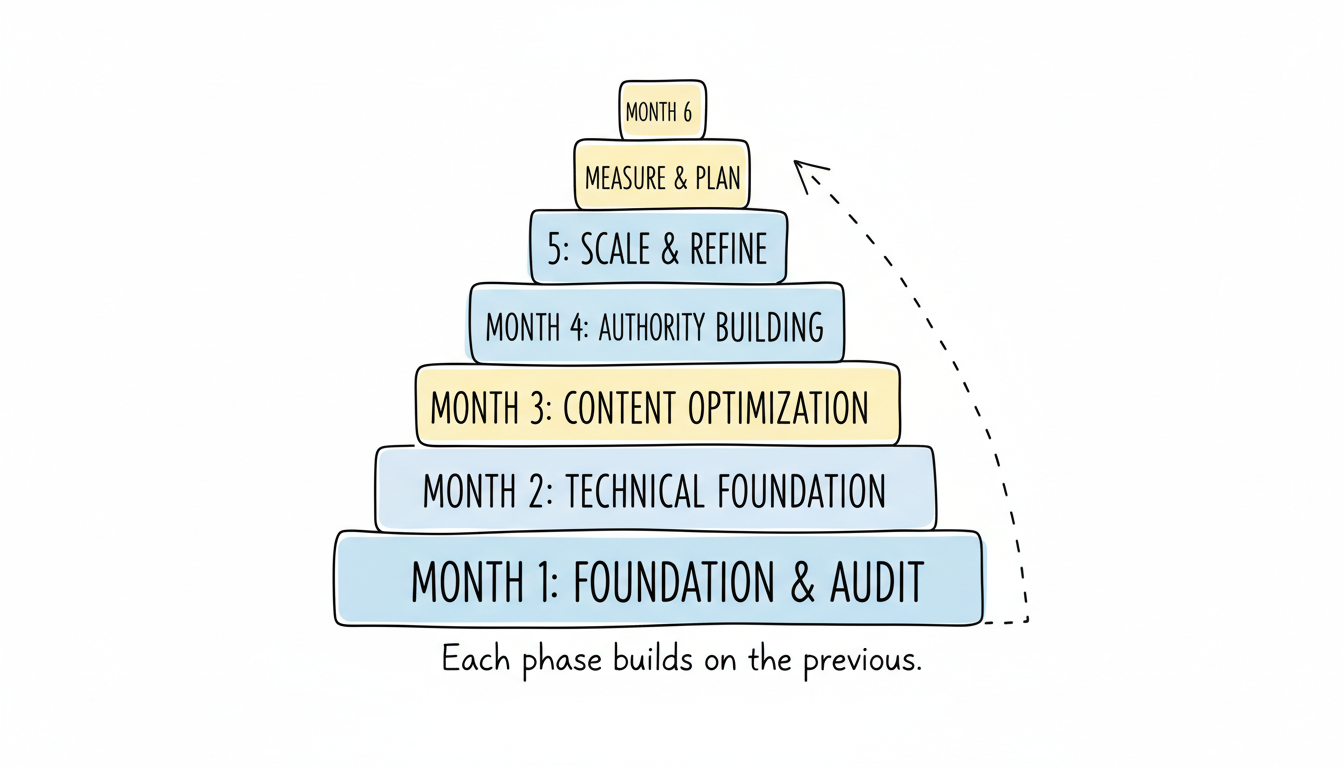
Sequential implementation builds each phase on previous work. Skipping phases or rushing timelines typically produces weaker results than disciplined execution of this roadmap.
By submitting this form, you agree to our Privacy Policy and Terms & Conditions.