
February 19, 2026


The search landscape has fundamentally changed. According to Y Combinator data, traditional search traffic is expected to drop 25% by 2026 and 50% by 2028, replaced by AI-generated answers. If your content strategy still focuses exclusively on ranking in Google's blue links, you're optimizing for a shrinking pie.
Enter GEO SEO—the practice of optimizing content so that generative AI engines like ChatGPT, Perplexity, Google Gemini, and Microsoft Copilot cite and reference your brand in their responses. This guide breaks down everything you need to know about Generative Engine Optimization in 2026.
Generative Engine Optimization (GEO) is the practice of optimizing your content and brand presence so AI-powered search engines reference, cite, or recommend you within their generated answers. Unlike traditional SEO, which focuses on ranking higher in search engine results pages (SERPs), GEO focuses on becoming a trusted source that AI systems pull from when synthesizing responses.
As Writesonic's research explains: "GEO focuses on getting your brand cited or referenced inside AI-generated answers, while SEO focuses on ranking higher in traditional search results."
The key distinction is this: SEO gets people to your website through clicks. GEO gets AI to recommend you before people even start searching—often without any click at all.
The shift toward AI-powered search is accelerating rapidly:
According to Lasso Up's analysis, "If you think SEO in 2026 is still about ranking #1 on Google, you might already be invisible."
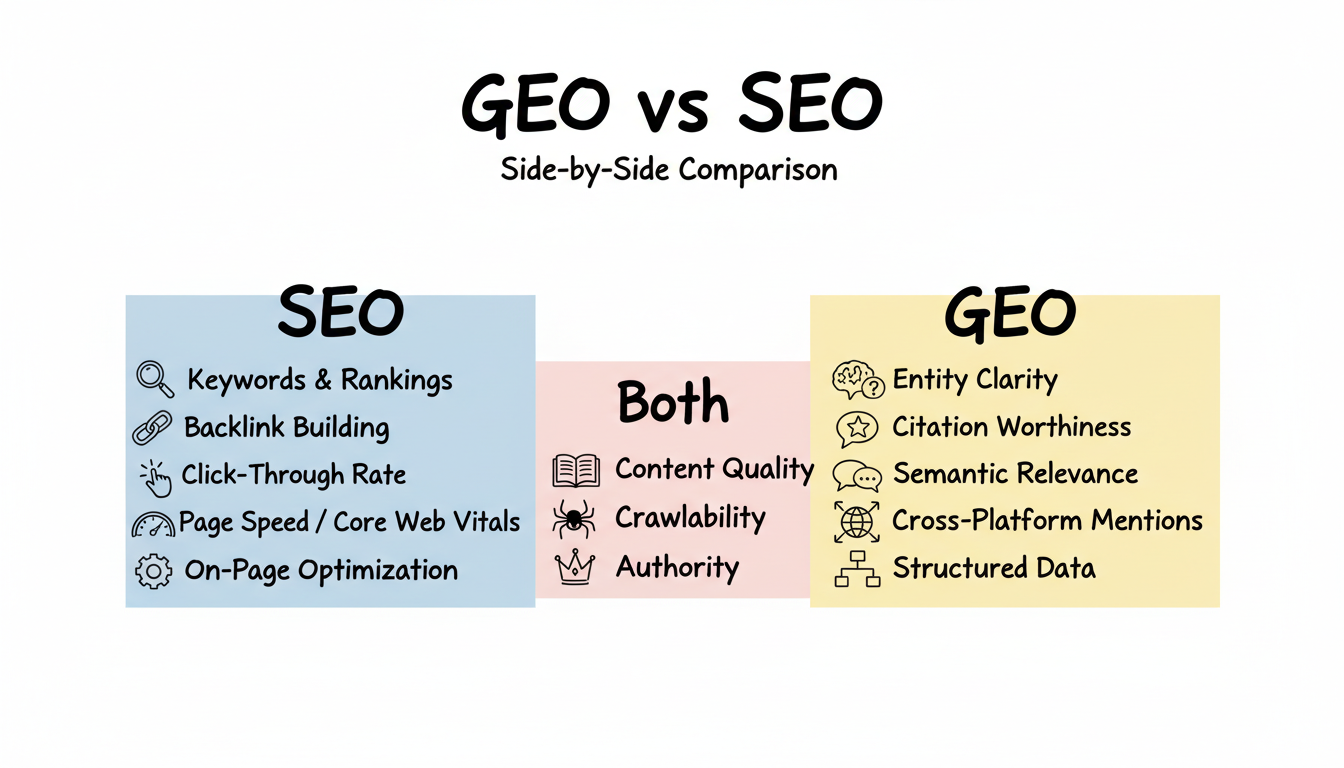
While GEO and SEO share foundational principles, they differ significantly in execution and measurement.
As Footbridge Media notes: "SEO helps your site show up in traditional search results, while GEO helps your business name show up in conversational answers generated by AI. These aren't links people click. They're direct responses, often quoting or referencing businesses by name."
Despite their differences, GEO and SEO aren't mutually exclusive. Search Engine Land argues that "anyone who knows how to optimize for search engines, especially from an entity-based SEO perspective, already has a good grounding to optimize for generative engines."
Strong SEO fundamentals—crawlability, indexing, content quality, and authority—form the foundation for GEO success. You can't optimize for AI search if search engines can't properly understand your content in the first place.
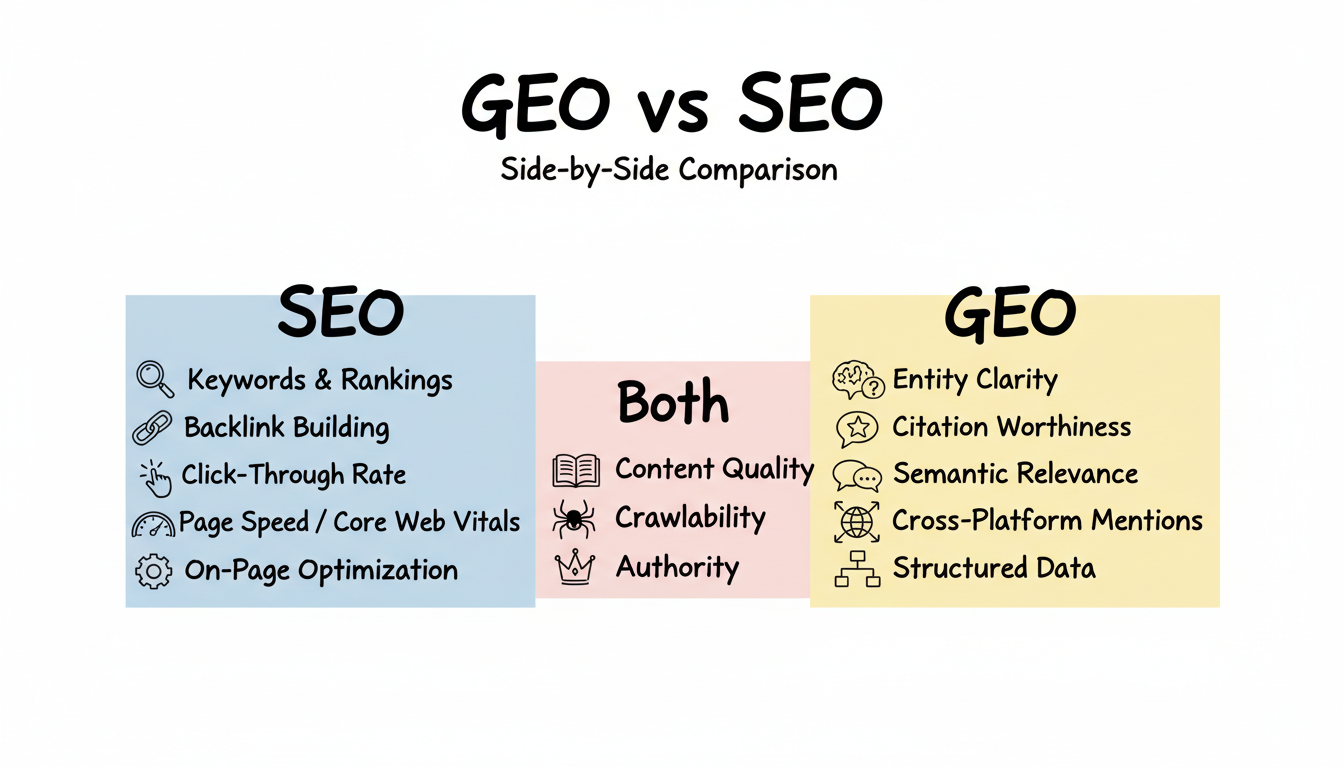
Understanding how AI systems decide what to cite is crucial for effective GEO. Unlike traditional search algorithms that rely heavily on backlinks and click metrics, generative engines evaluate content through different lenses.
AI models identify and connect entities—people, brands, products, concepts—to build understanding. Clear entity definition helps AI recognize your expertise. This means:
Implementing proper Google Knowledge Graph optimization ensures AI systems correctly identify and understand your brand entities.
Generative engines don't just match keywords—they understand context. Your content must appear in the right contexts to be cited for relevant queries. According to Zeo's GEO framework, content should be "contextually relevant (mentioned in the RIGHT contexts)" and "authority-driven (cited as a credible source)."
LLMs prioritize sources that appear trustworthy and authoritative. This includes:
AI crawlers like GPTBot and ClaudeBot need to parse your content effectively. This requires:
Understanding the differences between AI Overview vs featured snippets helps you structure content for maximum AI visibility.
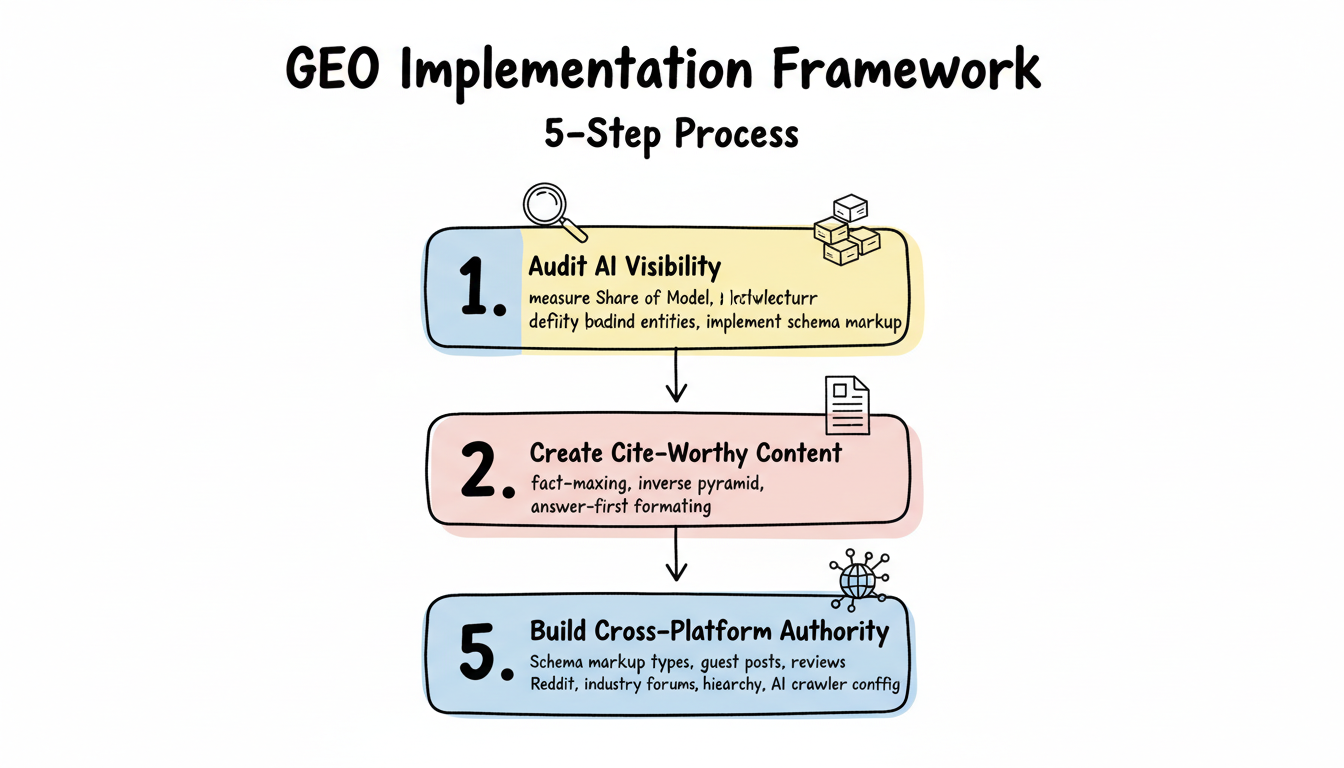
Based on leading agency methodologies and current best practices, here's a comprehensive framework for implementing GEO.
Before optimizing, understand where you stand:
Create clear, consistent entity definitions across your digital presence:
Define core entities:
Implement schema markup:
Standardize terminology:
Structure content so AI systems can easily extract and quote it. Following best practices for AI search content structure ensures maximum citation potential.
Fact-Maxing technique:
Inverse Pyramid structure:
Answer-first formatting:
Understanding content depth vs brevity for answer engines helps you strike the right balance between comprehensive coverage and concise answers.
GEO success depends on presence beyond your website:
High-trust platforms:
Third-party mentions:
Social proof signals:
Ensure AI crawlers can access and understand your content:
Schema markup types for GEO:
Content structure optimization:
AI crawler configuration:
Traditional SEO metrics don't fully capture GEO performance. Here's what to track:
Setting up an AI search analytics dashboard helps you track these metrics systematically and identify optimization opportunities.
Understanding AI search traffic attribution is crucial for properly measuring ROI from your GEO efforts.
Several platforms now offer GEO-specific analytics. For a comprehensive comparison of available solutions, check out our guide on top generative engine optimization tools.
GEO builds on SEO foundations. Neglecting technical SEO, content quality, or authority building undermines GEO efforts. The most effective approach integrates both disciplines.
Unlike SEO, where your website is the primary asset, GEO success depends heavily on how your brand appears across the web. Third-party mentions, reviews, and forum discussions all influence AI perceptions.
AI systems detect unnatural content patterns. Over-optimizing with repetitive keywords or manufactured statistics damages credibility. Focus on genuine value and accuracy.
Inconsistent brand names, conflicting information, or unclear entity relationships confuse AI systems. Maintain strict consistency across all digital touchpoints.
Some organizations block GPTBot or other AI crawlers, inadvertently removing themselves from AI training data. Unless you have specific legal or competitive reasons, allow AI crawler access.
Different industries require tailored GEO approaches:
For detailed strategies tailored to software companies, see our guide on AEO for SaaS companies.
As AI search continues evolving, several trends will shape GEO strategy. Understanding emerging AEO statistics and trends helps you stay ahead of the curve.
AI systems increasingly process images, video, and audio alongside text. Optimizing visual content with proper metadata and context will become essential.
AI platforms are moving toward real-time information access. Keeping content current and implementing data feeds will improve citation likelihood.
AI agents that take actions on behalf of users (booking appointments, making purchases) will require new optimization approaches focused on transactional intent.
New AI search platforms will emerge, each with unique ranking factors. Maintaining flexibility and monitoring emerging platforms will be crucial. An AI search platform comparison can help you prioritize which platforms to optimize for first.
GEO SEO represents the next evolution of search optimization. While traditional SEO remains important for ranking in search results, GEO ensures your brand gets cited when AI systems generate answers—increasingly the first touchpoint for user discovery.
The brands winning in 2026 are those optimizing for both search engines and generative engines simultaneously. They're building entity authority, creating cite-worthy content, maintaining cross-platform presence, and implementing technical structures that AI systems can easily parse.
Start your GEO journey today by auditing your current AI visibility, optimizing your entity architecture, and creating content structured for AI citation. The shift toward AI-powered search isn't coming—it's already here.
By submitting this form, you agree to our Privacy Policy and Terms & Conditions.



