February 19, 2026


ChatGPT Search has transformed how millions access real-time information. Instead of leaving the conversation to search elsewhere, users now get web results directly within ChatGPT—complete with citations and source links.
For businesses and content creators, understanding this shift matters. According to Similarweb data, ChatGPT processes 2.5 billion prompts daily with 800 million weekly active users. That's a massive audience now accessing real-time web information through conversational AI.
This guide explains how ChatGPT Search works, who can use it, and what makes it different from traditional search engines.
ChatGPT Search (originally launched as SearchGPT) is OpenAI's real-time web search feature integrated directly into ChatGPT. Rather than relying solely on training data with a knowledge cutoff, ChatGPT can now browse the web to answer questions about current events, recent developments, and time-sensitive topics.
According to Mashable's coverage, the feature adds a "Sources" button that reveals citations in a format familiar to traditional search engine users—showing the websites ChatGPT referenced when generating its response.
Key capabilities include:
The experience differs fundamentally from Google. Instead of returning a list of blue links to sift through, ChatGPT synthesizes information from multiple sources into a direct answer—then shows you where that information came from.
ChatGPT Search availability depends on your subscription tier. According to OpenAI's documentation, access breaks down as follows:
Subscription Tier | Access Level |
ChatGPT Plus | Full access |
ChatGPT Team | Full access |
ChatGPT Enterprise | Full access |
ChatGPT Edu | Full access |
Free tier | Limited access |
To use ChatGPT Search:
The automatic activation works well for clearly time-sensitive queries like "latest iPhone release" or "today's stock prices." For other queries, manually triggering search ensures you get current web results rather than training data.
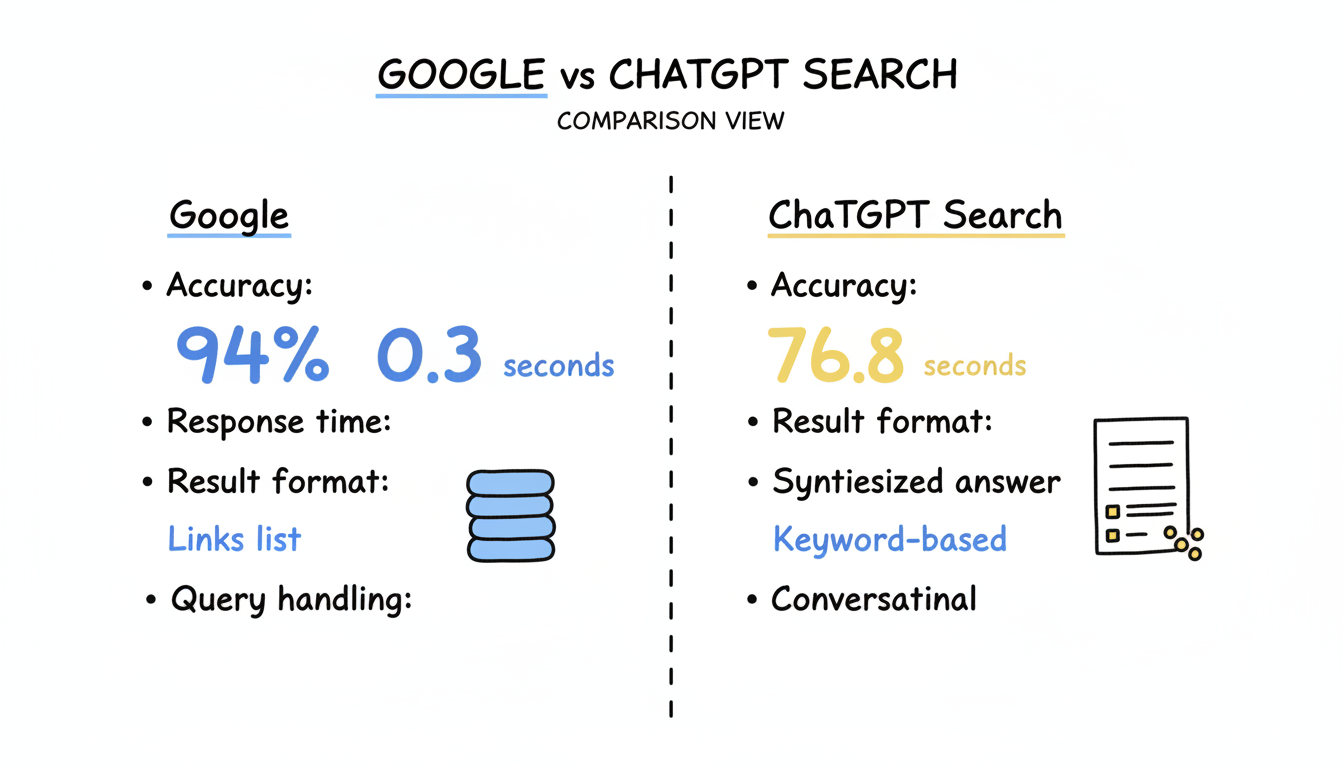
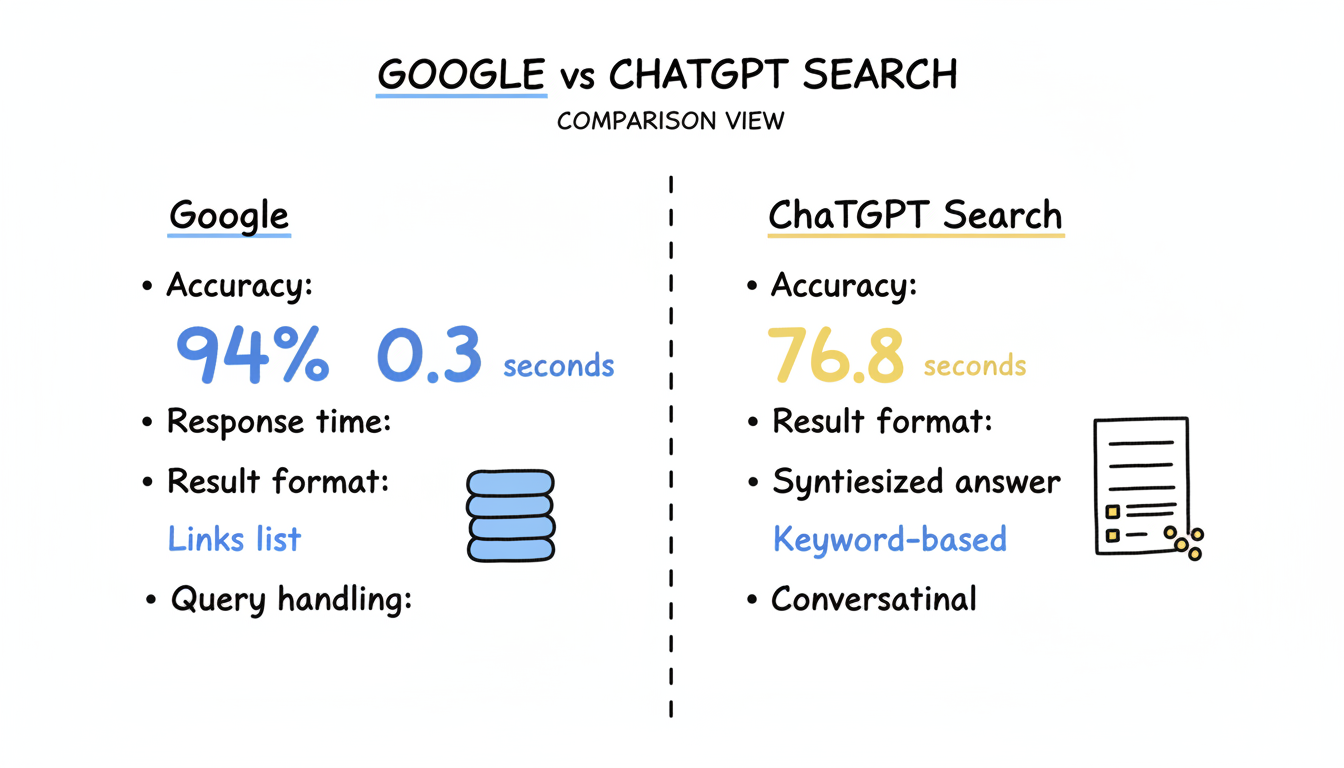
The comparison between ChatGPT Search and Google reveals distinct approaches to information retrieval.
According to Digital Synopsis research, Google achieves 94% accuracy for basic company facts compared to ChatGPT's 76%. Response time also differs dramatically—Google returns results in approximately 0.3 seconds while ChatGPT takes around 6.8 seconds.
Side-by-side comparison:
Factor | ChatGPT Search | |
Factual accuracy | 94% | 76% |
Response time | 0.3 seconds | 6.8 seconds |
Result format | Links list | Synthesized answer |
Citations | Implicit (link = source) | Explicit (Sources button) |
Query handling | Keyword-based | Conversational |
However, these metrics don't capture the full picture. ChatGPT excels at synthesizing information from multiple sources into coherent answers—something Google's traditional results require users to do themselves.
According to TheDigitalBloom's analysis, 87% of ChatGPT's citations match websites appearing in Bing's top 10 results. This suggests ChatGPT Search leverages Bing's index (through OpenAI's partnership with Microsoft) while adding conversational synthesis on top. Understanding these patterns helps inform your ChatGPT search optimization AEO strategy.
Perplexity AI positions itself as an AI-native search engine, making it ChatGPT Search's most direct competitor.
According to Addlly's comparison, Perplexity was built from the ground up for real-time web search, while ChatGPT added search capabilities to an existing conversational AI. This architectural difference shows in their citation patterns.
Citation behavior differences:
According to Nick Lafferty's correlation research:
According to TheDigitalBloom, the platforms favor different source types:
Source Type | ChatGPT Preference | Perplexity Preference |
Wikipedia | 47.9% | 13.2% |
8.3% | 46.7% | |
News sites | High | Moderate |
Forums | Lower | Higher |
These patterns have implications for content strategy. Wikipedia-style authoritative content performs better in ChatGPT, while community-driven and discussion-format content earns more citations from Perplexity.
Understanding ChatGPT's citation preferences helps inform content optimization strategy.
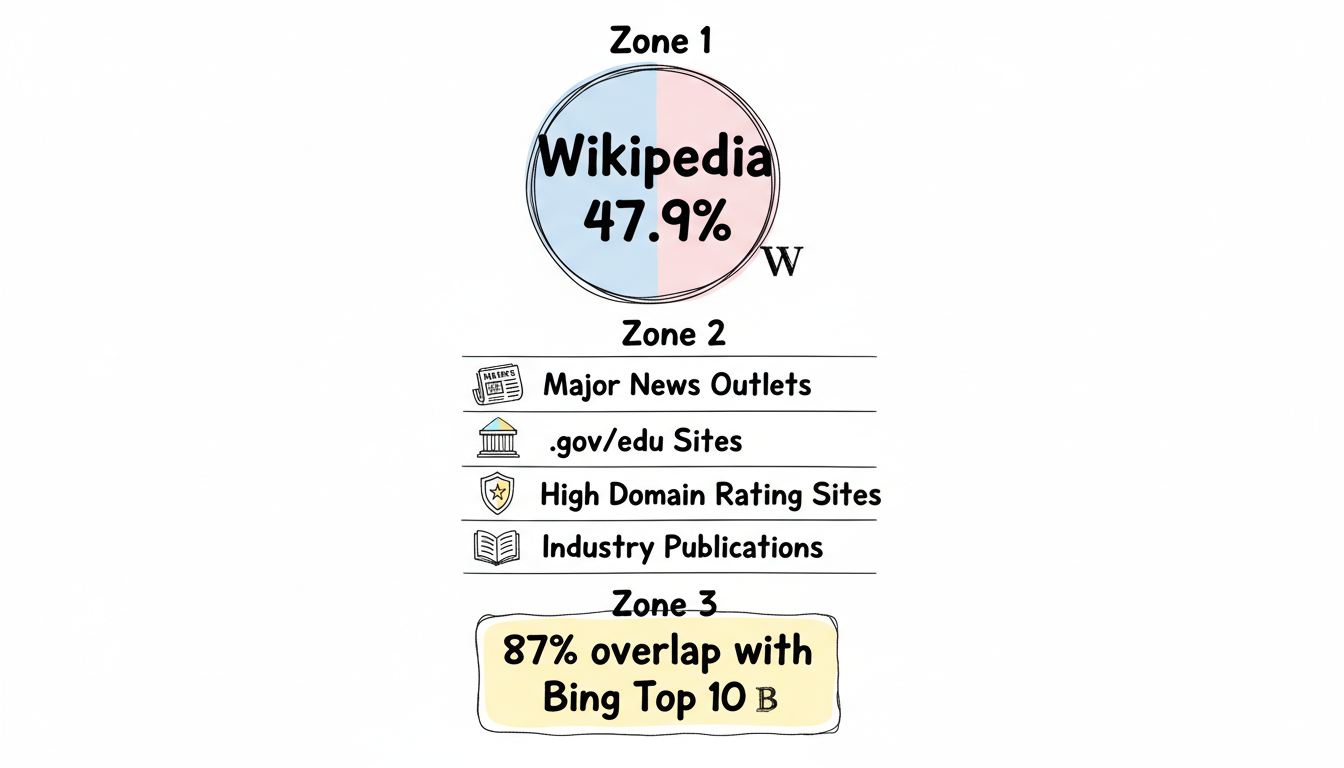
According to TheDigitalBloom's research, Wikipedia dominates ChatGPT citations at 47.9%—nearly half of all sources cited. This heavy reliance on Wikipedia suggests ChatGPT prioritizes established, authoritative sources with consistent formatting and comprehensive coverage.
Top citation sources for ChatGPT:
According to FortisMedia's ranking factor analysis, ChatGPT uses semantic search, entity connections, trust signals, and content formatting to evaluate sources. Unlike Google's link-based authority signals, ChatGPT appears to weight:
The 87% overlap with Bing's top 10 results indicates that traditional SEO still matters—content ranking well in Bing likely gets cited by ChatGPT Search. Tools like an AEO checker can help evaluate how well your content aligns with answer engine optimization best practices.
ChatGPT Search has notable limitations users should understand.
Accuracy concerns:
The 76% accuracy rate for factual queries (versus Google's 94%) means verification remains important. ChatGPT can synthesize incorrect information confidently, making the Sources button essential for fact-checking.
Speed trade-offs:
The 6.8-second average response time works for research-oriented queries but feels slow compared to instant Google results. For quick factual lookups, traditional search often delivers faster.
Coverage gaps:
ChatGPT Search doesn't index everything. Very recent content, paywalled material, and certain website types may not appear in results. The Bing partnership means ChatGPT inherits Bing's indexing limitations.
No visual search:
Unlike Google, ChatGPT Search doesn't handle image-based queries or return visual results. Users needing to search by image or browse product photos still need traditional search engines.
For content creators and businesses, earning ChatGPT citations requires specific optimization approaches.
Foundation strategies:
According to FortisMedia, focus on:
Practical tactics:
According to YourEverydayAI, 92% of Fortune 500 companies now use OpenAI products. Enterprise adoption is driving significant traffic through ChatGPT Search, making citation optimization increasingly valuable. Implementing technical AEO optimization ensures your content meets the structural requirements answer engines prioritize.
ChatGPT Search continues evolving rapidly. OpenAI's integration with Apple devices (ChatGPT Apps) and expanding enterprise features suggest search will become increasingly central to the ChatGPT experience.
Trends to watch:
For now, ChatGPT Search represents a fundamental shift in information access—conversational, synthesized, and citation-linked. Businesses that understand its mechanics and optimize accordingly position themselves to capture this growing traffic channel. Working with an AI SEO agency guide 2026 approach helps navigate these evolving requirements.
ChatGPT Search has matured into a legitimate search alternative for millions of users:
Understanding these patterns helps inform content strategy for the AI search era.
By submitting this form, you agree to our Privacy Policy and Terms & Conditions.