February 19, 2026


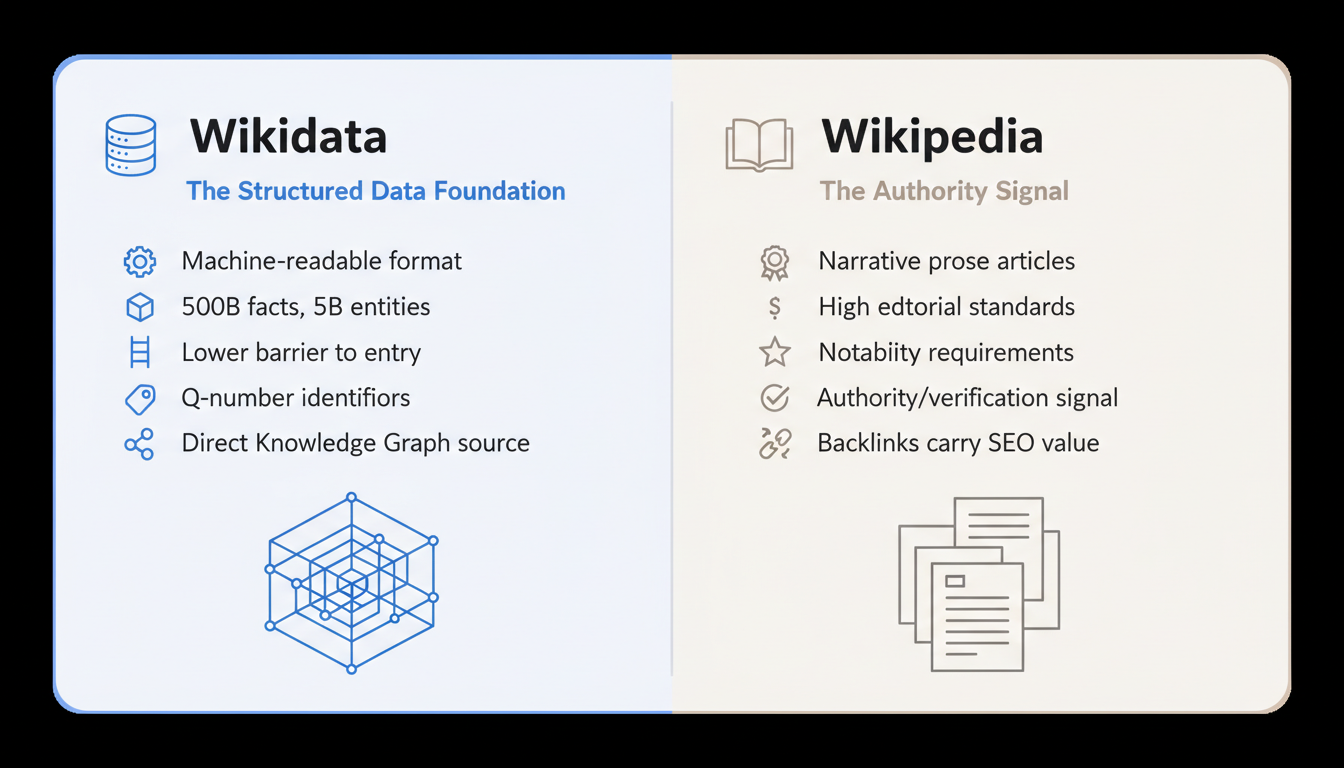
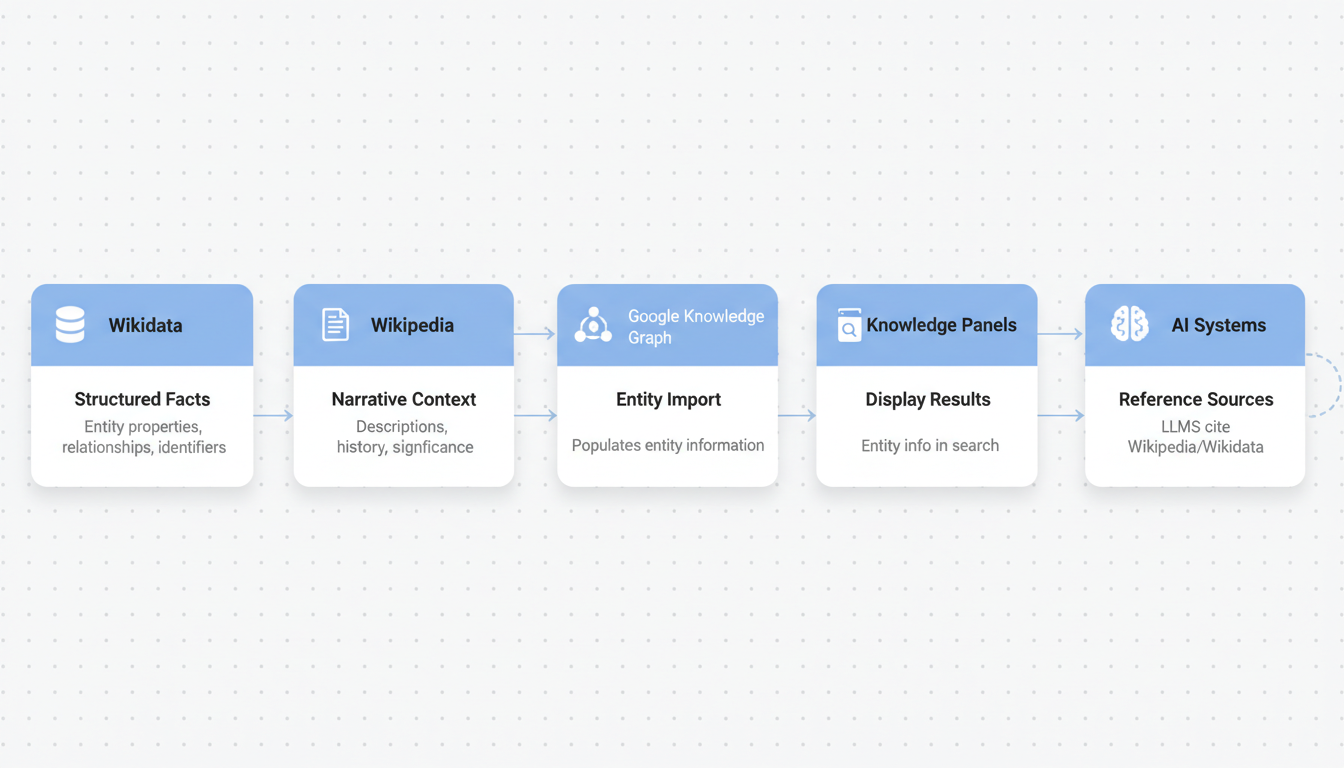
Wikipedia and Wikidata serve as foundational data sources for Google's Knowledge Graph. When your organization or brand appears accurately in these platforms, you significantly increase the likelihood of Knowledge Panel visibility, AI search citations, and entity recognition across search engines and LLMs.
This guide explains how Wikipedia and Wikidata influence knowledge graphs and provides actionable steps for leveraging these platforms for SEO.
Google's Knowledge Graph doesn't exist in isolation—it pulls from authoritative external sources to verify and populate entity information. Wikipedia and Wikidata rank among the most trusted sources.
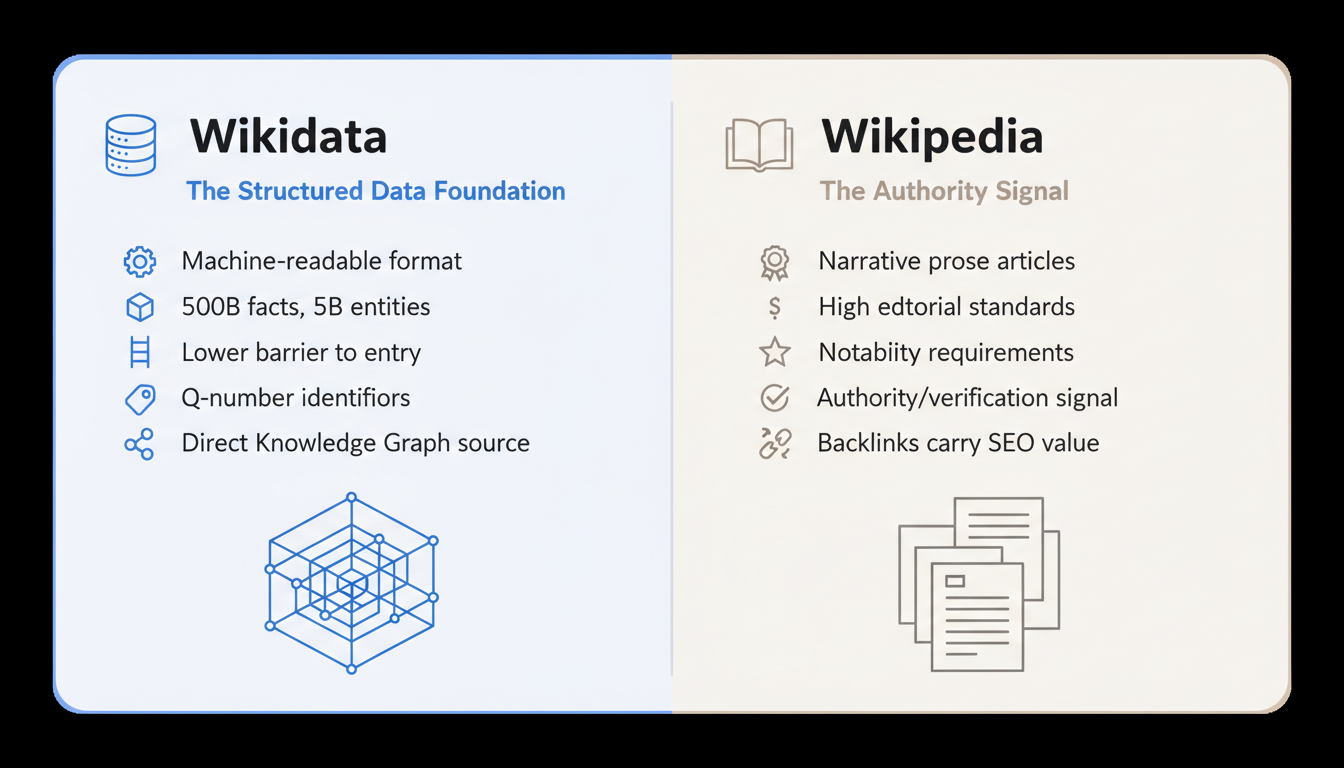
Wikidata is a free, collaborative knowledge base that stores structured data about entities—people, organizations, places, concepts, and things. Unlike Wikipedia's prose articles, Wikidata organizes information as machine-readable statements.
According to The Digital Bloom's AI visibility research, Wikidata serves as the #1 source for Google's Knowledge Graph, containing 500 billion facts about 5 billion entities.
Why Wikidata matters:
Wikipedia articles provide narrative context and verification for entities. A Wikipedia presence signals established notability and provides detailed information that knowledge panels can reference.
According to WikiConsult's knowledge graph guide, being listed in Wikidata or Wikipedia increases the chances of appearing in a Google Knowledge Panel or being mentioned by AI systems like ChatGPT.
Why Wikipedia matters:
According to ALMCORP's schema markup guide, when Google sees your entity linked to trusted sources via sameAs schema properties pointing to Wikipedia and Wikidata, it gains confidence in your entity's authenticity—directly impacting Knowledge Graph inclusion probability.
High-value sameAs targets:
Wikidata has lower barriers to entry than Wikipedia and should be your first priority.
Search Wikidata.org for your entity:
If your entity doesn't exist:
For organizations:
Property | Wikidata ID | Example |
Instance of | P31 | business, company, organization |
Industry | P452 | technology, retail, healthcare |
Founded | P571 | Date of establishment |
Headquarters | P159 | Location |
Official website | P856 | URL |
CEO/Founder | P169/P112 | Person entity link |
For individuals:
Property | Wikidata ID | Example |
Instance of | P31 | human |
Occupation | P106 | entrepreneur, author, CEO |
Employer | P108 | Organization entity link |
Education | P69 | Educational institution |
Date of birth | P569 | Date |
Wikidata entries should include references (sources) for claims:
According to ClickRank's entity SEO guide, tools like Google's Knowledge Graph Search API and Wikidata help uncover entity relationships—making your Wikidata entry a foundation for entity-based SEO and topical authority.
Wikipedia has stricter requirements than Wikidata. Not every entity qualifies for an article.
Wikipedia's notability guidelines require:
Entities that typically qualify:
Entities that often don't qualify:
If you meet notability criteria:
Important considerations:
Focus on building the coverage that creates notability:
Meanwhile, maintain accurate Wikidata presence and focus on optimizing for AI search engines through other channels.
Link your entity pages to Wikipedia and Wikidata using sameAs:
{
  "@type": "Organization",
  "name": "Your Company",
  "sameAs": [
    "https://en.wikipedia.org/wiki/Your_Company",
    "https://www.wikidata.org/wiki/Q12345678",
    "https://www.linkedin.com/company/your-company"
  ]
}
According to ALMCORP's guide, schema markup with strong sameAs links to Wikipedia, Wikidata, and authoritative sources signals to Google that entities should be included in their knowledge base.
Ensure information matches across:
Inconsistencies confuse search engines and weaken entity signals. For companies implementing comprehensive AEO strategies, this consistency becomes even more critical as AI systems cross-reference multiple sources.
Wikipedia and Wikidata are essential for Knowledge Graph optimization:
According to WikiConsult, knowledge graphs contain the reference information LLMs rely on when generating answers—making presence in these reference systems crucial as AI search continues expanding. Understanding the complete knowledge graph case study can help you see how these principles work in practice.
By submitting this form, you agree to our Privacy Policy and Terms & Conditions.